Measles Symptoms: Early Signs, Rash and Day-by-Day Timeline
Measles symptoms start with high fever, cough, runny nose and red eyes, then a rash 3 to 5 days later. See the timeline, risks and what to do after exposure.
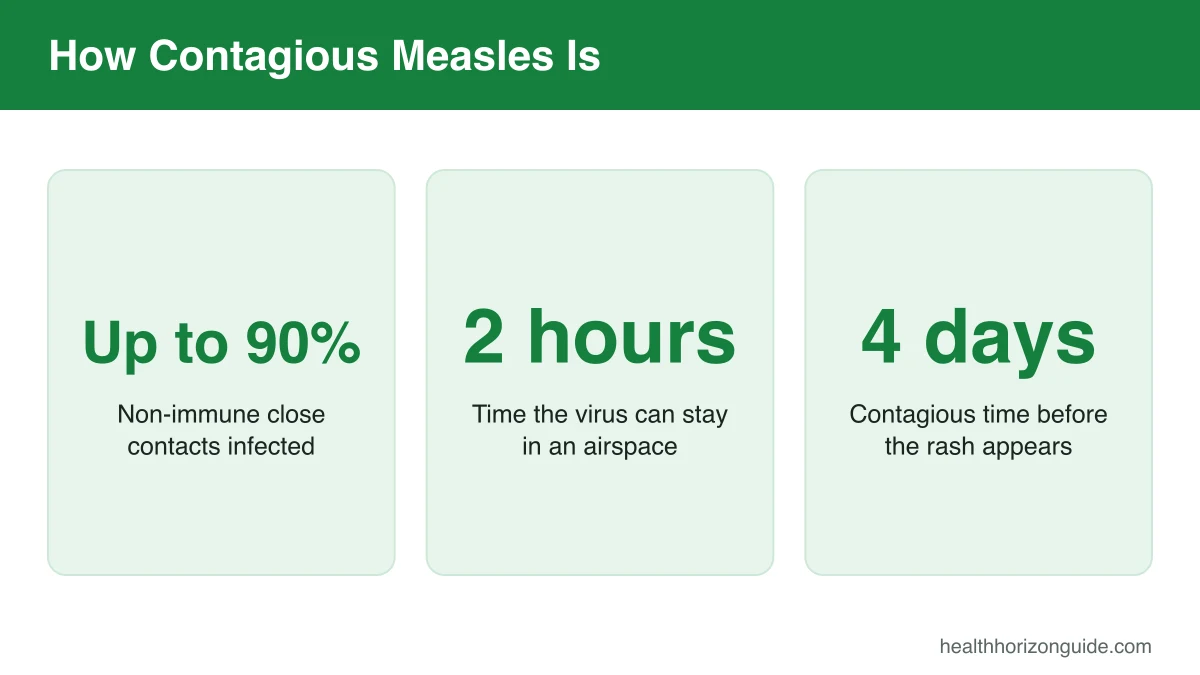
Measles symptoms start with a high fever, cough, runny nose and red, watery eyes, followed by a blotchy rash 3 to 5 days later. The first symptoms appear 7 to 14 days after contact with the virus, according to the Centers for Disease Control and Prevention (CDC). Measles spreads from 4 days before the rash appears through 4 days after.
The Pan American Health Organization (PAHO) said on 17 November 2026 that the United States, Mexico and Bolivia had lost measles elimination status. The rest of this guide covers measles symptoms, the timeline and the steps to take after an exposure.
Action checklist
Actions After a Possible Measles Exposure
Use these steps from the article to respond to a measles exposure and to spot the signs that need urgent care.
0 of 9 done
In this article
- What are the symptoms of measles?
- Early measles symptoms day by day: the timeline
- What does the measles rash look like?
- Measles symptoms in adults vs babies and children
- How does measles spread and how contagious is it?
- Why did the US and Mexico lose measles elimination status?
- Measles complications and who is at risk
- What to do after measles exposure
- How well does the MMR vaccine protect against measles?
- Measles vs other rashes
- When to seek emergency care for measles
- Measles symptoms: common questions
What are the symptoms of measles?
The symptoms of measles are a high fever, cold-like signs, small white spots inside the mouth and a spreading rash. The 6 main measles symptoms described by the CDC and the NHS are listed below.
- High fever, which may spike above 104°F.
- Cough.
- Runny or blocked nose.
- Red, sore, watery eyes (conjunctivitis).
- Tiny white spots inside the mouth, called Koplik spots.
- A rash of flat red spots that starts on the face and spreads down the body.
Early measles resembles a cold or flu. Readers comparing a fever and sore throat with other infections can read our guide to the "razor blade throat" COVID variant.
Early measles symptoms day by day: the timeline
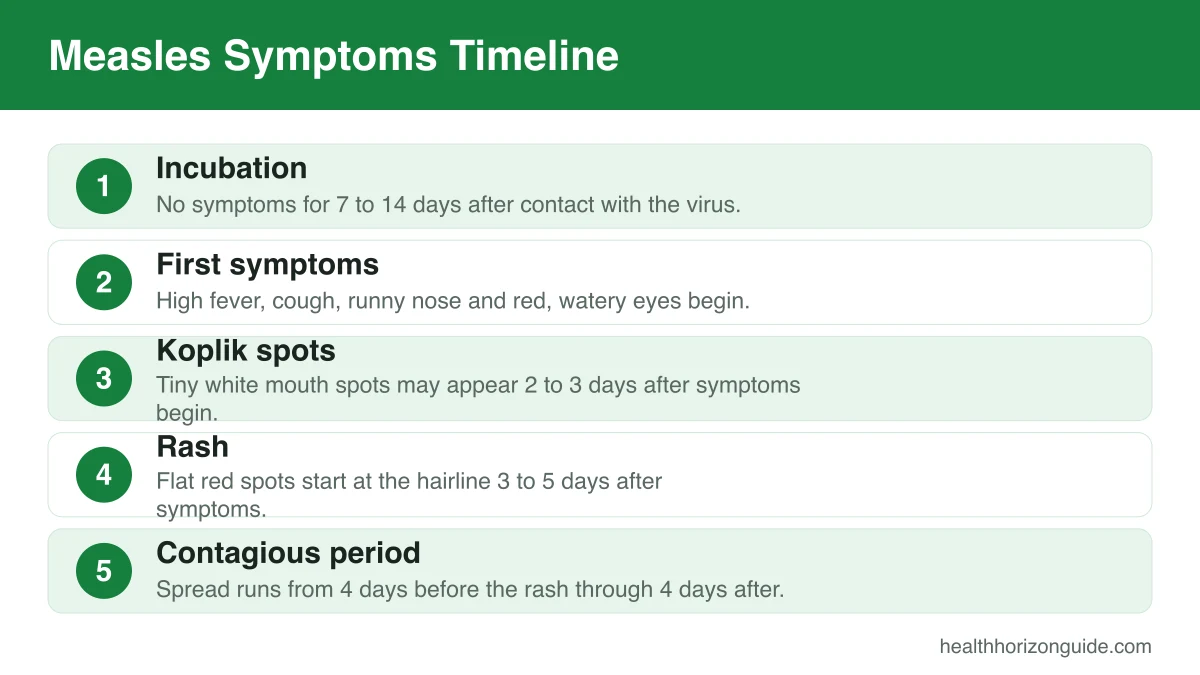
Measles symptoms follow a set order: an incubation period, cold-like symptoms, mouth spots and then the rash. The table below shows each stage of measles with the timing that the CDC gives.
| Stage | Timing per CDC | What happens |
|---|---|---|
| Incubation | 7 to 14 days after contact with the virus | No symptoms yet |
| First symptoms | Begin 7 to 14 days after contact | High fever, cough, runny nose, red eyes |
| Koplik spots | 2 to 3 days after symptoms begin | Tiny white spots may appear inside the mouth |
| Rash | 3 to 5 days after the first symptoms | Flat red spots spread from the hairline downward |
| Contagious period | 4 days before the rash through 4 days after | The virus can spread to other people |
Measles usually starts to get better in about a week, according to the NHS.
What are Koplik spots?
Koplik spots are tiny white spots inside the mouth that may appear 2 to 3 days after measles symptoms begin. The NHS describes small white spots inside the cheeks and on the back of the lips, which usually last a few days.
What does the measles rash look like?
The measles rash looks like flat red spots that start at the hairline and spread downward to the neck, trunk, arms, legs and feet. Small raised bumps may form on the flat spots, and the spots may join together, according to the CDC.
The measles rash looks brown or red on white skin and may be harder to see on brown and black skin, according to the NHS. The NHS adds that the measles rash is not usually itchy.
Measles symptoms in adults vs babies and children
Measles symptoms follow the same pattern of fever, cold-like signs and rash at every age in the sources we reviewed. The risk of complications differs by age. The CDC states that children younger than 5 years and adults older than 20 years are more likely to have measles complications.
Measles symptoms in adults
Measles symptoms in adults are fever, cough, runny nose, red eyes and the face-first rash. Vaccinated adults who catch measles tend to have a milder illness. The CDC notes that the rash in these cases may be absent or may start on the trunk and arms.
Measles symptoms in babies
Measles symptoms in babies are fever, cold-like signs and rash, with a higher risk of serious complications than in older children, according to the NHS. The NHS advises urgent medical advice when a baby with suspected measles feeds poorly or has fewer wet nappies than usual.
Babies younger than 12 months have usually not had a routine measles vaccine dose, since the first dose is given at 12 to 15 months. Our guides on why a baby cries for no clear reason and the baby development timeline for the first year cover everyday concerns.
How does measles spread and how contagious is it?
Measles spreads through the air when a person with measles coughs or sneezes, and measles is highly contagious. The CDC states that up to 90% of close contacts who are not immune will become infected.
The measles virus can stay in an airspace for up to 2 hours after a person with measles has left. A person with measles can spread the virus before knowing about the infection. The NHS advises staying away from nursery, school or work for at least 4 days from when the rash first appears.
Why did the US and Mexico lose measles elimination status?
The United States and Mexico lost measles elimination status because the same measles virus had spread without interruption for at least 12 months in each country, PAHO said. PAHO announced the decision on 17 November 2026, and the decision included Bolivia.
The United States had held measles elimination status since 2000. More than 5,000 measles cases had been recorded in the United States in 2026, according to Health Policy Watch reporting on the 17 November 2026 announcement.
PAHO expects the 3 countries to submit plans to stop measles transmission.
Measles complications and who is at risk
Measles complications range from ear infections and diarrhea to pneumonia and swelling of the brain. The 5 complication figures that the CDC gives for measles are listed below.
- Ear infections occur in about 1 in 10 children with measles.
- Diarrhea is reported in fewer than 1 in 10 people with measles.
- Hospital care is needed by about 1 in 5 unvaccinated people in the United States with measles.
- Pneumonia affects as many as 1 in 20 children with measles.
- Encephalitis, a swelling of the brain, affects about 1 in 1,000 children with measles.
Nearly 1 to 3 of every 1,000 children with measles die from respiratory or neurologic complications, according to the CDC. The CDC names 4 groups with a higher risk of measles complications: children younger than 5 years, adults older than 20 years, pregnant women and people with weakened immune systems.
What to do after measles exposure
The first step after measles exposure is a phone call to a doctor or clinic before any visit in person. The NHS advises calling ahead so that staff can see a person with possible measles apart from other patients. The 4 steps to take after a measles exposure are listed below.
- Call the doctor or clinic immediately, as the CDC advises, and describe the exposure.
- Check vaccination records for 2 documented MMR doses or other evidence of measles immunity.
- Ask the clinician about post-exposure options, since timing matters.
- Watch for fever, cough, runny nose and red eyes during the 7 to 14 days after the exposure.
MMR vaccine given within 72 hours of measles exposure may provide some protection or a milder illness, according to the CDC. Immune globulin may be given to high-risk people within 6 days of exposure. A clinician decides which option fits each person.
How well does the MMR vaccine protect against measles?
The MMR vaccine is 93% effective against measles after one dose and 97% effective after two doses, according to the CDC. The table below shows the CDC schedule for the measles, mumps and rubella (MMR) vaccine.
| Group | CDC recommendation |
|---|---|
| Children, first dose | 12 to 15 months of age |
| Children, second dose | 4 to 6 years of age |
| Infants aged 6 to 11 months before international travel | 1 dose before travel, then 2 more doses after the first birthday |
| Adults born in 1957 or later without evidence of immunity | 1 dose at minimum, or 2 doses for groups such as healthcare staff and international travelers |
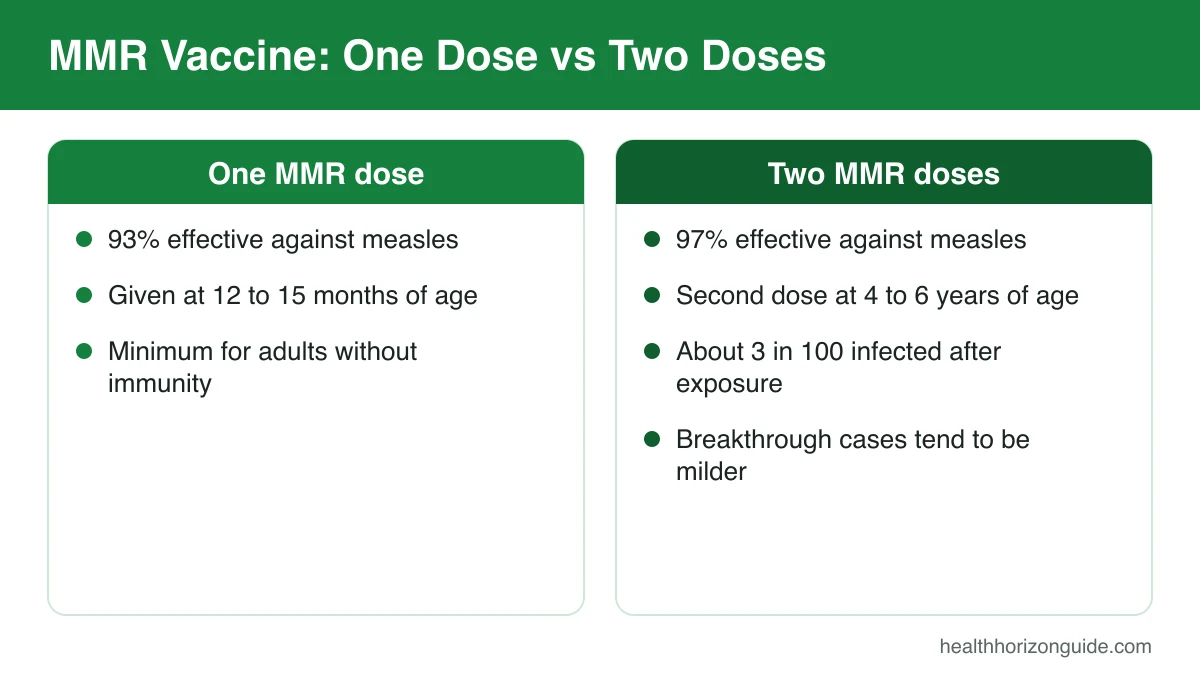
MMR protection against measles usually lasts for life. About 3 in 100 people with 2 MMR doses become infected after exposure to measles, and those cases tend to be milder, according to the CDC.
The MMR vaccine is not suitable during pregnancy or for some people with weakened immune systems. Vaccine decisions about measles belong in a conversation with a clinician.
Measles vs other rashes
Measles differs from other rash illnesses in the face-first spread, the Koplik spots and the cough, runny nose and red eyes that come before the rash. The table below compares measles with 3 other rash illnesses, based on Valley Children's Healthcare.
| Illness | Rash features per sources |
|---|---|
| Measles | Flat red spots that start at the hairline and spread downward, after fever, cough and red eyes |
| Rubella | A lighter rash that typically clears in 3 days, with enlarged lymph nodes behind the ear |
| Roseola | A rash that starts on the trunk, mostly at ages 6 months to 2 years, with no Koplik spots |
| Chickenpox | Blister-like spots instead of flat or raised red spots |
When to seek emergency care for measles
Emergency care for measles is needed when breathing, alertness or the nervous system is affected. The 7 emergency signs that the NHS lists for a person with measles are listed below.
- A seizure (fit).
- Severe difficulty breathing, such as gasping or being unable to speak in full sentences.
- Inability to stay awake.
- Sudden confusion.
- A child who is limp, floppy or not responding normally.
- A rash that does not fade when a glass is pressed against the skin.
- A stiff neck, or discomfort in bright light.
The NHS tells people with these measles warning signs to call 999 or go to an emergency department. The emergency number in the United States is 911.
Measles symptoms: common questions
How long do measles symptoms last?
Measles symptoms usually start to get better in about a week, according to the NHS.
Can a vaccinated person get measles?
Yes, a vaccinated person can get measles, although only about 3 in 100 people with 2 MMR doses become infected after exposure, according to the CDC.
Is the measles rash itchy?
No, the measles rash is not usually itchy, according to the NHS.