
Mediterranean Diet vs Keto: Which Is Better?
Mediterranean diet vs keto: compare foods, weight loss, blood sugar, cholesterol, fatty liver and inflammation, and learn who should avoid keto.

The Mediterranean diet and keto both lead to weight loss and lower blood sugar in the short term. The Mediterranean diet has stronger evidence for heart health and is easier to maintain. Keto cuts carbohydrates to 20 to 50 grams a day, while the Mediterranean diet keeps whole grains, legumes and fruit.
Action checklist
Choosing between the Mediterranean diet and keto
Use these steps from the article to decide between the Mediterranean diet and keto.
0 of 10 done
In this article
- What is the difference between the Mediterranean diet and keto?
- Mediterranean diet vs keto: which is better?
- Mediterranean diet vs keto for weight loss
- Mediterranean diet vs keto for diabetics and blood sugar
- Mediterranean diet vs keto for heart health and cholesterol
- Mediterranean diet vs keto for fatty liver
- Mediterranean diet vs keto for inflammation
- What should you check before choosing the Mediterranean diet or keto?
- When should you see a doctor about the Mediterranean diet or keto?
- Mediterranean diet vs keto: common questions
What is the difference between the Mediterranean diet and keto?
The difference between the Mediterranean diet and keto is the amount of carbohydrate each diet allows. Keto is a very low-carbohydrate, high-fat diet that pushes the body to burn fat and make ketones for fuel, a state called ketosis. The Mediterranean diet is a mostly plant-based pattern of vegetables, legumes, fruits, whole grains, nuts, seeds, fish and olive oil.
A Stanford Medicine trial that compared the two diets set keto at 20 to 50 grams of carbohydrate a day, with no limit on fat. Both diets in the trial limited added sugars and refined grains.
Foods allowed on the Mediterranean diet and keto
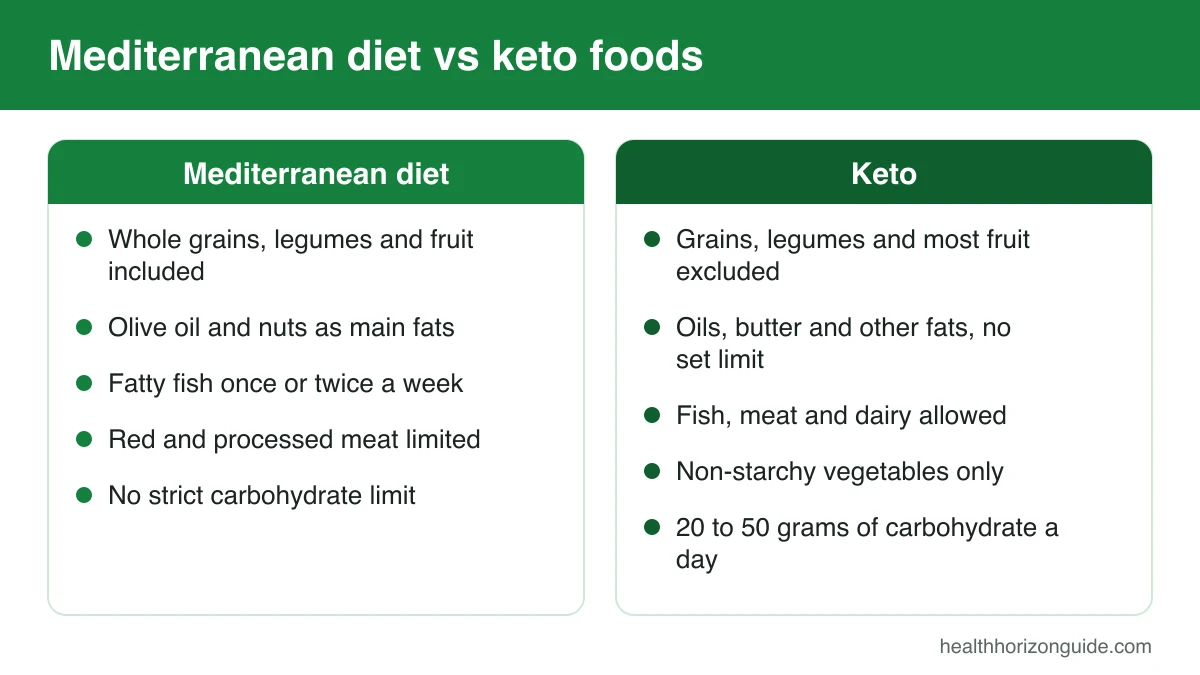
Foods allowed on the Mediterranean diet and keto overlap on vegetables, fish, nuts and olive oil, and differ on grains, legumes and fruit. The table below compares the Mediterranean diet and keto across 8 food groups.
| Food group | Mediterranean diet | Keto |
|---|---|---|
| Vegetables | All vegetables, as the largest part of the plate | Non-starchy vegetables, with starchy vegetables restricted |
| Fruit | Fresh fruit, including berries | Restricted |
| Whole grains | Eaten regularly | Excluded |
| Beans and legumes | Eaten about 3 times a week | Excluded |
| Fish and seafood | Fatty fish once or twice a week | Allowed |
| Meat and dairy | Red meat, processed meat and cheese are limited | Animal proteins and dairy are allowed |
| Main fats | Olive oil and nuts | Oils, butter and other fats, with no set limit |
| Added sugar and refined grains | Limited | Restricted |
Mediterranean diet vs keto: which is better?
The Mediterranean diet is the better choice for most people. The Mediterranean diet matched keto on blood sugar and weight in head-to-head research, and the Mediterranean diet has fewer medical cautions than keto.
An American Heart Association report scored 10 popular diets from 1 to 100 for heart-healthy eating. The Mediterranean diet scored 89 and placed in the top tier. The very low-carb keto diet scored 31 and placed in the bottom tier.
The 4 main differences in results between the Mediterranean diet and keto are listed below.
- Weight loss: the Mediterranean diet and keto produce similar weight loss when support is equal.
- Blood sugar: the Mediterranean diet and keto lower HbA1c by a similar amount.
- Cholesterol: LDL cholesterol rose on keto and fell on the Mediterranean diet.
- Staying power: most trial participants stopped keto once the study ended.
Mediterranean diet vs keto for weight loss
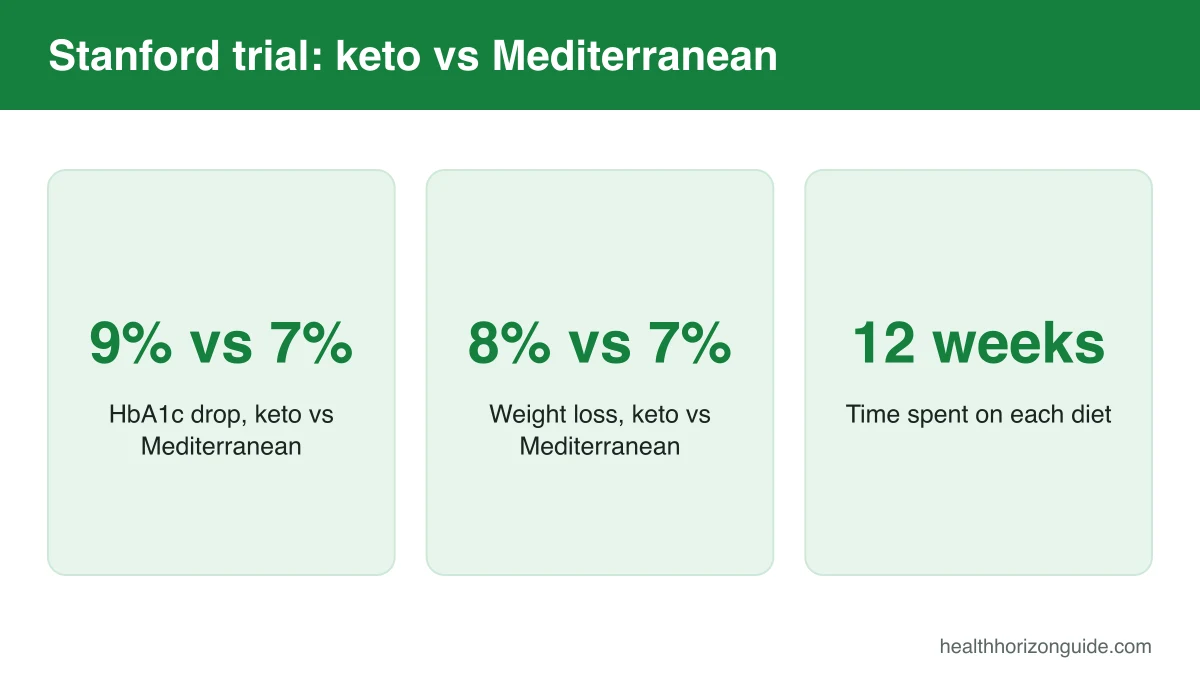
Neither the Mediterranean diet nor keto is clearly better for weight loss over the long term. Participants in the Stanford trial lost 8% of body weight on keto and 7% on the Mediterranean diet, with 12 weeks on each diet.
The American Heart Association report states that keto is likely to produce substantial short-term weight loss. The same report states that keto has not been shown to work better for long-term weight loss than less restrictive diets.
Weight loss on the Mediterranean diet still requires eating fewer calories, according to the American Heart Association. Our daily calorie calculator estimates a calorie target, and our BMI calculator shows a starting weight category.
Mediterranean diet vs keto for diabetics and blood sugar
The Mediterranean diet and keto lower blood sugar by a similar amount in people with type 2 diabetes or prediabetes. The Stanford trial enrolled 40 adults with type 2 diabetes or prediabetes, and 33 adults completed both diets.
HbA1c, a measure of average blood sugar, fell 9% on keto and 7% on the Mediterranean diet. The researchers concluded that the Mediterranean diet controlled glucose about as well as keto and was likely easier to sustain.
Keto supplied less fiber, thiamin, phosphorus and vitamins B6, C, D and E than the Mediterranean diet in the trial. The researchers found no extra overall health benefit from cutting legumes, fruits and whole grains.
Mediterranean diet vs keto for heart health and cholesterol
The Mediterranean diet is the better-supported diet for heart health and cholesterol. Reports on the Stanford trial state that LDL cholesterol rose about 10% on keto and fell about 5% on the Mediterranean diet. Triglycerides fell on both diets, with a larger drop on keto.
The American Heart Association describes a study of nearly 26,000 women in the United States who were followed for up to 12 years. Women who followed the Mediterranean diet closely had about a one-quarter lower risk of cardiovascular events. The study was observational, so the result shows a link and not proof of cause.
Long-term effects of keto on the heart are not known.
Mediterranean diet vs keto for fatty liver
Keto reduced liver fat more than the Mediterranean diet in one small 2026 trial, and both diets lowered liver fat. The trial, published in Cell Metabolism and reported by Healio, followed 55 adults with obesity across 3 diets for about 5 months.
Liver fat fell 67% on keto and 45% on the Mediterranean diet. Every diet group lost about 10% of body weight, so the extra effect of keto did not come from extra weight loss. Half of the keto group no longer had prediabetes, compared with 29% of the Mediterranean diet group.
The evidence has limits. The trial was small, all food was provided, and results beyond 5 months are unknown.
Mediterranean diet vs keto for inflammation
The Mediterranean diet has more trial evidence for lowering inflammation than keto. A meta-analysis of 33 randomized trials with 3,476 participants found that the Mediterranean diet lowered 3 inflammation markers: high-sensitivity C-reactive protein, interleukin-6 and interleukin-17.
The same analysis found no significant effect on standard C-reactive protein, so the evidence is mixed across markers. Research on keto and inflammation is at an earlier stage and comes mostly from short trials in adults with excess weight. Our science-backed gut health guide covers the link between diet and gut bacteria.
What should you check before choosing the Mediterranean diet or keto?
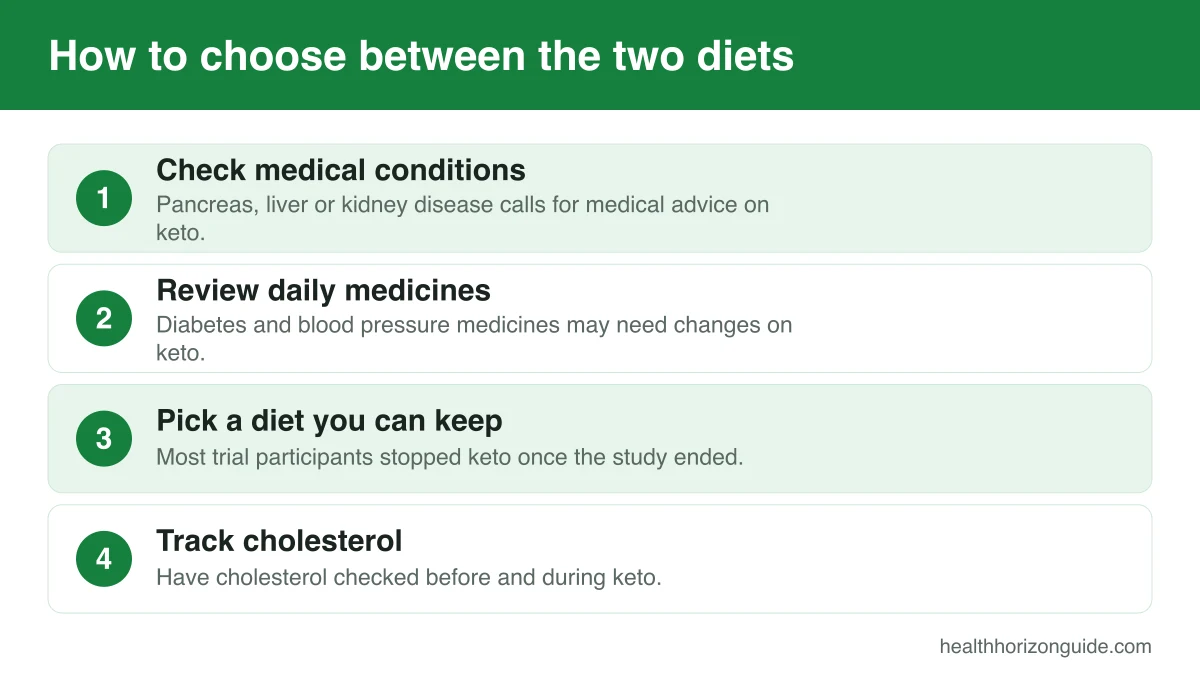
The points to check before choosing the Mediterranean diet or keto are medical conditions, daily medicines and how long the diet can be kept up. Keto carries more cautions than the Mediterranean diet on all 3 points.
Who should avoid keto?
People who should avoid keto include those with rare fat-metabolism disorders, acute pancreatitis, acute liver failure or advanced kidney disease. A 2026 review in Annals of Medicine describes contraindications and cautions for keto. The Mediterranean diet has no similar list in that review. The 7 groups below need to avoid keto or to use keto only with medical supervision.
- People with inherited fat-metabolism disorders, such as primary carnitine deficiency, or with porphyria.
- People with acute pancreatitis.
- People with acute liver failure.
- People with advanced chronic kidney disease.
- People with familial hypercholesterolaemia, an inherited form of high cholesterol.
- Pregnant and breastfeeding women, because safety data are limited.
- People who take SGLT2 inhibitors, insulin, sulfonylureas or blood pressure medicines.
What are the side effects of keto?
The side effects of keto in the first weeks are fatigue, headache and nausea, often called keto flu. The Annals of Medicine review lists digestive upset, frequent urination and low blood sugar as other early effects. The Mediterranean diet has no comparable adaptation period, because carbohydrate intake stays moderate.
Can you combine the Mediterranean diet and keto?
Yes, the Mediterranean diet and keto can be combined into a Mediterranean keto diet. A Mediterranean keto diet keeps carbohydrates at keto levels and takes fat mainly from olive oil, fish and nuts in place of butter and processed meat.
Evidence for the combined diet is limited, and we found no large long-term trials. A physician who commented on the 2026 liver trial advised people on keto to favor unsaturated fats. The same physician advised cholesterol tests before and during keto. Our comparison of the Mediterranean vs Balkan diet describes another regional eating pattern.
When should you see a doctor about the Mediterranean diet or keto?
A doctor's advice is needed before starting keto with diabetes, kidney disease, liver disease, high cholesterol or daily medicines. The Annals of Medicine review reports a higher risk of diabetic ketoacidosis when keto is combined with SGLT2 inhibitors.
Doses of insulin and sulfonylureas usually need adjusting on keto, because blood sugar can fall too low. Blood pressure can fall on keto as well, so blood pressure medicines may need review.
The Mediterranean diet needs fewer precautions. American Heart Association experts advise that people who do not drink should not start drinking wine for the Mediterranean diet.
Mediterranean diet vs keto: common questions
Is the Mediterranean diet low carb?
No, the Mediterranean diet is not a low-carb diet. The Mediterranean diet includes whole grains, legumes and fruit, which keto excludes. Our article on oatmeal and longevity covers one whole grain in detail.
Is keto or the Mediterranean diet easier to stick to?
The Mediterranean diet is easier to stick to than keto for most people. Participants in the Stanford trial were eating closer to the Mediterranean diet 3 months after the study, and most had stopped keto.
Does keto raise cholesterol more than the Mediterranean diet?
Yes, keto raised LDL cholesterol in the Stanford trial, while the Mediterranean diet lowered LDL cholesterol. Triglycerides fell more on keto than on the Mediterranean diet.