
Can You Use Niacinamide and Vitamin C Together?
Yes, you can use niacinamide and vitamin C together. Learn which goes first, morning or night use, side effects, patch testing and what not to mix.

Yes, you can use niacinamide and vitamin C together in the same skincare routine. The old warning against mixing the two comes from outdated research done at very high temperature, which does not match home use at room temperature. The usual order is the thinner product first, which is often the vitamin C serum, then niacinamide, moisturizer and sunscreen.
Action checklist
Using niacinamide and vitamin C together
Use these steps from the article to layer niacinamide and vitamin C with less risk of irritation.
0 of 10 done
In this article
- Can you use niacinamide and vitamin C together?
- Which goes first, niacinamide or vitamin C?
- Is it safe to mix niacinamide and vitamin C?
- Side effects of niacinamide and vitamin C
- What do niacinamide and vitamin C each do for skin?
- Niacinamide and vitamin C for dark spots and hyperpigmentation
- Niacinamide and vitamin C for acne-prone or sensitive skin
- What not to mix with vitamin C
- How to store niacinamide and vitamin C serums
- When to see a dermatologist
- Niacinamide and vitamin C: frequently asked questions
Can you use niacinamide and vitamin C together?
Yes, niacinamide and vitamin C can be used together in one routine, either layered as two products or combined in one formula. Healthline quotes dermatologist Dr. Meena Singh, who confirms that the pairing is fine.
Cleveland Clinic lists vitamin C among the ingredients that pair well with niacinamide. Both ingredients have antioxidant properties, and both are used for uneven skin tone.
Which goes first, niacinamide or vitamin C?
Vitamin C usually goes first, since the thinner product is applied before the thicker one. Healthline advises applying the thinner texture first and placing both niacinamide and vitamin C before moisturizer and sunscreen. The sources reviewed for this article include no clinical trial that compares the two orders.
The 5 steps below show how to layer niacinamide and vitamin C in a morning routine.
- Cleanse the face with a gentle cleanser and pat the skin dry.
- Apply the vitamin C serum, which is usually the thinner product.
- Apply the niacinamide serum or cream once the first layer has absorbed.
- Apply a moisturizer.
- Finish with a broad-spectrum sunscreen of SPF 30 or higher.
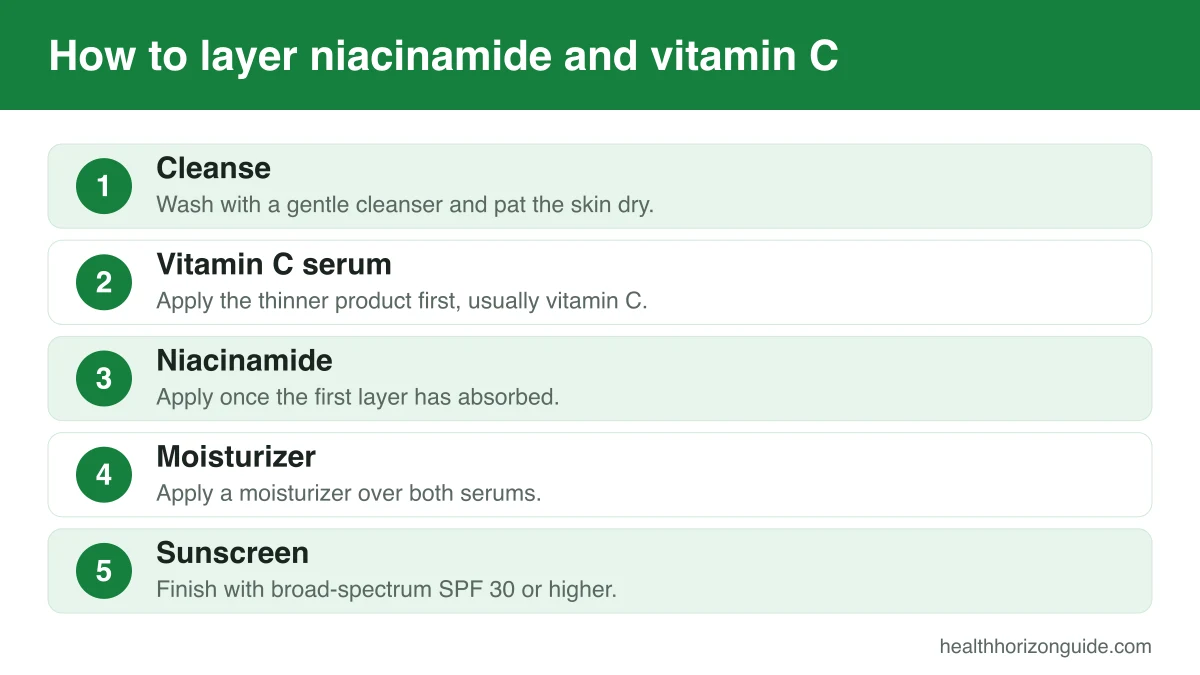
The order of niacinamide and vitamin C reverses when the niacinamide product is the thinner one. Cleveland Clinic notes that a niacinamide serum can also be mixed into a moisturizer.
Should you use niacinamide and vitamin C in the morning or at night?
Niacinamide and vitamin C work in the morning or at night, and morning suits vitamin C best. Cleveland Clinic's vitamin C guidance states that vitamin C is safe overnight but recommends morning use, so that vitamin C pairs with sunscreen. Niacinamide can be applied once or twice daily.
A split routine is a reasonable option for easily irritated skin. Vitamin C goes on in the morning and niacinamide goes on at night.
Niacinamide and vitamin C in one product vs separate serums
Niacinamide and vitamin C can come in one product or in two separate serums. Healthline describes a combined serum or mask as an alternative to layering. A combined formula means fewer steps. Separate serums allow each strength to be chosen and each product to be stopped alone when irritation appears.
A 2021 review of niacinamide research describes one study of a combined gel. The gel held 2% ascorbyl glucoside, a vitamin C derivative, and 3.5% niacinamide. The gel, applied with ultrasound, reduced hyperpigmentation more than no treatment over 4 weeks.
Is it safe to mix niacinamide and vitamin C?
Yes, mixing niacinamide and vitamin C is safe for most people at room temperature. The "do not mix" warning comes from older research that combined pure niacinamide with ascorbic acid at very high temperature, according to the dermatologist quoted by Healthline. That reaction formed nicotinic acid, a different form of vitamin B3 that can irritate skin.
Home use of niacinamide and vitamin C does not recreate those conditions. The 2021 review states that niacinamide, unlike nicotinic acid, does not cause flushing. One tolerance test in the same review found no stinging or flushing with 10% niacinamide.
Side effects of niacinamide and vitamin C
The main side effect of niacinamide and vitamin C is mild skin irritation. Cleveland Clinic describes niacinamide as generally gentle and states that most people have no side effects from a vitamin C serum.
The 4 possible reactions to niacinamide or vitamin C are listed below.
- Redness of the treated skin.
- Itching.
- Mild burning or stinging.
- Dryness.
Redness that looks like flushing points to irritation, since niacinamide does not cause the flushing linked to nicotinic acid. Healthline advises stopping a product that irritates and checking with a dermatologist before trying again.
How to patch test niacinamide and vitamin C
A patch test for niacinamide and vitamin C means trying each product on a small area of skin first. The American Academy of Dermatology (AAD) sets out the 4 steps below.
- Choose a quarter-sized spot where the product will not be rubbed or washed off, such as the inner arm or the bend of the elbow.
- Apply the product twice a day for 7 to 10 days, in the normal amount.
- Watch for redness, itching or swelling.
- Start using the product on the face when no reaction appears.
Test niacinamide and vitamin C one at a time. Healthline advises waiting at least 1 week before adding a second new product. A reaction calls for washing the product off, stopping use and applying a cool compress or petroleum jelly, according to the AAD.
What do niacinamide and vitamin C each do for skin?
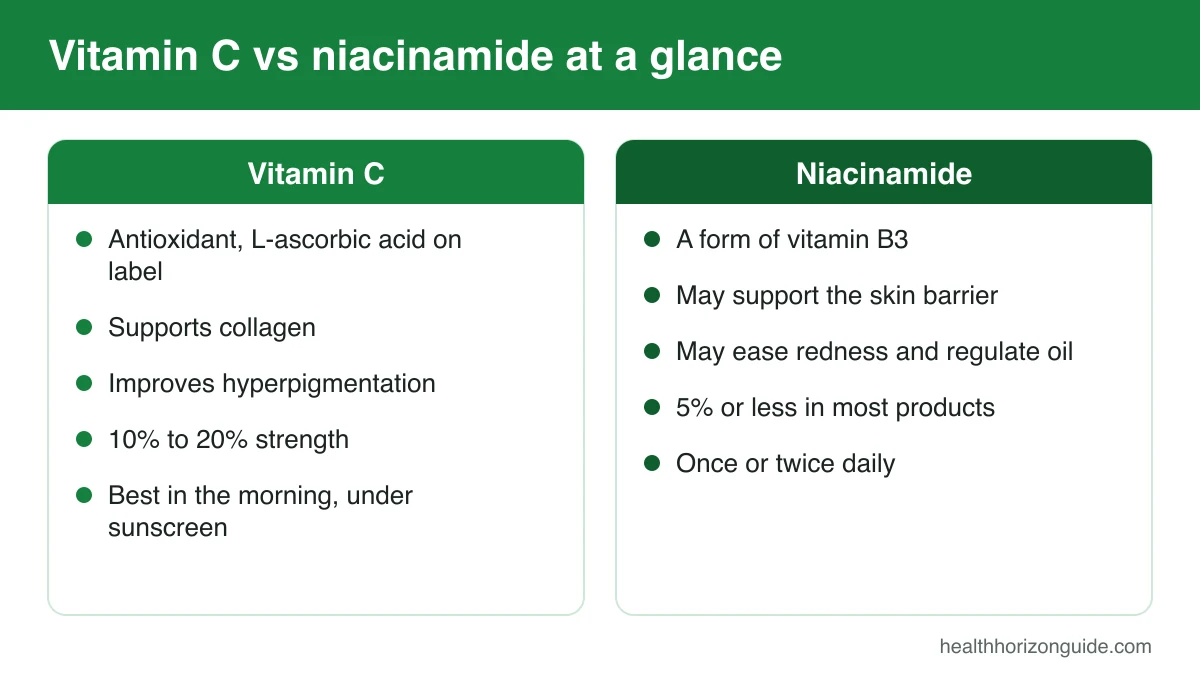
Niacinamide and vitamin C do different jobs that complement each other. The table below compares niacinamide and vitamin C on 5 attributes, using Cleveland Clinic guidance.
| Attribute | Vitamin C | Niacinamide |
|---|---|---|
| What the ingredient is | An antioxidant, listed as ascorbic acid or L-ascorbic acid | A form of vitamin B3 |
| Main roles | Protects against free radicals, supports collagen and improves hyperpigmentation | May support the skin barrier, ease redness, regulate oil and lighten dark spots |
| Typical strength | 10% to 20% L-ascorbic acid | 5% or less in most products |
| Rare side effects | Dryness, itching and redness | Itching, mild burning and redness |
| Usual timing | Morning, under sunscreen | Once or twice daily |
Niacinamide and vitamin C for dark spots and hyperpigmentation
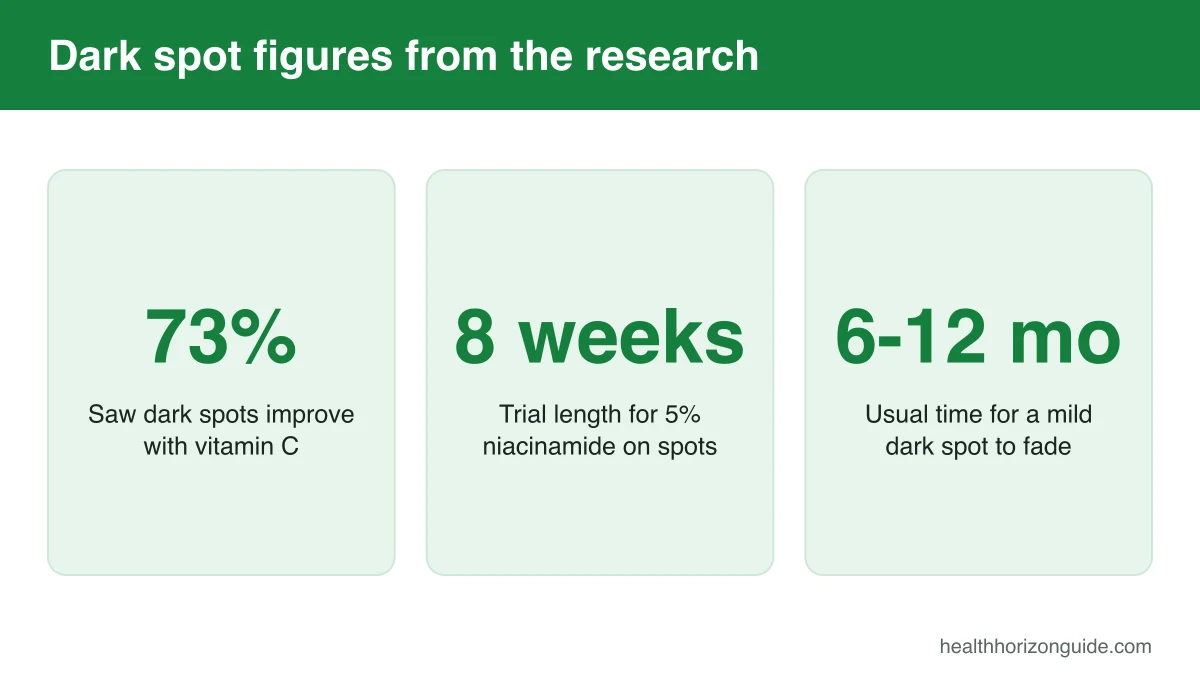
Niacinamide and vitamin C both have research support for fading dark spots, and the effect lasts only with continued use. Cleveland Clinic cites one study in which 73% of participants saw hyperpigmentation improve with topical vitamin C. The effect faded once use stopped.
The 2021 review reports that 5% niacinamide reduced hyperpigmented spots over 8 weeks in a study of 79 women, while 2% did not reach statistical significance. Niacinamide slows the transfer of pigment to surface skin cells. No trial in the sources reviewed tested L-ascorbic acid layered with niacinamide against either ingredient alone.
Sunscreen is the starting point for treating dark spots, with niacinamide and vitamin C added on top. The AAD lists vitamin C among the ingredients that fade dark spots and advises a broad-spectrum, tinted sunscreen with SPF 30 or higher.
Dark spots fade slowly, even with niacinamide and vitamin C. A spot a few shades darker than the surrounding skin usually fades within 6 to 12 months once the cause stops, according to the AAD.
Niacinamide and vitamin C for acne-prone or sensitive skin
Niacinamide and vitamin C suit acne-prone and sensitive skin when introduced slowly. Cleveland Clinic states that niacinamide may regulate oil production and may calm redness from acne. Healthline adds that vitamin C may help fade acne scars.
Sensitive skin needs a gentler start with niacinamide and vitamin C. Cleveland Clinic advises a low concentration of each ingredient for sensitive skin. Healthline suggests starting with one application a day or every other day.
Our skin type quiz helps readers identify a skin type before choosing a strength.
What not to mix with vitamin C
Vitamin C should not be applied at the same time as benzoyl peroxide, although niacinamide and vitamin C remain a safe pair. Dermatologist Zoe Diana Draelos, MD, explains in Dermatology Times that benzoyl peroxide is an oxidant that speeds up the breakdown of vitamin C.
Dr. Draelos suggests benzoyl peroxide in the morning and vitamin C at night for people who use both.
Retinol and glycolic acid need care for a different reason. The AAD notes that retinol and glycolic acid can cause temporary irritation, especially on sensitive skin. Adding either one to a routine with niacinamide and vitamin C is best done one product at a time.
How to store niacinamide and vitamin C serums
Niacinamide and vitamin C serums keep best at room temperature, away from sunlight. Vitamin C is sensitive to sun, heat and light, so Cleveland Clinic recommends dark or tinted glass packaging. Healthline advises checking the product label for storage instructions.
Our guide to refrigerated skincare products covers which products belong in a fridge. Our guide on how to pack skincare for travel covers carrying serums on a trip.
When to see a dermatologist
A dermatologist visit is needed when a reaction to niacinamide or vitamin C is severe or does not settle. The AAD advises seeing a dermatologist when a severe reaction does not improve after washing the product off and using a cool compress.
Dark spots that do not respond to over-the-counter products are another reason, since a dermatologist can offer prescription-strength treatment.
Niacinamide and vitamin C: frequently asked questions
Do niacinamide and vitamin C cancel each other out?
No, niacinamide and vitamin C do not cancel each other out in normal home use. The reaction behind that claim needed very high temperature, according to Healthline.
Do you need to wait between vitamin C and niacinamide?
No, a fixed waiting time between vitamin C and niacinamide is not set by the medical sources reviewed. Letting the first layer absorb is enough.
How long do niacinamide and vitamin C take to work?
Niacinamide and vitamin C take about 2 to 3 months to show results. Cleveland Clinic gives about 3 months for vitamin C, and the niacinamide trial on dark spots in the 2021 review ran for 8 weeks.