Physical Symptoms of Anxiety: What They Feel Like and Why
Physical symptoms of anxiety include a racing heart, chest tightness, dizziness and tingling. See why they happen, how long they last and when to get help.

The physical symptoms of anxiety include a racing heart, fast breathing, chest tightness, sweating, trembling, dizziness, tingling hands, stomach upset and muscle tension. These symptoms come from the stress response, which releases adrenaline and prepares the body for danger. Chest pain that is new, severe or lasting needs emergency care, since a heart attack can feel similar.
Action checklist
Actions for Physical Symptoms of Anxiety
Use these steps from the article to ease physical symptoms of anxiety and to spot the signs that need urgent care.
0 of 10 done
In this article
- What are the physical symptoms of anxiety?
- Why does anxiety cause physical symptoms?
- Anxiety attack and panic attack symptoms
- Anxiety chest pain vs heart attack
- How long do physical symptoms of anxiety last?
- What helps physical symptoms of anxiety in the moment and long term?
- Conditions that mimic the physical symptoms of anxiety
- When to see a doctor about physical symptoms of anxiety
- Physical symptoms of anxiety: common questions
What are the physical symptoms of anxiety?
The physical symptoms of anxiety are real body changes produced by the stress response, not imagined sensations. The table below lists the 9 most common physical symptoms of anxiety, what each symptom feels like and why each symptom happens.
| Symptom | What it feels like | Why it happens |
|---|---|---|
| Racing or pounding heart | A faster, irregular or more noticeable heartbeat | Adrenaline makes the heart beat faster to send blood to the muscles and vital organs |
| Fast breathing or breathlessness | Feeling out of breath or unable to catch a breath | Breathing quickens and the small airways open so the lungs take in more oxygen |
| Chest pain or tightness | Sharp or stabbing pain, or discomfort that is hard to describe | Chest pain is a recognised symptom of overbreathing (hyperventilation) |
| Dizziness or light-headedness | Feeling faint, weak or unable to think straight | Overbreathing lowers the carbon dioxide level in the blood |
| Tingling or numbness | Pins and needles in the hands, arms or around the mouth | Low carbon dioxide from overbreathing produces numbness and tingling |
| Sweating, chills or feeling hot | Sweating a lot, feeling hot or having chills | Sweat appears as part of the stress response |
| Trembling and muscle tension | Shaking, twitching and muscle aches | Muscles tense during the stress response |
| Stomach problems | Nausea, cramps, bloating, indigestion, constipation or diarrhoea | The sources we reviewed list gut symptoms without stating one mechanism |
| Headaches, tiredness and poor sleep | Tension headaches, fatigue and trouble falling or staying asleep | Cortisol keeps the body on high alert while the brain keeps sensing danger |
The symptom names come from the NHS and the National Institute of Mental Health (NIMH). NIMH adds two less familiar physical symptoms of anxiety: trouble swallowing and needing the bathroom often.
Why does anxiety cause physical symptoms?
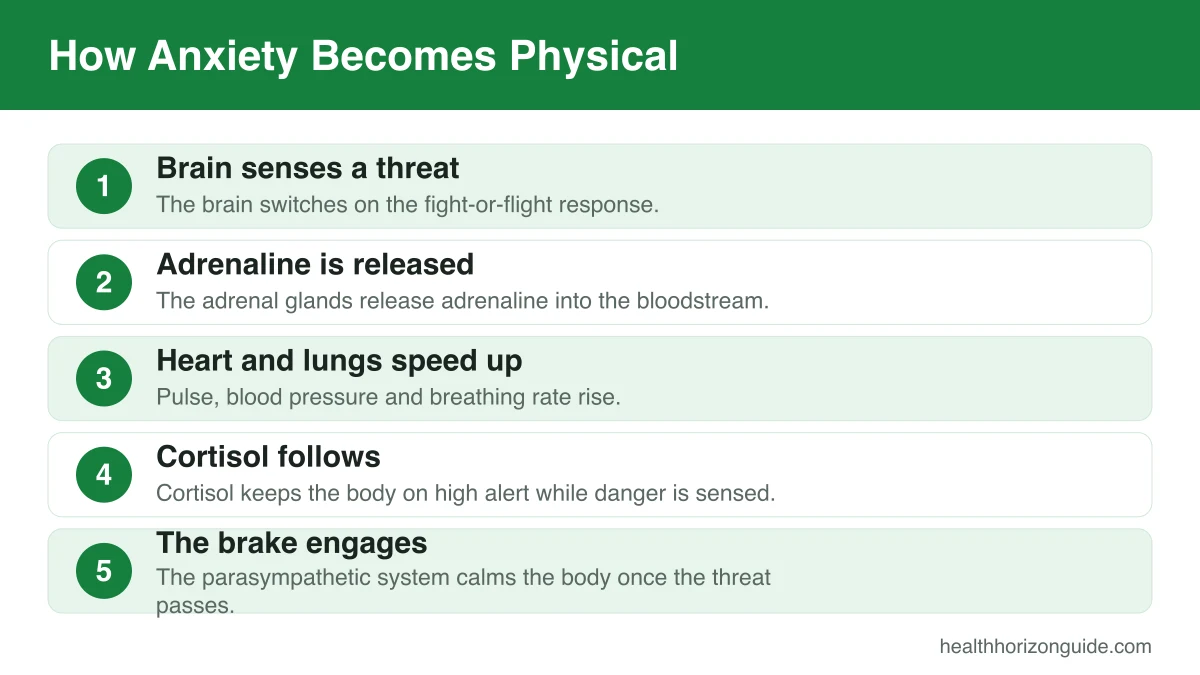
Anxiety causes physical symptoms because the brain switches on the fight-or-flight response. The adrenal glands release adrenaline, which raises the pulse and blood pressure, speeds up breathing and sharpens the senses, according to Harvard Health.
A second hormone, cortisol, follows when the brain keeps sensing danger. Cortisol keeps the body revved up until the threat passes, and then the parasympathetic nervous system acts as a brake. Harvard Health notes that the body can overreact to stressors that are not life-threatening, such as traffic, work pressure and family difficulties.
Readers who want the hormone side of the physical symptoms of anxiety can read our guide on how to lower cortisol.
Can you have physical symptoms of anxiety without feeling anxious?
Yes, physical symptoms of anxiety can appear without a conscious feeling of worry. The American Heart Association states that a panic attack can occur for no apparent reason. Harvard Health describes a stress response that fires during ordinary daily pressures.
None of the sources we reviewed gives a figure for how common this pattern is. Body symptoms without any anxious feeling deserve a medical check, since a physical illness can produce the same sensations.
Anxiety attack and panic attack symptoms
A panic attack produces the most intense physical symptoms of anxiety, arriving suddenly. Many people call this episode an anxiety attack, while NIMH and Cleveland Clinic use the term panic attack. The 9 physical symptoms of a panic attack listed by NIMH are shown below.
- Pounding or racing heart
- Sweating
- Chills
- Trembling
- Difficulty breathing
- Weakness or dizziness
- Tingly or numb hands
- Chest pain
- Stomach pain or nausea
Cleveland Clinic adds the emotional side of a panic attack: intense terror, a fear of losing control, a sense of dying and a feeling of being detached or unreal.
Anxiety chest pain vs heart attack
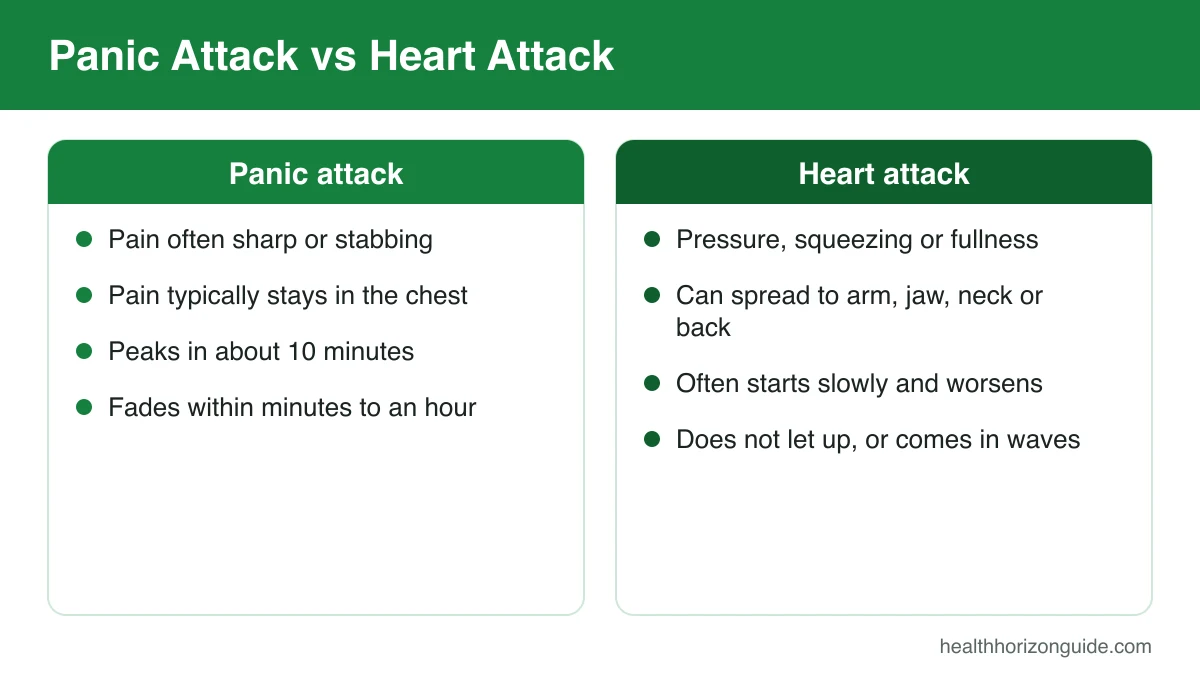
Anxiety chest pain is often sharp, stays in the chest and fades within minutes to an hour. Heart attack pain tends to feel like pressure and does not let up.
The table below compares anxiety chest pain, one of the physical symptoms of anxiety, with heart attack symptoms. The comparison draws on Cleveland Clinic, the American Heart Association and the CDC.
| Feature | Panic attack | Heart attack |
|---|---|---|
| Pain quality | Often sharp or stabbing, or hard to describe | Pressure, squeezing, fullness, aching or burning |
| Location | Typically stays in the chest | Can spread to the arm, shoulder, jaw, neck or back |
| Onset | Comes on quickly and peaks in about 10 minutes | Often starts slowly and worsens over a few minutes |
| Duration | A few minutes up to an hour, then fades | Lasts more than a few minutes, or comes and goes in waves |
| Typical trigger | Emotional stress, or no clear trigger | Tends to follow physical exertion |
The table cannot rule out a heart attack, since the two sets of symptoms overlap. Call 911 immediately when chest pain or discomfort comes with any of the CDC warning signs. Those signs are shortness of breath, a cold sweat, light-headedness, and discomfort in the jaw, neck, back, arm or shoulder.
Cleveland Clinic advises people who are unsure to take no chances and to seek care without waiting for symptoms to pass.
How long do physical symptoms of anxiety last?
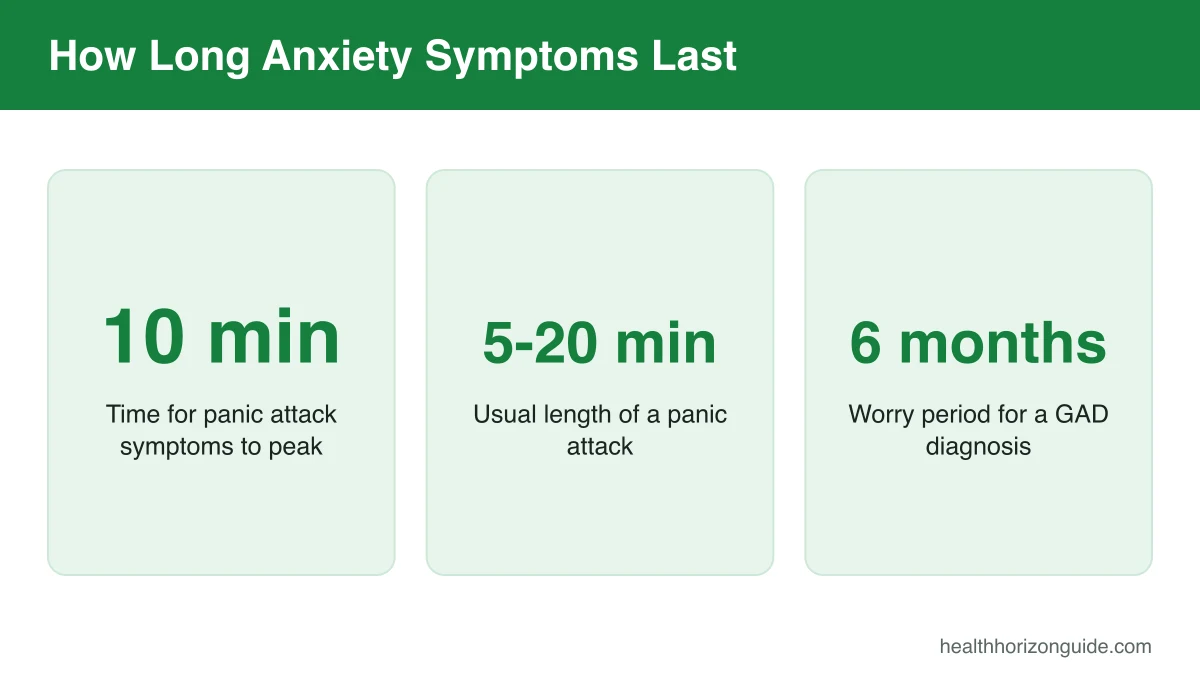
Physical symptoms of anxiety last 5 to 20 minutes during most panic attacks and peak within about 10 minutes, according to Cleveland Clinic. NIMH states that a panic attack can last from a few minutes to an hour, or sometimes longer.
Physical symptoms linked to generalised anxiety disorder follow a longer course. NIMH states that these symptoms can persist for months or years and rise and fall over time. The symptoms often worsen during stress such as illness or exams. A diagnosis of generalised anxiety disorder requires hard-to-control worry on most days for at least 6 months.
What helps physical symptoms of anxiety in the moment and long term?
Slow breathing helps physical symptoms of anxiety in the moment, and cognitive behavioural therapy (CBT) is the main long-term treatment. The 4 in-the-moment steps described by MedlinePlus, Cleveland Clinic and Harvard Health are listed below.
- Breathe in slowly, then breathe out through pursed lips, as though blowing out a candle.
- Remind yourself that the attack is temporary and will pass.
- Relax the muscles one group at a time.
- Take a brisk walk once the peak has passed, which deepens breathing and eases muscle tension.
The evidence for breathing exercises is early. The National Center for Complementary and Integrative Health reports a 2019 review of 3 studies with 880 participants. The review found preliminary evidence that slow diaphragmatic breathing may reduce stress. Relaxation techniques are generally considered safe, although some people report increased anxiety during practice.
Long-term treatment for physical symptoms of anxiety
Long-term treatment for physical symptoms of anxiety typically involves psychotherapy, medication or both, according to NIMH. NIMH calls CBT the gold standard psychotherapy for panic disorder and generalised anxiety disorder. Antidepressants such as SSRIs and SNRIs may take several weeks to start working, and the choice of any medication belongs to a clinician.
Regular exercise, enough sleep and less caffeine can reduce symptoms, although NIMH states that healthy habits cannot replace treatment. Our anxiety self-check tool offers a starting point for a conversation with a professional. Our guide to anxiety signs and how to get help explains the next steps.
Conditions that mimic the physical symptoms of anxiety
Conditions that mimic the physical symptoms of anxiety include thyroid disease, anemia, heart disease and breathing problems. The 4 conditions that Cleveland Clinic and MedlinePlus describe are listed below.
- An overactive thyroid (hyperthyroidism) causes nervousness, hand tremor, a racing heartbeat, sweating, heat intolerance and weight loss. Blood tests for TSH, T3 and T4 detect the condition.
- Iron deficiency anemia causes tiredness, dizziness, palpitations and shortness of breath. A complete blood count detects anemia.
- Heart disease can cause chest pain, palpitations and breathlessness.
- Breathing (respiratory) problems can cause shortness of breath and fast breathing.
NIMH states that a provider may carry out a physical exam to check that an unrelated physical problem is not causing the symptoms.
When to see a doctor about physical symptoms of anxiety
A doctor visit is advised when a person is struggling to cope with anxiety or self-help has not worked, which is the point the NHS names. Physical symptoms of anxiety that are new, frequent or unexplained need a medical assessment before anxiety is assumed.
The 3 situations that need urgent help are listed below.
- Call 911 for chest pain, trouble breathing or loss of consciousness.
- Seek emergency care for a first episode of rapid breathing, which MedlinePlus says may be a medical emergency.
- Call or text 988 in the US to reach the 988 Suicide and Crisis Lifeline when struggling or having thoughts of suicide.
Physical symptoms of anxiety: common questions
Can anxiety cause physical symptoms all day?
Yes, physical symptoms of anxiety can be present on most days in generalised anxiety disorder. NIMH states that the symptoms can persist for months or years and tend to rise and fall.
Can anxiety cause tingling in the hands?
Yes, anxiety can cause tingling in the hands through overbreathing. MedlinePlus states that low carbon dioxide in the blood produces numbness and tingling. NIMH lists tingly or numb hands among the physical symptoms of anxiety during panic attacks.
Are the physical symptoms of anxiety dangerous?
An occasional fast heart rate from stress that lasts a few minutes is usually not harmful, according to Cleveland Clinic. Physical symptoms of anxiety that happen regularly, or that resemble a heart attack, need medical care.
How common is anxiety?
Anxiety is experienced by most people at some point, according to the NHS. Our report on mental health trends in 2025 covers the wider picture behind the physical symptoms of anxiety.