How to Know Your Skin Type: 2 Simple Home Tests
Learn how to know your skin type with the bare-face and blotting sheet tests, the 5 skin types, how skin type changes, and a basic routine for each.

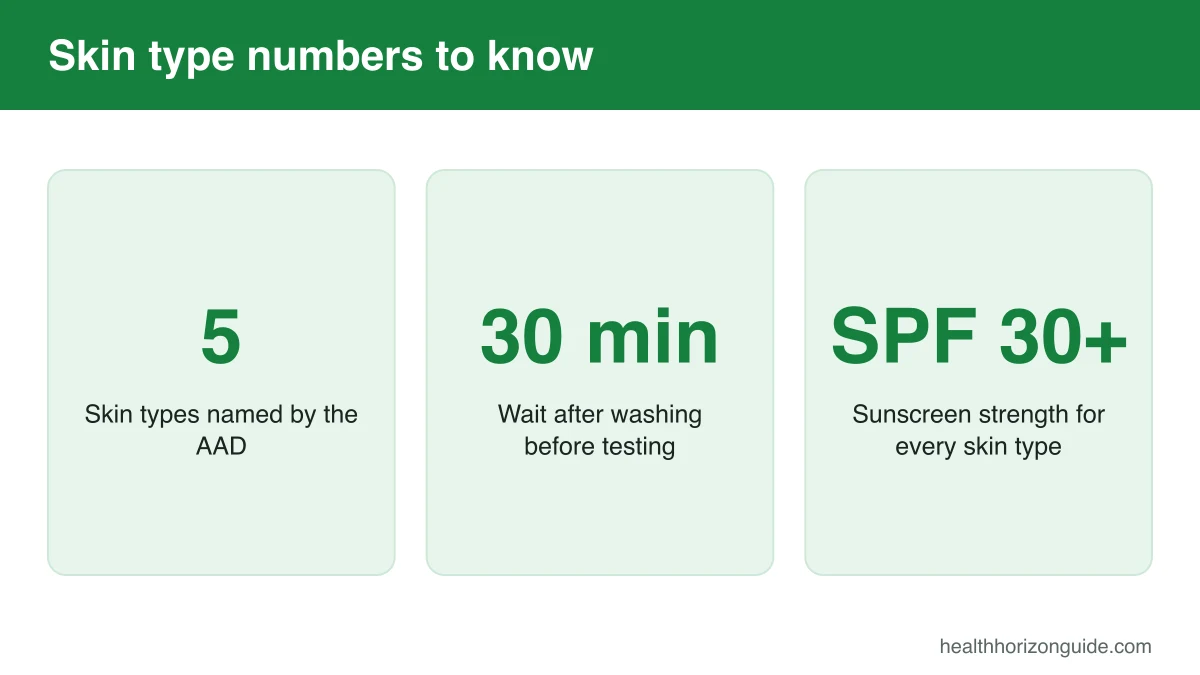
You can find your skin type at home by washing your face, applying nothing and checking how the skin looks and feels after about 30 minutes, a method described by Cleveland Clinic. The American Academy of Dermatology (AAD) sorts skin into 5 types: normal, dry, oily, combination and sensitive. Oil, tightness and how easily the skin reacts to products separate one skin type from another.
Action checklist
How to find and care for your skin type
Use these steps from the article to test your skin type at home and build a simple routine around it.
0 of 10 done
In this article
- What are the 5 skin types?
- How to test your skin type at home
- Skin type vs skin condition
- Can your skin type change?
- Fitzpatrick skin type is a different scale
- Basic skincare routine for each skin type
- Common skin type mistakes
- When to see a dermatologist about your skin type
- Skin type: frequently asked questions
What are the 5 skin types?
The 5 skin types are normal, dry, oily, combination and sensitive. Cleveland Clinic links most of the differences between skin types to sebum, the natural oil the skin produces.
The table below compares the signs of each skin type, based on Cleveland Clinic guidance.
| Skin type | How the skin looks | How the skin feels | Main cause |
|---|---|---|---|
| Normal | Even, not prone to acne | Neither dry nor oily, no sensitivities | Balanced oil production |
| Dry | Dull or scaly, fine lines more visible with age | Tight | Low sebum |
| Oily | Shiny, enlarged pores, blackheads and pimples | Greasy | Excess sebum |
| Combination | Oily forehead, nose and chin with drier cheeks, or the reverse | Oily in some areas, dry in others | Uneven oil production |
| Sensitive | Red after some products | Stinging, burning or itching | Skin that reacts easily |
Sensitive skin can overlap with the other skin types. Cleveland Clinic notes that sensitive skin can also be dry, oily or combination. Readers who prefer answering questions can use our skin type quiz alongside the 2 home tests below.
How to test your skin type at home
Testing your skin type at home needs a clean face, no products and about 30 minutes. Cleveland Clinic states that no universal skin type test exists, so the bare-face test and the blotting sheet test give a likely answer, not a diagnosis.
The bare-face test for skin type
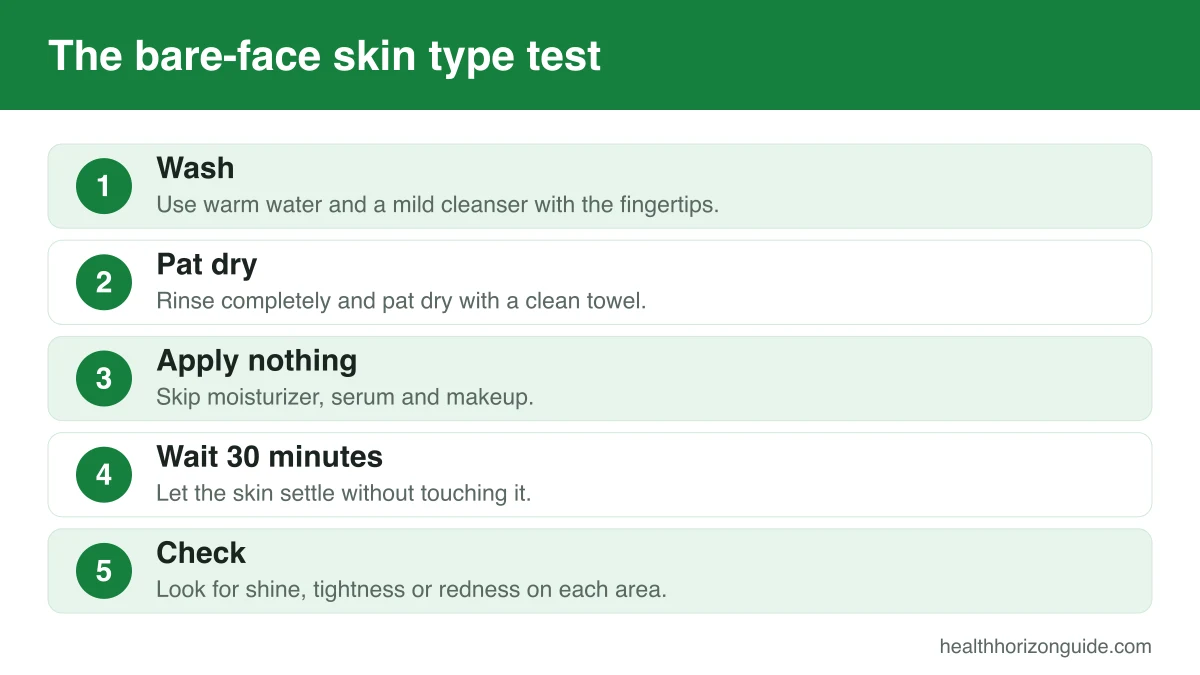
The bare-face test reads your skin type from how the skin looks and feels 30 minutes after washing. The 5 steps of the bare-face test are listed below.
- Wet the face with warm water and apply a mild cleanser with the fingertips.
- Rinse completely and pat the skin dry with a clean towel.
- Apply no moisturizer, serum or makeup.
- Wait about 30 minutes.
- Check the forehead, nose, chin and cheeks for shine, tightness and redness.
The washing steps follow AAD advice, which warns that scrubbing irritates the skin. The 5 possible results of the bare-face test, as described by Cleveland Clinic, are listed below.
- Shiny or oily skin after 30 minutes points to oily skin.
- Skin that still feels dry after 30 minutes points to dry skin.
- Oil in some areas and dryness in others points to combination skin.
- Skin that feels neither tight nor oily points to normal skin.
- Redness, stinging, burning or itching points to sensitive skin.
The blotting sheet test for skin type
The blotting sheet test measures skin type by the amount of oil a sheet of blotting paper collects. The 4 steps of the blotting sheet test are listed below.
- Wash and dry the face.
- Wait 30 minutes without applying any product.
- Press a blotting sheet gently on the forehead, nose, chin and cheeks.
- Hold the sheet up to the light and look at how much oil it holds.
Little or no oil on the sheet suggests dry skin. Oil from the forehead and nose only suggests combination skin, and oil from every area suggests oily skin.
Why a skin type test can give a mixed result
A skin type test can give a mixed result when the skin is reacting to weather, products or a recent change. Many people see an oily nose and cheeks that feel tight on the same morning. That pattern usually fits combination skin, and repeating the test on another day confirms it.
Skin type vs skin condition
Skin type is the usual oil and sensitivity pattern of the skin, while a skin condition is a problem that can appear on any skin type. Mixing the two leads people to choose products for the wrong reason.
The 4 common skin conditions mistaken for a skin type are listed below.
- Dehydration describes skin short of water rather than oil, so oily skin can still feel dehydrated.
- Acne is a condition that clogged pores can lead to, and oily skin is more prone to clogged pores.
- Rosacea is a condition that can occur alongside sensitive skin, according to Cleveland Clinic.
- Eczema, also called atopic dermatitis, is a condition that can cause lasting dryness on any skin type.
The AAD notes that dry skin can stem from conditions such as atopic dermatitis, psoriasis or kidney disease. Dryness that does not respond to home care is a reason to look past skin type.
Can your skin type change?
Yes, your skin type can change with age, season, hormones and pregnancy. Cleveland Clinic lists genetics, age, hormones, stress, diet, activity level, climate and some medications as factors that shape skin type.
How skin type changes with age
Skin type tends to become drier with age as oil production falls. MedlinePlus reports that women gradually produce less oil beginning after menopause, which can cause dryness and itching. Men have a minimal decrease, most often after age 80.
How skin type changes with the season
Skin type can shift between hot, humid summers and cool, dry winters, according to Cleveland Clinic. Skin that tests oily in July can test normal or dry in January, so a seasonal retest keeps a routine accurate.
How skin type changes with hormones and pregnancy
Skin type can change during puberty, pregnancy and breastfeeding, Cleveland Clinic states. Retesting the skin type after one of these life stages helps match products to the skin as it is now.
Fitzpatrick skin type is a different scale
Fitzpatrick skin type is a scale of how skin reacts to the sun, not of how oily or dry the skin is. Cleveland Clinic explains that the scale dates from 1975 and runs from type 1 to type 6.
Type 1 describes very light skin that always burns and never tans. Type 6 describes deep brown or black skin that never burns and always tans deeply. Providers use the Fitzpatrick skin type to estimate skin cancer risk and how skin may respond to laser hair removal.
Every Fitzpatrick type and every oil-based skin type needs daily sun protection. Cleveland Clinic states that there is no such thing as a healthy tan.
Basic skincare routine for each skin type
A basic routine for each skin type uses 3 products: a cleanser, a moisturizer and sunscreen. The AAD recommends a broad-spectrum, water-resistant sunscreen with SPF 30 or higher for every skin type.
The table below sets out the cleanser, moisturizer and sunscreen choice for each skin type, using AAD and Cleveland Clinic guidance.
| Skin type | Cleanser | Moisturizer | Sunscreen |
|---|---|---|---|
| Normal | Mild cleanser once daily | Day and night | Broad-spectrum SPF 30 or higher during the day |
| Dry | Gentle cleanser, showers of 5 to 10 minutes in warm water | Cream or ointment on damp skin, several times a day | Broad-spectrum, water-resistant SPF 30 or higher |
| Oily | Mild foaming wash up to twice a day and after sweating | Oil-free and noncomedogenic, still needed daily | Zinc oxide or titanium dioxide, free of fragrance and oils |
| Combination | Different products for oily and dry areas | Lighter where oily, richer where dry | Broad-spectrum SPF 30 or higher |
| Sensitive | Fragrance-free, free of dyes and harsh ingredients | Labeled hypoallergenic or fragrance-free | Broad-spectrum SPF 30 or higher |
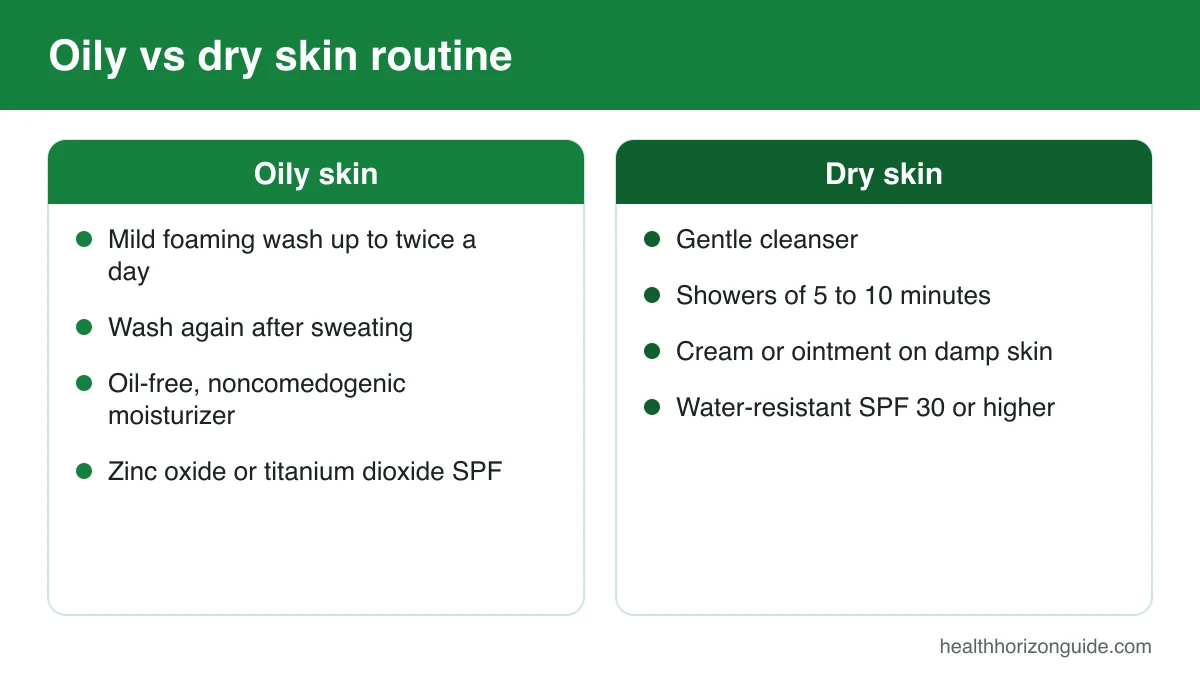
Oily skin still needs moisturizer, according to the AAD guide to oily skin, since harsh washing can trigger more oil. Dry skin does better with creams and ointments than lotions, the AAD dry skin tips state.
Cleveland Clinic gives an example of strength by skin type. A product for oily skin may hold 10% benzoyl peroxide, while one for combination skin may hold 2%. Readers adding active ingredients can see our guide to using niacinamide and vitamin C together.
Common skin type mistakes
The most common skin type mistake is choosing products without testing the skin type first. The 5 common skin type mistakes are listed below.
- Testing the skin type while moisturizer or makeup is still on the face.
- Scrubbing oily skin, which irritates the skin and can worsen acne, according to the AAD.
- Skipping moisturizer on oily skin, even though oily skin still needs hydration.
- Using too many products or products that are too harsh, which Cleveland Clinic warns can cause problems.
- Treating a condition such as dehydration or eczema as a fixed skin type.
Product care matters for every skin type as well. Our guide to skincare products that belong in the fridge covers storage. A trip to a new climate can change how a skin type behaves, and our guide on packing skincare for travel covers what to bring.
When to see a dermatologist about your skin type
A dermatologist visit about your skin type is worth booking when home tests and basic care do not settle the question. Cleveland Clinic notes that dermatology providers can refine a routine and prescribe medication when needed.
The 4 reasons to see a board-certified dermatologist are listed below.
- The skin type is still unclear after repeated home tests.
- Dry skin persists after trying the AAD home tips.
- Oily skin brings persistent blackheads or acne.
- A spot differs from the others, or changes, itches or bleeds.
Skin type: frequently asked questions
How long should you wait to test your skin type?
You should wait about 30 minutes after washing to test your skin type. Cleveland Clinic uses the 30-minute mark for both the bare-face test and the blotting paper test.
Can you have two skin types at once?
Yes, you can have two skin types at once in the form of combination skin. Sensitive skin can also sit on top of dry, oily or combination skin.
Is skin type genetic?
Yes, skin type is partly genetic. Cleveland Clinic lists genetics first among the factors that shape skin type, alongside age, hormones and climate.