Best Time to Take Iron Supplements: Morning or Night?
The best time to take iron supplements is the morning on an empty stomach. Learn the 2-hour gap for coffee, tea, calcium and antacids, and what research shows.
The best time to take iron supplements is in the morning, on an empty stomach, with water or a source of vitamin C. Coffee, tea, milk, calcium and antacids reduce iron absorption, so medical sources advise a 2-hour gap. A small amount of food with iron supplements can ease an upset stomach, and the dose should come from a clinician.
Action checklist
Iron supplement timing checklist
Use these steps from the article to time iron supplements for better absorption and fewer problems.
0 of 10 done
In this article
- What is the best time to take iron supplements?
- Is it better to take iron in the morning or at night?
- Should iron supplements be taken on an empty stomach or with food?
- Does vitamin C help iron absorption?
- What blocks iron absorption?
- Should iron be taken every day or every other day?
- Iron forms, timelines and side effects
- Is iron bisglycinate easier on the stomach?
- How long do iron supplements take to work?
- Side effects of iron supplements
- Best time to take iron supplements: common questions
What is the best time to take iron supplements?
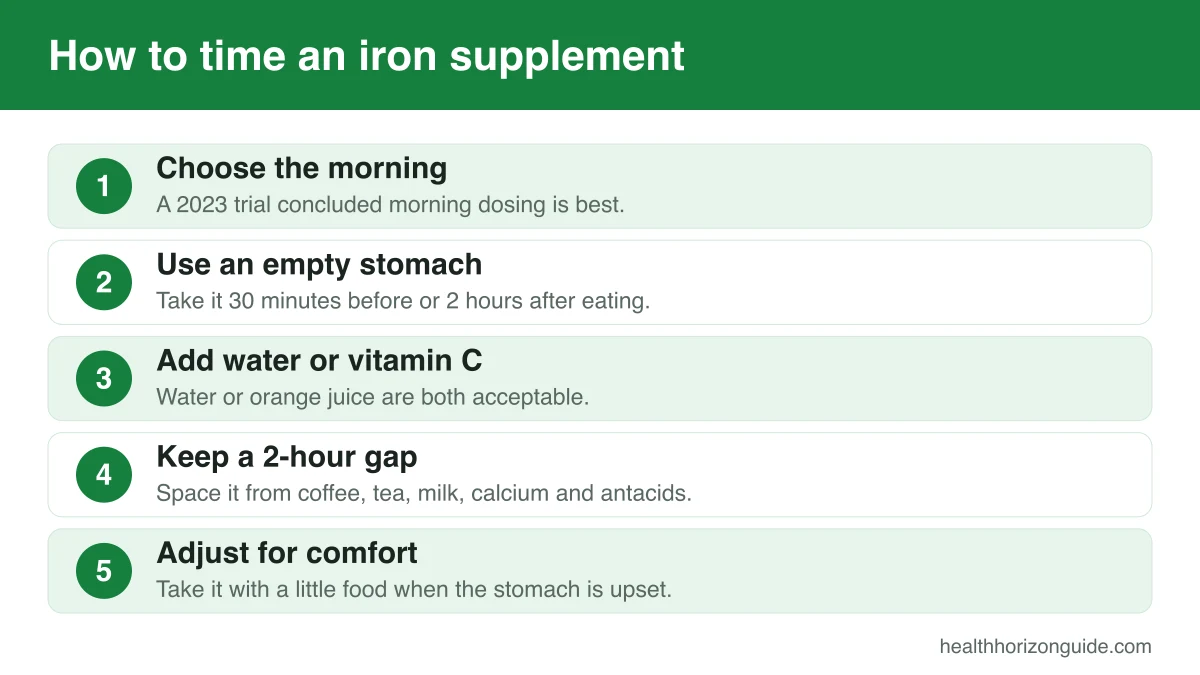
The best time to take iron supplements is the morning, away from meals and coffee. A 2023 trial in the American Journal of Hematology reached that conclusion after testing 34 iron-depleted women. The NHS gives a matching window of 30 minutes before eating or 2 hours after eating.
The 5 timing rules for iron supplements that these medical sources support are listed below.
- Take iron supplements in the morning when the daily routine allows.
- Take the dose on an empty stomach, 30 minutes before eating or 2 hours after eating.
- Swallow the dose with water, orange juice or another source of vitamin C.
- Keep a 2-hour gap from tea, coffee, milk, dairy foods, eggs, calcium and antacids.
- Take the dose with a small amount of food when an empty stomach causes an upset.
Timing affects how much iron the body absorbs, and the dose is a separate decision. Readers should follow the dose and schedule that a clinician sets for iron supplements.
Is it better to take iron in the morning or at night?
Taking iron supplements in the morning appears better than taking iron later in the day, although the evidence is limited. The 2023 trial found that iron absorption was 37% lower in the afternoon than in the morning. That difference fell just short of statistical significance, so the result is a trend and not proof.
The same trial measured hepcidin, a hormone linked to lower iron absorption. Hepcidin levels were higher in the afternoon than in the morning.
The trial did not test a bedtime dose, so the sources we reviewed give no data on iron supplements at night. Night dosing remains a practical choice when mornings are crowded with coffee, breakfast or other medicines. An evening dose taken 2 hours after the last meal still fits the NHS empty-stomach window.
Should iron supplements be taken on an empty stomach or with food?
Iron supplements are best absorbed on an empty stomach, according to MedlinePlus. MedlinePlus adds that iron supplements can upset the stomach, and that a small amount of food with the dose may help.
Food lowers iron absorption. The 2023 trial found that a breakfast with coffee cut iron absorption by 66%, even though the breakfast included orange juice.
Taking iron supplements with food is a trade between absorption and comfort. The NHS advises taking the dose with or after food when the stomach is upset. A clinician can check progress with a blood test.
Does vitamin C help iron absorption?
Yes, vitamin C increases the absorption of iron from iron supplements, although the effect on blood results is less certain. The 2023 trial found that a small amount of vitamin C raised iron absorption by 30%. A much larger amount of vitamin C gave no further increase.
Treatment results look less clear. The Cleveland Clinic describes a 2020 randomized trial of nearly 500 people with iron-deficiency anemia. Iron supplements alone worked about as well as iron supplements with vitamin C in that trial.
MedlinePlus and the NHS both note that a clinician may suggest orange juice or a vitamin C supplement with iron supplements. Water is also acceptable.
What blocks iron absorption?
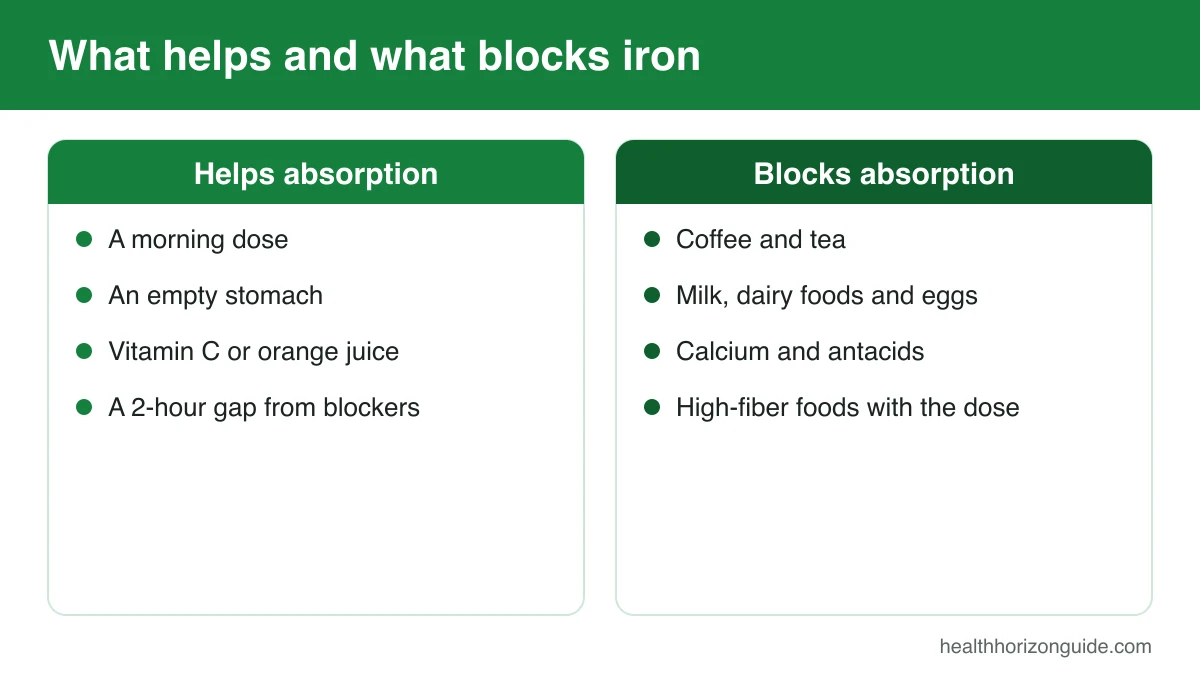
Iron absorption from iron supplements is blocked mainly by coffee, tea, milk, calcium and antacids. The table below shows each blocker, what the source says and the spacing the source states.
| Blocker | What the source says | Spacing stated |
|---|---|---|
| Coffee | Coffee with the dose cut iron absorption by 54% in the 2023 trial. | 2-hour gap (NHS) |
| Tea | Tea makes iron harder to absorb (NHS). | 2-hour gap (NHS) |
| Milk, dairy foods and eggs | These foods make iron harder to absorb (NHS). | 2-hour gap (NHS) |
| Calcium | Calcium should not be taken at the same time as iron (MedlinePlus). | Wait at least 2 hours after calcium (MedlinePlus) |
| Antacids | Antacids should not be taken at the same time as iron (MedlinePlus). | Wait at least 2 hours after antacids (MedlinePlus) |
| High-fiber foods | Whole grains, raw vegetables and bran should not be eaten with the dose (MedlinePlus). | No time gap stated |
Whole grains remain part of a healthy diet, as our guide to the health benefits of oatmeal explains. A bowl of oatmeal fits better at a different time of day from iron supplements.
Some medicines also interact with iron supplements. MedlinePlus lists tetracycline, penicillin, ciprofloxacin and some medicines for Parkinson disease and seizures, and advises at least 2 hours between these medicines and iron. Medicines that reduce stomach acid can impair iron absorption, so a clinician or pharmacist should review the full medicine list.
Should iron be taken every day or every other day?
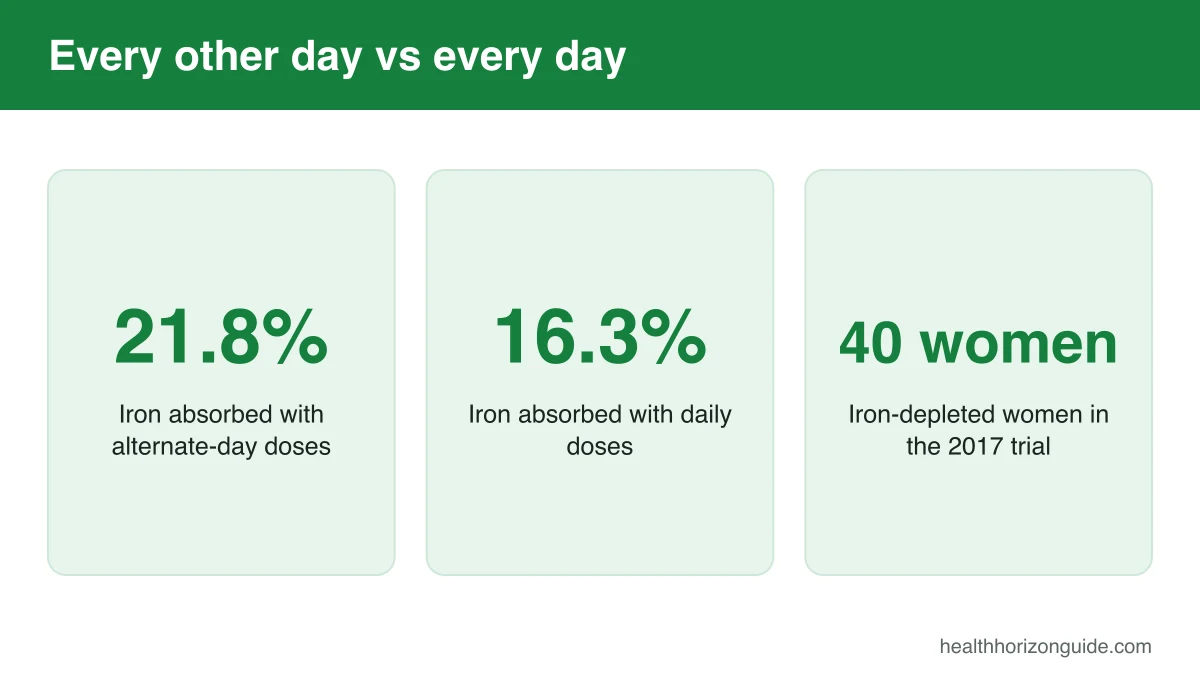
Iron supplements taken every other day were absorbed better per dose than daily iron in one small trial. The 2017 trial in The Lancet Haematology enrolled 40 iron-depleted women aged 18 to 40. Women on alternate-day dosing absorbed 21.8% of the iron, compared with 16.3% for women on consecutive-day dosing.
Hepcidin was higher in the daily group during the first 14 days. A second part of the study, with 20 women, compared one morning dose with the same amount split into two doses. Splitting the dose did not increase iron absorption and raised hepcidin.
The evidence has limits. The women were iron-depleted and not anemic, and the trial measured absorption instead of recovery from anemia. The authors called for confirmation in people with iron-deficiency anemia.
Alternate-day dosing of iron supplements is a question for a clinician. Readers should not change a prescribed schedule without that advice.
Iron forms, timelines and side effects
The best time to take iron supplements also depends on the form of iron, the treatment timeline and side effects. The sections below cover iron bisglycinate, how long iron takes to work and the common side effects.
Is iron bisglycinate easier on the stomach?
Iron bisglycinate may cause fewer stomach side effects than other iron supplements, based mainly on trials in pregnant women. Iron bisglycinate is a form of iron bound to the amino acid glycine. A 2023 review in Nutrition Reviews pooled 17 randomized trials of this form.
Pregnant women taking iron bisglycinate had higher hemoglobin than women taking other iron supplements. The rate of stomach and bowel side effects was roughly one third as high. The review found no significant difference in children. The authors stated that more trials are needed in other groups.
The sources we reviewed give no separate timing rules for iron bisglycinate, so the timing guidance above applies unless a clinician advises otherwise. Glycine-bound minerals appear in other products too, as our comparison of magnesium glycinate and magnesium citrate shows.
How long do iron supplements take to work?
Iron supplements take 3 to 4 weeks to make most people feel better, according to NHS guidance on ferrous sulfate. Full recovery takes longer. The table below shows the timeline that the NHS and MedlinePlus give for iron supplements.
| Milestone | Timeline | Source |
|---|---|---|
| First blood test to check progress | Within the first 4 weeks, when a doctor recommends one | NHS |
| Most people start to feel better | 3 to 4 weeks | NHS |
| Blood counts return to normal | About 2 months for most people | MedlinePlus |
| Iron works fully | Up to 2 to 4 months | NHS |
| Iron stores are rebuilt | A further 6 to 12 months of supplements | MedlinePlus |
The NHS describes a shorter continuation of 3 to 6 months after the condition improves. A clinician decides when iron supplements can stop, based on blood tests.
Side effects of iron supplements
The common side effects of iron supplements are constipation, diarrhea, nausea and stomach upset, according to MedlinePlus. Our article on why iron pills make the stomach hurt covers causes and relief in depth. Readers with ongoing constipation can also read our science-backed gut health guide.
Black stools are normal with iron supplements. MedlinePlus advises contacting a healthcare provider right away for the 3 warning signs listed below.
- Stools that look tarry
- Stools with red streaks
- Cramps, sharp pains or soreness in the stomach
MedlinePlus advises asking a provider about a different form of iron instead of stopping. Iron supplements must stay out of the reach of children, and a child who swallows an iron pill needs a poison control center immediately.
Best time to take iron supplements: common questions
Can iron supplements be taken with coffee?
No, iron supplements should not be taken with coffee. Coffee with the dose cut iron absorption by 54% in the 2023 trial, and the NHS advises a 2-hour gap.
What should a person do after a missed dose of iron?
A person who misses a dose of iron supplements should take the dose when remembered, unless the next dose is almost due. The NHS advises never taking 2 doses to make up for a missed dose.
Do iron supplements turn stool black?
Yes, iron supplements commonly turn stool black, and MedlinePlus describes this as normal. Tarry-looking stools or red streaks need a call to a healthcare provider right away.
Should everyone take iron supplements?
No, iron supplements are not for everyone. The Cleveland Clinic advises checking with a doctor before starting iron supplements.