
Magnesium Glycinate vs Citrate: Which Should You Take?
Magnesium glycinate vs citrate: compare uses for sleep, constipation, anxiety and blood pressure, plus side effects, drug interactions and the upper limit.

Magnesium glycinate and magnesium citrate supply the same mineral, and the main difference is the effect on the gut. Magnesium citrate draws water into the bowel and treats occasional constipation. Magnesium glycinate is gentler on the stomach and is the form most often suggested for sleep and stress. Evidence that either form improves sleep or anxiety is limited.
Action checklist
Choosing magnesium glycinate or citrate safely
Use these steps from the article before starting magnesium glycinate or magnesium citrate.
0 of 10 done
In this article
- What is the difference between magnesium glycinate and magnesium citrate?
- Magnesium glycinate vs citrate for sleep
- Magnesium glycinate vs citrate for constipation
- Magnesium glycinate vs citrate for anxiety
- Magnesium glycinate vs citrate for blood pressure
- Magnesium glycinate and citrate vs oxide, malate and threonate
- Side effects of magnesium glycinate and magnesium citrate
- Who should not take magnesium glycinate or magnesium citrate?
- What is the upper limit for magnesium glycinate and magnesium citrate?
- How to choose between magnesium glycinate and magnesium citrate
- Magnesium glycinate vs citrate: frequently asked questions
What is the difference between magnesium glycinate and magnesium citrate?
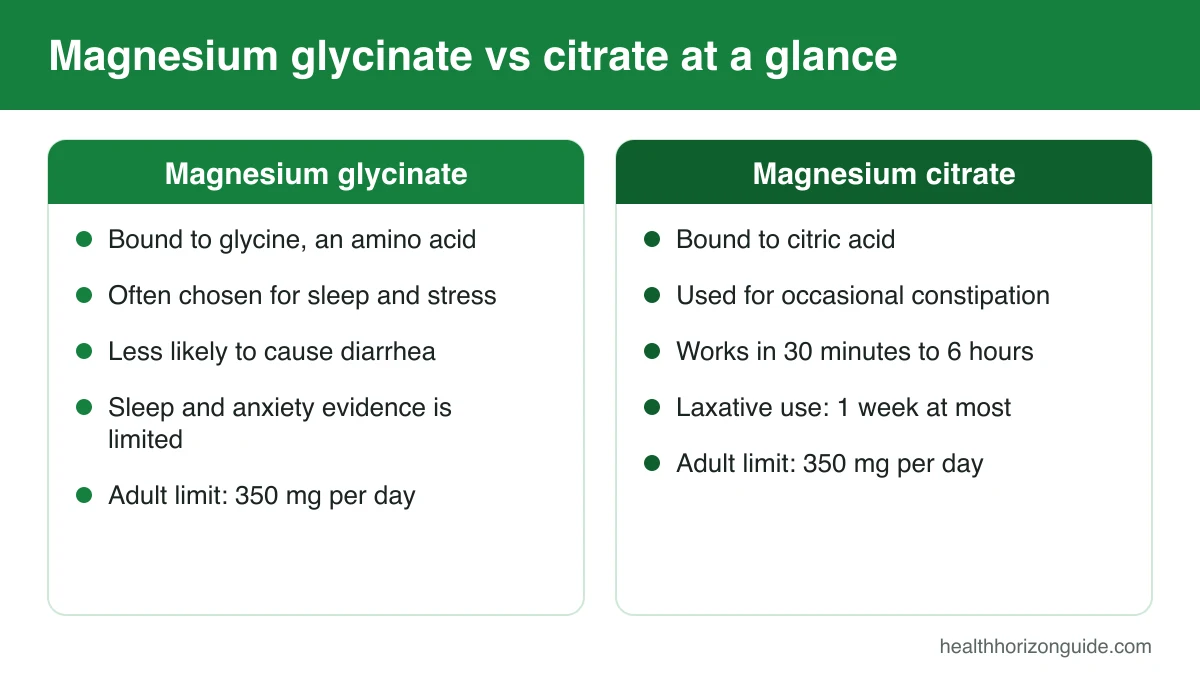
The difference between magnesium glycinate and magnesium citrate is the compound bound to the magnesium and the effect on the bowel. Magnesium glycinate is magnesium bound to glycine, an amino acid. Magnesium citrate is magnesium bound to citric acid, and MedlinePlus classes magnesium citrate as a saline laxative.
The table below compares magnesium glycinate and magnesium citrate on 6 points.
| Point of comparison | Magnesium glycinate | Magnesium citrate |
|---|---|---|
| Bound to | Glycine, an amino acid | Citric acid |
| Common use | Daily supplement, often chosen for sleep and stress | Occasional constipation on a short-term basis, and bowel emptying before a colonoscopy |
| Effect on the bowel | Less likely to cause diarrhea than magnesium citrate | Holds water in the stool, with a bowel movement 30 minutes to 6 hours after a laxative dose |
| Absorption | Described as well absorbed by a Cleveland Clinic dietitian, but not ranked in the NIH fact sheet | Listed by the NIH among the forms absorbed more completely than magnesium oxide |
| Evidence for sleep and anxiety | Limited, with few trials on this form | Limited |
| Adult upper limit from supplements | 350 mg of magnesium per day | 350 mg of magnesium per day |
Which is better absorbed, magnesium glycinate or citrate?
Neither magnesium glycinate nor magnesium citrate is proven to be better absorbed than the other. The NIH Office of Dietary Supplements (ODS) states that forms of magnesium that dissolve well in liquid are absorbed more completely.
Small studies cited by the ODS found that the aspartate, citrate, lactate and chloride forms are absorbed more completely than magnesium oxide and magnesium sulfate. The ODS comparison does not rank magnesium glycinate.
A Cleveland Clinic dietitian describes magnesium glycinate as a form that the body absorbs and uses well. The Supplement Facts panel declares the amount of elemental magnesium. That figure is the fair way to compare magnesium glycinate with magnesium citrate.
Magnesium glycinate vs citrate for sleep
Magnesium glycinate is the form most often suggested for sleep, but the evidence for any form of magnesium is limited. The National Center for Complementary and Integrative Health (NCCIH) states that very little research exists on magnesium for insomnia. No trial in the sources for this article compares magnesium glycinate with magnesium citrate for sleep.
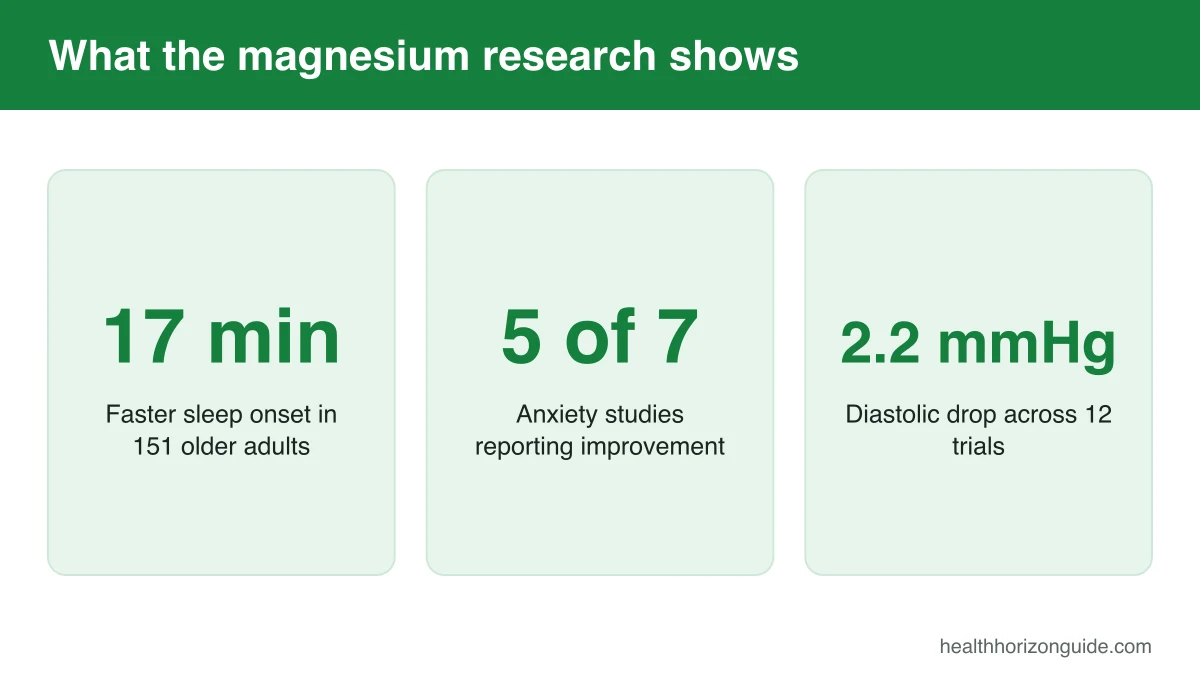
A 2021 review of 3 trials with 151 older adults found that people fell asleep about 17 minutes faster with magnesium than with placebo. The reviewers rated the evidence as low to very low quality. NCCIH adds that a 2022 review of 9 studies showed conflicting findings on sleep quality.
The choice of magnesium glycinate for sleep rests mostly on tolerance. Mayo Clinic Press reports that magnesium glycinate is less likely to cause diarrhea than magnesium citrate, which matters for a supplement taken at night.
Magnesium glycinate vs citrate for constipation
Magnesium citrate is the better choice for occasional constipation, and magnesium glycinate is not sold as a laxative. MedlinePlus states that magnesium citrate causes water to be retained with the stool, which softens the stool and increases the number of bowel movements. A bowel movement usually follows within 30 minutes to 6 hours.
Magnesium citrate is a short-term laxative. MedlinePlus advises against taking magnesium citrate for more than 1 week unless a doctor says so. A sudden change of bowel habits that lasts more than 2 weeks needs a doctor, not more magnesium citrate or magnesium glycinate. Our science-backed gut health guide covers everyday habits that support digestion.
Magnesium glycinate vs citrate for anxiety
Neither magnesium glycinate nor magnesium citrate is proven to treat anxiety. A 2024 systematic review of 15 trials found that 5 of 7 studies on anxiety reported an improvement in self-reported anxiety. Most studies were small, the doses and formulas differed, and some products contained other active ingredients.
The same review could not name a best form, because the vast majority of studies used magnesium oxide and not magnesium glycinate or magnesium citrate. An earlier 2017 systematic review called the evidence for mild anxiety suggestive but inconclusive.
Our guide on how to lower cortisol covers other approaches to stress. Anxiety that disrupts daily life needs a doctor or a mental health professional.
Magnesium glycinate vs citrate for blood pressure
Neither magnesium glycinate nor magnesium citrate is shown to lower blood pressure better than the other, and the effect of magnesium on blood pressure is small.
The NIH ODS describes one analysis of 12 trials in adults with hypertension that found a drop of about 2.2 mmHg in diastolic blood pressure. A second analysis of 22 studies found drops of 3 to 4 mmHg systolic and 2 to 3 mmHg diastolic.
Magnesium glycinate and magnesium citrate do not replace prescribed blood pressure medicine. A person with high blood pressure needs a doctor's advice before adding either supplement.
Magnesium glycinate and citrate vs oxide, malate and threonate
Magnesium oxide, magnesium malate and magnesium threonate differ from magnesium glycinate and magnesium citrate in absorption and in the amount of research behind each form. The 3 other common forms are described below.
- Magnesium oxide is absorbed less completely than magnesium citrate, according to the NIH ODS. Most sleep and anxiety trials used magnesium oxide.
- Magnesium malate is easily absorbed, but the Sleep Foundation finds no conclusive research on magnesium malate and sleep.
- Magnesium threonate has early research on memory and sleep quality. The Sleep Foundation notes that this research is still limited.
Side effects of magnesium glycinate and magnesium citrate
The side effects of magnesium glycinate and magnesium citrate are mainly digestive: diarrhea, nausea and abdominal cramping. The NIH ODS links these effects to high intakes of magnesium from supplements and medicines. Loose, watery or more frequent stools are the listed side effect of magnesium citrate on MedlinePlus.
Serious harm from magnesium is rare and tied to very large amounts. The ODS reports that toxicity has followed very large doses of magnesium-containing laxatives and antacids, typically more than 5,000 mg per day. Extremely high intakes can lead to irregular heartbeat and cardiac arrest.
Stomach upset is common with other minerals too, and our article on why iron pills make your stomach hurt explains a similar problem.
Two symptoms after magnesium citrate need a prompt call to a doctor: blood in the stool, and no bowel movement after use.
Who should not take magnesium glycinate or magnesium citrate?
People with kidney disease and people on certain medicines should not take magnesium glycinate or magnesium citrate without medical advice. Healthy kidneys remove excess magnesium in the urine. The risk of magnesium toxicity rises when kidney function is impaired, because the body cannot clear the excess.
The 3 groups below need a doctor or pharmacist to review magnesium glycinate or magnesium citrate first.
- People who have, or have ever had, kidney disease.
- People who take bisphosphonates, antibiotics, diuretics or proton pump inhibitors, which the NIH ODS lists as medicines that interact with magnesium.
- People who are pregnant or breastfeeding, or who follow a magnesium-restricted or sodium-restricted diet.
Timing matters with medicines. The ODS states that bisphosphonates and some antibiotics are poorly absorbed when taken too close to a magnesium supplement. MedlinePlus advises taking other medicines at least 2 hours before or 2 hours after magnesium citrate. Timing affects other minerals as well, as our guide to the best time to take iron supplements explains.
What is the upper limit for magnesium glycinate and magnesium citrate?
The upper limit for magnesium glycinate and magnesium citrate is 350 mg of supplemental magnesium per day for adults. The NIH ODS reports this figure as the Tolerable Upper Intake Level. The same 350 mg limit applies to children aged 9 to 18 and during pregnancy. The limit for children aged 4 to 8 is 110 mg.
The upper limit covers magnesium from supplements and medicines only. Magnesium found naturally in food and drinks has no upper limit. Magnesium glycinate and magnesium citrate count toward the same 350 mg total. NCCIH advises against going above the limit unless a health care provider recommends a higher amount.
How to choose between magnesium glycinate and magnesium citrate
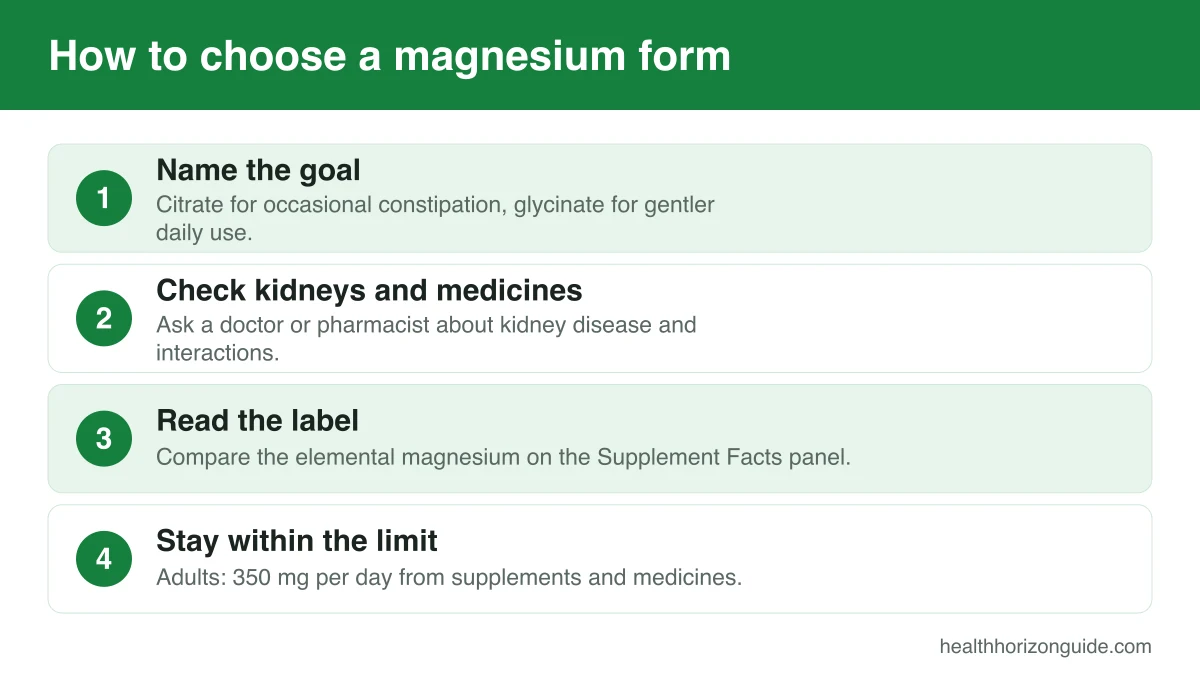
The choice between magnesium glycinate and magnesium citrate depends on the goal and on how the gut reacts. The 4 steps below summarise the points in this article.
- Name the goal. Occasional constipation points to magnesium citrate, and a gentler daily supplement points to magnesium glycinate.
- Check kidney health and current medicines with a doctor or pharmacist.
- Read the elemental magnesium figure on the Supplement Facts panel.
- Keep the daily total from all supplements and medicines within the 350 mg adult upper limit, unless a clinician advises otherwise.
Magnesium glycinate vs citrate: frequently asked questions
Can you take magnesium glycinate and citrate together?
Magnesium glycinate and magnesium citrate both count toward the same 350 mg adult upper limit for supplemental magnesium. A pharmacist or doctor can check the combined amount on both labels.
Does magnesium glycinate make you poop?
Magnesium glycinate is less likely to loosen stools than magnesium citrate, according to Mayo Clinic Press. High intakes of any magnesium supplement can still cause diarrhea.
Is magnesium citrate safe to take every day?
Magnesium citrate as a laxative is meant for short-term use only. MedlinePlus advises against use for more than 1 week unless a doctor directs it, and magnesium glycinate is not a substitute treatment for ongoing constipation.