Roseola vs Measles: How the Rashes Differ
Roseola rash appears after the fever breaks, while measles rash appears during a high fever. See the differences, seizure risk and when to call a doctor.
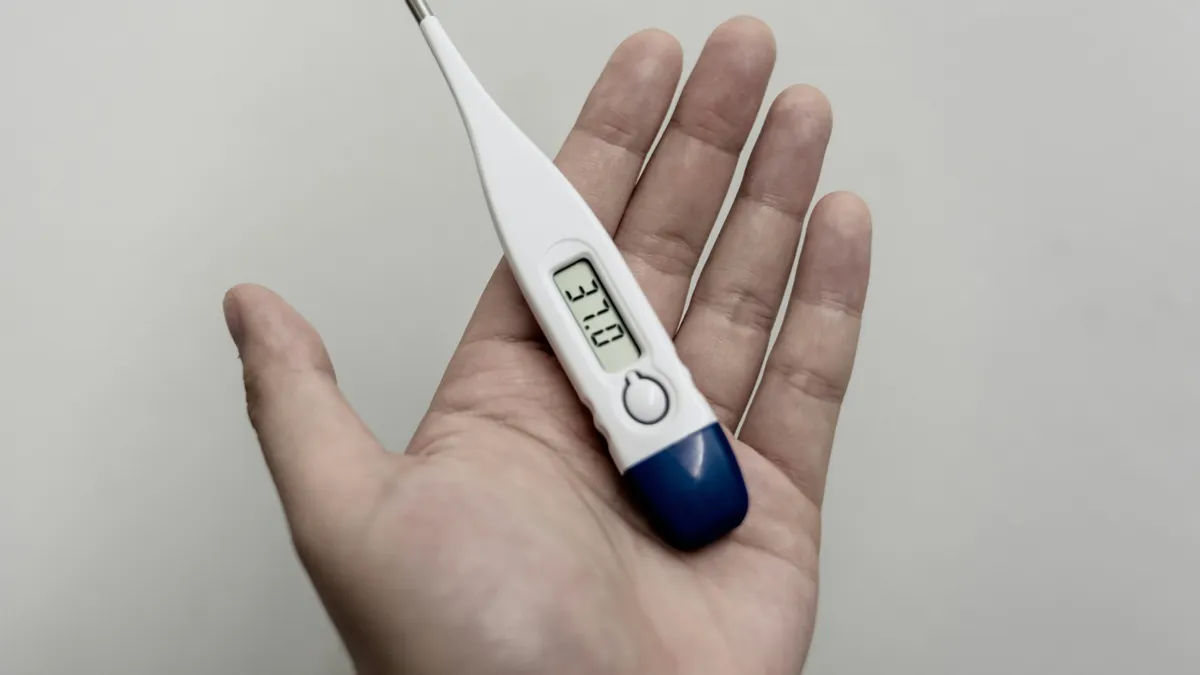
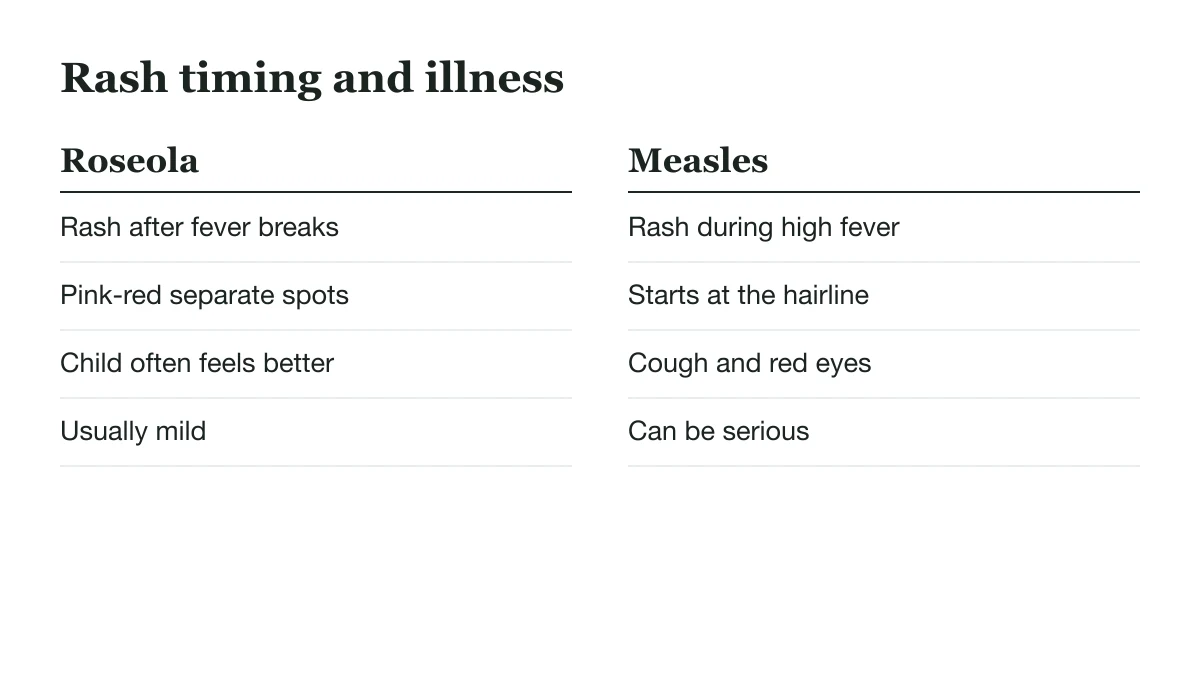
Roseola and measles both cause fever and a rash, but the order differs. In roseola the rash appears after the fever breaks, according to Cleveland Clinic, while in measles the rash appears while the fever is high, according to the CDC.
Measles is the more serious illness and spreads through the air. A child with a fever and rash who has not had two doses of the MMR vaccine, or who was exposed to a case, needs a call to a doctor right away.
In this article
- What is the difference between roseola and measles?
- How does the roseola rash look and when does it appear?
- How does the measles rash look and when does it appear?
- How can you tell roseola from measles at home?
- How contagious are roseola and measles?
- What are the complications of roseola and measles?
- When should you call a doctor or seek emergency care?
- What does roseola feel like for a family?
- Common questions about roseola and measles
What is the difference between roseola and measles?
The difference between roseola and measles lies in the timing of the rash, the other symptoms and the risk of complications. The next table sets out the main features from the sources cited.
| Feature | Roseola | Measles |
|---|---|---|
| Cause | Human herpesvirus 6, sometimes human herpesvirus 7 | Measles virus |
| Typical age | Babies and children under 2 | Any unvaccinated age; children under 5 and adults over 20 are at higher risk |
| Fever | Sudden, about 103 to 105 F (39.5 to 40.5 C), for about 3 to 4 days | High, can exceed 104 F, and may spike again when the rash appears |
| Other symptoms | Cold-like signs, loss of appetite, swollen eyelids, swollen neck glands | Cough, runny nose, red watery eyes, Koplik spots in the mouth |
| Rash timing | Within 24 hours after the fever breaks | 3 to 5 days after symptoms start, during the fever |
| Rash look | Pink-red spots, often separate, starting on the chest, back and tummy | Flat red spots starting at the hairline, spreading down, often joining together |
| Rash duration | About 2 to 4 days | Spreads from head to feet over several days |
| Seriousness | Usually mild | Pneumonia and brain swelling can occur |
Roseola figures are from Cleveland Clinic, and measles figures are from the CDC.
How does the roseola rash look and when does it appear?
The roseola rash appears after the fever breaks and looks like pink-red spots. Cleveland Clinic states that the rash shows up within 24 hours after the fever ends and lasts about 2 to 4 days.
The rash does not itch or hurt and does not cause the skin to flake or peel. The NHS notes that it starts on the chest, tummy and back, spreads to the neck and arms, and is harder to see on brown or black skin.
The cold-like phase before the rash lasts 3 to 7 days, according to the NHS. Roseola infection mostly affects children under 2, and nearly all children have had it by their second birthday.
How does the measles rash look and when does it appear?
The measles rash starts as flat red spots at the hairline and spreads downward, according to the CDC. The rash reaches the neck, trunk, arms, legs and feet, and the spots may run together.
Measles symptoms begin 7 to 14 days after exposure with a high fever, cough, runny nose and red, watery eyes. Tiny white Koplik spots may appear inside the mouth 2 to 3 days later, and the rash follows 3 to 5 days after symptoms begin.
The fever can spike again above 104 F when the rash appears. The measles symptoms guide on this site covers the full timeline.
Do both illnesses look different on dark skin?
Both rashes can be harder to see on dark skin. The NHS states that the roseola rash is harder to see on brown or black skin, so the fever pattern and other symptoms help more than color alone.
The CDC does not describe how the measles rash looks on darker skin, so cough, red eyes and the fever pattern matter more than color. A clinician should assess any fever with a rash when the color is unclear.
How can you tell roseola from measles at home?
You can tell roseola from measles at home only by comparing the order of events, and a doctor confirms the cause. A child who feels better when the rash appears fits roseola, and a child who feels worse at that point fits measles better.
Parents can work through the following questions in order.
- Did the fever end before the rash started? That order points toward roseola.
- Does the child also have a cough, runny nose and red watery eyes? That cluster points toward measles.
- Has the child had two doses of MMR? Two doses are about 97 percent effective against measles, and one dose about 93 percent, according to the CDC.
- Was the child near someone with measles, or on recent international travel? A yes answer calls for a doctor to be contacted at once.
That sequence is a guide, not a diagnosis. Other viral rashes also follow fever, which is why a pediatrician examines the child.
How contagious are roseola and measles?
Measles is far more contagious than roseola, and its spread runs through the air. The CDC states that people can be infected by entering a room up to 2 hours after a person with measles left it.
The CDC clinical page says patients are contagious from 4 days before to 4 days after the rash appears. Roseola is contagious from the start of the fever until 24 hours after it ends, according to Cleveland Clinic.
The NHS says a child with roseola can return to nursery once the temperature has passed and the child feels well, without waiting for the rash to disappear.
What are the complications of roseola and measles?
The complications of roseola and measles differ greatly in how serious they are. Roseola usually passes without lasting harm, while measles can cause pneumonia and brain swelling.
The CDC reports ear infections in about 1 in 10 measles cases, and about 1 in 5 unvaccinated U.S. cases leads to hospitalization. Pneumonia is the leading cause of measles death in young children.
Roseola has one familiar complication. A febrile seizure affects about 10 to 15 percent of children aged 6 to 18 months with roseola, according to Cleveland Clinic.
What should you do during a febrile seizure?
During a febrile seizure, place the child on a soft surface on their side and call the child's doctor. The American Academy of Pediatrics' HealthyChildren site advises that nothing goes in the mouth.
Call 911 or your local emergency number if the seizure lasts 5 minutes or more. Cleveland Clinic advises calling 911 for a first-time febrile seizure.
Most febrile seizures last less than one or two minutes and are harmless to the brain, according to the same HealthyChildren page. Watching one is frightening for a parent, and a calm second adult helps.
When should you call a doctor or seek emergency care?
You should call a doctor when a baby or child has a fever with a rash and is unwell. A baby under 3 months with a temperature of 100.4 F (38 C) or higher needs a call right away.
Cleveland Clinic lists these reasons to call a pediatrician for roseola.
- Fever of 102 F (39 C) lasting 24 hours.
- A child who is unwell or not acting like themself after the fever ends.
- An itchy or painful rash.
- Signs of dehydration.
- A febrile seizure in a child who has had one before.
Seek urgent care or call 911 or your local emergency number for difficulty breathing, a seizure lasting 5 minutes or more, or signs of brain infection. The NHS adds blue, grey or blotchy skin, a rash that does not fade under a glass, a very sleepy child and a weak high-pitched cry.
Fluid questions often arise in feverish babies, and the guide on when babies can have water and juice covers the age rules. Fever with vomiting can dry a baby out quickly, and the page on baby spit-up vs vomit lists the signs of dehydration.
Should you call before visiting the clinic if measles is possible?
Yes, call before visiting the clinic if measles is possible. A call lets the office plan so that other patients, including babies too young for vaccine, are not exposed in the waiting room.
The CDC advises calling a doctor or hospital right away when measles is suspected, and says to have someone phone ahead before arriving at an emergency room. The office may offer testing outside the building or ask you to wait in the car.
What does roseola feel like for a family?
Roseola is stressful because the fever is high and sudden, and the rash appears only when the child is already recovering. Parents often describe days of worry about a fever that peaks and then a rash that arrives once the child seems better.
Fussiness and poor sleep often come with the fever. Readers can find comfort strategies in why a baby cries for no reason.
Common questions about roseola and measles
Is roseola a type of measles?
No, roseola is not a type of measles. Roseola comes from human herpesvirus 6 or 7, while measles comes from the measles virus.
Can a vaccinated child get measles?
Yes, though rarely. Two doses of MMR are about 97 percent effective, so a small share of vaccinated people can still be infected.
Does roseola need antibiotics?
No, antibiotics do not work against viruses. Cleveland Clinic states that care is mostly rest and fever-reducing medicine as advised by a pediatrician.
Action checklist
Fever and rash checks
Use these steps when a child has a fever followed by a rash.
0 of 8 done