
How Many Steps a Day Should I Walk?
Most adults should walk about 7,000 steps a day. See what large studies found, where 10,000 steps came from, targets by age, and how steps convert to miles.

Most adults should walk about 7,000 steps a day for good health. A 2025 analysis in The Lancet Public Health linked 7,000 daily steps with a 47% lower risk of death from any cause, compared with 2,000 steps. Adults aged 60 and over gain most of the benefit at 6,000 to 8,000 steps a day.
Action checklist
Daily steps action checklist
Use these actions to set a realistic daily step goal and build up to it gradually.
0 of 10 done
In this article
- How many steps a day should I walk?
- What counts as an active number of steps a day?
- How many steps a day is good for health?
- Where did 10,000 steps a day come from?
- How many steps a day should older adults walk?
- Does pace matter for steps a day?
- What else shapes a daily step goal?
- How many steps a day to lose weight?
- How many miles and minutes are daily steps?
- How to add more steps a day
- When does walking more steps a day need a doctor?
- Frequently asked questions about steps a day
How many steps a day should I walk?
The number of steps a day most adults should walk is about 7,000, based on the largest review of step-count research so far. No official body sets a daily step target. The US guidelines ask for 150 minutes of moderate activity a week instead. The table below shows 4 daily step targets and the research finding behind each one.
| Steps a day | Group studied | Research finding |
|---|---|---|
| About 4,400 | Older women, mean age 72 | Lower death rate than about 2,700 steps a day |
| 6,000 to 8,000 | Adults aged 60 and over | Risk of early death levels off in this range |
| About 7,000 | Adults in general | 47% lower risk of death than 2,000 steps a day |
| 8,000 to 10,000 | Adults under 60 | Risk of early death levels off in this range |
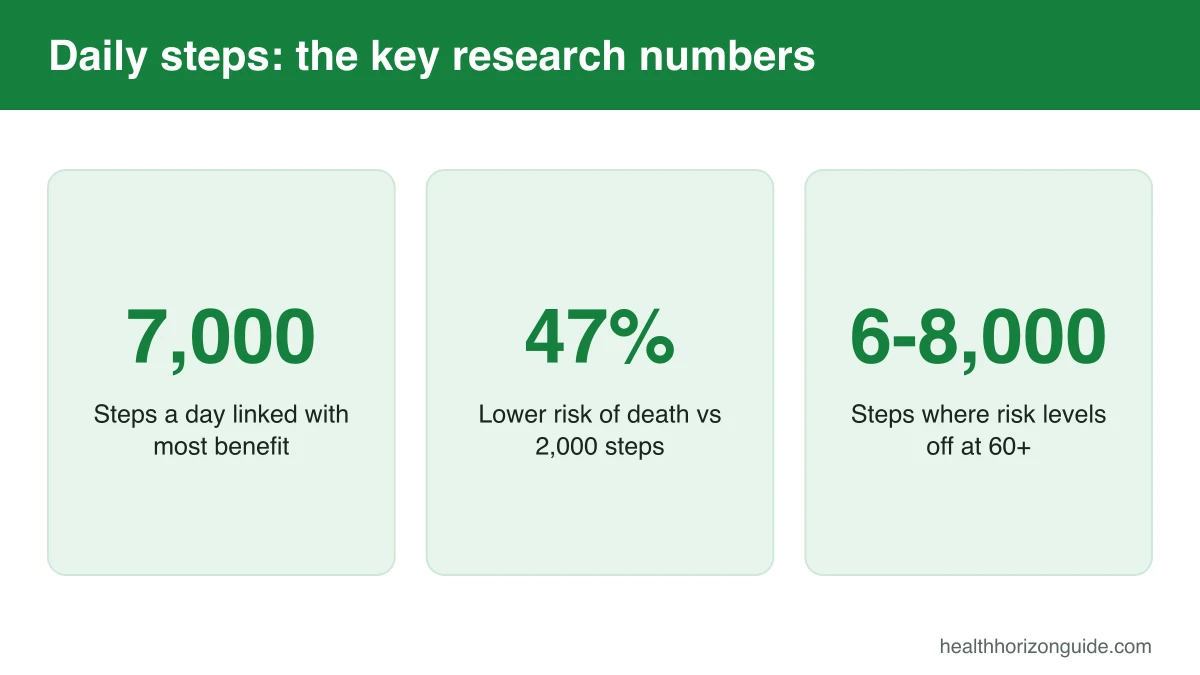
These daily step figures come from observational studies. The studies show a link between steps a day and health, and they cannot prove that walking alone caused the difference.
What counts as an active number of steps a day?
An active number of steps a day is 10,000 or more on the step index that researchers use to sort adults into activity levels. The index was proposed in a 2004 paper in Sports Medicine for healthy adults. The table below lists the 5 step-count activity categories.
| Steps a day | Activity category |
|---|---|
| Fewer than 5,000 | Sedentary |
| 5,000 to 7,499 | Low active |
| 7,500 to 9,999 | Somewhat active |
| 10,000 to 12,499 | Active |
| 12,500 or more | Highly active |
These categories describe activity levels, and they are not health targets. Most American adults walk about 6,000 steps a day, according to Cleveland Clinic, which places the average adult in the low active category.
How many steps a day is good for health?
A good number of steps a day for health is around 7,000, with clear gains starting well below that figure. The 2025 Lancet Public Health meta-analysis reviewed 57 studies and pooled 31 of them, covering more than 160,000 adults.
The review compared 7,000 steps a day with 2,000 steps a day. The 5 reported differences besides the death rate are listed below.
- Cardiovascular disease: 25% lower risk.
- Type 2 diabetes: 14% lower risk.
- Dementia: 38% lower risk.
- Depressive symptoms: 22% lower risk.
- Falls: 28% lower risk.
The risk curve for several outcomes bent at around 5,000 to 7,000 steps a day. Heart disease benefits kept rising beyond 7,000 steps, while the gains for most other conditions levelled off.
The authors listed limits to this evidence on daily steps. Few studies were available for most outcomes, and the certainty was lower for the dementia, cancer and falls results. Residual confounding remains possible, since healthier people tend to walk more.
Where did 10,000 steps a day come from?
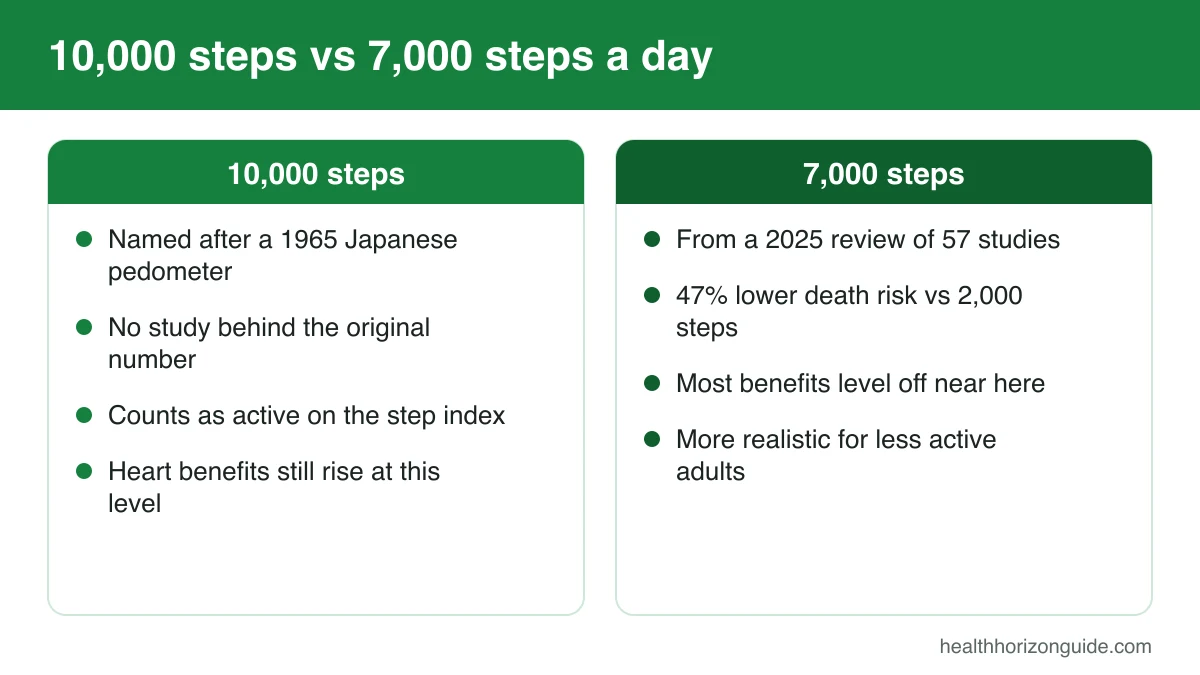
The 10,000 steps a day target came from a Japanese pedometer sold in 1965, not from a health study. The Yamasa Clock company named the device Manpo-kei, which translates as 10,000 steps meter. Harvard epidemiologist I-Min Lee traced the history and reported that no studies had tested 10,000 steps when the device was developed.
Later research shows that 10,000 steps a day is a healthy level and is not a required minimum. The 2025 review describes 7,000 steps as a more realistic goal for people who are less active.
How many steps a day should older adults walk?
Older adults should walk about 6,000 to 8,000 steps a day, according to a 2022 meta-analysis of 15 studies with nearly 50,000 people. The risk of early death stopped falling beyond that range for adults aged 60 and over. The same curve levelled off at 8,000 to 10,000 steps a day for adults under 60.
Smaller daily step counts still matter in later life. A 2019 study in JAMA Internal Medicine followed 16,741 women with a mean age of 72. Women who took about 4,400 steps a day had lower death rates than women who took about 2,700, and the benefit levelled off at about 7,500 steps.
Does pace matter for steps a day?
Pace matters less than the total number of steps a day in the studies that measured both. A National Cancer Institute study of about 4,800 US adults aged 40 and over found 51% lower mortality at 8,000 steps a day than at 4,000 steps.
Step intensity showed no link with mortality once total steps were counted. The 2022 meta-analysis and the 2019 study of older women reported similar results.
Brisk walking still counts toward the weekly activity guideline of 150 minutes. The NHS walking for health guide describes a brisk walk as about 3 miles an hour. A walker at brisk pace can still talk and cannot sing. Laboratory studies use about 100 steps a minute as a marker of moderate intensity in adults aged 21 to 60.
What else shapes a daily step goal?
A daily step goal also depends on body weight aims, distance, time and health conditions. The sections below cover weight loss, step conversions, practical ways to add steps a day and the signs that need a doctor.
How many steps a day to lose weight?
No fixed number of steps a day guarantees weight loss, because weight loss depends on calorie balance. Most weight loss comes from eating fewer calories, according to the CDC guidance on physical activity and weight. Walking raises the number of calories the body uses, and activity combined with lower calorie intake creates a calorie deficit.
The CDC states that the activity needed for a healthy weight varies greatly from person to person. A 30-minute walk covers about 3,000 to 4,000 steps and burns about 200 calories, according to Cleveland Clinic. Readers can estimate their own energy needs with our daily calorie calculator and check their weight category with the BMI calculator.
How many miles and minutes are daily steps?
Daily steps convert to distance at roughly 2,000 to 2,500 walking steps per mile, depending on step length. Cleveland Clinic describes 10,000 steps as almost five miles. The table below gives estimated miles and brisk walking minutes for 4 step counts a day, using 100 steps a minute.
| Steps a day | Estimated miles | Minutes at 100 steps a minute |
|---|---|---|
| 5,000 | 2 to 2.5 | 50 |
| 7,000 | 2.8 to 3.5 | 70 |
| 10,000 | 4 to 5 | 100 |
| 12,500 | 5 to 6.25 | 125 |
These conversions are estimates. Taller people take longer steps and cover a mile in fewer steps. The minutes include every step of the day, so a dedicated walk needs less time than the table suggests.
How to add more steps a day
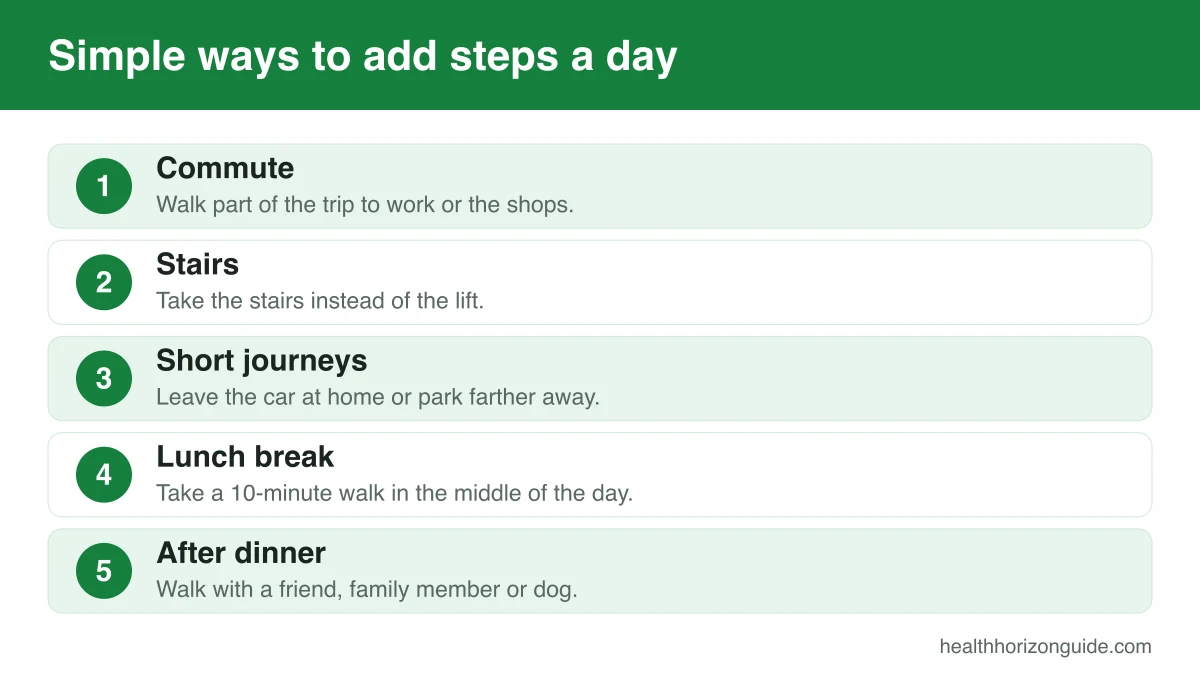
Adding more steps a day works best through small walks built into the existing routine. The NHS advises people who are not very active to increase walking distance gradually. The 6 ways to add daily steps below come from NHS and Cleveland Clinic guidance.
- Walk part of the commute or the trip to the shops.
- Take the stairs instead of the lift.
- Leave the car at home for short journeys, or park farther from the entrance.
- Take a 10-minute walk during the lunch break.
- Walk with a friend, family member or dog after dinner.
- Listen to music or a podcast to keep a steady pace.
Desk workers often struggle to reach a daily step goal after a full day of sitting. Short walking breaks add steps and interrupt long sitting spells, which our guide to lower back pain when sitting covers in more detail.
Do steps a day help blood sugar?
Steps a day are linked with a lower risk of type 2 diabetes. The 2025 review reported a 14% lower risk at 7,000 steps a day than at 2,000 steps. Our article on whether prediabetes can be reversed explains how activity fits with other changes.
When does walking more steps a day need a doctor?
Walking more steps a day needs a doctor first when a medical condition is not well controlled or exercise safety is uncertain, according to the American Academy of Family Physicians. Most adults can raise daily steps safely. The 5 symptoms that mean stopping the walk and speaking to a doctor are listed below.
- Chest pain or pressure.
- Trouble breathing.
- Lightheadedness or dizziness.
- A cold sweat or nausea.
- Severe joint pain or cramps.
Severe chest pressure that lasts more than a few minutes during a walk needs emergency care.
Frequently asked questions about steps a day
Is 5,000 steps a day enough?
5,000 steps a day is the lower edge of the low active category and brings benefit compared with 2,000 steps. The 2025 review found that the risk curve bends at 5,000 to 7,000 steps a day.
Is 10,000 steps a day necessary?
No, 10,000 steps a day is not necessary for most health benefits. Research links about 7,000 steps a day with most of the gain, although heart benefits continue to rise above that level.
Do steps a day have to come from one walk?
No, steps a day can be spread across several short walks. The NHS states that a brisk 10-minute daily walk counts toward the 150 minutes of weekly exercise.
How many steps a day does a 30-minute walk add?
A 30-minute walk adds about 3,000 to 4,000 steps a day, according to Cleveland Clinic.