Lower Back Pain When Sitting: Causes, Relief and Red Flags
Lower back pain when sitting often comes from disc and muscle load in a long, still posture. See the likely causes, what helps and the red flags.
Lower back pain when sitting usually comes from sustained load on the discs, muscles and joints of the lumbar spine during a long, still posture. Disc-related pain and sciatica tend to feel worse in a chair, while spinal stenosis and spinal arthritis tend to feel better. Most episodes improve within a few weeks with movement breaks, walking and small changes to how a person sits.
Action checklist
Actions for Lower Back Pain When Sitting
Use these steps from the article to ease lower back pain when sitting and to spot the signs that need a doctor.
0 of 10 done
In this article
- Why does my lower back hurt when I sit?
- Lower back pain when sitting but not standing: which conditions fit?
- How to sit with lower back pain: what helps?
- How long does lower back pain from sitting last?
- When to see a chiropractor, physical therapist or doctor
- Red flags with lower back pain
- Lower back pain when sitting: common questions
Why does my lower back hurt when I sit?
The lower back hurts during sitting because a long static posture keeps load on the lumbar discs and the back muscles. Studies that measured disc pressure found the pressure lowest when lying down and higher when sitting than when standing, according to Harvard Health. People often report tighter, more painful back muscles after prolonged sitting, although Harvard Health adds that no medical study proves sitting causes more muscle spasm. Deconditioning plays a part in lower back pain when sitting. The National Institute of Arthritis and Musculoskeletal and Skin Diseases lists weak back and abdominal muscles as a risk factor for back pain, together with desk work done with poor posture or in an uncomfortable chair.
Does sitting cause lower back pain?
Research does not show that sitting alone causes lower back pain. A systematic review of 10 studies with objectively measured sitting time found that all but one study linked prolonged sitting to an immediate rise in reported low back pain. The same review concluded that no link between sitting and clinical episodes of low back pain could be drawn. A 2021 meta-analysis found an association between self-reported workplace sitting and low back pain in cross-sectional studies. The authors called the prospective evidence inconclusive and stated that reverse causality could not be ruled out. Intervention studies in the same analysis linked less workplace sitting to less pain. The plain reading is that sitting can aggravate a sore lower back in the moment, while the evidence that sitting creates the underlying problem is weak.
Lower back pain when sitting but not standing: which conditions fit?
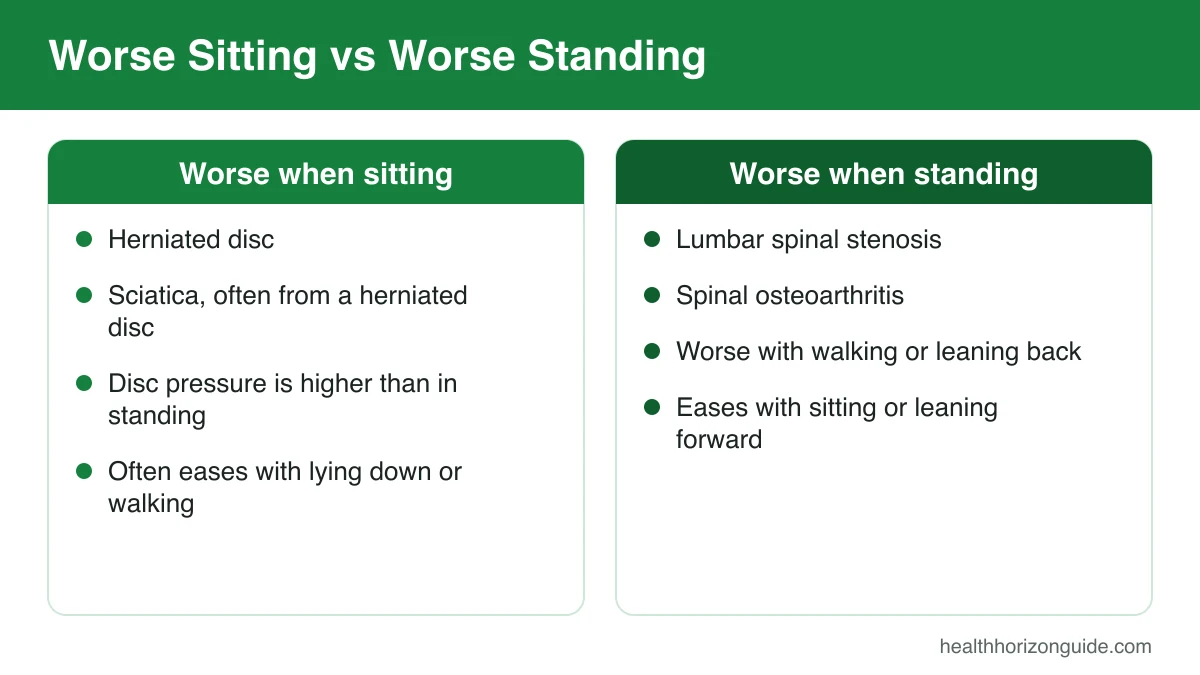
Lower back pain when sitting but not standing points more toward a disc problem or sciatica than toward spinal stenosis, based on the patterns described by Harvard Health and the MSD Manual. The table below compares the conditions that sources link to lower back pain that is worse with sitting against the conditions that are worse with standing or walking.
| Condition | Typical features per sources | Tends to feel worse with | Tends to feel better with |
|---|---|---|---|
| Herniated disc | Pain that often travels down a leg, with numbness or weakness | Sitting, coughing, sneezing, straining, leaning forward | Lying down, then standing and walking |
| Sciatica | Burning pain in the lower back, leg and sometimes foot, often from a herniated disc pressing on a nerve | Sitting | Lying down, then standing and walking |
| Lumbar spinal stenosis | Lower back pain that may travel down one or both legs, usually in older adults | Walking, leaning back | Sitting, leaning forward |
| Spinal osteoarthritis (facet joint arthritis) | Pain over a specific part of the spine, usually in older adults | Standing | Sitting |
| Muscle strain or sprain | Pain on one or both sides of the spine that starts with lifting, bending or twisting | Movement | Rest |
The MSD Manual notes that these features are typical and not always present, so the table cannot diagnose lower back pain when sitting. Readers whose pain eases in a chair and returns with walking can read our guide to chiropractic care for spinal stenosis.
Lower back pain when standing up from sitting
Lower back pain when standing up from sitting is most often described as muscle tightness after a long, still posture. The sources we reviewed say little about this exact moment. Harvard Health reports that back muscles often feel tighter after prolonged sitting, and the MSD Manual states that strain pain worsens with movement and eases with rest. Lower back pain when sitting down and getting up deserves an assessment when the pain travels down a leg or comes with numbness or weakness, since those features match a herniated disc in the MSD Manual table.
How to sit with lower back pain: what helps?
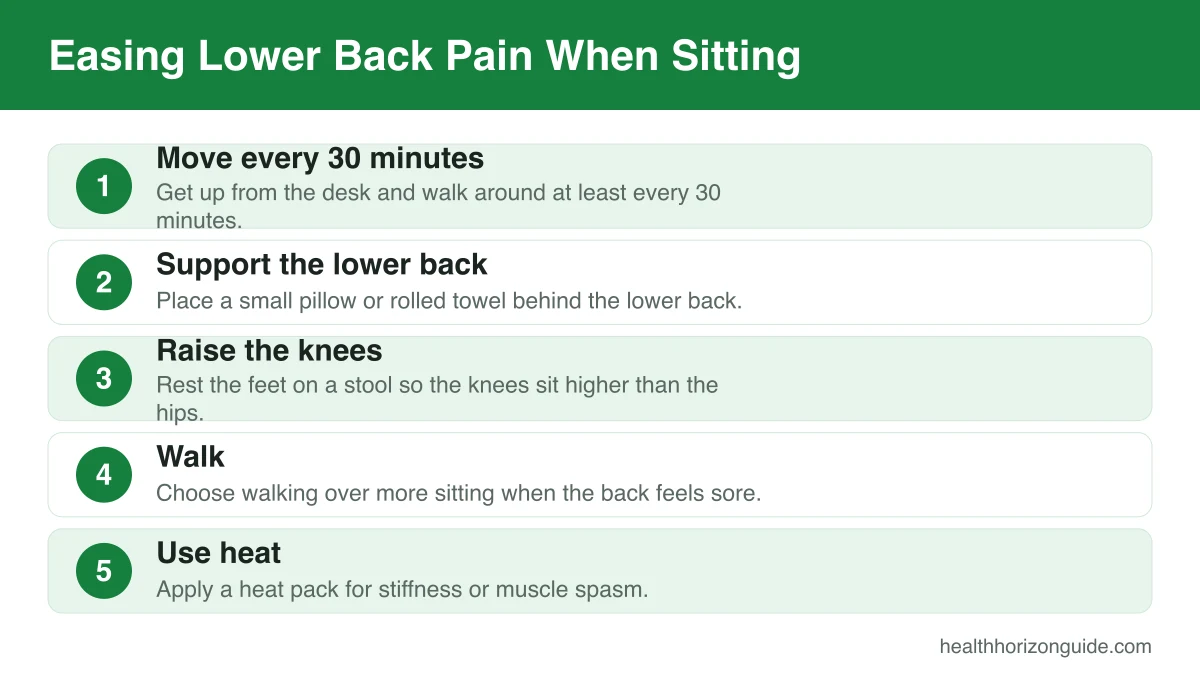
Sitting with lower back pain becomes easier with shorter sitting periods and more movement rather than with one perfect posture. The 6 measures that sources describe for lower back pain when sitting are listed below.
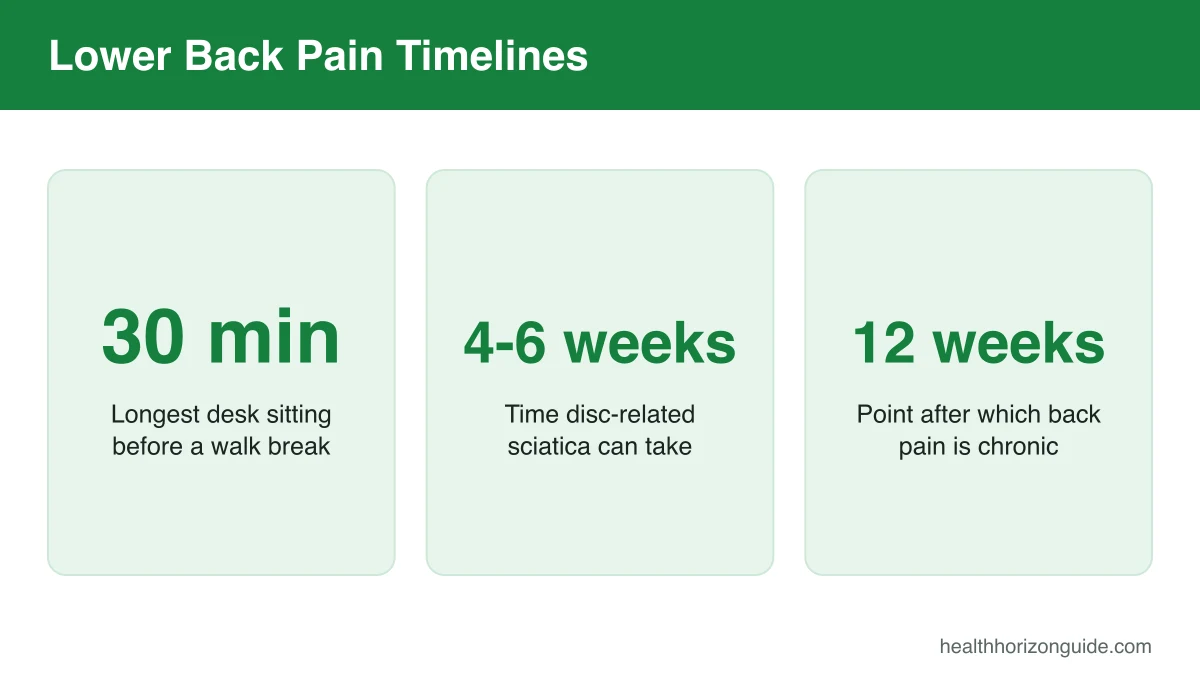
- Get up at least every 30 minutes and walk around when working at a desk, as Harvard Health advises.
- Place a small pillow or rolled towel behind the lower back as lumbar support during long periods of sitting, as MedlinePlus advises.
- Use a chair with a straight back, an adjustable seat and backrest, and armrests.
- Change position by resting the feet on a stool so that the knees sit higher than the hips.
- Choose walking over more sitting, since Harvard Health states that walking is better than sitting for a sore back.
- Apply a heat pack for stiffness or muscle spasm, which the NHS lists as a self-care step.
The NHS advises people with back pain to keep moving and to avoid long periods in bed. Chair height, screen position and desk layout are covered in our guide on how to fix posture while sitting at a desk, so this article on lower back pain when sitting does not repeat them.
Exercises for lower back pain from sitting
Exercises for lower back pain from sitting include knee-to-chest stretches, pelvic tilts and bridges, which Harvard Health describes for use with a doctor's approval. MedlinePlus warns that stretching or strengthening started too soon can worsen pain, and states that a physical therapist can advise on timing. The NHS tells readers to stop an exercise when the pain gets worse. Readers with leg pain can find movement options in our guide to sciatica stretches.
Lower back pain when sitting in a car
Lower back pain when sitting in a car is managed with lower back support and a stop every hour, according to MedlinePlus. Harvard Health names long car rides as a typical trigger and states that sitting pressure, rather than bumpy roads, is frequently the cause. The 3 car measures that MedlinePlus gives are listed below.
- Place a small pillow or rolled towel behind the lower back before a long drive.
- Stop and walk around every hour on a long-distance trip.
- Avoid lifting heavy objects just after a long ride.
How long does lower back pain from sitting last?
Lower back pain from sitting usually lasts a few weeks at most. The NHS states that back pain often improves within a few weeks, although the pain can last longer or come back. NIAMS classes back pain as acute when the pain lasts a few days to a few weeks, subacute at 4 to 12 weeks, and chronic beyond 12 weeks. Sciatica from a herniated disc can take four to six weeks to improve, according to Harvard Health.
When to see a chiropractor, physical therapist or doctor
A doctor is the right first contact when lower back pain when sitting has not improved after a few weeks of self-care, which is the point named by the NHS, NIAMS and Harvard Health. The roles of the 3 professionals differ.
- A doctor examines the back and decides whether a test such as an X-ray or MRI is needed.
- A physical therapist builds an exercise plan and advises when stretching and strengthening can begin.
- A chiropractor provides spinal manipulation, a hands-on treatment that osteopathic physicians and physical therapists also use.
The evidence for spinal manipulation is modest. The National Center for Complementary and Integrative Health reports moderate-quality evidence of a modest improvement in acute low back pain, similar to the improvement from anti-inflammatory drugs. The American College of Physicians lists spinal manipulation as one option, with evidence of low strength, according to the same source. Side effects such as temporary soreness, stiffness or headache usually resolve within 24 hours, and serious events are very rare. Our guide to seeing a chiropractor for lower back pain explains what a visit involves.
Red flags with lower back pain
Red flags with lower back pain are symptoms that need urgent medical care rather than a better chair. The 7 red flags named by the NHS, NIAMS and the MSD Manual are listed below.
- Numbness in the groin, or loss of feeling around the genitals or anus.
- Changes in bladder or bowel control, including difficulty passing urine.
- Weakness, numbness or tingling in the legs.
- Fever, or feeling hot, shivery and unwell.
- Pain that is worse at night or does not ease with rest.
- Unexplained weight loss.
- Back pain that starts after a fall or serious accident.
The NHS tells people with groin numbness, bladder or bowel changes, or symptoms in both legs to call emergency services or go to an emergency department. Constant pain that worsens regardless of position or activity is a feature the MSD Manual lists for cancer and spinal infection, which differs from lower back pain when sitting that eases on standing.
Lower back pain when sitting: common questions
Is it better to sit or stand with lower back pain?
Neither sitting nor standing for long periods is better than changing position often. Harvard Health advises against prolonged sitting, and MedlinePlus advises against prolonged standing for people with lower back pain.
Why does my lower back hurt when sitting for long periods?
The lower back hurts when sitting for long periods because disc pressure is higher in sitting than in standing and the back muscles stay in one position. Harvard Health reports that lower back pain when sitting often eases with lying down and then walking.
Is tailbone pain the same as lower back pain when sitting?
Tailbone pain is a separate topic from lower back pain when sitting, since tailbone pain is felt at the very base of the spine. Our guide to tailbone pain covers that area.