Chiropractor for Babies: Does It Work and Is It Safe?
Reliable evidence does not show that a chiropractor for babies helps colic, reflux, sleep or torticollis. See the research, the risks and safer first steps.
Reliable evidence does not show that a chiropractor for babies improves colic, reflux, sleep or torticollis. A paediatrician or family doctor should be the first contact for a crying, unsettled or unwell baby, since those symptoms sometimes point to a medical problem. The Chiropractic Board of Australia advises chiropractors not to use spinal manipulation on children under 2, and the NHS states that there is very little evidence that spinal manipulation helps colic.
Action checklist
Before booking a chiropractor for a baby
Work through these steps with a paediatrician or family doctor before paying for infant chiropractic sessions.
0 of 9 done
In this article
What is a chiropractor for babies?
A chiropractor for babies is a chiropractor who offers hands-on treatment to infants, usually for crying, feeding, sleep or head-turning concerns. A chiropractor is not a medical doctor. A chiropractic visit does not replace the routine health checks that a baby has with a paediatrician, family doctor or health visitor.
Why do parents take a baby to a chiropractor?
Parents take a baby to a chiropractor mainly because the baby cries for hours, struggles with feeds or sleeps poorly, and waiting for the problem to pass feels unbearable. Parent forums show exhausted parents asking whether a session is worth the money and whether the treatment is safe for a newborn. The 4 concerns that parents most often bring to a chiropractor for babies are listed below.
- Colic, meaning long spells of crying with no obvious cause.
- Reflux, meaning milk that comes back up during or after feeds.
- Torticollis, meaning a head tilt or a strong preference for turning the head one way.
- Poor sleep and general unsettled behaviour.
What techniques does a chiropractor use on a newborn or infant?
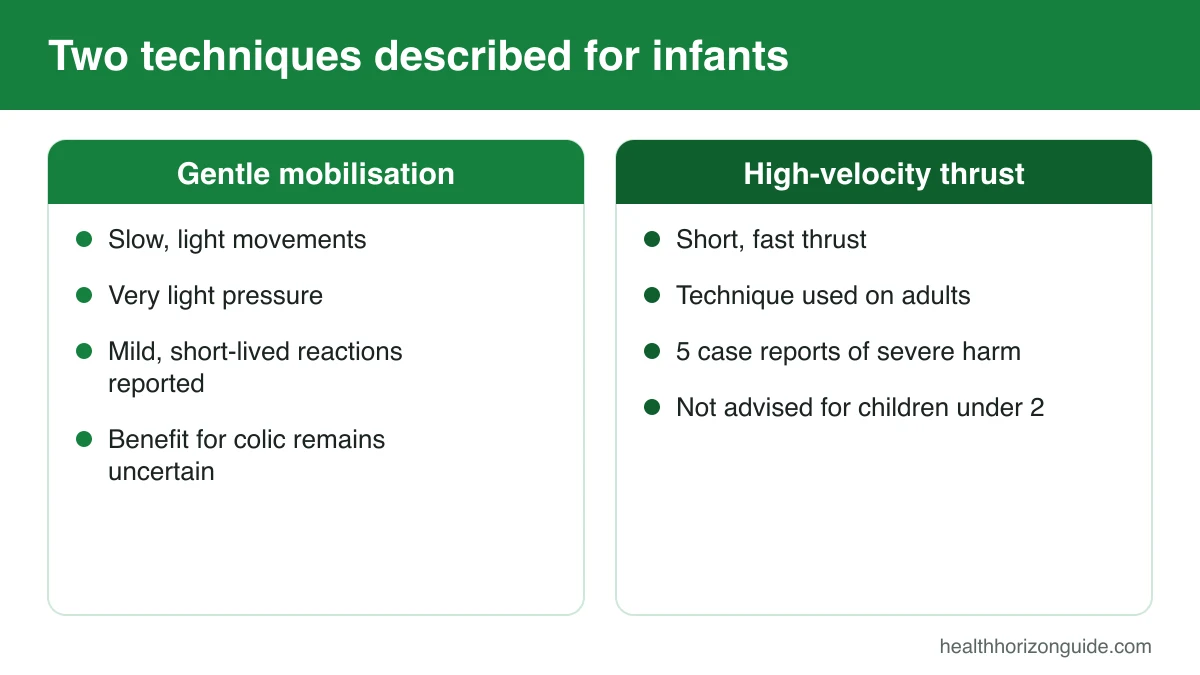
Techniques that a chiropractor uses on a newborn are described as gentle, low-velocity mobilisations with very light pressure, not the quick thrusts used on adults. A 2019 systematic review in PLoS One separated these two approaches. Gentle mobilisation uses slow, light movements, and high-velocity manipulation uses a short, fast thrust. The same review linked the severe harms reported in infants to the high-velocity type.
Does chiropractic care for babies work?
Chiropractic care for babies has no reliable evidence of benefit for colic, reflux, torticollis or sleep. The research consists of small trials that rely on parent reports. The table below summarises what research shows about a chiropractor for babies by condition.
| Condition | What the research shows | Strength of evidence |
|---|---|---|
| Colic | Six small trials suggested less crying, but the effect was not statistically significant in trials where parents did not know the treatment. | Weak and inconclusive |
| Reflux | We found no controlled trial showing a benefit. | Absent |
| Torticollis | A systematic review rated the evidence as very low quality and the effect as uncertain. | Very weak |
| Sleep | A 2021 trial of 185 infants found no effect on hours of sleep. | No benefit shown |
Chiropractor for colic
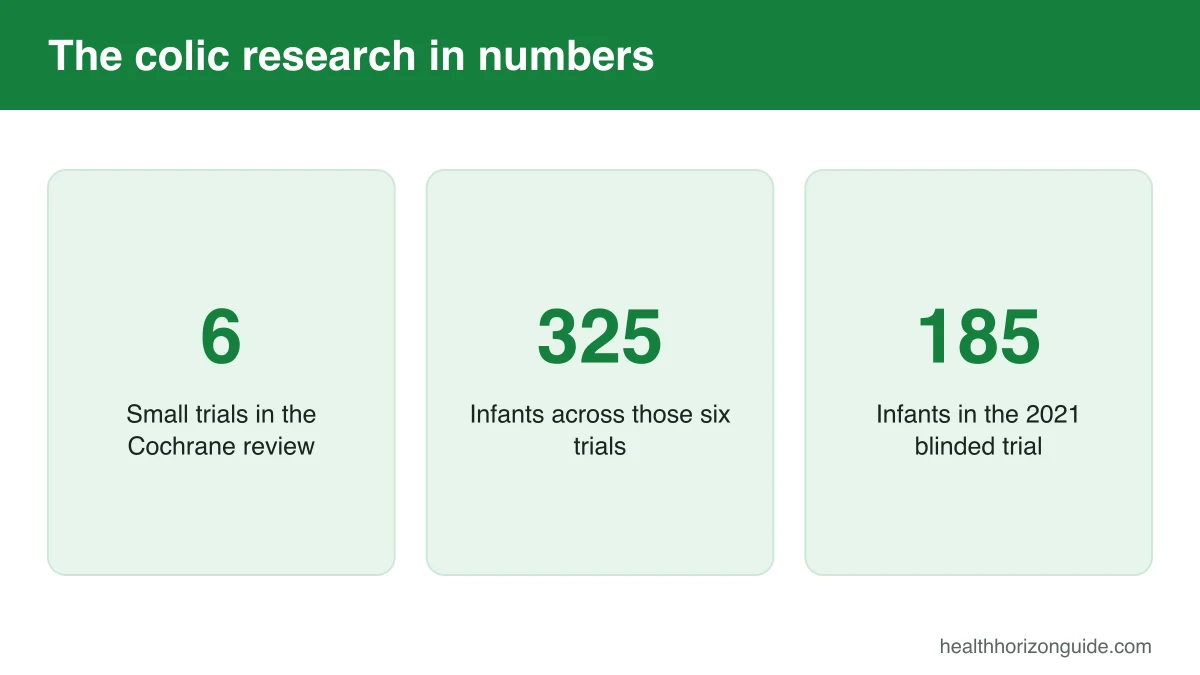
A chiropractor for colic is not supported by reliable evidence. The Cochrane review of manipulative therapies for infantile colic pooled 6 trials with 325 infants. Parents reported about 1 hour and 12 minutes less crying per day. The reduction was no longer statistically significant once the analysis was limited to trials in which parents did not know whether the baby had been treated. The authors concluded that the trials were too small and too prone to bias to settle the question of benefit or safety. A 2021 Danish trial kept the parents of 185 infants unaware of the treatment, and the half-hour difference in crying was not statistically significant after adjustment.
Colic usually gets better by 3 to 4 months of age, according to the NHS, so a baby who settles after chiropractor visits may simply have outgrown the crying.
Chiropractor for baby reflux
A chiropractor for baby reflux has no trial evidence of benefit. The 2021 Danish colic trial recorded no effect on gastrointestinal symptoms. Reflux has a physical cause that manual treatment does not change: the NHS explains that the muscle ring at the top of the food pipe is still weak in babies and strengthens with age.
Chiropractor for torticollis
A chiropractor for torticollis is not an established treatment. The 2019 PLoS One review found very low quality evidence and could not say whether gentle mobilisation helps infants with torticollis. A head tilt needs a medical examination first, since a chiropractor for babies cannot rule out the less common causes.
Is chiropractic safe for babies?
Chiropractic care for babies is not proven safe, and several health bodies say the possible risk is not justified when benefit is unproven. Serious harm appears rare in published reports, but the true rate is unknown.
Reported adverse events in infants
Reported adverse events in infants after chiropractic care range from brief crying or irritability to rare severe injury. The 2019 PLoS One review found mild, short-lived reactions after gentle mobilisation. The review also found 5 case reports of severe harm after high-velocity manipulation, in 4 infants and 1 child. The authors noted that severe harms were poorly described and probably linked to an underlying illness that had been missed. A 2007 systematic review in the journal Pediatrics identified 9 serious events after spinal manipulation in children and teenagers, including bleeding around the brain. That review also described 20 cases of delayed diagnosis or manipulation given for a serious illness such as meningitis. Missed illness is therefore a second risk of using a chiropractor for babies as the first contact.
What medical bodies say about chiropractic care for babies and toddlers
Medical bodies that have reviewed chiropractic care for babies and toddlers do not recommend spinal manipulation for young children. The positions of 4 bodies are summarised below.
- The NHS colic guidance does not advise spinal manipulation or cranial osteopathy, stating that little evidence supports them and that they may hurt the baby.
- Safer Care Victoria reviewed spinal manipulation of children under 12 in 2019. The review found little evidence of harm in Australia, a very poor evidence base for benefit, and stated that the practice is not wholly without risk.
- The Chiropractic Board of Australia reinstated an interim policy in June 2024 that advises chiropractors not to use spinal manipulation on children under 2.
What should parents do before booking a chiropractor for a baby?
Parents should see a paediatrician or family doctor before booking a chiropractor for a baby. A doctor can examine the baby, check weight gain and rule out illness. Our guides on why a baby cries for no clear reason and newborn day and night sleep patterns explain what is typical. Parents who still want to compare prices can read how much a chiropractor costs, although infant sessions pay for a treatment without proven benefit.
Established care for colic
Established care for colic is soothing, feeding support and time, not a chiropractor for babies. The NHS lists holding or cuddling the baby, keeping the baby upright during feeds, winding after feeds, gentle rocking, a warm bath and white noise. A doctor should assess a baby whose crying continues past 4 months or who is not gaining weight. Our comparison of a gassy baby versus colic explains the difference.
Established care for baby reflux
Established care for baby reflux is feeding advice first and medical treatment only when needed, and neither involves a chiropractor. The NHS advises holding the baby upright during and after feeds, burping regularly and asking a health visitor to check feeding technique. A doctor may check for cow's milk allergy, suggest thickened formula or prescribe medicine. Reflux usually improves by the age of 1. Our guide to a baby crying after feeding covers other causes.
Established care for torticollis
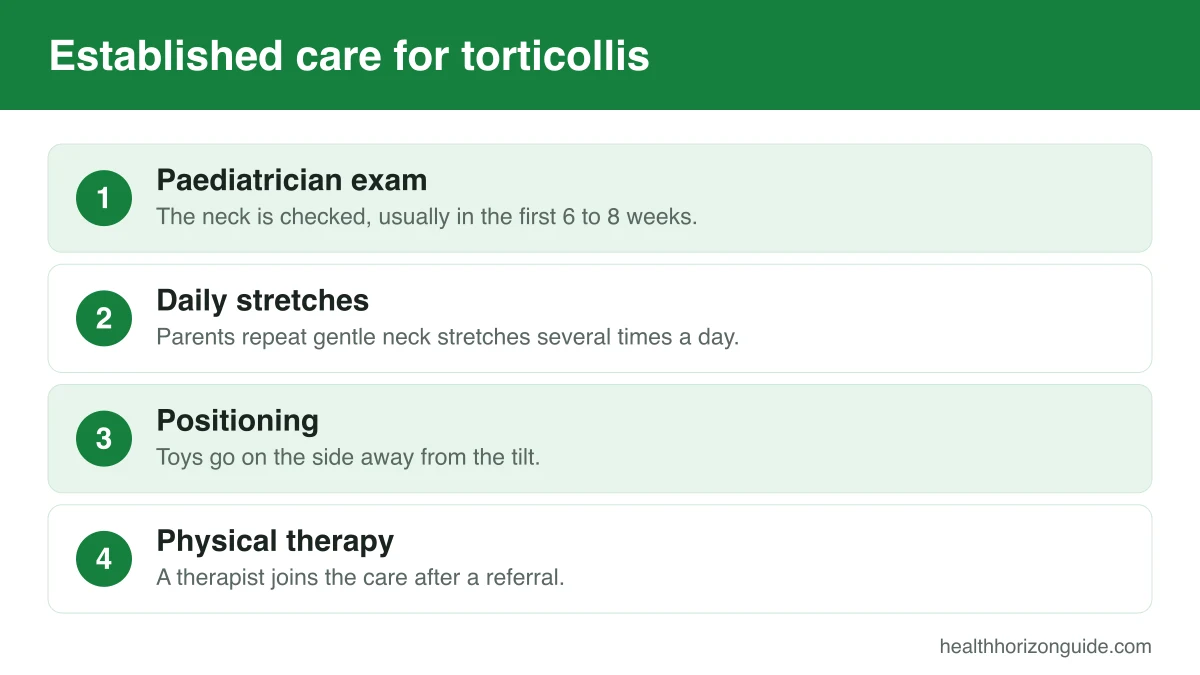
Established care for torticollis is a stretching programme taught by a paediatrician or physical therapist, not a chiropractor for babies. The American Academy of Pediatrics parent site, HealthyChildren.org, states that gentle stretching and positioning cure congenital muscular torticollis in the vast majority of cases. Early treatment matters. The 4 usual steps of torticollis care are listed below.
- A paediatrician examines the neck, usually within the first 6 to 8 weeks of life.
- Parents learn gentle neck stretches to repeat several times a day.
- Parents place toys and activity on the side away from the tilt so the baby turns toward them.
- A physical therapist joins the care when the paediatrician refers the baby.
Symptoms in a baby that need a doctor urgently
Symptoms in a baby that need a doctor urgently are signs of serious illness that no chiropractor for babies can assess or treat. The 6 symptoms below, taken from NHS guidance, need same-day medical care, and breathing difficulty or a baby who cannot be woken needs emergency services.
- A temperature of 38 degrees C (100.4 degrees F) or higher in a baby under 3 months.
- Poor feeding or refusing feeds.
- Green or yellow vomit, or vomit that contains blood.
- Breathing trouble, such as very fast breathing, grunting or the chest sucking in.
- Unusual drowsiness, floppiness or difficulty waking.
- A weak or high-pitched cry that does not sound like the baby's normal cry.
Frequently asked questions about a chiropractor for babies
Is a chiropractor safe for a newborn?
A chiropractor is not proven safe for a newborn. Serious harm is rarely reported, but benefit is unproven, and the Chiropractic Board of Australia advises chiropractors not to use spinal manipulation on children under 2.
Can a chiropractor help toddlers?
A chiropractor has no reliable evidence of benefit for toddlers. The Safer Care Victoria review of children under 12 found a very poor evidence base, so a paediatrician remains the first contact for a toddler's health concern.
Why do some babies seem better after a chiropractor visit?
Some babies seem better after a chiropractor visit because colic and reflux improve with age. Colic usually eases by 3 to 4 months, and trials that kept parents unaware of the treatment did not show a clear effect.