Lower Back Pain When Bending Over: Causes and What to Do
Lower back pain when bending over usually comes from a strained muscle or ligament. Learn the causes, first-days self-care, safe lifting and red flags.
Lower back pain when bending over is most often caused by a strained muscle or ligament, and less often by a disc problem, sciatica, or wear in the small joints of the spine. Most cases improve within a few weeks with gentle activity, heat or ice, and short-term pain relief. Numbness around the buttocks or pelvis, loss of bladder or bowel control, leg weakness, or fever with back pain needs urgent medical care.
Action checklist
What to do for lower back pain when bending over
Follow these source-based actions in the first days of lower back pain and when lifting afterwards.
0 of 10 done
In this article
- What causes lower back pain when bending over?
- How do you treat lower back pain from bending over in the first days?
- How can you bend and lift safely to prevent lower back pain?
- When does a chiropractor, physical therapist or doctor fit lower back pain?
- Which red flags with lower back pain need urgent care?
- Frequently asked questions about lower back pain when bending over
What causes lower back pain when bending over?
Lower back pain when bending over is caused most often by a sudden injury to the muscles and ligaments that support the back, according to MedlinePlus. Strains and sprains bring muscle spasms and pain that worsens with movement, which explains why bending is often the moment the pain appears.
The table below compares the 5 common causes of lower back pain when bending over, how each cause usually feels, and what sources recommend.
| Cause | How it usually feels | What sources recommend |
|---|---|---|
| Muscle or ligament strain (pulled back muscle) | An ache or sharp pain in the lower back, muscle spasms, stiffness, and pain that worsens with movement | Staying active, ice for the first days and heat afterwards, and short-term over-the-counter pain relief |
| Herniated or worn disc | Lower back pain that may worsen with bending or twisting; a herniated disc can send sharp, shooting pain down one buttock and leg | Activity as tolerated, and a medical visit when pain travels below the knee or lasts longer than 4 weeks |
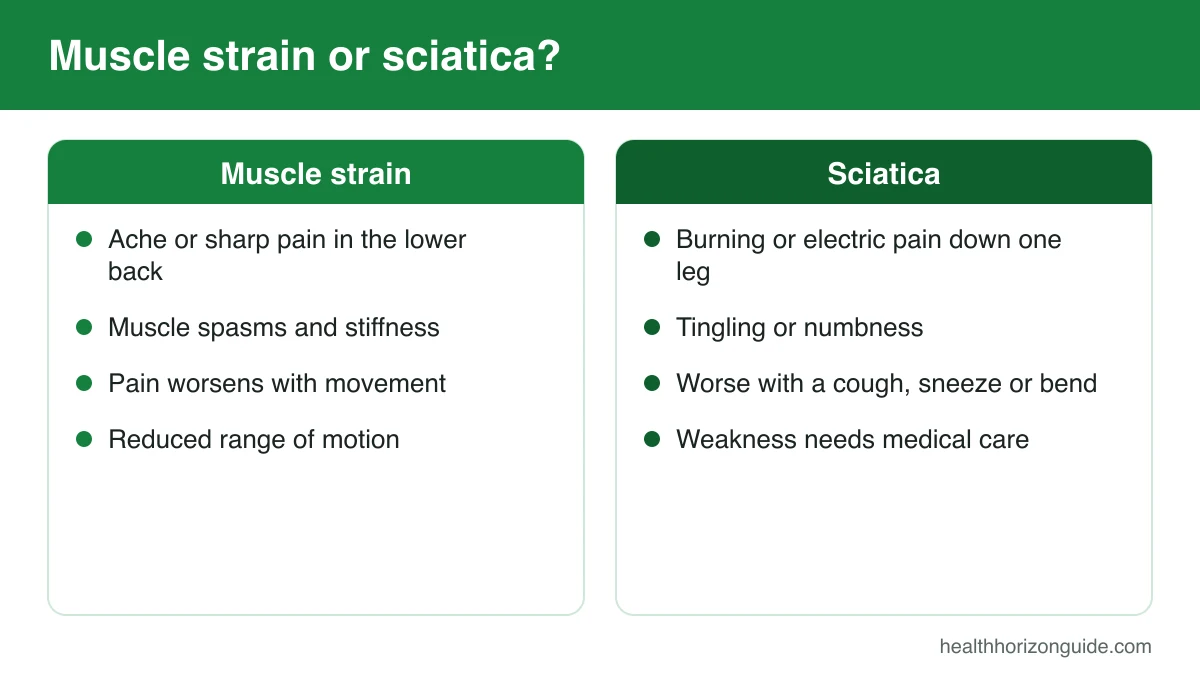
| Sciatica | Burning or electric-shock pain down one leg, with tingling or numbness; coughing, sneezing, and bending can make the pain worse | Ice, then heat, gentle stretching, light activity, and only short rest; medical care for weakness or moderate to severe pain |
| Facet joint arthritis | Aching or sharp pain near the spine, stiffness, and tenderness that worsens with bending and twisting | Physical therapy, pain relievers, and avoiding repetitive twisting |
| Sacroiliac (SI) joint pain | Pain in the lower back and buttock that can spread into the thigh; worse with long sitting or standing, stairs, and rising from a chair | An examination by a clinician, because SI joint pain can be hard to confirm from symptoms alone |
What does a pulled back muscle feel like when bending forward?
A pulled back muscle feels like an ache or sharp pain with spasms and stiffness in the lower back. Cleveland Clinic describes strains and sprains as the most common causes of back pain, and lists muscle spasms, pain that worsens with movement, and reduced range of motion as the signs. Lower back pain when bending forward can be mild, or severe enough to prevent movement, according to MedlinePlus.
Why does sharp lower back pain when bending over travel down the leg?
Sharp lower back pain when bending over that travels down the leg usually points to an irritated sciatic nerve. Sciatica is nerve pain from injury or irritation of the sciatic nerve, and the pain can feel like a burning or electric shock down one leg, according to Cleveland Clinic. Common causes of sciatica include a herniated disc, spinal stenosis, degenerative disc disease, and osteoarthritis.
Why does lower back pain get worse when coughing?
Lower back pain when coughing or sneezing is a recognised feature of sciatica. Cleveland Clinic states that sciatica pain can get worse when a person coughs, sneezes, or bends. Chest pain and back pain together during coughing is a different pattern, and Cleveland Clinic lists that pattern as a reason to call a doctor.
Why does lower back pain appear when bending over and standing up?
Lower back pain when bending over and standing up fits a strain most often, and sometimes a joint problem. A strain hurts with movement in general, so the return to upright can hurt as much as the bend. The Mayo Clinic lists moving from sitting to standing among the activities that aggravate sacroiliac joint pain. Facet joint arthritis worsens with bending and twisting, especially bending backward, according to Cleveland Clinic. The sources we reviewed do not tie pain on straightening up to one single cause, so the pattern alone cannot confirm a diagnosis. Our guide to SI joint pain covers that joint in more detail.
Which less common causes of lower back pain are serious?
Less common serious causes of lower back pain include a spinal fracture, a spinal infection, and cancer in the spine. MedlinePlus lists a compression fracture, which often follows osteoporosis, among the causes of sudden low back pain. MedlinePlus names kidney infection, kidney stones, and a leaking abdominal aortic aneurysm as less common sources of the same pain.
How do you treat lower back pain from bending over in the first days?
First-days self-care for lower back pain from bending over is a short period of reduced activity followed by staying as active as possible. MedlinePlus states that bed rest is not recommended. The 5 self-care measures that MedlinePlus describes for acute low back pain are listed below.
- Reduce normal activity for the first few days only, then return to movement.
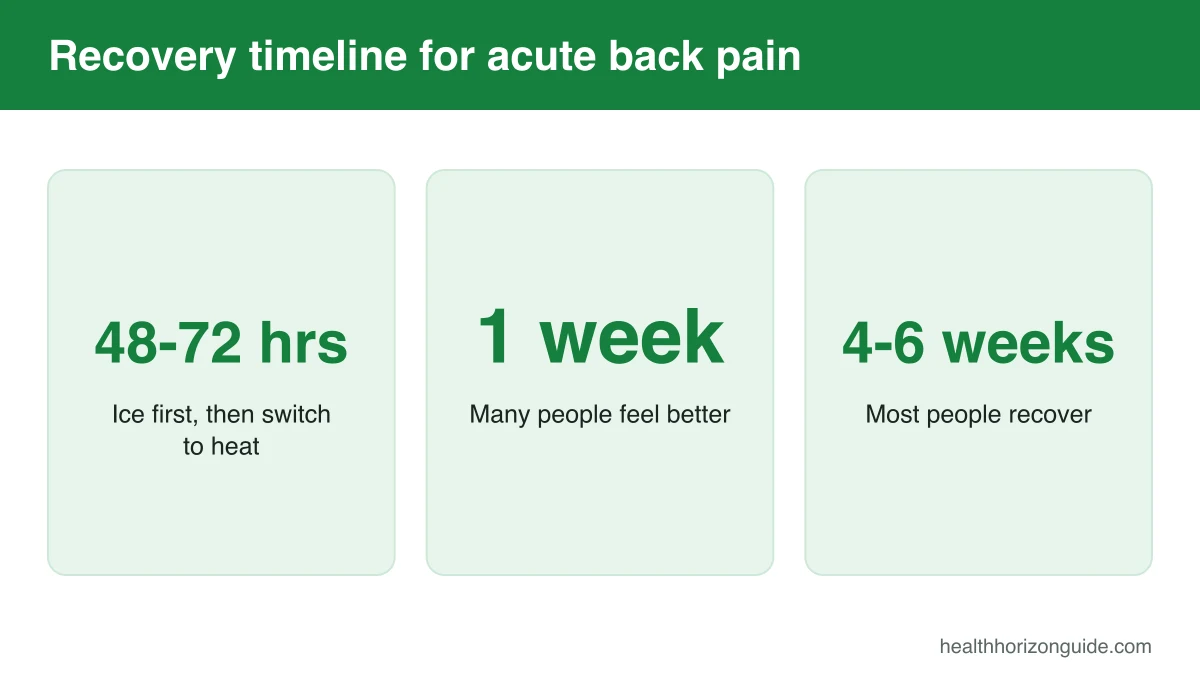
- Use ice for the first 48 to 72 hours, then switch to heat.
- Take an over-the-counter pain reliever such as ibuprofen or acetaminophen, and follow the package directions.
- Sleep curled on one side with a pillow between the knees, or on the back with a pillow under the knees.
- Avoid heavy lifting and twisting for the first 6 weeks.
The American College of Physicians guideline notes that most people with acute lower back pain improve over time regardless of treatment. The guideline recommends superficial heat on moderate-quality evidence, and massage, acupuncture, or spinal manipulation on low-quality evidence.
How long does lower back pain from bending over last?
Lower back pain from bending over lasts a few days to a few weeks in most cases. Many people feel better within 1 week, and most recover within 4 to 6 weeks, according to MedlinePlus. Many cases of sciatica improve within 4 to 6 weeks without medical treatment, according to Cleveland Clinic. MedlinePlus suggests a gradual return to exercise after 2 to 3 weeks, starting with walking, stationary cycling, or swimming. A physical therapist can advise when stretching is safe, because stretching too early can make the pain worse. Readers with leg symptoms can review our sciatica stretches once a clinician agrees.
How can you bend and lift safely to prevent lower back pain?
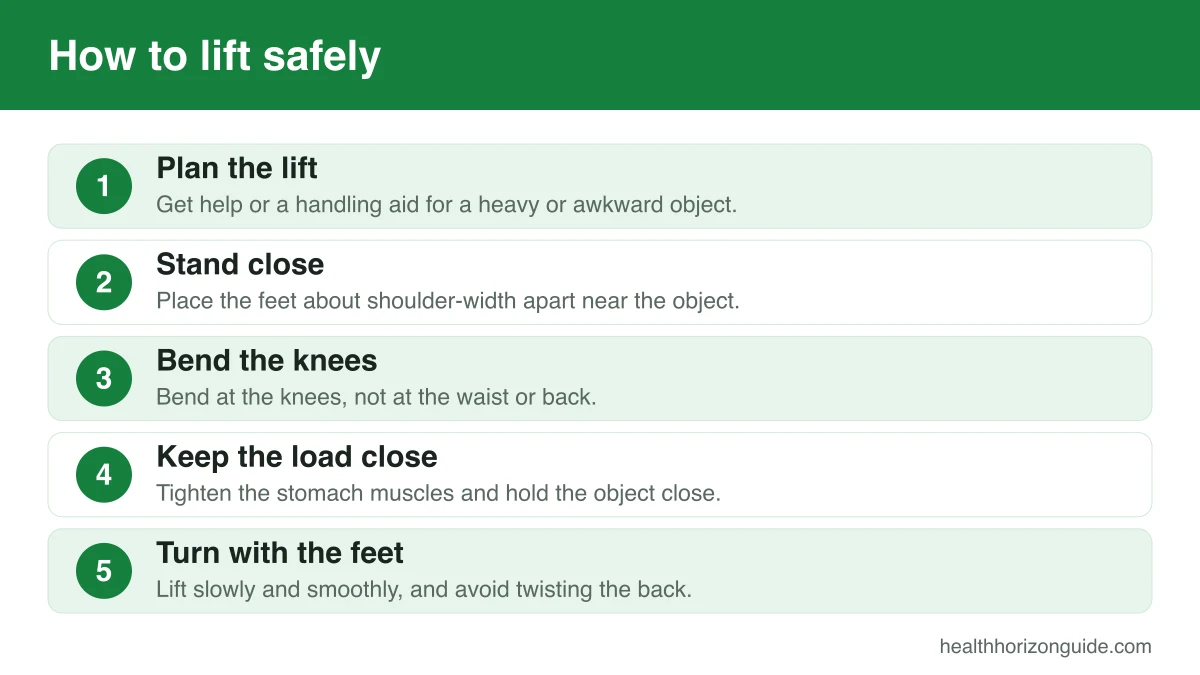
Bending and lifting safely means bending at the knees and hips instead of the waist, and keeping the load close to the body. Trainers often call this movement a hip hinge, although the occupational health sources describe the same idea without that name. People in their 30s and older are more likely to hurt the back while bending to lift, according to MedlinePlus. The 6 steps below combine the MedlinePlus instructions with the lifting technique from the UK Health and Safety Executive.
- Plan the lift, and get help or a handling aid when the object is heavy or awkward.
- Stand as close to the object as possible, with the feet about shoulder-width apart.
- Bend at the knees, not at the waist or back.
- Tighten the stomach muscles and hold the object close to the body.
- Lift slowly and smoothly with the hip and knee muscles.
- Turn by moving the feet, and avoid twisting the back.
The Health and Safety Executive adds that a slight bend of the back, hips, and knees at the start of a lift is better than a full stoop or a deep squat. Posture habits through the day matter for lower back pain as well, and our posture and back pain self-check helps readers review those habits.
When does a chiropractor, physical therapist or doctor fit lower back pain?
A doctor fits lower back pain first whenever warning signs appear or the pain lasts longer than 4 weeks. A physical therapist fits recovery, because MedlinePlus advises asking a physical therapist when to begin stretching and strengthening. A chiropractor fits some cases of uncomplicated pain. The American College of Physicians guideline lists spinal manipulation as one option for acute lower back pain, on low-quality evidence. Our article on seeing a chiropractor for lower back pain explains what that care involves.
Which red flags with lower back pain need urgent care?
Red flags with lower back pain are symptoms that suggest nerve damage, infection, fracture, or another serious illness. MedlinePlus advises prompt contact with a healthcare provider for the 7 warning signs listed below.
- Loss of bladder or bowel control.
- Weakness or numbness in the buttocks, thigh, leg, or pelvis, which includes the groin area.
- Difficulty walking or keeping balance.
- Unexplained fever with back pain.
- Back pain after a severe blow, fall, or other serious accident.
- Unintentional weight loss.
- Pain that travels down the leg below the knee.
Cleveland Clinic advises calling emergency services when back pain comes with loss of bladder or bowel control, or with numbness or weakness in the legs.
Frequently asked questions about lower back pain when bending over
Is rest or movement better for lower back pain when bending over?
Movement is better than bed rest for lower back pain when bending over. MedlinePlus recommends reduced activity for the first few days only, then staying as active as possible.
Is heat or ice better for a pulled back muscle?
Ice comes first for a pulled back muscle, for the first 48 to 72 hours, followed by heat, according to MedlinePlus.
Can lower back pain when bending over be a herniated disc?
Lower back pain when bending over can come from a herniated disc, although a strain is more common. Sharp, shooting pain down one buttock and leg makes a disc cause more likely, and our page on a herniated disc covers that condition.
When should a doctor check lower back pain when bending over?
A doctor should check lower back pain when bending over when the pain lasts longer than 4 weeks or any red flag appears. MedlinePlus advises a visit when a new episode feels different or worse than earlier back pain.