
Chiropractor for Plantar Fasciitis: Can a Chiropractor Help?
A chiropractor may ease plantar fasciitis with hands-on foot and calf work, but stretching, rest and supportive shoes come first. See the evidence and routine.

A chiropractor for plantar fasciitis can help mainly through hands-on work on the foot, ankle and calf, combined with stretching and loading advice. Research shows fair evidence that this kind of manual therapy improves function in the short term, and the same research does not show that a chiropractor works better than standard care. Most plantar fasciitis improves with simple home treatment, so stretching, rest and supportive shoes come first.
Action checklist
Plantar fasciitis self-care checklist
Use these steps from the article to manage plantar fasciitis at home and to know when to get medical help.
0 of 10 done
In this article
- What is plantar fasciitis?
- Can a chiropractor help with plantar fasciitis?
- Stretches for plantar fasciitis and treatment at home
- Established plantar fasciitis treatments from doctors and podiatrists
- How long does plantar fasciitis last?
- Who to see first for plantar fasciitis and other heel pain
- Signs that heel pain needs a doctor
- Common questions about a chiropractor for plantar fasciitis
What is plantar fasciitis?
Plantar fasciitis is irritation and inflammation of the plantar fascia, the band of tissue that runs from the heel to the front of the foot and supports the arch. The American Academy of Orthopaedic Surgeons (AAOS) describes plantar fasciitis as one of the most common causes of heel pain. Risk factors named by the AAOS include tight calf muscles, flat feet or a high arch, obesity, long periods of standing on hard surfaces, repetitive high-impact activity such as running, and a new or increased activity level. Plantar fasciitis is most common between the ages of 40 and 60.
Plantar fasciitis symptoms
The main plantar fasciitis symptom is pain on the bottom of the foot, around the heel and arch. The NHS lists the pattern that points to plantar fasciitis rather than another foot problem: the pain is much worse with the first steps after sleeping or resting, the pain eases with movement, and the pain returns after long periods of standing, walking or running. MedlinePlus adds that the heel pain may feel dull or sharp, and that the sole may ache or burn.
Heel pain in the morning
Heel pain in the morning is the classic sign of plantar fasciitis. The AAOS states that the pain arrives with the first few steps out of bed or after a long rest, and usually eases after a few minutes of walking. Pain from plantar fasciitis tends to be worse after exercise, not during exercise.
Can a chiropractor help with plantar fasciitis?
A chiropractor can help with plantar fasciitis as one option for hands-on care and exercise advice, not as a proven replacement for standard treatment. The useful part of a chiropractor visit is the part that overlaps with physical therapy: manual therapy to the lower leg and foot, plus a stretching plan the patient continues at home.
What a chiropractor does for plantar fasciitis
A chiropractor treats plantar fasciitis with soft-tissue work, foot and ankle mobilisation, and stretching and loading advice. Soft-tissue work means massage and pressure techniques on the calf muscles and the sole of the foot. Mobilisation means moving the joints of the foot and ankle by hand to improve their range of motion. Stretching and loading advice covers calf and plantar fascia stretches, a gradual return to walking or running, and footwear changes.
What the evidence shows for chiropractic and plantar fasciitis
The evidence for chiropractic-style manual therapy in plantar fasciitis is fair in the short term and limited beyond that. A 2018 systematic review of 7 randomized controlled trials found that adding manual therapy improved function from 4 weeks to 6 months, compared with stretching, strengthening or other modalities. Pain improved too, although pain relief was mostly equal to the comparison treatments. The review authors recommended joint and soft-tissue mobilisation together with stretching and strengthening, not manual therapy alone.
A 2012 literature review led by chiropractic researchers graded manipulative therapy at level B, or fair evidence, for short-term treatment of plantar fasciitis. The same review asked for larger trials with better methods. Three limits apply to plantar fasciitis patients who are choosing a chiropractor. The reviews tested manual therapy techniques, not chiropractic visits specifically. The trials were small. No source we reviewed shows that chiropractic care shortens the overall course of plantar fasciitis.
Stretches for plantar fasciitis and treatment at home
Stretches for plantar fasciitis are the most effective way to relieve the pain, according to the AAOS, and a chiropractor or physical therapist will usually teach the same movements. The 6 steps of a plantar fasciitis treatment at home routine are listed below.
- Do the plantar fascia stretch in the morning, while still sitting on the bed. Cross the sore foot over the opposite knee, pull the toes back toward the shin, hold for 10 seconds and repeat 20 times.
- Use a towel when the toes are hard to reach. Loop the towel around the big toe and pull back gently, with the same hold and repeat count.
- Do the calf stretch against a wall. Keep the back knee straight and the heel on the ground, bend the front knee, push the hips toward the wall, hold for 10 seconds and repeat 20 times on each side.
- Roll the foot over a cold water bottle or ice for 20 minutes, 3 to 4 times a day.
- Cut back on activities that bring on the pain, such as running, and switch to cycling or swimming.
- Wear shoes with cushioned heels and good arch support, add insoles or heel pads, and avoid walking barefoot on hard surfaces.
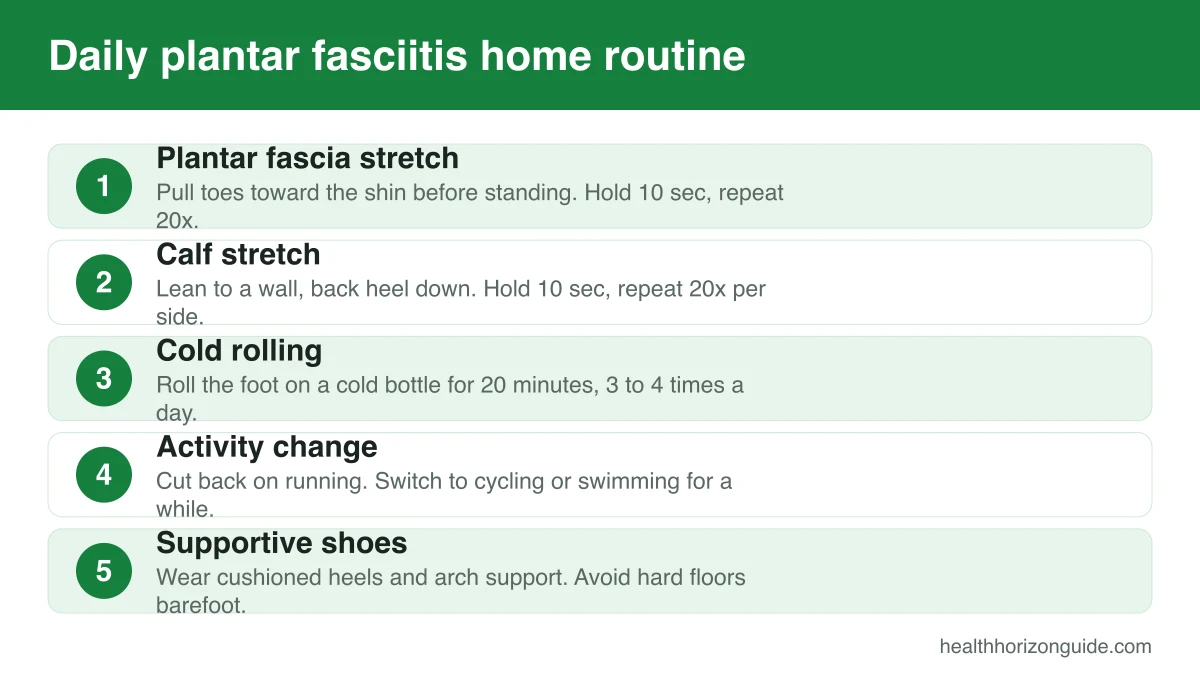
Steps 1 to 5 come from the AAOS guidance on plantar fasciitis, and step 6 comes from the NHS.
Established plantar fasciitis treatments from doctors and podiatrists
Established plantar fasciitis treatments are mostly nonsurgical and start with the simplest options. The table below summarises what orthopedic, NHS and MedlinePlus sources say about each plantar fasciitis treatment.
| Treatment | What the sources say |
|---|---|
| Rest and activity change | Reduce or stop painful activity. MedlinePlus advises resting as much as possible for at least a week. |
| Supportive shoes and insoles | Cushioned shoes, heel pads and prefabricated or custom inserts reduce strain on the plantar fascia. |
| Night splints | A splint stretches the plantar fascia during sleep. The AAOS calls night splints hard to get used to and very effective. |
| Physical therapy | A therapist supervises stretching and may add massage and cold treatment. |
| Pain relievers | Anti-inflammatory medicines reduce pain. The AAOS advises against using them for more than 1 month without seeing a primary care doctor. |
| Steroid injections | Cortisone reduces inflammation. Cortisone can also weaken the plantar fascia and lead to a rupture, so doctors may limit or avoid the injection. |
| Shockwave therapy | Results are mixed, according to the AAOS. The NHS lists shockwave therapy as an option when other treatments have not helped. |
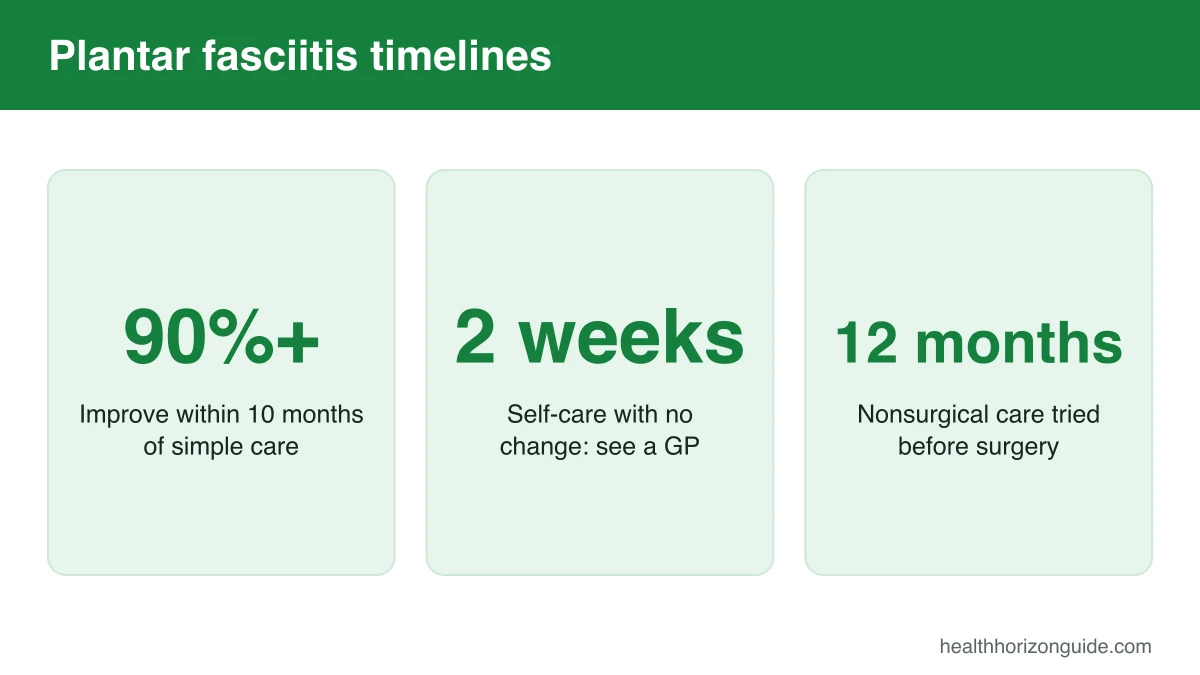
| Surgery | Surgery is rare. The AAOS says surgery is generally considered only after 12 months of nonsurgical treatment has failed. |
How long does plantar fasciitis last?
Plantar fasciitis usually lasts several months, and the published estimates vary. The AAOS reports that more than 90% of patients with plantar fasciitis improve within 10 months of starting simple treatment. Cleveland Clinic states that healing can take a few weeks to a few months once treatment begins. MedlinePlus gives a longer range and notes that nonsurgical treatments almost always improve the pain.
Who to see first for plantar fasciitis and other heel pain
The first person to see for plantar fasciitis is a primary care doctor or a podiatrist when home treatment has not worked. The NHS route is a GP first, then a physiotherapist for exercises or a podiatrist for insoles, shoe advice and night splints. A chiropractor is a reasonable second choice for readers who want hands-on treatment and already see a chiropractor for back or joint care.
Podiatrist vs chiropractor for plantar fasciitis
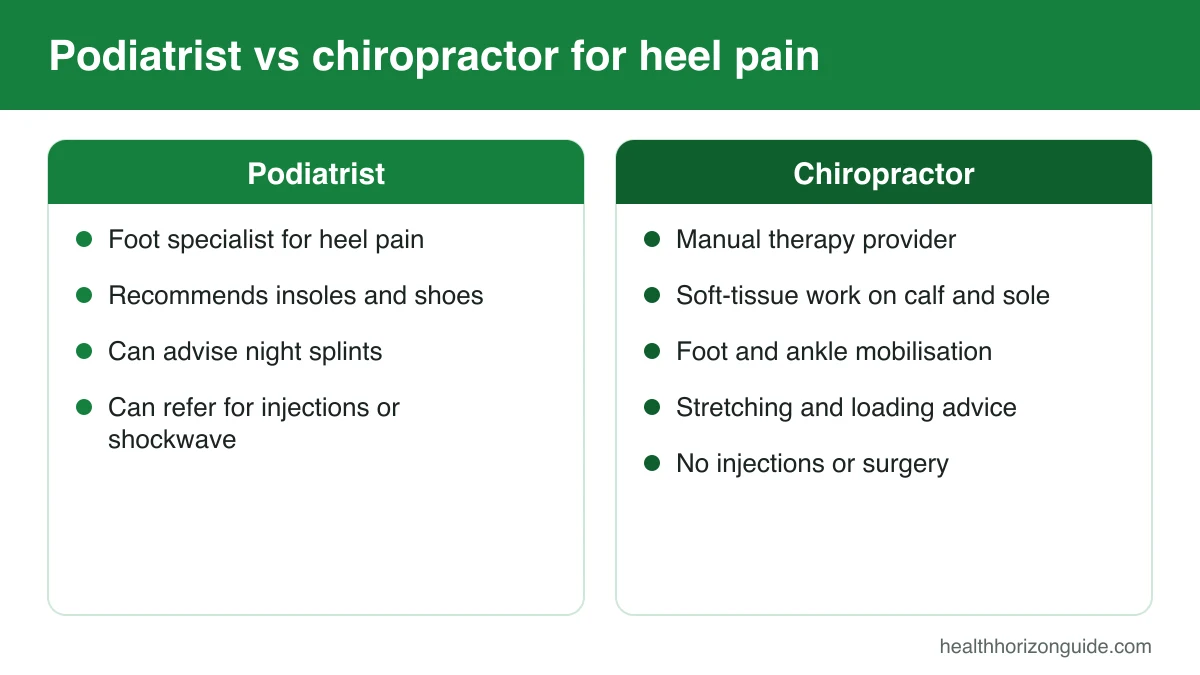
A podiatrist is the foot specialist for plantar fasciitis, and a chiropractor is a manual therapy provider who may treat the foot. A podiatrist can recommend insoles and night splints and can refer for injections or shockwave therapy. A chiropractor offers soft-tissue work, joint mobilisation and exercise advice, and does not give steroid injections or perform surgery. Our guides explain the difference between a chiropractor and a physical therapist, how a chiropractor compares with an orthopedic doctor, and how much a chiropractor costs per visit. Readers with pain higher up the leg can read how chiropractors approach knee pain.
Signs that heel pain needs a doctor
Heel pain needs a doctor when the pain is severe, is getting worse, or has not improved after 2 weeks of self-care. Not every sore heel is plantar fasciitis, and a chiropractor should refer on when these signs appear. The 7 signs below come from the NHS heel pain guidance and the MedlinePlus heel pain page.
- Severe heel pain that starts after an injury needs urgent medical advice.
- Heel pain that has not improved after 2 weeks of home treatment needs a GP visit.
- Pain that keeps coming back or stops normal activities needs a GP visit.
- Tingling or loss of feeling in the foot needs a GP visit.
- Diabetes with heel or foot pain needs a GP visit, since foot problems can be more serious with diabetes.
- A red or swollen heel is a reason to contact a medical professional.
- Being unable to put weight on the foot, even after resting, is a reason to contact a medical professional.
Readers who are unsure about their blood sugar can check the warning signs of diabetes.
Common questions about a chiropractor for plantar fasciitis
Does a chiropractor adjust the spine for plantar fasciitis?
Some chiropractors include a spinal adjustment in a plantar fasciitis visit. The reviews we cite support joint and soft-tissue mobilisation combined with stretching, and the medical sources we reviewed do not list spinal adjustment as a plantar fasciitis treatment.
How many chiropractor visits does plantar fasciitis need?
No source we reviewed sets a standard number of chiropractor visits for plantar fasciitis. The trials in the 2018 review measured results between 4 weeks and 6 months. A patient with no change after 2 weeks of treatment should see a doctor.
Is walking good for plantar fasciitis?
Long periods of walking or standing can make plantar fasciitis worse, according to the NHS. Low-impact exercise such as swimming or cycling puts less stress on the feet while the plantar fascia settles.