Chiropractor for Herniated Disc: Does It Help and Is It Safe?
A chiropractor can ease herniated disc pain for some people but cannot fix the disc. See the evidence, the risks, the emergency signs and the alternatives.

A chiropractor can ease the pain of some herniated discs, yet a chiropractor cannot push a disc back into place or cure the herniation. Research gives low to moderate support for spinal manipulation and traction-style care as short-term relief for back and leg pain. Chiropractic care is not appropriate when a herniated disc causes loss of bladder or bowel control, numbness around the groin or growing leg weakness, which are medical emergencies.
Action checklist
Before you see a chiropractor for a herniated disc
Use these steps from the article to decide whether chiropractic care suits your herniated disc.
0 of 9 done
In this article
- Can a chiropractor help with a herniated disc?
- What is a herniated disc?
- What does a chiropractor do for a herniated disc?
- What do the evidence and clinical guidelines say?
- Is it safe to see a chiropractor with a herniated disc or bulging disc?
- How long does a herniated disc take to heal?
- Other treatments and related questions about herniated discs
- What are the alternatives to a chiropractor for a herniated disc?
- What self-care helps a herniated disc?
- When should you see a doctor instead of a chiropractor?
- Frequently asked questions about chiropractors and herniated discs
Can a chiropractor help with a herniated disc?
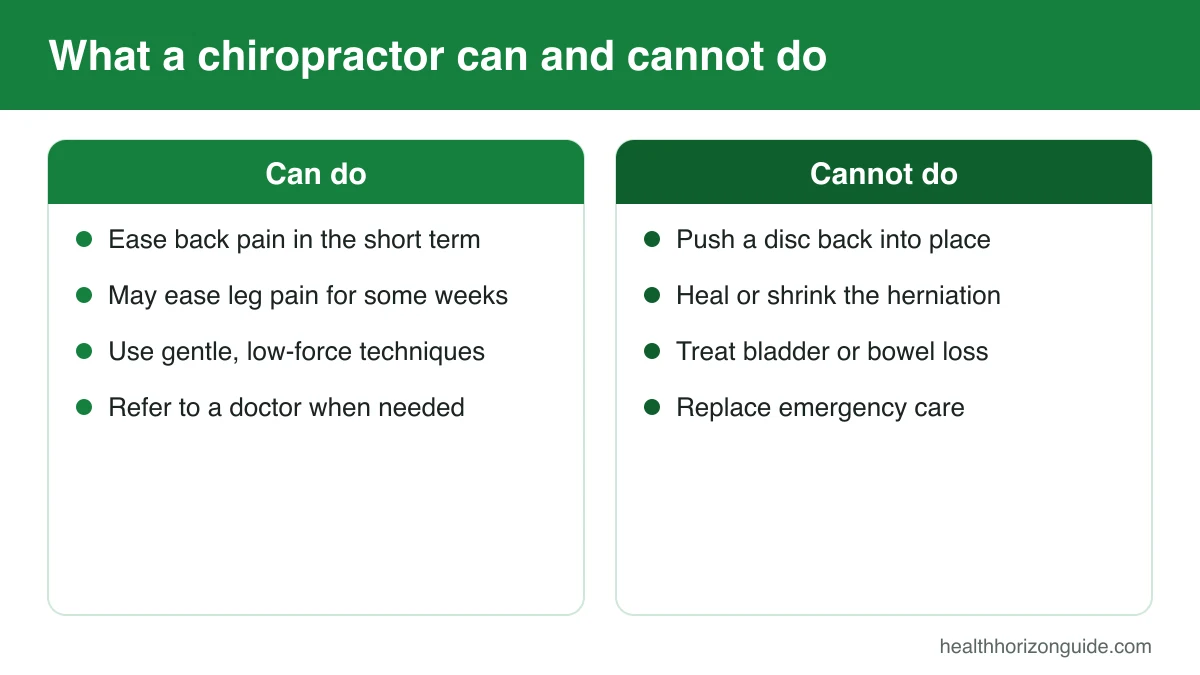
A chiropractor can help with a herniated disc by easing pain and stiffness in the short term, not by repairing the disc. Chiropractic care is one of several conservative options. The 4 things a chiropractor can and cannot do for a herniated disc are listed below.
- A chiropractor can ease back pain. Spinal manipulation may lead to small improvements in pain and function for low back pain, according to the National Center for Complementary and Integrative Health (NCCIH).
- A chiropractor may ease leg pain for a while. One 2014 study described by NCCIH found less leg pain after 12 weeks when manipulation was added to advice and home exercise, with no difference after 1 year.
- A chiropractor cannot put a herniated disc back. The disc does not slip out of position, so no adjustment can slide the disc back in.
- A chiropractor cannot treat a nerve emergency. Loss of bladder or bowel control needs a hospital, not an adjustment.
What is a herniated disc?
A herniated disc is a spinal disc whose soft, jelly-like centre pushes out through the tougher outer ring, as Cleveland Clinic describes. The escaped material can press on a nearby nerve. Common symptoms of a herniated disc in the lower back are back pain, pain that shoots from the buttock down the leg (sciatica), tingling, numbness and muscle weakness. A chiropractor treats those symptoms, not the tear in the disc.
How do bulging, slipped and herniated discs differ?
Bulging, slipped and herniated discs differ mainly in whether the outer layer of the disc has cracked. Mayo Clinic explains that a herniated disc is more likely to cause pain than a bulging disc, and that many bulging discs cause no symptoms. The table below compares the 3 terms a chiropractor or doctor may use for a herniated disc.
| Term | What the term means | Typical symptoms |
|---|---|---|
| Bulging disc | The outer layer pushes outward but stays intact, usually around a quarter to a half of the disc's edge. | Often none |
| Herniated disc | A crack in the outer layer lets some of the softer inner material stick out. | More likely to irritate a nerve and cause pain |
| Slipped disc | An everyday name for a herniated disc. The disc itself does not slip. | Same as a herniated disc |
What does a chiropractor do for a herniated disc?
A chiropractor treats a herniated disc with hands-on or table-based techniques that move or gently stretch the spine. The table below describes the 4 techniques a chiropractor most often uses for a herniated disc and what the research says about each one.
| Technique | What happens | Strength of evidence |
|---|---|---|
| Flexion-distraction | The patient lies face down on a hinged table while the chiropractor gently bends and stretches the lower spine in a slow rhythm. | Limited. We found only small studies and no large published trial. |
| Spinal decompression | A motorised table applies controlled traction to the spine. | Moderate for short-term pain relief and weak for long-term results. |
| Gentle mobilisation | The chiropractor moves a joint slowly within its normal range, without a thrust. | Moderate, as part of conservative care. |
| Spinal manipulation | The chiropractor applies a quick, controlled thrust to a spinal joint. | Low to moderate for low back pain. Less studied for sciatica. |
The traction and mobilisation ratings come from a 2024 review in the Journal of Clinical Medicine. Our guide to the pros and cons of spinal decompression therapy covers decompression tables for a herniated disc in more detail.
What does a chiropractic visit for a herniated disc involve?
A chiropractic visit for a herniated disc involves a health history, a physical examination and a check for warning signs ahead of any treatment. NCCIH states that practitioners should assess patients thoroughly and that patients should share their health conditions and medications. Bring any MRI report to the first visit.
What do the evidence and clinical guidelines say?
The evidence for chiropractic care of a herniated disc is low to moderate in strength and mostly limited to short-term relief. The American College of Physicians named spinal manipulation as one of several options for acute or chronic low back pain in its 2017 guideline, and rated the supporting evidence as low, according to NCCIH. Manipulation is not widely used for sciatica but may help, based on a 2015 review that had many limitations. The 2024 review rated the evidence as moderate for manipulation and mobilisation in people with a herniated disc and leg pain, provided no worsening nerve signs were present. None of these sources shows that a chiropractor can shrink or heal a herniated disc.
Is it safe to see a chiropractor with a herniated disc or bulging disc?
Seeing a chiropractor with a herniated disc or bulging disc is generally low risk when no warning signs of nerve damage are present. Spinal manipulation often causes mild side effects such as increased pain, stiffness or headache, and most of these effects fade within 24 hours, NCCIH reports. Serious problems are very rare, although no accurate estimates exist. Neck manipulation has been linked to rare tears in the neck arteries, which matters for a herniated disc in the neck. Patients who worry about making a herniated disc worse can ask for low-force techniques and should stop treatment when leg pain, numbness or weakness increases.
When is chiropractic care not appropriate for a herniated disc?
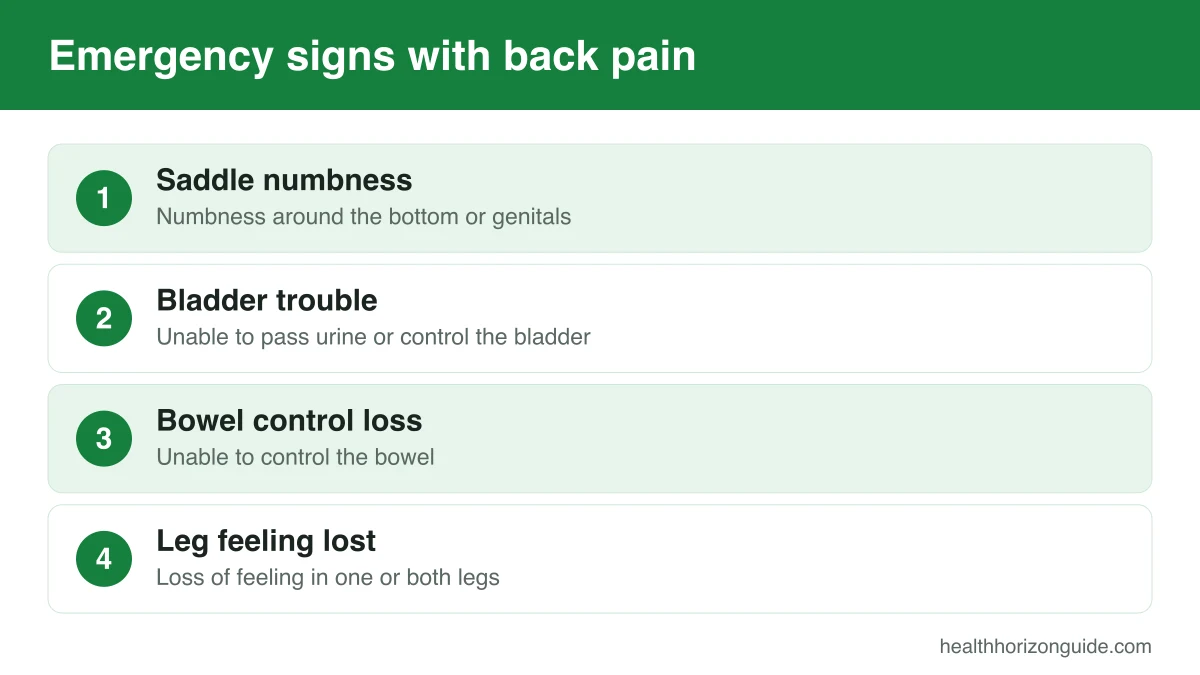
Chiropractic care is not appropriate for a herniated disc when signs of severe nerve compression appear. A large herniated disc can, in rare cases, injure the nerves that control the bladder and bowel, a condition called cauda equina syndrome that may need emergency surgery. The NHS advises calling emergency services or going to an emergency department when back pain occurs with any of the 5 signs listed below.
- Numbness around the bottom or genitals (saddle numbness).
- Inability to pass urine.
- Loss of control of the bladder or bowel.
- Loss of feeling in one or both legs.
- Back pain that started with a serious accident, such as a car crash.
Leg weakness that keeps getting worse is a further reason to skip the chiropractor and see a doctor quickly.
How long does a herniated disc take to heal?
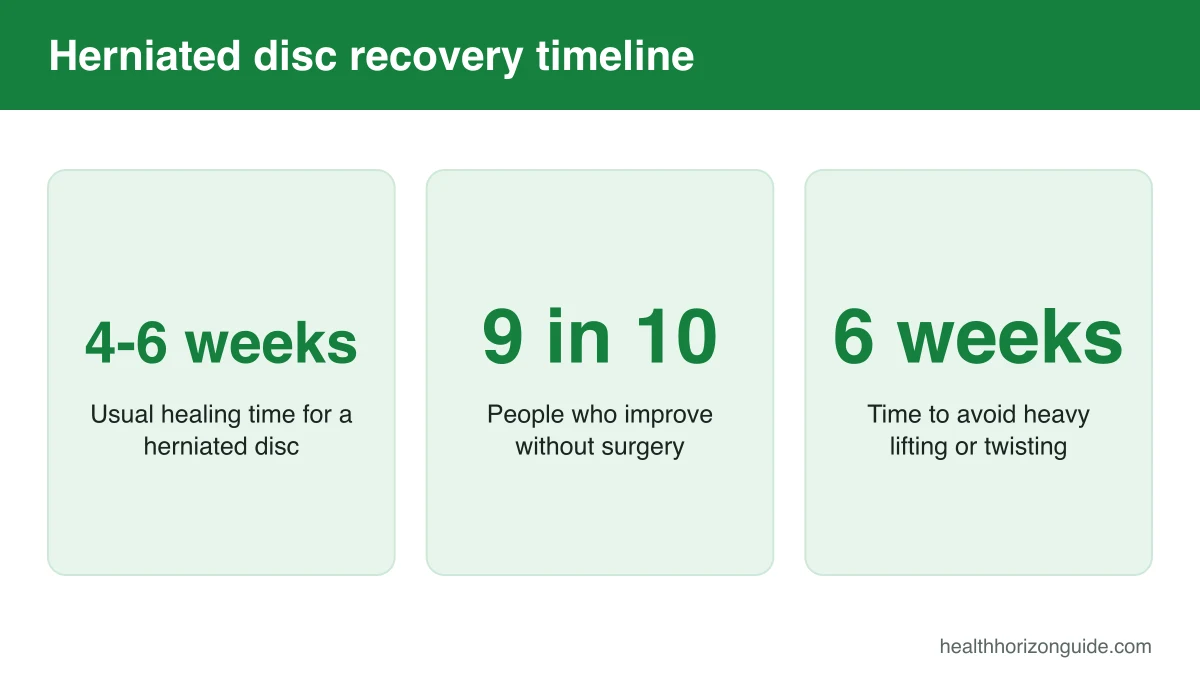
A herniated disc takes about four to six weeks to heal in most cases, according to Cleveland Clinic. Herniated discs get better without surgery for 9 out of 10 people. MedlinePlus adds that a full return to all activities can take several months to a year or more. MedlinePlus advises no heavy lifting or twisting for the first 6 weeks and a gradual return to exercise from 2 to 3 weeks. No source we reviewed shows that a chiropractor shortens the healing time of a herniated disc.
Other treatments and related questions about herniated discs
Other treatments for a herniated disc include medical care and self-care, which matter as much as chiropractic care.
What are the alternatives to a chiropractor for a herniated disc?
The alternatives to a chiropractor for a herniated disc are physical therapy, medication, steroid injections and surgery. The table below compares these 4 alternatives using Cleveland Clinic and MedlinePlus information.
| Treatment | What the treatment involves | What sources say |
|---|---|---|
| Physical therapy | Exercises that relieve nerve pressure, strengthen the muscles that support the spine and teach safe movement. | Important for nearly everyone with disc disease. |
| Medication | Anti-inflammatory pain relievers or muscle relaxants. | Usually the first step, along with a short rest. |
| Steroid injections | An epidural or nerve block injection near the irritated nerve. | May control pain for several months but do not fix the disc. |
| Surgery | Removal of all or part of the disc, most often by microdiscectomy. | Considered only when other treatments have not worked. |
Our guides to chiropractic treatment techniques for sciatica and treatment for a compressed lower back explain related options for herniated disc symptoms.
What self-care helps a herniated disc?
Self-care for a herniated disc centres on staying gently active. The NHS recommends rest only while the pain is very bad, followed by gentle activity such as walking, swimming or yoga. Our morning stretches for lower back pain offer a gentle starting point, and the posture and back pain self-check tool can highlight daily habits that load the spine.
When should you see a doctor instead of a chiropractor?
See a doctor instead of a chiropractor for a herniated disc when symptoms are severe, spreading or not improving. The 4 situations that call for a medical appointment are listed below.
- Pain has not improved after four to six weeks of conservative care.
- Tingling, numbness or loss of strength appears in the arms, hands, legs or feet.
- Standing or walking becomes difficult.
- Severe back pain does not go away, or painkillers do not help.
Frequently asked questions about chiropractors and herniated discs
Can a chiropractor fix a slipped disc?
A chiropractor cannot fix a slipped disc, because the disc does not slip and cannot be pushed back. Chiropractic care may reduce pain while the herniated disc heals.
Can a chiropractor help a bulging disc?
A chiropractor can help a bulging disc only when the bulging disc causes back pain or stiffness. Many bulging discs cause no symptoms and need no treatment, unlike a painful herniated disc.
Is it safe to see a chiropractor with degenerative disc disease?
Seeing a chiropractor with degenerative disc disease is not well studied in the sources we reviewed. NCCIH notes that serious side effects of manipulation may be more likely in people with underlying health problems, so a doctor should assess worn or herniated discs first.