
Chiropractor vs Physical Therapist: What Is the Difference?
Chiropractor vs physical therapist: compare training, methods, visits, back pain evidence and red flags, and learn which provider to see first.

A chiropractor and a physical therapist both treat muscle, joint and spine pain without medicines or surgery, but the two professions rely on different main methods. A chiropractor centers care on hands-on spinal adjustments, while a physical therapist centers care on exercise, movement training and education. Neither provider is a medical doctor, and many people with back pain use both at different stages.
Action checklist
Choosing between a chiropractor and a physical therapist
Use these steps from the article to pick the right provider for back, neck or joint pain.
0 of 9 done
In this article
- What is the difference between a chiropractor and a physical therapist?
- Who should you see first, a chiropractor or a physical therapist?
- What do evidence and guidelines say for low back pain?
- How do a chiropractor and a physical therapist work together?
- Chiropractor vs orthopedic doctor, osteopath and medical doctor
- Which red flags need a medical doctor instead of a chiropractor or physical therapist?
- Chiropractor vs physical therapist: common questions
What is the difference between a chiropractor and a physical therapist?
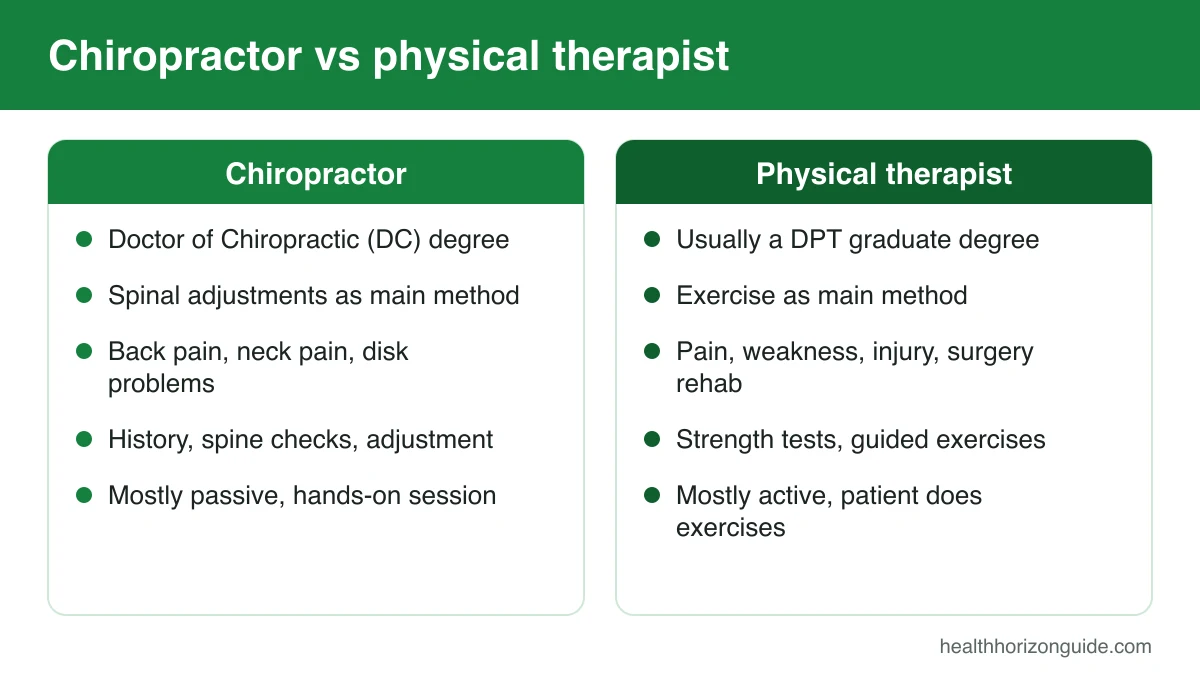
The difference between a chiropractor and a physical therapist is the main treatment method and the focus of each session. A chiropractor holds a Doctor of Chiropractic (DC) degree and mainly uses spinal adjustments to ease pain and improve joint movement. A physical therapist holds a graduate degree, usually a Doctor of Physical Therapy (DPT), and mainly uses exercise to rebuild strength, mobility and function.
The table below compares a chiropractor and a physical therapist on 6 points.
| Point of comparison | Chiropractor | Physical therapist |
|---|---|---|
| Training and degree | Doctor of Chiropractic (DC), 4 to 5 years at an accredited chiropractic college, state license | Graduate degree in physical therapy, usually a Doctor of Physical Therapy (DPT), state license |
| Main methods | Spinal adjustments, often combined with exercise advice, heat or cold, and electrical therapies | Exercises for strength, mobility, stamina and coordination, plus heat, cold or electrical stimulation for pain |
| Conditions commonly treated | Low back pain, neck pain, osteoarthritis and spinal disk conditions | Pain, weakness and loss of movement, including recovery from injury or surgery |
| Typical visit | Health history, posture and spine movement checks, then an adjustment on a treatment table | Tests of strength, flexibility and walking, then guided exercises and teaching |
| Referral and insurance in the US | Often booked directly, and coverage depends on the insurance plan | All 50 states allow some form of direct access, and coverage depends on the insurance plan |
| Session focus | Mostly passive, because the chiropractor performs the treatment | Mostly active, because the patient performs the exercises |
What does a chiropractor do?
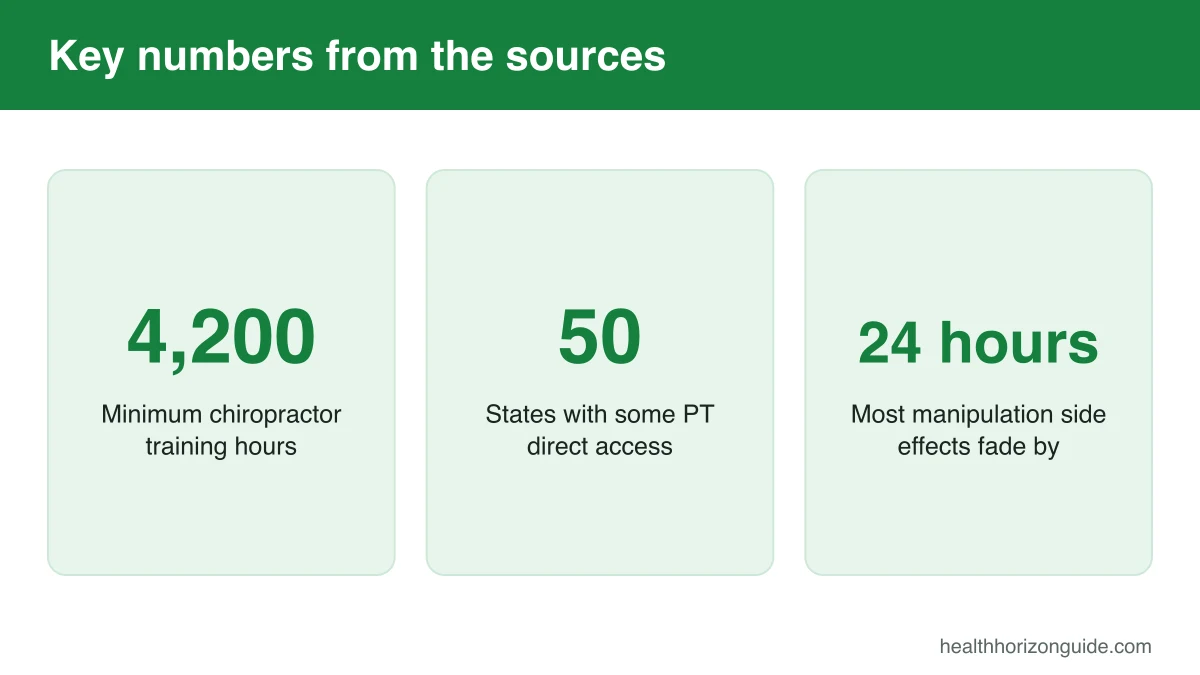
A chiropractor diagnoses and treats muscle and bone problems, mainly with spinal adjustments. MedlinePlus states that doctors of chiropractic complete 4 to 5 years at an accredited chiropractic college, with a minimum of 4,200 hours of classroom, laboratory and clinical experience. The same source describes chiropractic care as conservative, without medicines or surgery. A spinal adjustment, also called spinal manipulation, is a controlled thrust applied to a joint of the spine by hand or with a device. Our guide to chiropractic techniques explains the main adjustment methods.
What does a physical therapist do?
A physical therapist assesses how the body moves and treats pain and weakness mainly with exercise. Cleveland Clinic explains that a physical therapist checks muscle strength, joint flexibility and the ability to walk or move, then uses exercises to build strength, mobility, stamina and coordination. Some physical therapists perform spinal manipulation, although the National Center for Complementary and Integrative Health (NCCIH) notes that most spinal manipulation is done by a chiropractor. Physiotherapist is the name for the same profession in countries such as the United Kingdom.
What happens at a first visit?
A first visit with a chiropractor or a physical therapist starts with a health history and a physical exam. A chiropractor checks muscle strength, posture, spinal range of motion and structural problems, and runs standard nervous system and orthopedic tests, according to MedlinePlus. A physical therapist measures strength, flexibility and movement, then teaches exercises to practice between sessions.
Who should you see first, a chiropractor or a physical therapist?
The provider to see first depends on the type of problem and the goal of treatment. The 4 common starting points are listed below.
- New low back or neck pain with no red flags: a chiropractor or a physical therapist is a reasonable first stop, because guidelines list both manipulation and movement-based care as options.
- Long-lasting or recurring back pain: a physical therapist fits well, because exercise is a first-line treatment for chronic low back pain.
- Recovery from surgery, a fracture or a sports injury, or problems with weakness and balance: a physical therapist is the usual choice.
- Any red-flag symptom listed later in this article: a medical doctor or emergency care comes first, before a chiropractor or a physical therapist.

The American Physical Therapy Association reports that all 50 states allow some form of direct access to a physical therapist without a referral, although a number of states still attach limits. Insurance plans set their own referral and visit rules for a chiropractor and a physical therapist.
What do evidence and guidelines say for low back pain?
Evidence and guidelines support both spinal manipulation and exercise as options for low back pain, with small average benefits for each. The American College of Physicians (ACP) guideline, summarized by American Family Physician, lists heat, massage, acupuncture and spinal manipulation as first options for acute and subacute low back pain. The evidence for manipulation in that guideline is low quality and shows a minimal improvement in function compared with sham treatment. Acute low back pain has a high probability of improving considerably within one month.
The ACP guideline lists exercise, motor control exercise, multidisciplinary rehabilitation and spinal manipulation among first-line options for chronic low back pain. Moderate-quality evidence shows that exercise gives a minimal improvement in pain and function compared with no exercise. Low-quality evidence found no pain difference between spinal manipulation and sham manipulation for chronic pain. The guideline does not name a chiropractor or a physical therapist as the better provider.
Is spinal manipulation by a chiropractor safe?
Spinal manipulation by a chiropractor causes mild, short-lived side effects fairly often and serious harm very rarely. NCCIH reports that increased pain, stiffness and headache are common after manipulation, and most of these side effects go away within 24 hours. Serious spinal, nerve or neck-artery problems have been reported, although NCCIH calls these events very rare. Neck manipulation has been linked to small tears in the neck arteries that can lead to stroke, and researchers disagree on whether manipulation causes the tears. People with underlying health problems, and pregnant people, should discuss the risks with a chiropractor or a physical therapist before treatment starts.
How do a chiropractor and a physical therapist work together?
A chiropractor and a physical therapist work together by pairing hands-on care for pain with exercise for strength and function. Some people start with adjustments from a chiropractor while pain is sharp, then move to a physical therapist to build strength once movement is easier. Many chiropractors add exercise and rehabilitation to adjustments, which our article on chiropractic rehab covers in detail. Each provider should know about the other provider's treatment. Our guide explains how to use an FSA for chiropractic care.
Chiropractor vs orthopedic doctor, osteopath and medical doctor
A chiropractor differs from an orthopedic doctor, an osteopath and a medical doctor mainly in medical training and legal scope. A physical therapist shares the same limits and does not prescribe medicines or perform surgery.
Chiropractor vs orthopedic doctor
An orthopedic doctor is a physician and surgeon who treats bone, joint and muscle conditions, while a chiropractor provides non-surgical manual care. Orthopedic doctors try non-surgical treatment first for most conditions. A chiropractor or a physical therapist cannot operate, so problems that need surgery belong with an orthopedic doctor.
Chiropractor vs osteopath
An osteopath in the United States is a Doctor of Osteopathic Medicine (DO), a fully licensed physician, while a chiropractor is not a physician. A DO can prescribe medicines and perform surgery, and receives extra training in hands-on manipulation. Osteopaths in some other countries work as manual therapists, with a role closer to a chiropractor or a physical therapist.
Chiropractor vs doctor
A chiropractor is a licensed provider with a doctoral degree, but not a medical doctor. A chiropractor holds a DC degree, and a physical therapist usually holds a DPT degree, while a medical doctor holds an MD or DO degree and can prescribe medicines and order hospital care. Massage is another non-medical option, and our comparison of a chiropractor vs deep tissue massage explains that choice.
Which red flags need a medical doctor instead of a chiropractor or physical therapist?
Red flags that need a medical doctor are signs of nerve compression, infection, serious injury or a problem outside the spine. The NHS advises emergency care for back pain that comes with any of the 6 signs listed below.
- Pain, tingling, weakness or numbness in both legs.
- Loss of feeling around the genitals or anus.
- Trouble urinating, or loss of bladder or bowel control.
- New changes in sexual function or genital sensation.
- Chest pain.
- Back pain that started after a serious accident, such as a car crash.
Urgent medical advice is needed for back pain with fever, shivering or a general feeling of illness, and for sudden severe pain or pain that gets worse quickly. The NHS notes that back pain usually improves within a few weeks, so pain that does not improve in that time deserves a medical review as well. Milder aches can be checked first with our posture and back pain self-check tool before a visit to a chiropractor or a physical therapist.
Chiropractor vs physical therapist: common questions
Is a chiropractor or a physical therapist better for lower back pain?
Neither a chiropractor nor a physical therapist is proven better for all lower back pain. Guidelines list spinal manipulation and exercise as options, and exercise has the stronger evidence for chronic pain.
Is chiropractor vs physical therapy the same as chiropractor vs physiotherapist?
Chiropractor vs physical therapy and chiropractor vs physiotherapist are the same comparison. Physical therapist is the United States name, and physiotherapist is the name in countries such as the United Kingdom.
What is the difference between chiropractic and chiropractor?
Chiropractic is the name of the profession and the type of care, while a chiropractor is the licensed person who provides the care. Physical therapy and physical therapist follow the same pattern.