
How to Fix Forward Head Posture: Exercises and Daily Habits
Learn how to fix forward head posture with 5 exercises, desk and sleep changes, a realistic timeline, and the warning signs that need a doctor.
Fixing forward head posture takes a daily routine that strengthens the neck and upper back, stretches the chest, and changes the desk, phone and sleep habits that push the head forward. Chin tucks, scapular squeezes, wall angels, a doorway chest stretch and thoracic extension are the exercises used most often. Expect weeks to months of steady practice, and see a clinician first for numbness, tingling, weakness or severe headaches.
Action checklist
Forward head posture daily action checklist
Use these actions from the article to work on forward head posture each day.
0 of 10 done
In this article
- What is forward head posture?
- How to fix forward head posture with exercises
- What causes forward head posture?
- What are the symptoms of forward head posture?
- How long does it take to fix forward head posture?
- Daily habits that support forward head posture correction
- Forward head posture and a neck hump
- When to see a chiropractor, physical therapist or doctor
- Forward head posture FAQ
What is forward head posture?
Forward head posture is a position in which the head hangs too far in front of the shoulders, according to the Cleveland Clinic. The weight of the head then pulls on the muscles at the back of the neck, tightens the chest muscles and rounds the shoulders forward. Tech neck, text neck and nerd neck are everyday names for the same position.
Forward head posture wall test
The forward head posture wall test is a check of whether the back of the head rests against a wall while the body stands straight. Stand with the back against a wall so the shoulder blades, hips and backs of the legs touch the wall, and keep the chin level. A head that does not reach the wall with the chin level suggests forward head posture.
How to fix forward head posture with exercises
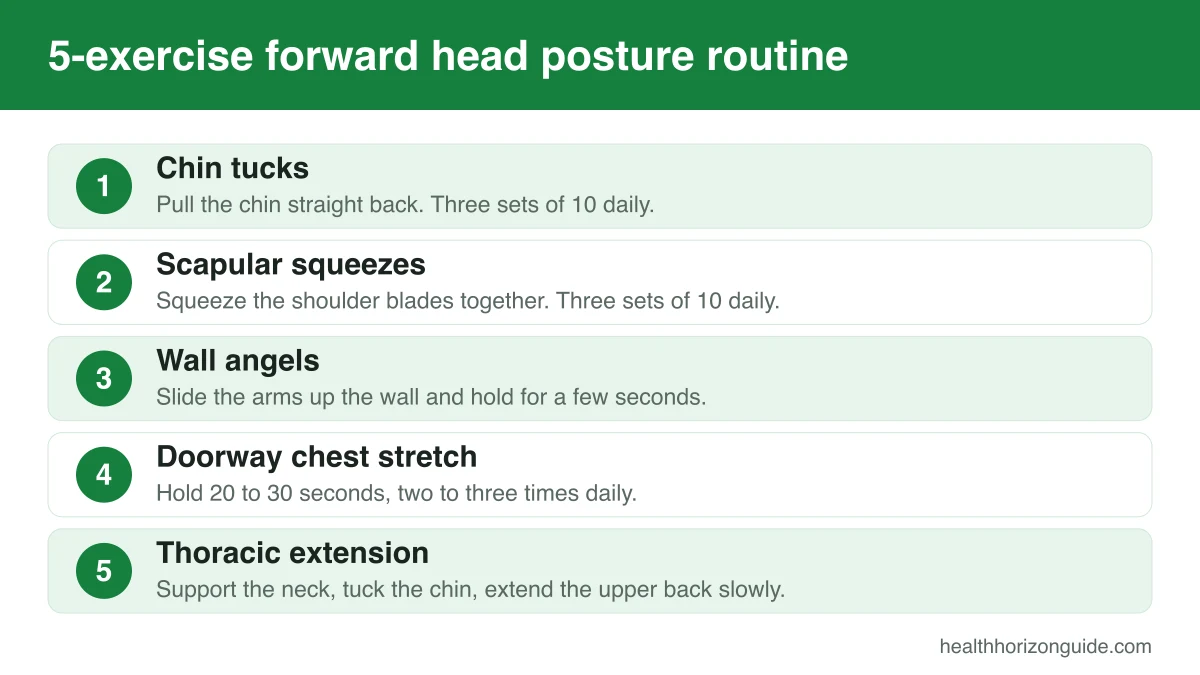
Forward head posture exercises strengthen the muscles that pull the head and shoulder blades back and stretch the tight chest. The 5 exercises below form one routine, and the sets and hold times come from Cleveland Clinic guidance on posture-related neck humps wherever a number is given. Move slowly and stop any exercise that causes sharp pain or tingling.
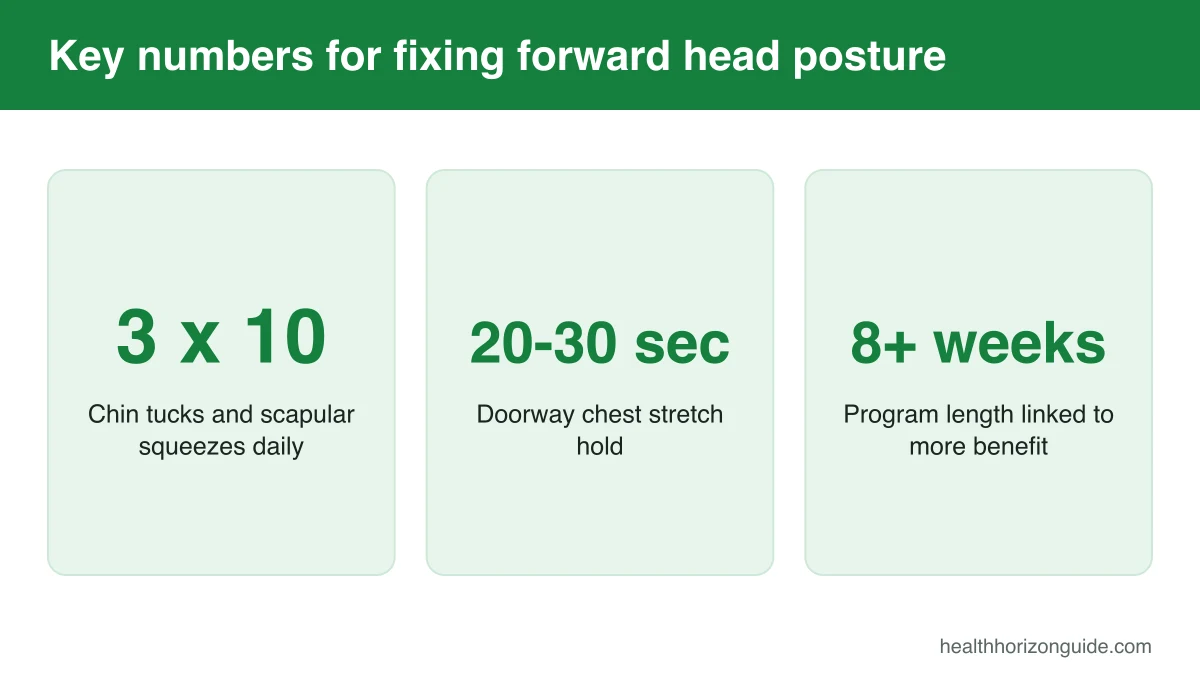
- Chin tucks: sit or stand tall and pull the chin straight back without tilting the head up or down. Hold for several seconds, then relax. Do three sets of 10 daily.
- Scapular squeezes: squeeze the shoulder blades together while the arms rest at the sides, then release. Do three sets of 10 daily.
- Wall angels: stand with the back against a wall, arms at the sides and palms turned out. Slide the arms out to the sides and overhead while the backs of the hands stay on the wall, hold for a few seconds, then lower slowly. The source gives no set count.
- Doorway chest stretch: stand in an open doorway with the arms raised like a goalpost and the palms on the door frame. Step forward with one foot until the chest stretches. Hold for 20 to 30 seconds, two to three times daily.
- Thoracic extension: support the neck with both hands, keep the chin tucked, and slowly extend the upper back by lifting the chest, then return to the start. The trial that used this exercise published no repetitions or hold times, so keep the movement small.
Do forward head posture exercises work?
Forward head posture exercises have low to moderate certainty evidence of benefit. A 2026 meta-analysis of 10 randomized trials with 550 participants found that therapeutic exercise improved the craniovertebral angle, the standard measure of head position, by a mean of 3.38 degrees compared with controls. Neck pain and neck function improved as well. The authors rated the certainty as moderate for head position and low for pain and disability.
Upper back work has some support. A small randomized trial of 32 adults with forward head posture found that upper thoracic mobilization plus a thoracic extension exercise improved standing head position and neck pain more than treatment aimed only at the upper neck. The trial had no control group, so the finding is preliminary. The routine pairs well with these morning stretches for lower back pain.
Forward head posture vs normal posture
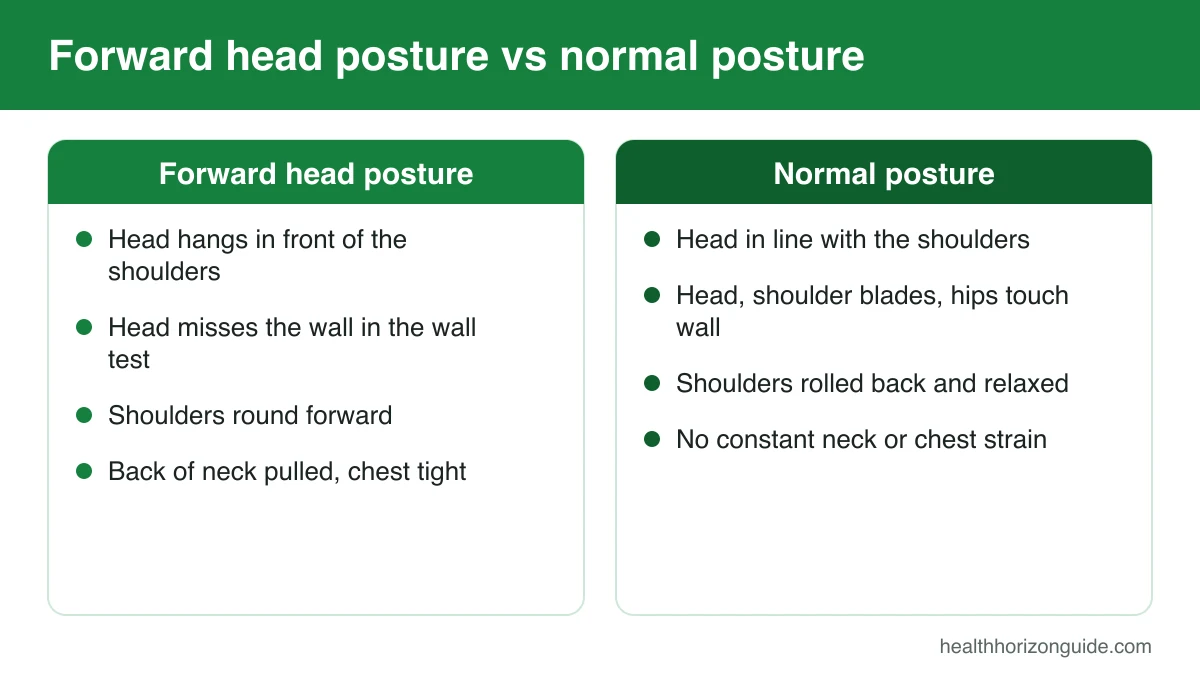
Forward head posture differs from normal posture in where the head sits relative to the shoulders. The table below compares forward head posture with normal posture on 4 points.
| Point | Forward head posture | Normal posture |
|---|---|---|
| Head position | Head hangs in front of the shoulders | Head held in line with the shoulders |
| Wall test | Back of the head does not reach the wall with the chin level | Head, shoulder blades and hips touch the wall |
| Shoulders | Rounded forward | Rolled back and relaxed |
| Muscles | Back of the neck is pulled and the chest is tight | Neck and chest muscles are not under constant strain |
What causes forward head posture?
Forward head posture is caused mainly by long periods spent looking down or leaning toward a screen. Weak upper back and neck muscles and tight chest muscles then hold the head forward. The 4 common causes of forward head posture are listed below.
- Looking down at a phone for long stretches, often called text neck.
- Working at a desk from a couch or kitchen table.
- Bending over a desk for an hour or more without a break.
- Using a computer monitor that sits too high or too low.
What are the symptoms of forward head posture?
Forward head posture symptoms are neck and upper back stiffness, rounded shoulders and headaches. The Cleveland Clinic lists rounded shoulders, pain or stiffness in the back and shoulder blades, fatigue and headaches among the symptoms of the rounded upper back that often comes with forward head posture. Pain centred on one shoulder can have other causes, which our guide to a chiropractor for shoulder pain explains. Numbness, tingling or weakness in an arm or hand needs a medical check.
How long does it take to fix forward head posture?
Fixing forward head posture takes weeks to months of consistent practice. The 2026 meta-analysis found that exercise programs lasting 8 weeks or longer were linked with greater benefit than shorter programs, although the authors called that finding exploratory. The Cleveland Clinic states that a posture-related neck hump will not go away overnight and can take months or longer to correct. Slow visible change in the first weeks is a common worry, and the meta-analysis suggests that longer, combined programs may work better than chin tucks alone.
Daily habits that support forward head posture correction
Daily habits decide how well forward head posture exercises hold, since a few minutes of exercise cannot offset many hours spent with the head forward. Our posture and back pain self-check tool gives a quick way to review these habits and the symptoms of forward head posture.
How to fix posture while sitting at a desk
Fixing posture at a desk means raising the screen so the eyes meet the middle of the screen. The 4 desk and phone changes that reduce forward head posture are listed below.
- Place the computer on a stand or riser so the field of vision falls in the middle of the screen.
- Hold the phone at eye level and avoid looking down at the lap.
- Set a timer for about every 10 minutes as a prompt to check head and shoulder position.
- Take regular breaks from screens.
How to fix posture while sleeping
Fixing posture while sleeping means choosing a pillow that keeps the neck level with the mattress, not bent up or down, according to Cleveland Clinic advice on pillows and neck pain. Sleeping on the back with the head bent forward repeats forward head posture for hours, and stomach sleeping with the head twisted is described as the worst position. A contour pillow with a central dip suits most people. No pillow corrects forward head posture alone.
Do posture correctors and braces fix forward head posture?
Posture correctors and braces do not fix forward head posture on their own. A Cleveland Clinic physical therapist discourages passive devices such as harnesses, since the wearer gets no benefit once the harness comes off. Digital reminders that buzz or vibrate work for some people. MedlinePlus adds that a soft neck collar should not be worn continuously, as long-term use can weaken the neck muscles.
Forward head posture and a neck hump
A neck hump that appears with forward head posture is usually a forward curve of the upper spine called kyphosis. Bad posture is the most common cause, and osteoporosis and degenerative spinal changes are other causes, the Cleveland Clinic reports. A posture-related hump can often be improved by strengthening the upper back and neck, depending on age and severity. Our guide on how to realign your spine covers alignment in more detail.
When to see a chiropractor, physical therapist or doctor
See a professional about forward head posture when exercises do not help or nerve symptoms appear. A primary care provider can rule out underlying problems first. A physical therapist teaches the exercises correctly, and chiropractors also work with posture-related neck problems. Some clinics offer cervical decompression treatment for certain neck conditions. MedlinePlus advises contacting a provider for the 6 warning signs listed below.
- Numbness, tingling or weakness in an arm or hand.
- Neck symptoms that do not improve within 1 week of self-care.
- Neck pain that follows a fall, blow or injury.
- Pain that gets worse when lying down or wakes the person at night.
- Trouble walking or balancing.
- Loss of control over urination or bowel movements.
Emergency care is needed for a fever and headache with a neck so stiff that the chin cannot touch the chest. A severe headache should be assessed by a doctor and not treated with posture exercise alone.
Forward head posture FAQ
The 3 questions below cover common worries about forward head posture.
Can forward head posture be fixed permanently?
Forward head posture can often be improved, and no source promises a permanent fix. Lasting change depends on keeping the exercises and daily habits in place.
Are chin tucks enough to fix forward head posture?
Chin tucks alone are probably not enough for forward head posture. The 2026 meta-analysis suggests that combined exercise programs may produce larger improvements than a single exercise.
Is tech neck the same as forward head posture?
Tech neck is an everyday name for the neck strain that comes with forward head posture. The term describes the head-down position used with phones and laptops.