
Is It Safe to See a Chiropractor While Pregnant?
Seeing a chiropractor while pregnant appears low risk in healthy pregnancies, but evidence is limited. Learn how care is adapted and when to avoid it.

Seeing a chiropractor while pregnant appears to be low risk for most healthy pregnancies, although the research is limited and cannot prove complete safety. Published reviews report mostly mild, short-lived soreness, plus a small number of serious injuries described in case reports. Chiropractic care in pregnancy should be agreed with the midwife or obstetrician first, and avoided while certain pregnancy complications are present.
Action checklist
Before seeing a chiropractor while pregnant
Use these steps from the article to make chiropractic care in pregnancy as safe as the evidence allows.
0 of 10 done
In this article
- Is it safe to see a chiropractor during pregnancy?
- How do chiropractors adapt care for pregnant women?
- Does chiropractic care help pregnancy back and pelvic pain?
- Can a chiropractor turn a breech baby with the Webster technique?
- What else should pregnant women know before booking chiropractic care?
- When is chiropractic care not appropriate in pregnancy?
- Should the midwife or obstetrician know about chiropractic care?
- Which warning signs need urgent maternity care?
- Frequently asked questions about seeing a chiropractor while pregnant
Is it safe to see a chiropractor during pregnancy?
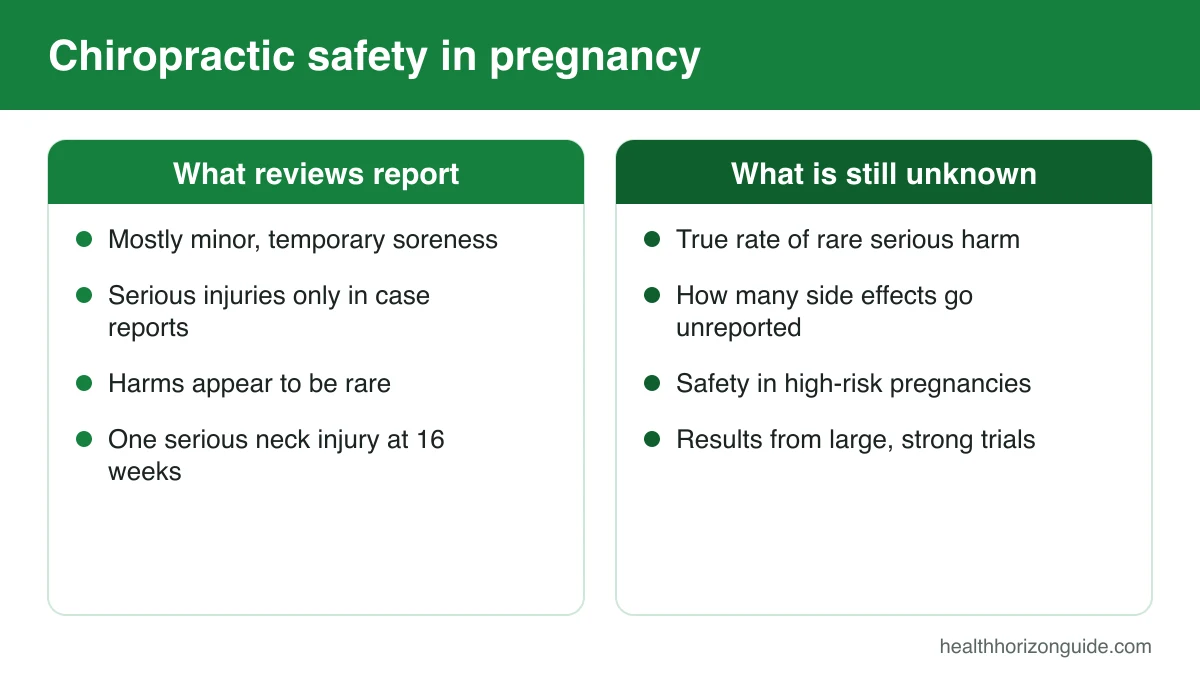
Seeing a chiropractor during pregnancy is considered low risk but not proven safe, according to the reviews available. A 2021 systematic review of adverse events from spinal manipulation in pregnant and postpartum women included 21 studies and found mostly minor, temporary reactions such as soreness. The same review described one serious event: a woman who was 16 weeks pregnant had a tear in a neck artery following neck manipulation. The authors concluded that harms from chiropractic care appear to be rare, and they warned that under-reporting limits how certain anyone can be.
The 4 main points that sources make about the safety of chiropractic care in pregnancy are listed below.
- Minor reactions: temporary soreness or tenderness is the side effect reported most often.
- Serious events: an earlier 2012 review by the same research group found seven cases, ranging from short-lived pain to fracture and stroke.
- Evidence quality: most studies are small, and many do not record side effects carefully.
- Medical clearance: best-practice recommendations advise clearance from the obstetric provider in higher-risk pregnancies.
Chiropractor in the first, second and third trimester
A chiropractor in the first, second or third trimester is not ruled out by trimester alone in the sources we reviewed. Best-practice recommendations instead tell chiropractors to adapt chiropractic care to the stage of pregnancy and to the comfort of the patient. The table below summarises what the sources say about each trimester.
| Trimester | What the sources say |
|---|---|
| First trimester | No source we reviewed sets a separate rule for early pregnancy. Vaginal bleeding or cramping needs an obstetric check before any manipulation. |
| Second trimester | Lying face down becomes harder as the abdomen grows. Pillows, wedges or a table with a section that lowers under the abdomen may be used. |
| Third trimester | Lying flat on the back can cause dizziness or nausea, so side-lying or propped positions are used. Ruptured membranes or signs of imminent birth are reasons to stop. |
How do chiropractors adapt care for pregnant women?
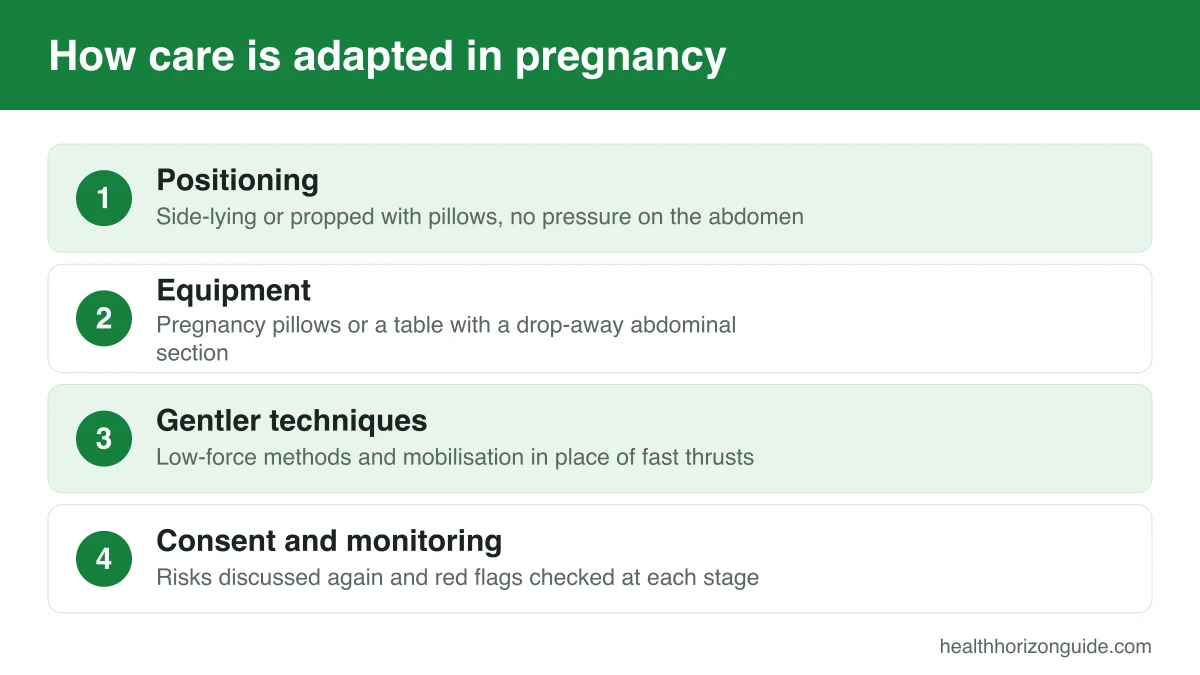
Chiropractors adapt care for pregnant women by changing the position, the equipment and the force used. The 2022 best-practice recommendations for chiropractic care for pregnant and postpartum patients were agreed by an expert panel and contain 71 statements. The 4 main ways that chiropractic care is adapted in pregnancy are listed below.
- Positioning: the patient lies on one side or is propped with pillows or wedges, and no pressure is placed on the abdomen.
- Equipment: pregnancy pillows or a table with a drop-away abdominal section make room for the growing abdomen.
- Gentler techniques: low-force methods and mobilisation can replace fast thrusts, since pregnancy loosens the ligaments and less force is needed.
- Consent and monitoring: risks are discussed again as the pregnancy progresses, and the chiropractor keeps checking for red flags such as raised blood pressure.
Home self-treatment is a different subject from chiropractic care, and our guide to cracking your back while pregnant covers it separately.
Does chiropractic care help pregnancy back and pelvic pain?
Chiropractic care for pregnancy back and pelvic pain has inconclusive but favourable evidence. A 2020 systematic review of chiropractic care for pregnancy-related low back and pelvic girdle pain examined 50 articles, including 30 randomised controlled trials. The review rated the evidence for chiropractic care and spinal manipulation in pregnancy low back pain as inconclusive. Osteopathic manipulative therapy had moderate, favourable evidence for the same problem. The authors summed up the whole field as lacking conclusive evidence.
Pelvic girdle pain has even less research behind it. The best-practice recommendations state that no studies have tested spinal manipulation alone for pelvic girdle pain in pregnancy. A short trial of chiropractic care may be considered, and the plan should be changed or stopped when the pain does not improve. Many women describe trying a chiropractor out of desperation and getting mixed results, which matches the uncertain research. Our guides to back pain during pregnancy, upper backache in pregnancy and managing pelvic girdle pain during pregnancy describe other relief options.
Can a chiropractor turn a breech baby with the Webster technique?
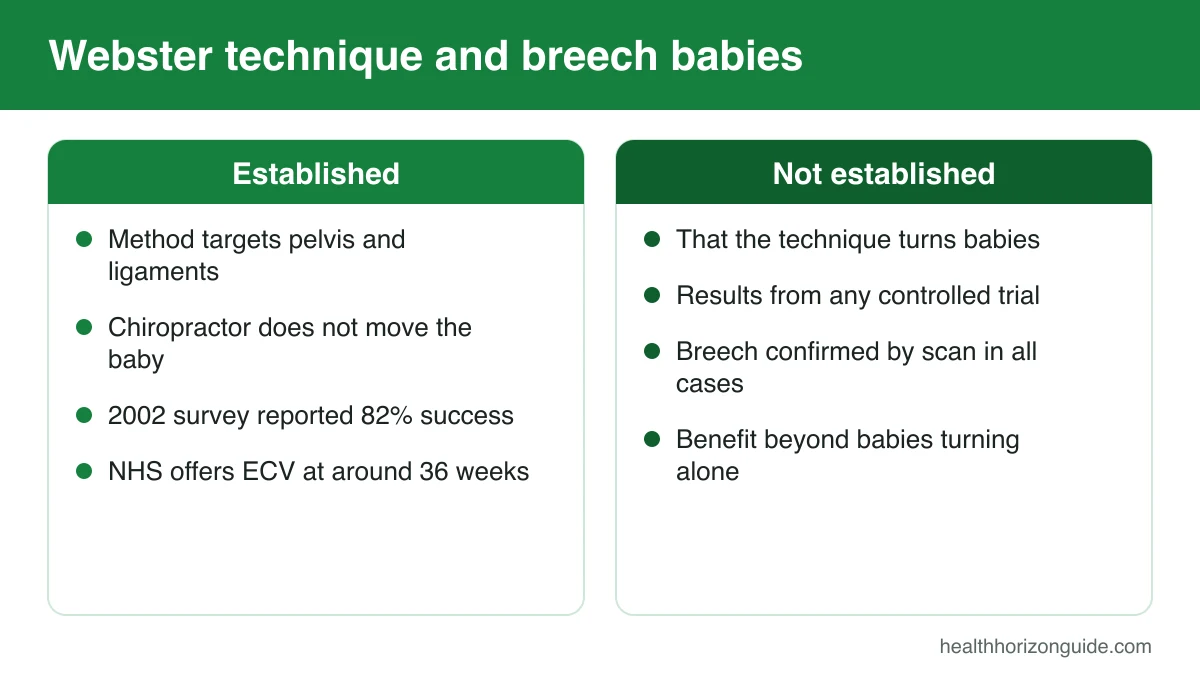
A chiropractor using the Webster technique is not proven to turn a breech baby. The Webster technique is a chiropractic method aimed at the pelvis and the ligaments around the uterus. Chiropractic literature states that the chiropractor does not try to move the baby during the Webster technique.
The main evidence is a 2002 survey of chiropractors who used the Webster technique. Surveys were mailed to 1,047 chiropractors, and 112 usable replies reported that most breech presentations resolved, with a stated success rate of 82%. The survey has serious limits. Results were self-reported by the chiropractors, no comparison group existed, and the breech position was not confirmed by ultrasound in 59 cases. Babies also turn head-down without any treatment, so the survey cannot show that chiropractic care caused the change. We found no controlled trial of the Webster technique.
The established medical option is external cephalic version. The NHS guidance on breech babies explains that an obstetrician usually offers this procedure at around 36 weeks and turns the baby by pressing on the abdomen. Our page on the Webster technique in chiropractic care explains the method in more detail.
What else should pregnant women know before booking chiropractic care?
Pregnant women should know three further safety points before booking chiropractic care. The sections below cover the conditions that rule out manipulation, the need to involve the maternity team, and the symptoms that need urgent maternity care.
When is chiropractic care not appropriate in pregnancy?
Chiropractic care is not appropriate in pregnancy when signs of an obstetric complication are present. The best-practice recommendations say that treatment should stop and the patient should be referred when a red flag appears. The recommendations advise caution with fast-thrust manipulation of the lower back and pelvis in the 8 situations listed below.
- Vaginal bleeding that the maternity team has not assessed.
- Cramping in the abdomen or pelvis.
- Ruptured membranes or signs that birth is close, including signs of preterm labour.
- Placenta previa or placental abruption.
- Suspected ectopic pregnancy.
- Bowel obstruction.
- Pregnancy-induced high blood pressure or pre-eclampsia.
- Recent injury to the pelvis.
An older narrative review of the chiropractic literature also lists premature labour and sudden pelvic pain as reasons not to adjust. Extra caution and prior obstetric clearance are advised for twin or multiple pregnancies, a previous miscarriage or stillbirth, and bleeding disorders.
Should the midwife or obstetrician know about chiropractic care?
The midwife or obstetrician should know about chiropractic care before the first visit. The best-practice recommendations encourage chiropractors to co-manage pregnant patients with the obstetric provider and to share records with the consent of the patient. The chiropractor should be told the week of pregnancy, any complications and the names of the maternity team. A concerning change in blood pressure or symptoms during a visit calls for immediate referral back to the obstetric provider.
Which warning signs need urgent maternity care?
Warning signs that need urgent maternity care are symptoms that point to a pregnancy complication, not a joint or muscle problem. Chiropractic care is the wrong service for these symptoms. Eight of the urgent maternal warning signs listed by the CDC are shown below.
- Vaginal bleeding or fluid leaking during pregnancy.
- Severe belly pain that starts suddenly or does not go away.
- The baby moving less than usual or not moving.
- A headache that will not go away or gets worse.
- Vision changes, dizziness or fainting.
- Extreme swelling of the hands or face.
- Fever of 100.4°F (38°C) or higher.
- Chest pain or trouble breathing.
The CDC advises seeking medical care immediately when any of these signs appears.
Frequently asked questions about seeing a chiropractor while pregnant
Can I see a chiropractor in the first trimester?
A chiropractor in the first trimester is not ruled out by the sources we reviewed. Chiropractic care should wait for an obstetric check when bleeding or cramping is present.
Do chiropractors use a special table for pregnant women?
Chiropractors who treat pregnant women often use pregnancy pillows or a table with a lowering abdominal section. Chiropractic care in pregnancy should never press on the abdomen.
Is neck manipulation safe in pregnancy?
Neck manipulation in pregnancy carries a rare but serious risk, since several of the serious injuries in the case reports followed neck manipulation. The risks of chiropractic care should be discussed for each area of the spine before treatment.
Does every chiropractor treat pregnant women?
Not every chiropractor treats pregnant women regularly. Women should ask how much experience of chiropractic care in pregnancy the chiropractor has before booking.