
What Is Zone 2 Cardio? Heart Rate, Benefits and Examples
Zone 2 cardio is steady exercise at about 60% to 70% of max heart rate. Learn how to find your zone, the talk test, real benefits and safety tips.

Zone 2 cardio is steady aerobic exercise at a low-to-moderate intensity, usually described as about 60% to 70% of your maximum heart rate. Zone 2 feels comfortable, and you can still hold a light conversation. Brisk walking, easy cycling and slow jogging are common examples.
Action checklist
Zone 2 cardio checklist
Use these steps to start zone 2 cardio safely and keep the effort at the right level.
0 of 8 done
In this article
- What is zone 2 cardio?
- What is the zone 2 heart rate?
- How do you know you are in zone 2?
- What are the benefits of zone 2 training?
- How much zone 2 cardio do you need per week?
- What are examples of zone 2 cardio?
- Is zone 2 cardio safe for everyone?
- How zone 2 fits into a wider health routine
- Zone 2 cardio FAQ
What is zone 2 cardio?
Zone 2 cardio is moderate, steady aerobic exercise in the second of five heart rate zones. Cleveland Clinic places zone 2 at 60% to 70% of your estimated maximum heart rate and calls it a comfortable workout effort. Zone 2 raises your heart rate a little, but not enough to leave you breathless.
The 5 heart rate zones run from very easy to all-out effort. The 3 main features of zone 2 cardio are listed below:
- Intensity: about 60% to 70% of estimated maximum heart rate.
- Breathing: faster than at rest, with enough breath to talk in sentences.
- Duration: an effort you can hold for a long, steady session.
What is the zone 2 heart rate?
The zone 2 heart rate is roughly 60% to 70% of your maximum heart rate. Most people estimate maximum heart rate with the formula 220 minus age. Cleveland Clinic gives the example of a 40-year-old, whose estimated maximum is 180 beats per minute (bpm) and whose zone 2 range is about 108 to 126 bpm.
The table below shows how the zone 2 estimate for that 40-year-old is calculated.
| Step | Calculation | Result |
|---|---|---|
| Estimated maximum heart rate | 220 minus 40 | 180 bpm |
| Lower end of zone 2 | 60% of 180 | 108 bpm |
| Upper end of zone 2 | 70% of 180 | 126 bpm |
The 220-minus-age formula is an estimate, not a measurement. Your true maximum heart rate can sit above or below the formula result. Lab or field testing gives a more personal figure, so treat any calculated zone 2 heart rate as a starting point.
How do you know you are in zone 2?
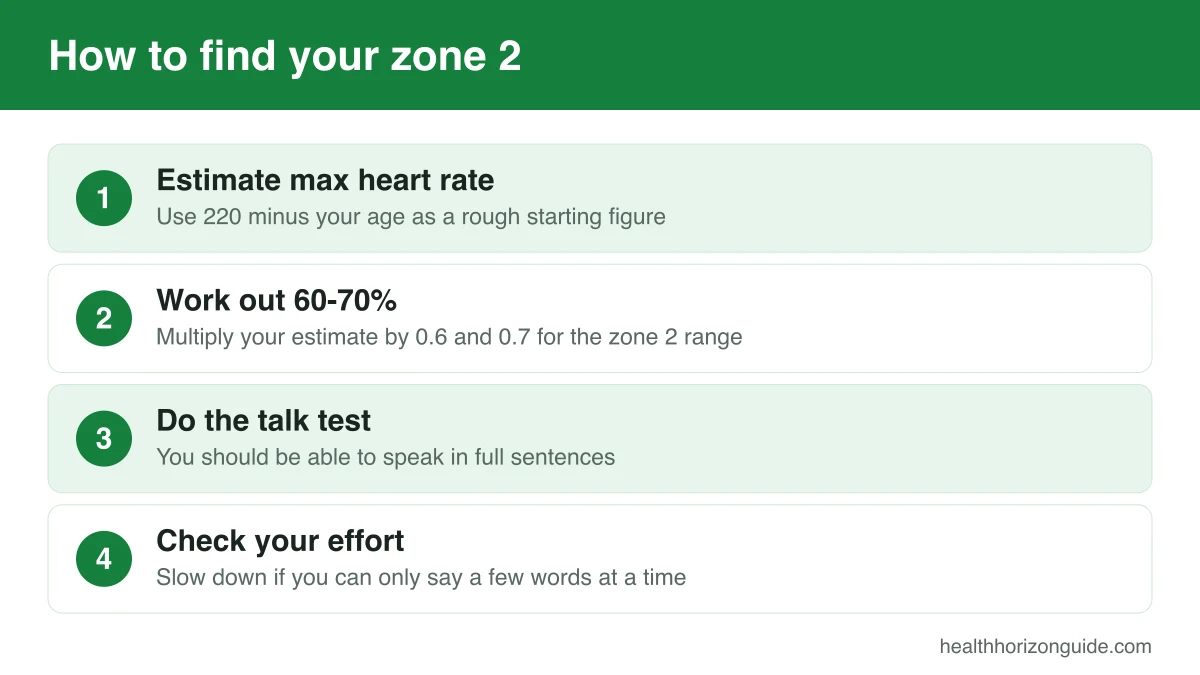
You know you are in zone 2 when you can talk comfortably but your breathing is clearly faster than at rest. Heart rate, the talk test and perceived exertion are the 3 common ways to check zone 2 effort. The steps below combine all three:
- Estimate your zone 2 heart rate range with 60% to 70% of 220 minus your age.
- Start at an easy pace and watch your heart rate on a watch or chest strap.
- Try the talk test: speak a full sentence out loud.
- Rate how hard the effort feels; zone 2 should feel easy to moderate, never straining.
- Slow down or walk when you can only manage a few words at a time.
What is the talk test for zone 2?
The talk test for zone 2 is being able to hold a light conversation while you exercise. Mayo Clinic describes moderate intensity as breathing that quickens without leaving you out of breath, where you can talk but not sing. Short, clipped answers suggest the effort has moved above zone 2.
How does perceived exertion relate to zone 2?
Perceived exertion is how hard the exercise feels to you, and zone 2 should feel comfortable and sustainable. Mayo Clinic notes that perceived exertion does not always match heart rate, and the match varies by person. Using both measures together gives a fuller picture of zone 2 effort.
Many people find that true zone 2 feels slower than expected. Runners often need to slow down or add short walking breaks to keep their heart rate in zone 2. Walking uphill or on an incline can raise a walking heart rate into zone 2.
What are the benefits of zone 2 training?
The benefits of zone 2 training are the general benefits of regular moderate aerobic exercise. Cleveland Clinic lists 4 claimed benefits of zone 2 cardio:
- Heart and lung function: a stronger heart muscle and better use of oxygen.
- Fat use: lower intensities rely more on fat for fuel than higher intensities.
- Endurance: the body learns to resist fatigue over longer sessions.
- Easier recovery: less strain on muscles, tendons and ligaments than hard training.
Zone 2 also counts toward the weekly activity targets set by health agencies. Moderate aerobic activity, including zone 2 cardio, is the main tool those guidelines recommend.
Is zone 2 training overhyped?
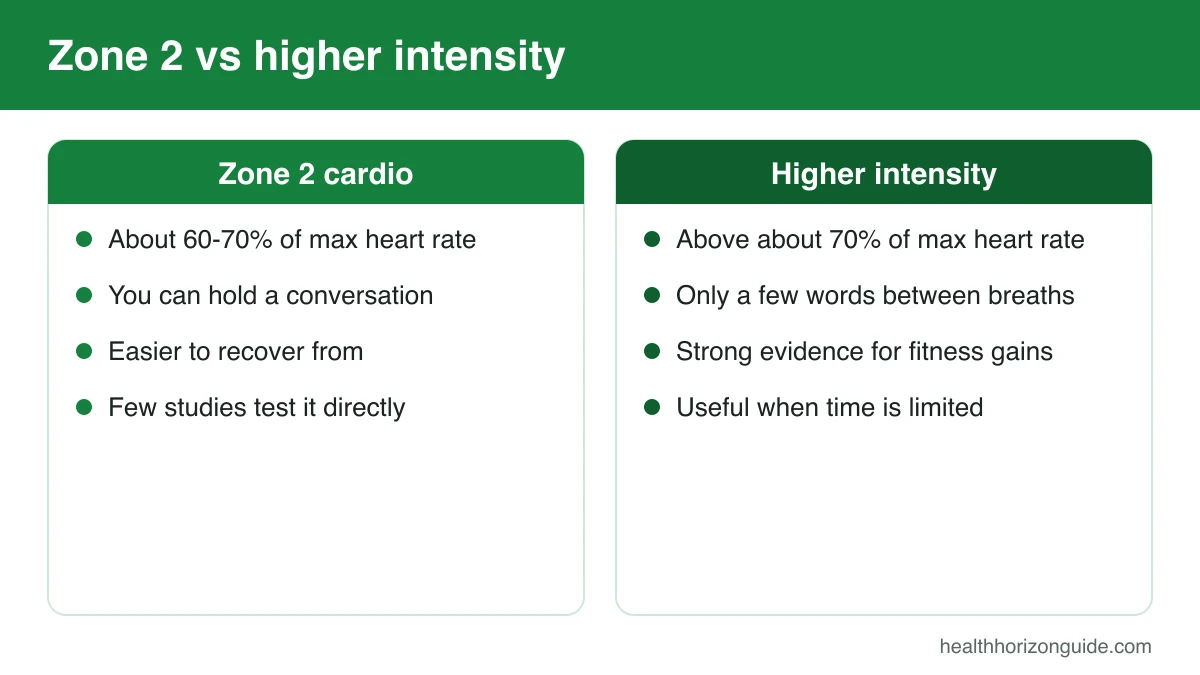
Yes, some popular claims about zone 2 training go further than the research supports. A 2025 narrative review in Sports Medicine, titled "Much Ado About Zone 2", challenges the broad public endorsement of zone 2 as the best intensity. The authors report that few studies test zone 2 directly.
The same review argues that higher-intensity exercise has strong evidence for improving mitochondrial capacity and cardiometabolic health. The authors state that intensities above zone 2 matter most when total training time is limited. Zone 2 cardio remains useful and safe for most people, but it is not proven to be the single best intensity.
How much zone 2 cardio do you need per week?
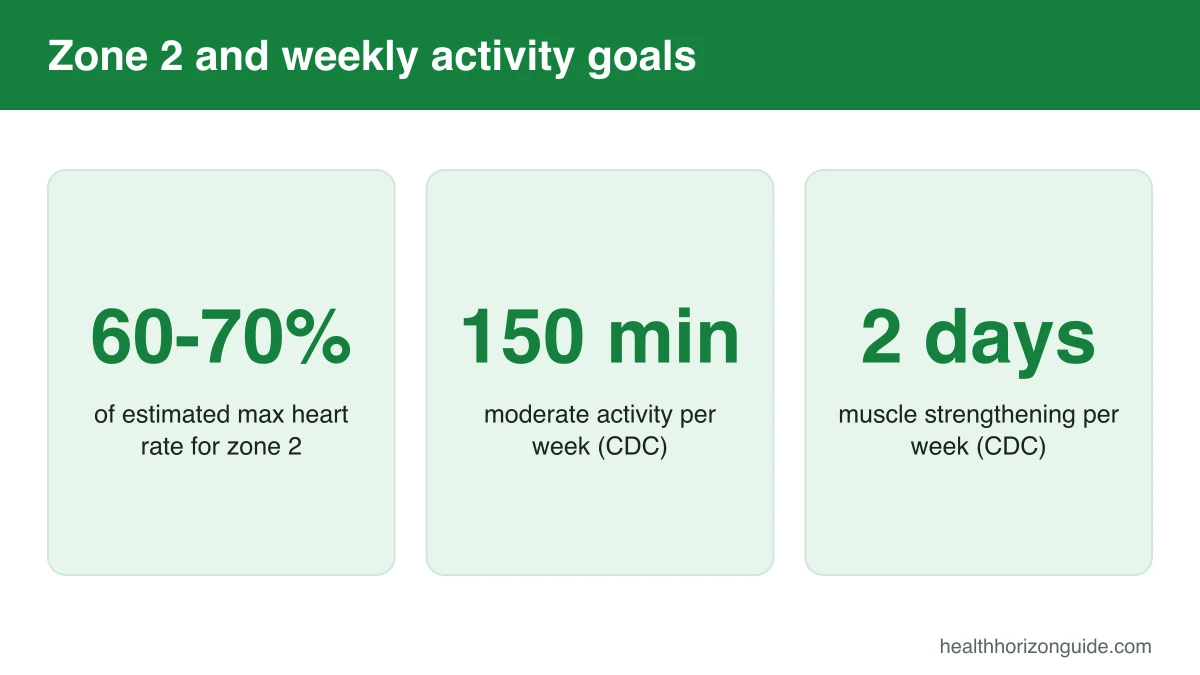
No official guideline sets a zone 2 target, but zone 2 cardio counts toward the general adult goal of 150 minutes of moderate activity per week. The Centers for Disease Control and Prevention (CDC) recommends at least 150 minutes of moderate-intensity activity a week, such as 30 minutes a day on 5 days. The CDC accepts 75 minutes of vigorous activity or an equal mix instead.
The table below compares the adult aerobic and strength targets from 2 health organisations.
| Organisation | Moderate aerobic activity | Vigorous alternative | Muscle strengthening |
|---|---|---|---|
| CDC | At least 150 minutes a week | 75 minutes a week | 2 days a week |
| World Health Organization | 150 to 300 minutes a week | 75 to 150 minutes a week | 2 or more days a week |
The World Health Organization guidelines recommend 150 to 300 minutes of moderate activity or 75 to 150 minutes of vigorous activity each week for adults. The American Heart Association recommendation of at least 150 minutes of moderate activity is cited by Cleveland Clinic, which places zone 2 in that moderate category.
The American Heart Association defines moderate intensity as about 50% to 70% of maximum heart rate, as Mayo Clinic reports. Zone 2 sits inside that moderate band. Vigorous intensity runs from about 70% to 85% of maximum heart rate.
What are examples of zone 2 cardio?
Examples of zone 2 cardio are steady, rhythmic activities done at a conversational pace. The 5 zone 2 activities that Cleveland Clinic lists are below:
- Brisk walking on flat ground.
- Slow running, well below race pace.
- Relaxed cycling, indoors or outdoors.
- Slow, steady swimming laps.
- Elliptical or rowing machine sessions.
Walking is the simplest place to start zone 2 cardio for most adults. Our guide to how many steps a day you should walk explains daily step goals that pair well with zone 2 walks.
Is zone 2 cardio safe for everyone?
Zone 2 cardio is a lower-strain form of exercise that suits many adults, but some people need medical advice first. People with heart conditions, or those taking medicines that change heart rate, should ask a doctor before relying on heart rate zones.
Beta blockers slow the heartbeat, so standard zone 2 heart rate ranges may not apply. The American Heart Association states that a target heart rate may need adjusting and that a brief exercise stress test can help set a new one. The talk test is a simpler guide in that situation. Never stop or change a prescribed medicine to reach a heart rate zone.
The 3 warning signs that mean you should stop exercising right away and seek urgent medical care are:
- Chest pain or pressure.
- Fainting or feeling close to fainting.
- Severe shortness of breath.
How zone 2 fits into a wider health routine
Zone 2 cardio works best as one part of a balanced weekly routine. Strength training on 2 days a week, some harder sessions when appropriate, sleep and diet all affect results.
Can zone 2 cardio help with weight management?
Zone 2 cardio burns calories and uses fat as a main fuel, but weight change depends on total energy balance. The daily calorie calculator estimates how much energy your body uses in a day.
Can zone 2 cardio help with blood sugar?
Regular moderate activity, including zone 2 cardio, is one of the lifestyle changes linked to better blood sugar control. Our article on whether prediabetes can be reversed covers the role of activity alongside weight and diet.
Can zone 2 cardio help with stress?
Moderate exercise such as zone 2 cardio is a common part of stress management. Our guide on how to lower cortisol explains the evidence on exercise and other habits.
Zone 2 cardio FAQ
Is walking zone 2 cardio?
Yes, brisk walking can be zone 2 cardio when it raises your heart rate to about 60% to 70% of your maximum. A faster pace or an incline helps when flat walking feels too easy.
Why does my heart rate jump out of zone 2 so fast?
Heart rate rises quickly in many people because the 220-minus-age formula is only an estimate and fitness levels vary. Slowing the pace, walking hills or using the talk test can keep the effort in zone 2.
Is zone 2 better than high-intensity exercise?
No, current evidence does not show that zone 2 is better than high-intensity exercise. A 2025 review found that higher intensities have strong support for fitness and cardiometabolic health, so many people benefit from a mix.
Do I need a heart rate monitor for zone 2?
No, a heart rate monitor is helpful but not required for zone 2 cardio. The talk test and perceived exertion give a free and practical guide to moderate effort.