
GAD-7 Score Meaning: What Each Score Range Tells You
GAD-7 scores run 0 to 21: minimal (0-4), mild (5-9), moderate (10-14) and severe (15-21). See what scores like 8, 11 and 17 mean and what to do next.

A GAD-7 score of 0 to 4 is minimal anxiety, 5 to 9 is mild, 10 to 14 is moderate and 15 to 21 is severe, based on the cut points proposed by Spitzer and colleagues in 2006. A score of 10 or higher is the usual point for a follow-up conversation with a clinician.
The GAD-7 is a screening questionnaire, not a diagnosis. Work out your own total with the anxiety self-check, then use the ranges below to understand what the number can and cannot tell you.
In this article
What do GAD-7 scores mean?
GAD-7 scores mean minimal, mild, moderate or severe anxiety symptoms over the previous two weeks. The bands come from the 2006 Spitzer study, and the University of Washington screening guide uses the same four labels. The table below shows the four bands and what each one usually leads to.
| GAD-7 total | Band | Usual next step |
|---|---|---|
| 0 to 4 | Minimal anxiety | No action needed unless symptoms bother you |
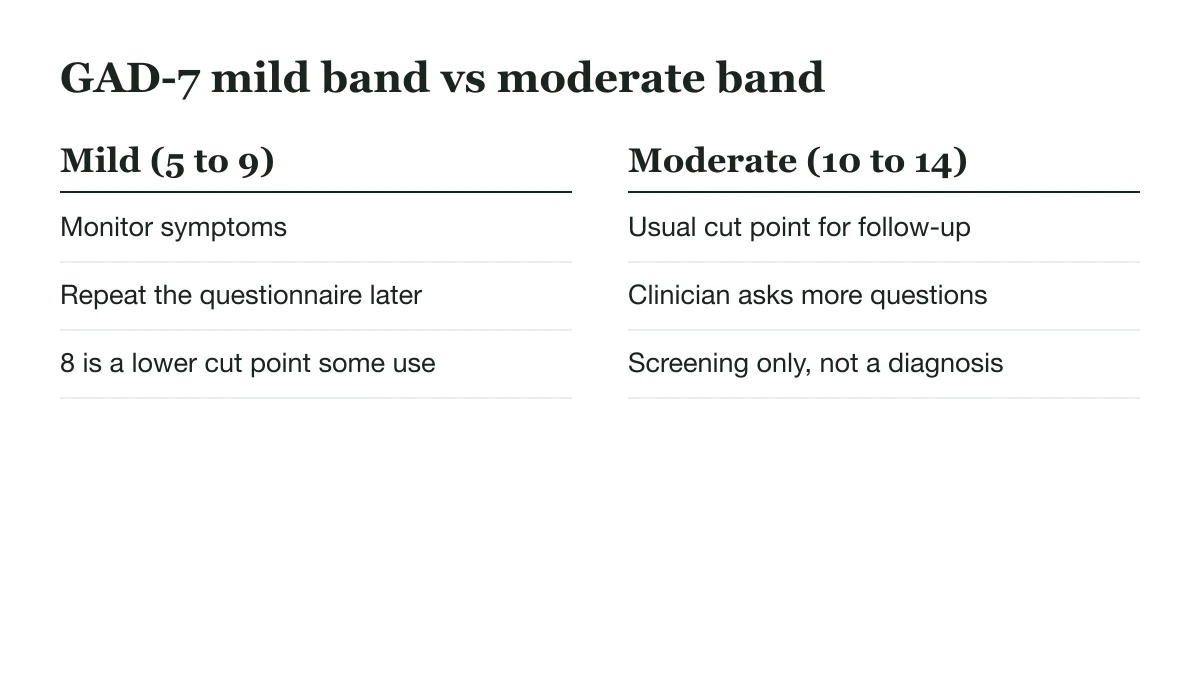
| 5 to 9 | Mild anxiety | Monitor symptoms and repeat the questionnaire later |
| 10 to 14 | Moderate anxiety | Further evaluation by a clinician |
| 15 to 21 | Severe anxiety | Prompt evaluation by a clinician |
The labels come from the authors of the original study, who suggested that scores of 5, 10 and 15 may correspond to mild, moderate and severe anxiety. The "usual next step" column is a plain summary of the screening approach, not a rule for any one person.
How is the GAD-7 scored?
The GAD-7 is scored by adding seven answers, each rated from 0 to 3, to give a total between 0 and 21. The seven questions ask how often a problem has bothered you over the last 2 weeks, such as feeling nervous, being unable to stop worrying, trouble relaxing and feeling restless.
The four answer choices are "not at all" (0), "several days" (1), "more than half the days" (2) and "nearly every day" (3).
A worked example shows how the total builds up. Seven answers of "more than half the days" give 7 x 2 = 14, which falls in the moderate band. Moving just one answer up to "nearly every day" makes the total 15, which falls in the severe band.
Small changes in one answer can move a total across a band line. For that reason, a band label describes a range, and the exact number matters less than the pattern of answers.
What do single GAD-7 scores such as 8, 9, 10, 11 and 17 mean?
Single GAD-7 scores of 8 and 9 fall in the mild band, while 10 and 11 fall in the moderate band and 17 falls in the severe band. The sections below explain each number in turn.
Is a GAD-7 score of 8 bad?
A GAD-7 score of 8 is in the mild range, but the University of Washington guide calls a score of 8 or greater a reasonable cut point for identifying probable generalized anxiety disorder. At that cut point, sensitivity is 92% and specificity is 76%.
Some experts therefore treat 8 as a reason to look more closely, even though the standard band says mild. A clinician decides what to do with it, based on symptoms and daily life.
What does a GAD-7 score of 9 mean?
A GAD-7 score of 9 is the top of the mild range, one point below the standard cut point of 10. A score of 9 still sits above the lower 8-point cut point described above.
Repeating the questionnaire after a few weeks shows whether the symptoms are settling or rising. A reading of 9 that climbs to 10 or more is a clearer reason to see a clinician.
What does a GAD-7 score of 10 mean?
A GAD-7 score of 10 is the recommended cut point for further evaluation. The 2006 study named a score of 10 or greater as the point for identifying probable generalized anxiety disorder.
Scoring exactly 10 does not mean a disorder is present. It means the screening result is high enough that a clinician should ask more questions.
What does a GAD-7 score of 11 mean?
A GAD-7 score of 11 is in the moderate range and above the 10-point cut point. A clinician would usually follow up with a longer conversation about symptoms, sleep, daily function and other conditions.
The score also overlaps with other problems. The same questionnaire picks up some symptoms of panic disorder, social anxiety disorder and post-traumatic stress disorder, so the follow-up sorts out which one applies.
What does a GAD-7 score of 17 mean?
A GAD-7 score of 17 is in the severe range, which spans 15 to 21. A score of 17 means most of the seven items were answered "more than half the days" or "nearly every day".
Prompt assessment by a doctor or mental health professional is sensible. Anyone who feels unsafe or has thoughts of suicide can call or text 988 in the United States, as described later in this article.
How accurate is the GAD-7 score?
The GAD-7 score is good at flagging probable generalized anxiety disorder but not at confirming it. In the 2006 study, 2,740 adults completed the questionnaire at 15 primary care clinics, and 965 of them also had an interview with a mental health professional.
At a cut point of 10, sensitivity was 89% and specificity was 82% for generalized anxiety disorder. These figures come from the original JAMA Internal Medicine article.
In plain terms, a low score makes generalized anxiety disorder less likely. A high score still needs an interview, because some people who score 10 or more do not have the disorder.
The University of Washington guide reports how the GAD-7 performs at the same cut point of 10 for other conditions, shown below.
| Condition | Sensitivity at 10 | Specificity at 10 |
|---|---|---|
| Generalized anxiety disorder | 89% | 82% |
| Panic disorder | 74% | 81% |
| Social anxiety disorder | 72% | 80% |
| Post-traumatic stress disorder | 66% | 81% |
What does the GAD-7 not tell you?
The GAD-7 does not tell you which anxiety disorder is present, or whether any disorder is present at all. The University of Washington guide describes it as an initial screening tool and states that further diagnostic assessment is needed to determine the presence and type of anxiety disorder.
The score also cannot show the cause. Physical conditions, medicines, caffeine, poor sleep and depression can all raise anxiety answers, and only a clinician can separate them.
The result covers only the last 2 weeks. A stressful fortnight can produce a high score in a person without an anxiety disorder, and a calm fortnight can produce a low score in a person with long-standing symptoms.
The score is also not a measure of how a person feels. Two people with a total of 12 can have very different days.
What should you do after a high GAD-7 score?
After a high GAD-7 score, book a visit with a doctor or mental health professional and bring the result with you. The score gives the clinician a starting point for questions.
The steps below describe a practical order for the next few weeks.
- Write down the total, the date and the answers that scored 2 or 3.
- Note how often symptoms interfere with work, sleep, school or relationships.
- Book an appointment with a primary care clinician or a mental health professional.
- List medicines, supplements, caffeine and alcohol use, because these can affect anxiety.
- Repeat the questionnaire after a few weeks, and share both results.
Readers who want a fuller picture of physical signs can read about the physical symptoms of anxiety. A broader guide covers anxiety signs and how to get help.
When does anxiety need urgent help?
Anxiety needs urgent help when a person feels unsafe or has thoughts of suicide. In the United States, the 988 Suicide and Crisis Lifeline answers by call, text or chat 24 hours a day, every day. Calls and texts to 988 are free and confidential.
In a life-threatening situation, call 911. Chest pain that is new, severe or unexplained is also an emergency, even when anxiety seems the likely cause, as explained in the guide to anxiety chest pain.
Anxiety that lasts, spreads to many situations or worsens over time deserves attention, according to the National Institute of Mental Health.
GAD-7 score questions
What score on the GAD-7 indicates anxiety?
A GAD-7 score of 10 or higher is the usual sign of probable generalized anxiety disorder. Some experts use 8 as a lower cut point to catch more cases.
Can the GAD-7 diagnose generalized anxiety disorder?
No, the GAD-7 cannot diagnose generalized anxiety disorder. It screens for probable cases, and a clinician must confirm the diagnosis with an assessment.
Is the GAD-7 a Likert scale?
The GAD-7 uses four ordered answer choices scored 0 to 3, which is the same style as a Likert-type scale. The seven scores are added to give a total from 0 to 21.
Action checklist
After you get a GAD-7 score
Use these steps to turn a GAD-7 total into a useful conversation with a clinician.
0 of 9 done