Mediterranean Diet vs Dairy-Free Diet: Key Differences
Mediterranean diet vs dairy-free diet: see how the two differ, how much dairy the Mediterranean diet includes, and how to follow it without dairy.
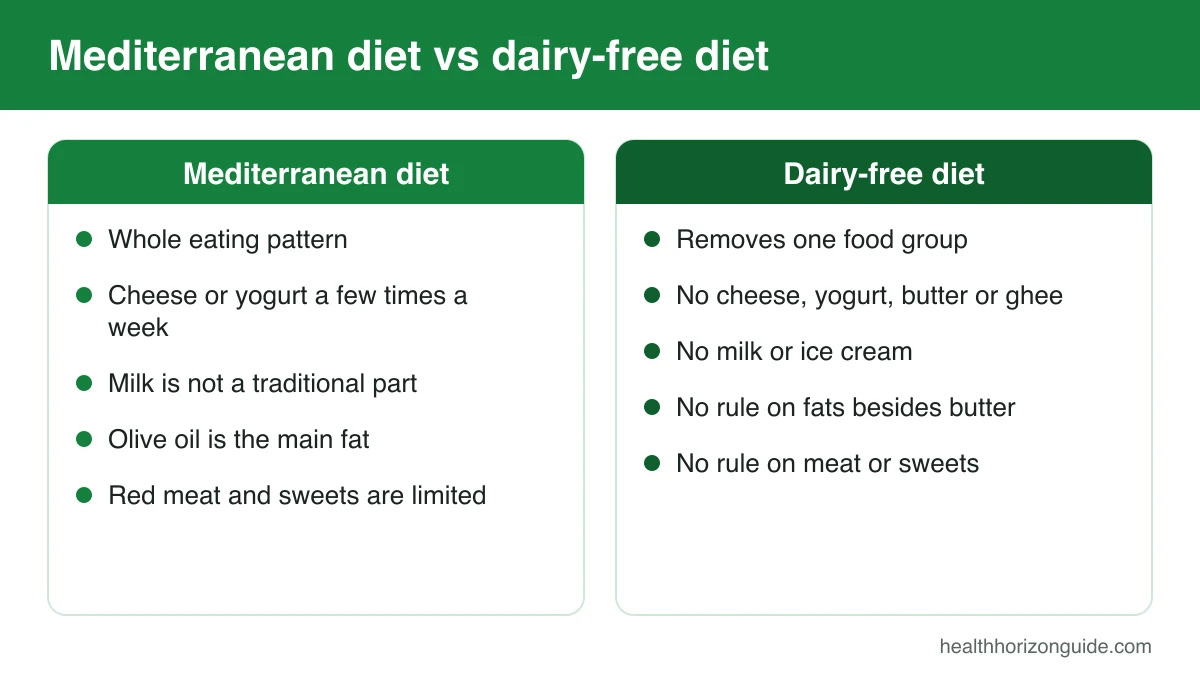
The Mediterranean diet and a dairy-free diet are different kinds of diet. The Mediterranean diet is a whole eating pattern that includes a few servings of cheese or yogurt a week, according to Cleveland Clinic. A dairy-free diet removes one food group and sets no rules for the rest, so the Mediterranean diet can be followed without dairy.
Action checklist
Following the Mediterranean diet without dairy
Use these steps from the article to follow a dairy-free Mediterranean diet safely.
0 of 10 done
In this article
- What is the difference between the Mediterranean diet and a dairy-free diet?
- How much dairy does the Mediterranean diet include?
- Is the Mediterranean diet dairy-free?
- Can you do the Mediterranean diet without dairy?
- Who needs a dairy-free diet?
- Which nutrients need replacing on a dairy-free Mediterranean diet?
- Mediterranean diet vs dairy-free diet: which is better for health?
- How do you read labels for hidden dairy on a dairy-free diet?
- When should you see a doctor or dietitian about a dairy-free diet?
- Mediterranean diet vs dairy-free diet: common questions
What is the difference between the Mediterranean diet and a dairy-free diet?
The difference between the Mediterranean diet and a dairy-free diet is that one is an eating pattern and the other is a single exclusion. The Mediterranean diet covers every food group, and a dairy-free diet names only what to leave out.
What is the Mediterranean diet?
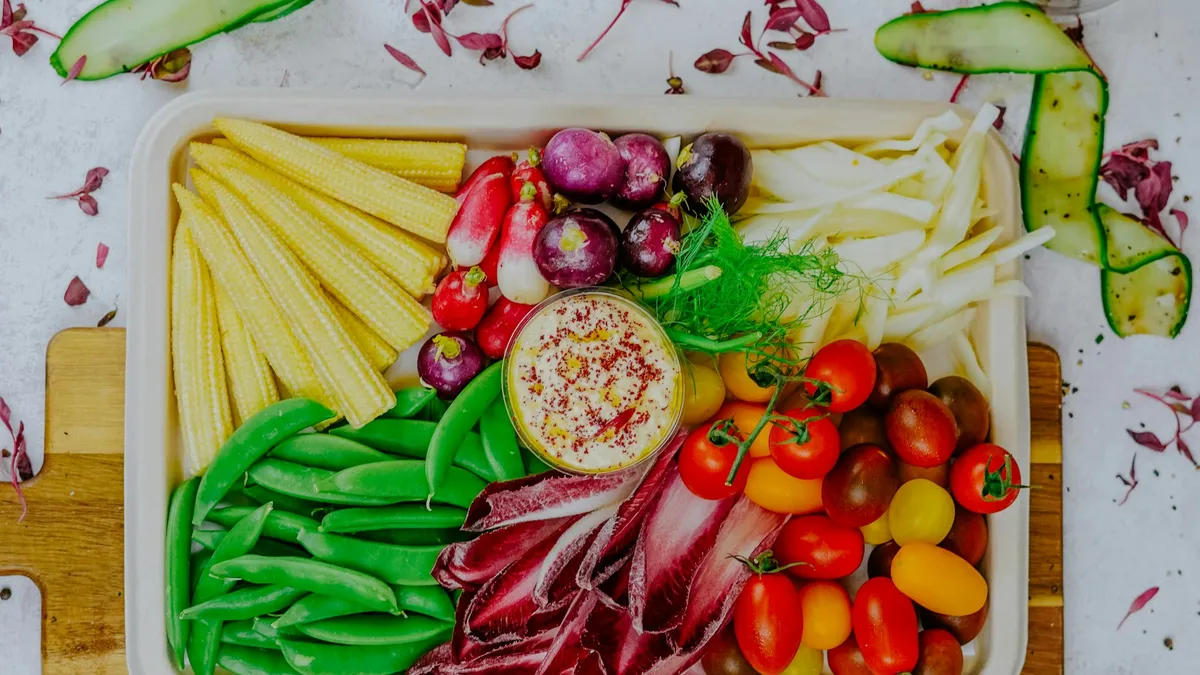
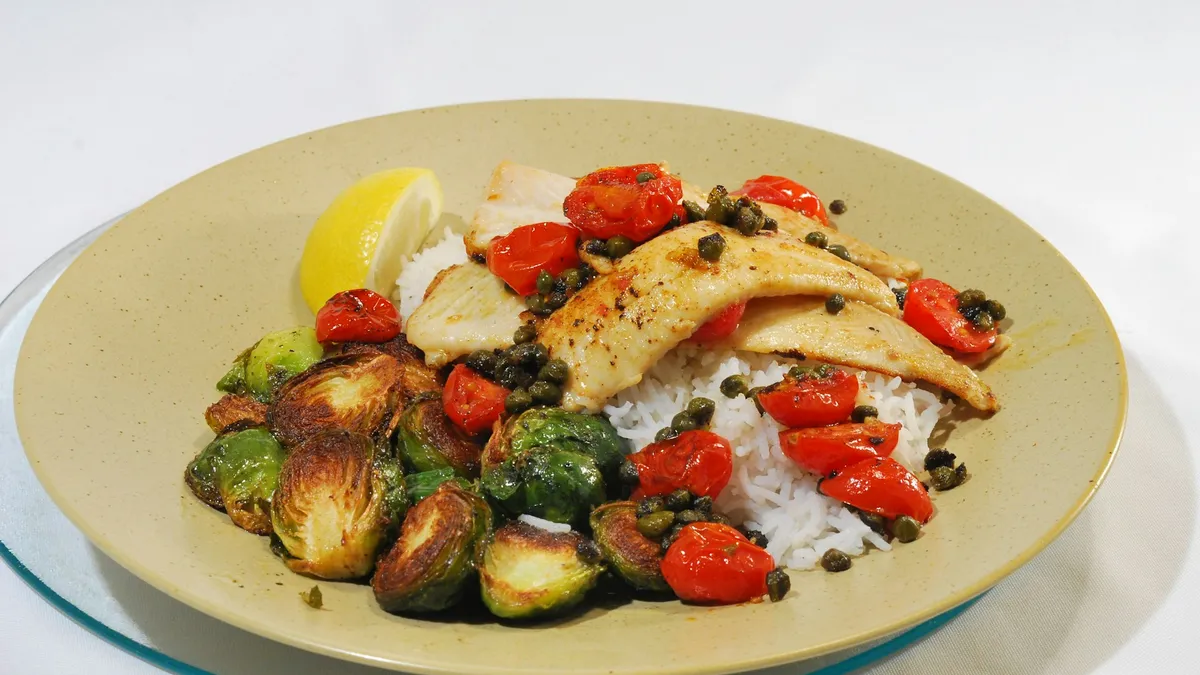
The Mediterranean diet is a flexible eating pattern built on vegetables, fruit, beans, nuts, whole grains and olive oil. The pattern includes fish and seafood. Red meat, processed meat, sweets and some dairy are limited.
What is a dairy-free diet?
A dairy-free diet is a diet that excludes milk and every food made from milk. Cheese, yogurt, butter, ghee, cream and ice cream are excluded. A dairy-free diet sets no rules for vegetables, grains, meat or sugar, so the quality of a dairy-free diet depends on the other foods chosen.
Foods allowed on the Mediterranean diet and a dairy-free diet
Foods allowed on the Mediterranean diet and a dairy-free diet conflict only on milk products. The table below compares the Mediterranean diet and a dairy-free diet across 7 food groups.
| Food group | Mediterranean diet | Dairy-free diet |
|---|---|---|
| Vegetables and fruit | Eaten as the base of the diet | Allowed, with no rule set |
| Whole grains, beans and nuts | Eaten as staples | Allowed, with no rule set |
| Fish and seafood | Included | Allowed, with no rule set |
| Main fat | Olive oil | Any fat except butter and ghee |
| Cheese and yogurt | A few servings a week | Excluded |
| Milk | Not a traditional part of the diet | Excluded |
| Red meat, processed meat and sweets | Limited | Allowed, with no rule set |
How much dairy does the Mediterranean diet include?
The Mediterranean diet includes a few servings of cheese or yogurt a week, according to Cleveland Clinic dietitian Julia Zumpano. That amount is smaller than in a standard American diet.
Milk is not a traditional part of the Mediterranean diet. Cleveland Clinic recommends less processed cheeses, such as Parmesan, feta or part-skim mozzarella. Plain Greek yogurt is preferred over sweetened yogurt on the Mediterranean diet.
Is the Mediterranean diet dairy-free?
No, the Mediterranean diet is not dairy-free. The Mediterranean diet is a lower-dairy pattern that keeps modest amounts of cheese and yogurt.
Can you do the Mediterranean diet without dairy?
Yes, you can do the Mediterranean diet without dairy, because dairy is a small part of the pattern. The staple foods of the Mediterranean diet contain no milk.
Cleveland Clinic suggests unsweetened almond or soy milk in place of milk. The NHS counts unsweetened, calcium-fortified plant drinks as part of the dairy food group. The table below lists 6 dairy foods and a non-dairy Mediterranean diet replacement for each.
| Dairy food | Non-dairy Mediterranean replacement |
|---|---|
| Milk | Unsweetened, calcium-fortified soy or almond drink |
| Yogurt | Unsweetened, calcium-fortified soy alternative to yogurt |
| Feta on salads | Olives, toasted nuts or seeds |
| Butter | Extra-virgin olive oil |
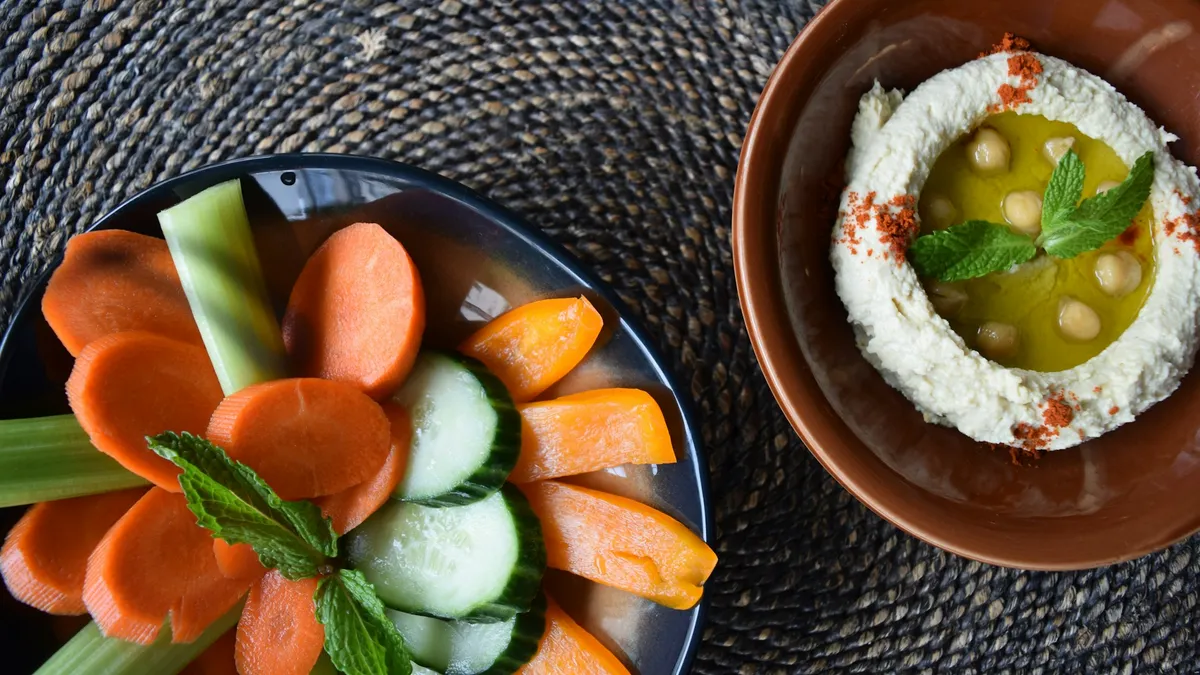
| Creamy sauces and dips | Tahini or hummus |
| Ice cream | All-fruit sorbet |
Plant-based replacements differ from dairy foods in calories. Our daily calorie calculator estimates a calorie target for a dairy-free Mediterranean diet.
Who needs a dairy-free diet?
People who need a dairy-free diet are mainly people with a cow's milk allergy. People with lactose intolerance need less lactose, and many do not need a fully dairy-free diet. The Mediterranean diet suits both groups once dairy is replaced.
What is the difference between cow's milk allergy and lactose intolerance?
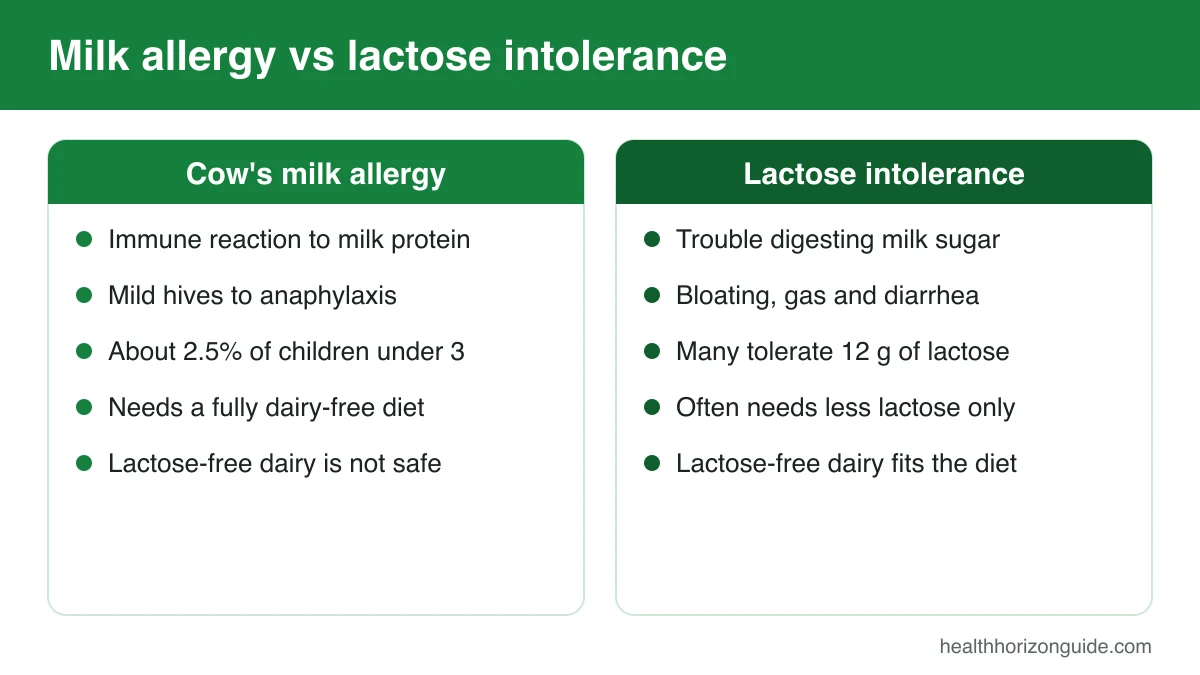
The difference between cow's milk allergy and lactose intolerance is that the allergy involves the immune system and the intolerance involves digestion. The National Institute of Diabetes and Digestive and Kidney Diseases (NIDDK) describes milk allergy as an immune system disorder.
The 4 differences that shape a dairy-free diet are listed below.
- Cause: milk allergy is a reaction to milk protein, and lactose intolerance is a reaction to milk sugar.
- Symptoms: milk allergy ranges from mild hives to anaphylaxis, and lactose intolerance causes bloating, gas and diarrhea.
- Frequency: about 2.5% of children under 3 are allergic to milk, and about 36% of people in the United States have lactose malabsorption.
- Diet: milk allergy requires avoiding all milk protein, and many people with lactose intolerance tolerate about 12 grams of lactose, the amount in 1 cup of milk.
Food Allergy Research and Education (FARE) reports that up to 75% of children outgrow a milk allergy.
Is lactose-free the same as dairy-free?
No, lactose-free is not the same as dairy-free. Lactose-free dairy has added lactase and contains the same vitamins and minerals as standard dairy, according to the NHS. Lactose-free products still contain milk protein, so a dairy-free diet for milk allergy excludes them. Lactose-free yogurt and cheese fit the Mediterranean diet for people with lactose intolerance.
Which nutrients need replacing on a dairy-free Mediterranean diet?
The nutrients that need replacing on a dairy-free Mediterranean diet are calcium, vitamin D, iodine, vitamin B12 and protein. The NIDDK warns that people who avoid all milk products may get less calcium and vitamin D than the body needs. The 5 nutrients and their non-dairy sources are listed below.
- Calcium: canned salmon and sardines with soft bones, broccoli, leafy greens, almonds, dried beans, tofu and fortified soy milk, as named by the NIDDK.
- Vitamin D: eggs, salmon, fortified cereals and sunlight on the skin (NIDDK).
- Iodine: fish, shrimp, seaweed, eggs and iodized salt, as named by the NIH Office of Dietary Supplements.
- Vitamin B12: fish, meat, poultry and eggs. Plant foods contain no vitamin B12 unless fortified, according to the NIH vitamin B12 fact sheet.
- Protein: fish, eggs, beans, lentils and nuts, which are staples of the Mediterranean diet.
A dairy-free Mediterranean diet that keeps fish and eggs has a food source for all 5 nutrients.
Mediterranean diet vs dairy-free diet: which is better for health?
The Mediterranean diet is the better-studied choice for general health. Our sources show no general health benefit from a dairy-free diet for people who tolerate dairy.
Which diet is better for heart health?
The Mediterranean diet is better for heart health on current evidence. The PREDIMED trial assigned 7,447 adults at high cardiovascular risk to a Mediterranean diet with olive oil, a Mediterranean diet with nuts, or a reduced-fat diet. Cardiovascular disease was about 30% lower in both Mediterranean diet groups, according to Harvard's Nutrition Source.
Our research found no comparable trial of a dairy-free diet for heart health.
Which diet is better for weight loss?
Neither the Mediterranean diet nor a dairy-free diet is better for weight loss by design. The American Heart Association states that weight loss on the Mediterranean diet still requires cutting calories. A dairy-free diet lowers weight only when total calories fall. Our Mediterranean diet vs keto comparison covers weight loss in more detail.
Which diet is better for inflammation?
A dairy-free diet is not shown to be better for inflammation in people who tolerate dairy. A systematic review of 27 randomized trials concluded that dairy products and dairy proteins have neutral to beneficial effects on inflammation markers. Milk allergy is a separate case, because milk protein triggers an immune reaction.
Our Mediterranean diet vs Zone diet comparison covers another eating plan promoted for inflammation.
Which diet is better for gut health?
A dairy-free diet is better for gut health only for people who react to dairy. Lactose intolerance causes bloating, gas and diarrhea, and eating less lactose reduces those symptoms.
The Mediterranean diet supplies fiber from beans, whole grains and vegetables. Research on the Mediterranean diet and gut bacteria is promising, and results from controlled trials are not yet consistent. Our science-backed gut health guide explains how fiber feeds gut bacteria.
How do you read labels for hidden dairy on a dairy-free diet?
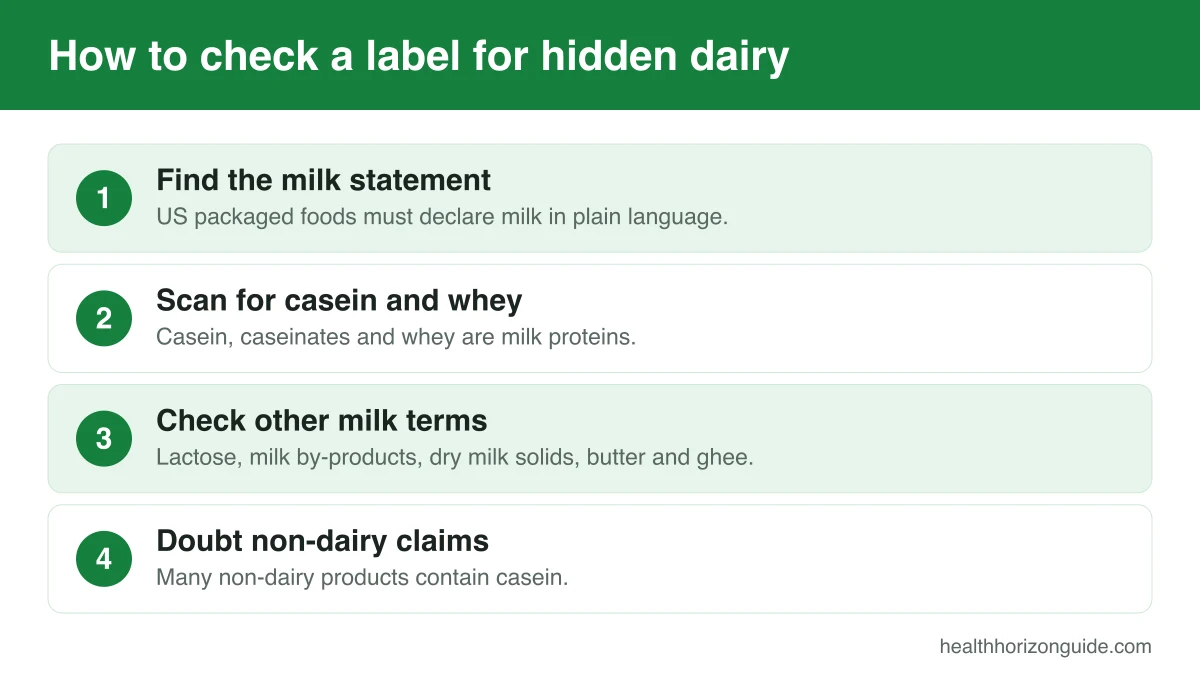
Reading labels for hidden dairy means checking the ingredient list for milk-derived terms. FARE states that United States law requires packaged foods to declare milk in plain language. The 7 terms below signal milk in a product, according to FARE and the NIDDK.
- Casein and caseinates
- Whey
- Lactose
- Lactalbumin and lactoglobulin
- Milk by-products
- Dry milk solids and nonfat dry milk powder
- Butter and ghee
A "non-dairy" label is not a guarantee, because FARE warns that many non-dairy products contain casein. A parent of a child with a milk allergy needs to read every label, even on packaged Mediterranean diet foods.
When should you see a doctor or dietitian about a dairy-free diet?
You should see a doctor or dietitian about a dairy-free diet before removing dairy from a child's diet and whenever a milk allergy is suspected. The NHS advises against cutting out dairy for an adult or a child without first speaking to a GP or dietitian.
Hives or other symptoms soon after milk need a medical assessment, and anaphylaxis needs emergency care.
The NHS advises that babies under 1 year should not be given rice, oat or almond drinks. A dietitian can plan a dairy-free Mediterranean diet that meets calcium and iodine needs.
Mediterranean diet vs dairy-free diet: common questions
Is feta cheese allowed on a dairy-free diet?
No, feta cheese is not allowed on a dairy-free diet, because feta is made from milk. FARE notes that goat's milk protein is very similar to cow's milk protein and may trigger a reaction.
Are eggs part of a dairy-free diet?
Yes, eggs are part of a dairy-free diet, because eggs are not a milk product. Eggs supply vitamin D, vitamin B12 and iodine on a dairy-free Mediterranean diet.
Is Greek yogurt allowed on the Mediterranean diet?
Yes, plain Greek yogurt is allowed on the Mediterranean diet in modest amounts. Greek yogurt is excluded on a dairy-free diet. Our Mediterranean vs Balkan diet comparison describes another regional eating pattern.