Best Sleeping Position for Lower Back Pain
The best sleeping position for lower back pain is on the side or back with pillow support. Learn each setup, mattress evidence and night-time red flags.
The best sleeping position for lower back pain is usually on the side with a pillow between the knees, or on the back with a pillow under the knees. Both setups aim to keep the spine in a neutral line and take strain off the lower back. Stomach sleeping is the position that most medical sources advise against.
Action checklist
Sleep setup checklist for lower back pain
Use these steps from the article to set up a sleeping position that puts less strain on the lower back.
0 of 10 done
In this article
- What is the best sleeping position for lower back pain?
- How strong is the evidence for sleeping positions and lower back pain?
- Mattress firmness and pillows for lower back pain
- How to get in and out of bed with lower back pain
- Why does my lower back hurt when I wake up?
- Best sleeping position for sciatica
- Best sleeping position for neck pain
- Lower back pain when lying down: when to see a doctor
- Frequently asked questions about sleeping with lower back pain
What is the best sleeping position for lower back pain?
The best sleeping position for lower back pain is side sleeping or back sleeping with pillow support, according to guidance from Mayo Clinic, Cleveland Clinic and MedlinePlus. No single position suits every person, so comfort through the night is the practical test. The table below compares the 3 main sleeping positions for lower back pain and the pillow setup that sources describe for each one.
| Sleeping position | Pillow setup | What sources say |
|---|---|---|
| Side | Knees partly bent, a small pillow between the knees, a head pillow thick enough to keep the neck level | Described as a good choice by Cleveland Clinic and MedlinePlus |
| Back | A pillow or rolled towel under the knees, a head pillow that supports the neck | May relax the back muscles and keep the curve of the lower back, per Mayo Clinic |
| Stomach | A thin pillow under the hips and lower stomach, a very thin head pillow or none | Can be hard on the back and tends to twist the neck |
Side sleeping with a pillow between the knees
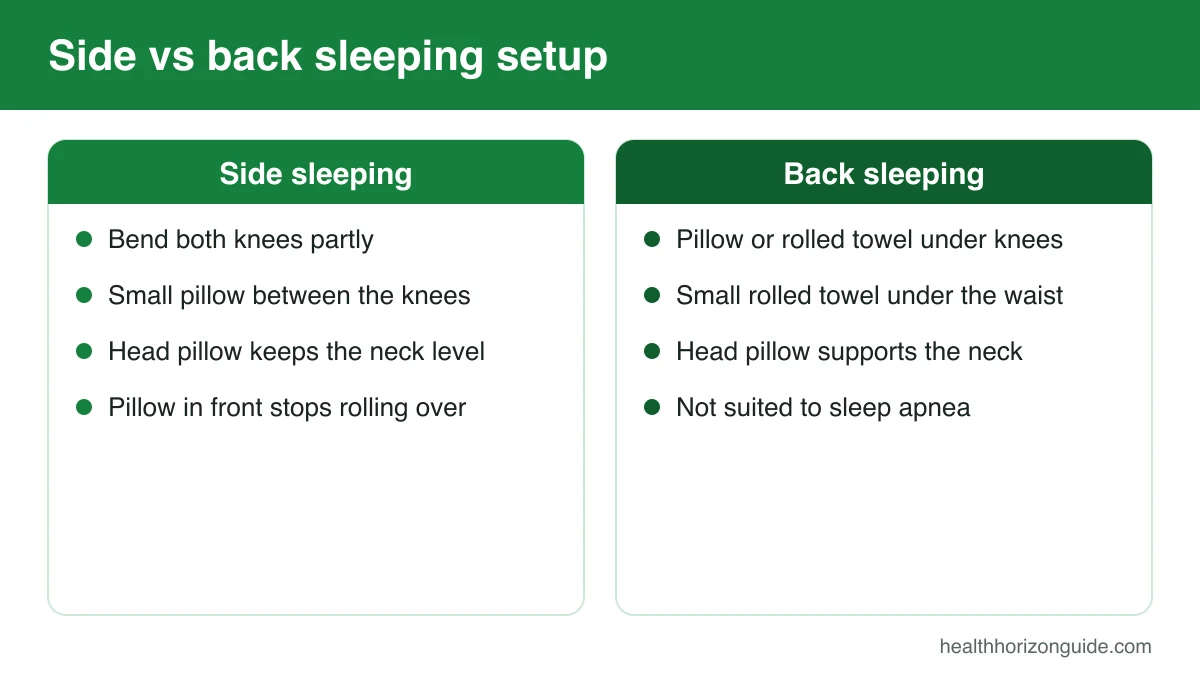
Side sleeping with a pillow between the knees is the setup that Cleveland Clinic and MedlinePlus describe for side sleepers who have lower back pain. MedlinePlus suggests a curled, fetal-style position with a pillow between the legs. The 4 steps for the side sleeping setup are listed below.
- Lie on one side and bend both knees partly.
- Place a small pillow between the knees.
- Choose a head pillow thick enough to keep the upper spine straight and parallel to the mattress.
- Put a pillow in front of the body to prevent rolling onto the stomach.
Back sleeping with a pillow under the knees
Back sleeping with a pillow under the knees may relax the back muscles and keep the natural curve of the lower back, according to Mayo Clinic. A small rolled towel under the waist adds support for people who need more. MedlinePlus gives the same advice for people who usually sleep on the back: a pillow or rolled towel goes under the knees. Cleveland Clinic lists back sleeping as a good position for lower back pain, except for people with sleep apnea.
Stomach sleeping and its drawbacks
Stomach sleeping is the position most sources advise against for lower back pain. Cleveland Clinic states that stomach sleeping tends to twist the neck and throw the spine out of alignment. Mayo Clinic notes that stomach sleeping can be hard on the back. People who cannot sleep any other way can place a pillow under the hips and lower stomach, and use a very thin head pillow or none.
How strong is the evidence for sleeping positions and lower back pain?
The evidence for sleeping positions and lower back pain is limited and based mostly on expert guidance. The Cleveland Clinic, MedlinePlus and NHS pages we reviewed present position advice as practical guidance and do not cite large trials that compare one position against another. A sleeping position is a comfort measure for lower back pain, not a cure. Daytime habits matter as well. MedlinePlus states that health care providers do not recommend bed rest for back pain, and the NHS advises people to keep active and avoid long periods in bed.
Mattress firmness and pillows for lower back pain
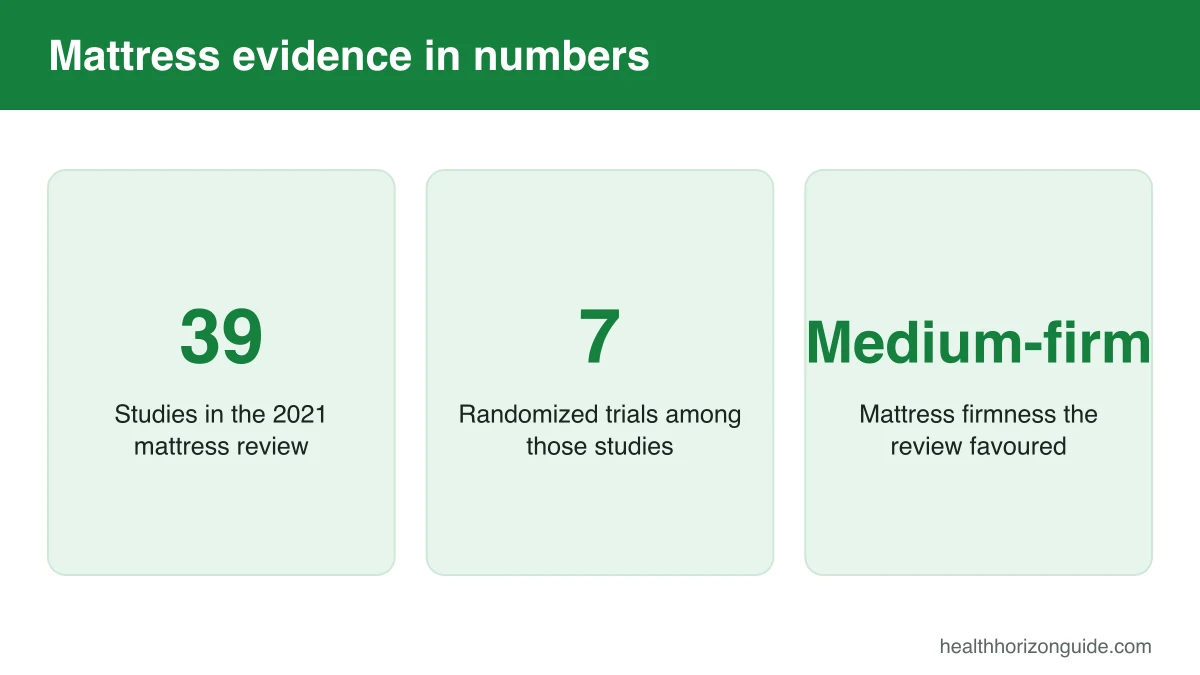
Mattress firmness for lower back pain is most often recommended as medium-firm, although the research behind the advice has clear limits. A 2021 review in the Journal of Orthopaedics and Traumatology examined 39 studies and concluded that medium-firm mattresses support comfort, sleep quality and spinal alignment. Only 7 of the 39 studies were randomized trials, so the conclusion deserves caution. No mattress type has been proven to treat lower back pain.
Cleveland Clinic recommends a medium-firm mattress that feels supportive without letting the body sink in. One useful clue is stiffness that disappears after a night in a different bed. Pillows matter for the neck: Mayo Clinic advises a head pillow that keeps the neck in line with the chest and back.
How to get in and out of bed with lower back pain
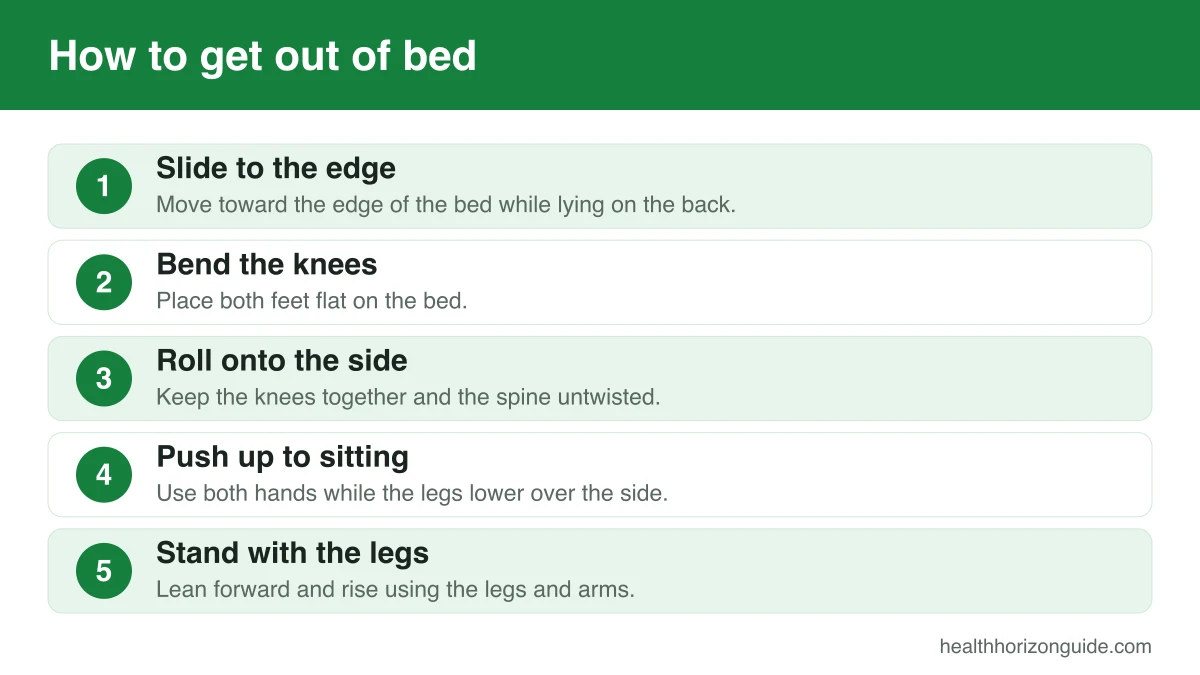
Getting out of bed with lower back pain is easiest with a roll onto the side, a method that avoids twisting the spine. The 5 steps below follow a patient guide from Hawaii Pacific Health.
- Slide toward the edge of the bed while lying on the back.
- Bend both knees and place the feet flat on the bed.
- Roll onto the side nearest the edge with the knees together and the spine untwisted.
- Push up to sitting with both hands while the legs lower over the side.
- Lean forward and stand by using the legs and arms.
The guide describes getting out of bed only. Reversing the same steps is a logical way to get into bed with lower back pain: sit on the edge, lower onto the side, then roll onto the back.
Why does my lower back hurt when I wake up?
Lower back pain on waking is most often linked to sleeping position, hours of lying still, or an unsupportive mattress, according to Cleveland Clinic. A night without movement lets the back stiffen, which explains why many people feel sore and stiff every morning and then loosen up once they move. Underlying conditions can also cause morning lower back pain. Cleveland Clinic names degenerative disk disease, spinal arthritis, fibromyalgia and pregnancy among the possible causes.
Morning stiffness often eases with gentle movement before standing. Cleveland Clinic suggests bringing one knee to the chest, holding for 3 seconds, then switching legs. Sitting on the edge of the bed first and standing with the legs is the next step. Our guide to morning stretches for lower back pain covers more options. A healthcare provider should assess lower back pain that occurs most mornings for 2 or 3 months, or that keeps getting worse. Readers who want to fix posture while sleeping and during the day can start with our posture and back pain self-check tool.
Best sleeping position for sciatica
The best sleeping position for sciatica is the same side or back setup used for lower back pain, since the sources we reviewed do not show that one position works better for nerve pain in the leg. MedlinePlus home care guidance for back pain suggests a curled side position with a pillow between the legs, or a pillow under the knees for back sleepers. Comfort is the guide: a position that sends more pain, tingling or numbness down the leg is the wrong one. Our article on sciatica treatment techniques explains the condition in more detail.
Best sleeping position for neck pain
The best sleeping position for neck pain is on the side or back with a pillow that keeps the neck level with the spine. Mayo Clinic advises a pillow that holds the neck in line with the chest and back. Side sleepers need a thick head pillow that keeps the upper spine straight, according to Cleveland Clinic. Stomach sleeping turns the head to one side for hours, which is a problem for neck pain and lower back pain alike. More detail is available in our guide to care options for neck pain.
Lower back pain when lying down: when to see a doctor
Lower back pain when lying down needs a doctor when the pain is worse at night or does not ease with rest. Most lower back pain improves with movement and time, so night pain that persists in every position is a different pattern. The 6 night-time red flags that the NHS and MedlinePlus link to a possible serious cause are listed below.
- Pain that is worse at night or does not improve with rest.
- Fever, or feeling hot, shivery or generally unwell.
- Unexplained weight loss.
- Numbness, tingling or weakness in both legs.
- Loss of feeling around the genitals or anus.
- Bladder or bowel changes, such as difficulty urinating or loss of control.
The last 3 signs in the list are treated as an emergency by the NHS and need immediate care. A medical assessment should rule out every sign above before any hands-on treatment, including chiropractic care for lower back pain.
Frequently asked questions about sleeping with lower back pain
Does a pillow between the knees help lower back pain?
A pillow between the knees is a low-risk setup that several medical sources recommend for side sleepers with lower back pain. Large trials have not tested the setup, so the benefit rests on clinical guidance and personal comfort.
Is a firm or soft mattress better for lower back pain?
A medium-firm mattress is the firmness most sources favor for lower back pain. The supporting studies are mostly small or not randomized, so personal comfort still counts.
Is bed rest good for lower back pain?
Bed rest is not recommended for lower back pain by MedlinePlus or the NHS. Both sources advise staying as active as possible when no sign of a serious cause is present.
How long should morning lower back pain last before seeing a doctor?
Morning lower back pain deserves a medical visit when the pain occurs most mornings for 2 or 3 months or gets worse, according to Cleveland Clinic. Any red-flag symptom needs attention sooner.