Chiropractor for Lower Back Pain: Does It Help and Is It Safe?
A chiropractor for lower back pain uses spinal manipulation. See what guidelines say, how many visits are typical, the side effects and the red flags.

A chiropractor for lower back pain mainly uses spinal manipulation, a controlled hands-on thrust to a spinal joint, together with soft-tissue work. Research shows moderate-quality evidence of a modest improvement in pain and function, and the American College of Physicians lists spinal manipulation as one of several non-drug options for acute and chronic low back pain. Chiropractic care is not a cure, and certain symptoms need a doctor or emergency care first.
Action checklist
Before you see a chiropractor for lower back pain
Use these steps from the article to prepare for a chiropractor visit and to spot symptoms that need a doctor first.
0 of 9 done
In this article
- What does a chiropractor do for lower back pain?
- Does chiropractic care work for lower back pain?
- How many chiropractor visits for lower back pain?
- What happens at a chiropractor visit for lower back pain?
- Chiropractic adjustment side effects and who should not have spinal manipulation
- Lower back pain triggers, self-care and warning signs
- Self-care for lower back pain that sources recommend
- Red flags: when lower back pain needs a doctor or emergency care
- Alternatives to a chiropractor for lower back pain
- Frequently asked questions about a chiropractor for lower back pain
What does a chiropractor do for lower back pain?
A chiropractor treats lower back pain with spinal manipulation, also called a chiropractic adjustment, plus supporting hands-on methods. The National Center for Complementary and Integrative Health (NCCIH) describes spinal manipulation as a technique in which a practitioner uses the hands or a device to apply a controlled thrust to a joint of the spine.
The 4 main things a chiropractor does for lower back pain are listed below.
- Health history and physical exam: questions about symptoms, injuries and medicines, plus a check of how well the spine moves.
- Spinal manipulation: a quick, controlled thrust applied to a spinal joint by hand or with a device.
- Spinal mobilization: a gentler movement with no thrust that stays within the natural range of the joint.
- Soft-tissue work: massage and other hands-on work on the muscles around the lower back.
Does chiropractic care work for lower back pain?
Chiropractic care for lower back pain produces a modest improvement in pain and function, according to the research that NCCIH reviewed. The benefit is small and is similar to other recommended treatments such as exercise.
What the American College of Physicians 2017 guideline says
The American College of Physicians 2017 guideline lists spinal manipulation as a non-drug option for acute, subacute and chronic low back pain, which is the main treatment a chiropractor provides for lower back pain. The guideline announcement advises starting with non-drug therapy and notes that acute and subacute low back pain usually improves over time regardless of treatment. NCCIH adds that the strength of the evidence favoring spinal manipulation in the guideline is low.
Acute vs chronic lower back pain
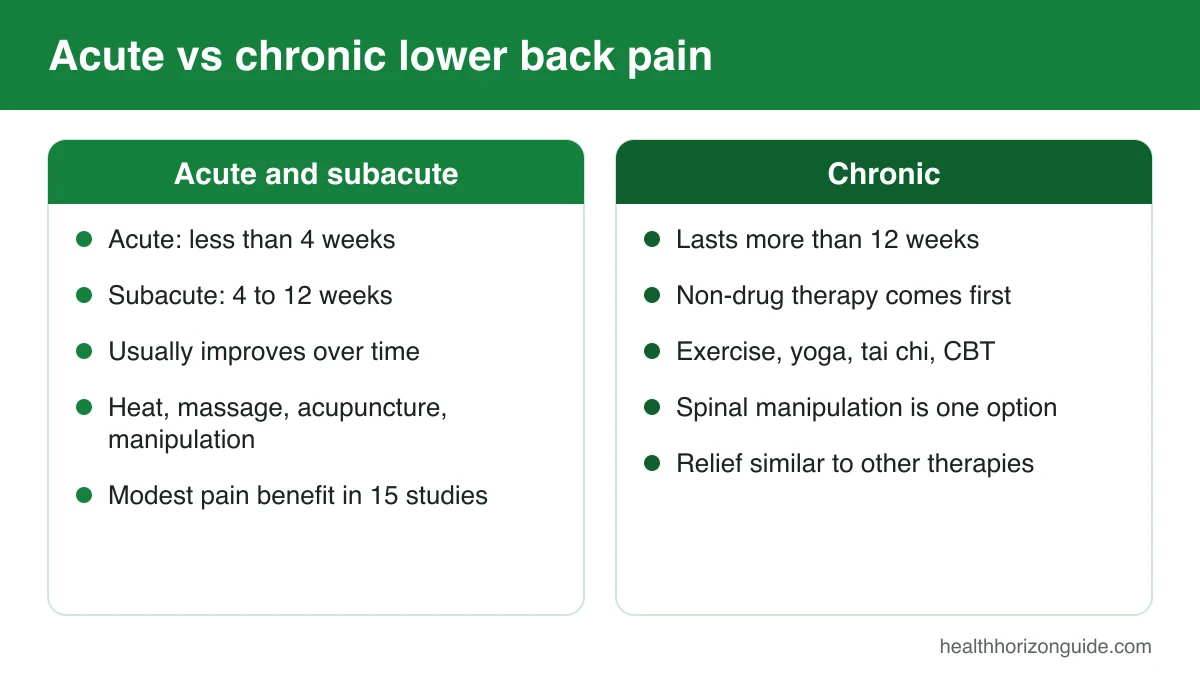
Acute lower back pain lasts less than 4 weeks, and chronic lower back pain lasts more than 12 weeks, under the definitions in the American College of Physicians guideline. Subacute lower back pain lasts 4 to 12 weeks. The table below compares what the guideline and NCCIH say about chiropractic spinal manipulation for each duration of lower back pain.
| Type of lower back pain | Duration | Non-drug options in the 2017 guideline | Evidence on spinal manipulation (NCCIH) |
|---|---|---|---|
| Acute and subacute | Less than 4 weeks, and 4 to 12 weeks | Superficial heat, massage, acupuncture or spinal manipulation | A 2017 analysis of 15 studies found moderate-quality evidence of a modest improvement in pain, similar to anti-inflammatory drugs. |
| Chronic | More than 12 weeks | Exercise, acupuncture, tai chi, yoga, cognitive behavioral therapy, spinal manipulation and others | A 2019 review of 47 studies found moderate-quality evidence that short-term pain relief was similar to other recommended therapies. |
How many chiropractor visits for lower back pain?
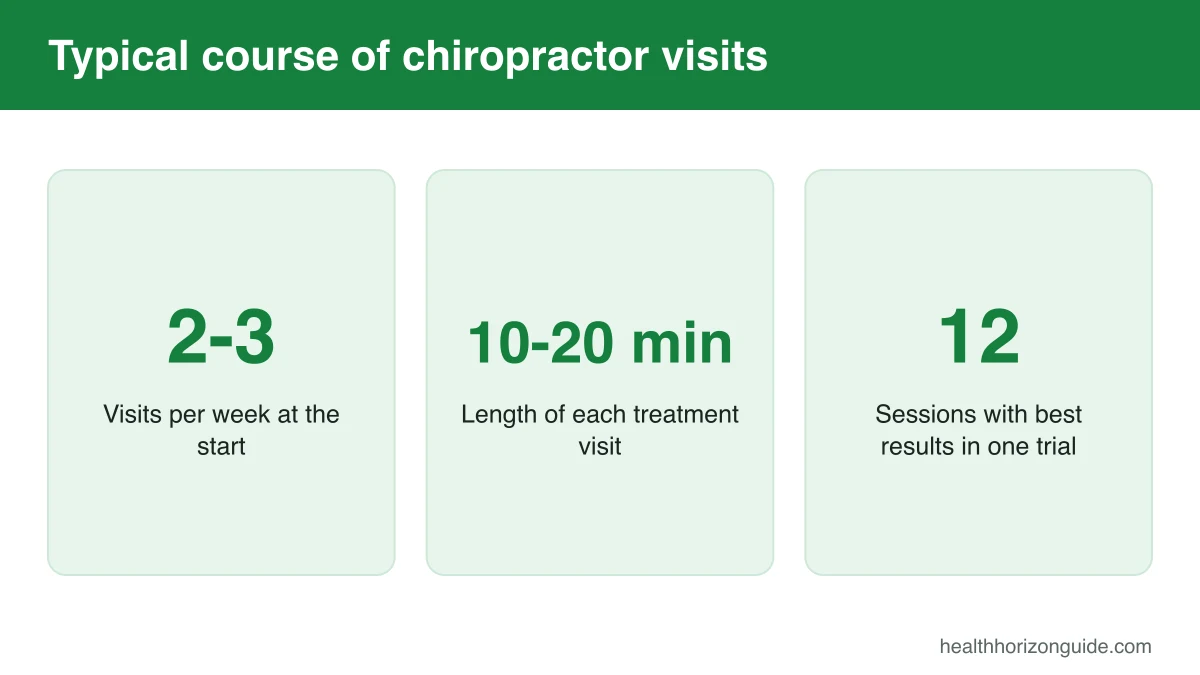
Chiropractor visits for lower back pain usually start at 2 or 3 short visits per week, over several weeks, according to MedlinePlus. Each visit lasts about 10 to 20 minutes, and treatment may drop to once a week once the pain improves.
The guidelines we reviewed do not set a fixed number of chiropractor visits. One randomized trial of 400 adults with chronic low back pain compared 0, 6, 12 and 18 spinal manipulation sessions over 6 weeks. Twelve sessions gave the most favorable results, but the authors reported that 12 sessions were not well distinguished from the other doses. The advantage over a light massage control was negligible at 24 weeks.
A sensible step is to ask the chiropractor at the first visit how many visits the plan includes and how progress will be checked.
What happens at a chiropractor visit for lower back pain?
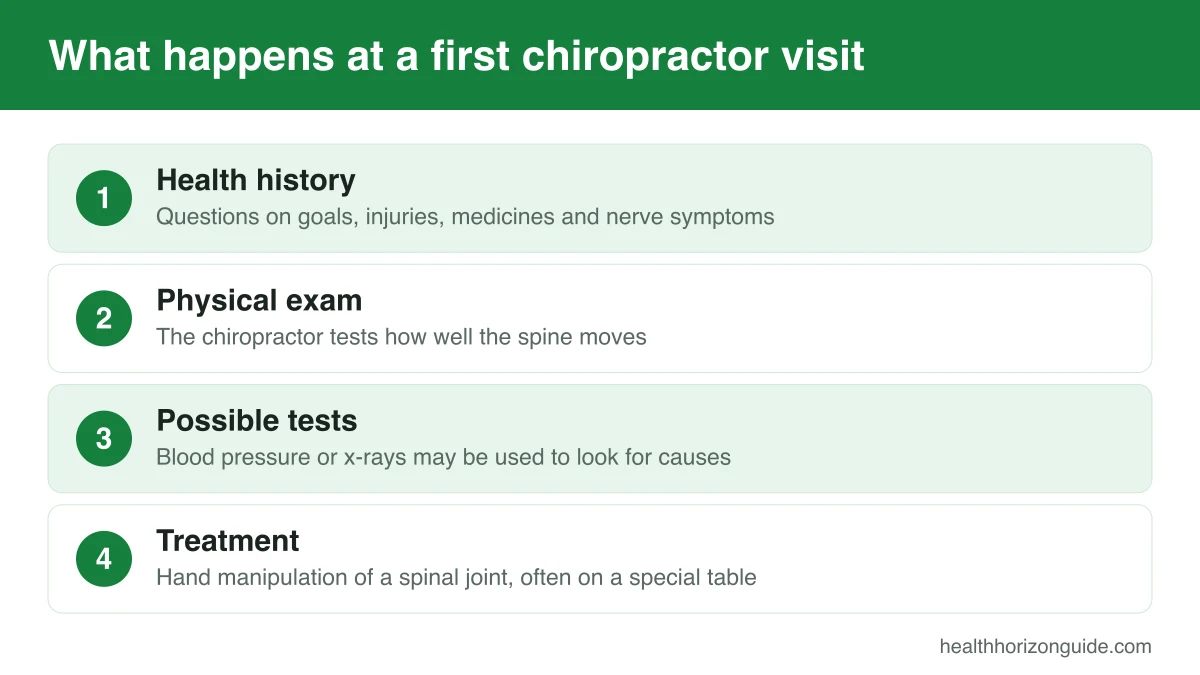
A first chiropractor visit for lower back pain is a 30 to 60 minute appointment with questions, a physical exam and sometimes treatment, according to MedlinePlus. The 4 steps of a typical first visit are listed below.
- The chiropractor asks about treatment goals, health history, injuries, medicines, lifestyle and nerve symptoms such as numbness or tingling.
- The chiropractor performs a physical exam that includes testing how well the spine moves.
- The chiropractor may check blood pressure or order x-rays to look for causes of the lower back pain.
- Treatment starts at the first or second visit, usually with the patient lying on a special table while the chiropractor manipulates a spinal joint by hand.
MedlinePlus states that the manipulation itself should not cause pain.
Chiropractic adjustment side effects and who should not have spinal manipulation
Chiropractic adjustment side effects for lower back pain are usually mild and temporary. NCCIH reports that increased pain or discomfort, stiffness and headache are the most common side effects, and most go away within 24 hours.
Serious side effects have been reported, including serious spinal or nerve problems and strokes linked to neck manipulation. NCCIH describes these events as very rare. The risk may be higher in people with underlying health problems, so patients should tell the chiropractor about every health condition and medicine. Pregnant women should discuss the risks with a healthcare provider first.
The 6 groups who should not have chiropractic treatment in the affected area, according to MedlinePlus, are listed below.
- People with bone fractures or bone tumors.
- People with severe arthritis.
- People with bone or joint infections.
- People with severe osteoporosis.
- People with severely pinched nerves that cause numbness, tingling and weakness in the arms or legs.
- People with acute neck pain and symptoms of pinched nerves.
Readers with a diagnosed disc problem can read our guide to seeing a chiropractor for a herniated disc.
Lower back pain triggers, self-care and warning signs
Lower back pain triggers, self-care and warning signs decide whether a chiropractor is the right next step. The sections below cover common pain patterns, recommended self-care and the symptoms that need medical care instead.
Lower back pain when sitting, bending over or lying down
Lower back pain when sitting, bending over or lying down usually improves within a few weeks, as most back pain does according to the NHS. The NHS advises staying active and avoiding long periods in bed. A chiropractor asks about lifestyle at the first visit, which is the time to describe the positions that bring on the pain.
The NHS advises seeing a doctor when back pain does not improve with rest, is worse at night, or gets worse with sneezing, coughing or a bowel movement. Readers whose pain appears mainly when sitting can try our posture and back pain self-check tool.
Why does my back hurt when I wake up?
Lower back pain on waking most often comes from sleep position, lying still for hours or an unsupportive mattress, according to Cleveland Clinic. Underlying conditions such as spinal arthritis, sciatica or a herniated disk can cause morning pain as well.
Cleveland Clinic suggests bringing one knee to the chest while still lying down, then getting up slowly. Our guide to morning stretches for lower back pain covers more options. Pain on most mornings for 2 or 3 months should be checked by a healthcare provider before a course with a chiropractor.
Self-care for lower back pain that sources recommend
Self-care for lower back pain centers on staying active, and self-care is the first step before or alongside a chiropractor. The 4 self-care measures that the NHS recommends are listed below.
- Stay active and keep up daily activities.
- Use an ice pack wrapped in a cloth for pain and swelling, or a heat pack for stiffness and muscle spasms.
- Try back exercises and stretches, and stop when the pain gets worse.
- Ask a pharmacist or doctor whether an anti-inflammatory medicine is suitable.
The NHS lists manual therapy as a treatment when back pain is severe or has not improved after a few weeks.
Red flags: when lower back pain needs a doctor or emergency care
Lower back pain needs emergency care, not a chiropractor, when the pain comes with nerve, bladder or bowel symptoms. The 6 signs that the NHS says need an emergency department or an emergency call are listed below.
- Pain, tingling, weakness or numbness in both legs.
- Loss of feeling around the genitals or anus.
- Difficulty urinating, or loss of bladder or bowel control.
- Changes in genital sensation or sexual function.
- Chest pain.
- Back pain that started after a serious accident, such as a car crash.
Urgent same-day medical advice is needed when lower back pain comes with feeling hot, shivery or generally unwell, or when the pain is sudden, severe or getting worse quickly. A routine doctor visit should come before a chiropractor when back pain comes with unexplained weight loss, a lump or swelling in the back, or no improvement after a few weeks of home treatment.
Alternatives to a chiropractor for lower back pain
Alternatives to a chiropractor for lower back pain include exercise, heat, massage and acupuncture. The American College of Physicians guideline lists these options beside spinal manipulation. Our comparison of a chiropractor vs physical therapist explains how the two approaches differ.
Frequently asked questions about a chiropractor for lower back pain
Is a chiropractor worth it for lower back pain?
A chiropractor is a reasonable option with a modest expected benefit for lower back pain. No source we reviewed shows that spinal manipulation works better than exercise or other recommended therapies.
Can a chiropractor help sciatica?
A chiropractor may help sciatica, but the evidence is limited. NCCIH states that spinal manipulation is not widely used for sciatica and that the supporting studies have many limitations. Our guide to sciatica chiropractic treatment techniques covers the detail.
Do you have to keep going back to a chiropractor?
Chiropractor visits for lower back pain normally follow a course of several weeks, not open-ended care. MedlinePlus describes visits becoming less frequent as the pain improves.