Chiropractor for Carpal Tunnel: Can It Help?
A chiropractor may ease mild carpal tunnel symptoms short term, but the evidence is limited. Compare splints, injections and surgery, and learn the red flags.

A chiropractor may ease mild carpal tunnel symptoms in the short term, but the evidence is limited and mostly low quality. A Cochrane review of 16 trials with 741 people found limited and very low quality evidence for exercise and mobilisation treatments. The NHS lists a night wrist splint, a steroid injection and surgery as the main treatments for carpal tunnel syndrome.
Action checklist
Carpal tunnel action checklist
Use these steps from the article to manage carpal tunnel symptoms and to decide when a doctor is needed.
0 of 9 done
In this article
- Can a chiropractor help carpal tunnel?
- What is carpal tunnel syndrome?
- What does a chiropractor do for carpal tunnel?
- How does chiropractic care compare with standard carpal tunnel treatment?
- Carpal tunnel care beyond the chiropractor
- Carpal tunnel vs pinched nerve in the neck
- Carpal tunnel self-care and wrist exercises
- Workstation tips for carpal tunnel
- When to see a doctor for carpal tunnel
- Carpal tunnel in pregnancy
- Chiropractor for carpal tunnel: common questions
Can a chiropractor help carpal tunnel?
A chiropractor can possibly help with short-term carpal tunnel symptoms, but no strong evidence shows that chiropractic care works better than standard care. A 1998 trial of 91 people compared ibuprofen and night wrist supports with chiropractic manipulation, ultrasound and wrist supports. Both groups improved, with no significant difference between the two treatments.
The table below summarises the strength of evidence from 4 types of research on chiropractic and hands-on care for carpal tunnel.
| Research on hands-on care | What the research shows |
|---|---|
| Chiropractic vs medical care (1998 trial, 91 people) | Both groups improved over 9 weeks. Neither was better. |
| Exercise and mobilisation (Cochrane review, 16 trials, 741 people) | Limited and very low quality evidence of benefit. Only 2 studies measured side effects. |
| Manual therapy on its own (2022 meta-analysis, 6 trials, 401 people) | Large effects on pain right after treatment. Therapists were not blinded, and long-term effects were not pooled. |
| Neck adjustment for wrist symptoms (2008 review) | The double crush idea was judged controversial and probably not valid for sensory symptoms. |
The 2022 manual therapy meta-analysis mostly tested soft tissue and nerve mobilisation, which physiotherapists also deliver. Those trials did not test spinal adjustment. Readers whose hand symptoms come with desk-related neck or back pain can start with our posture and back pain self-check.
What is carpal tunnel syndrome?
Carpal tunnel syndrome is pressure on the median nerve as the nerve passes through the wrist. Mayo Clinic describes the carpal tunnel as a narrow passage on the palm side of the wrist, surrounded by bones and ligaments. The American Academy of Orthopaedic Surgeons (AAOS) states that the tunnel is about an inch wide and that the condition usually worsens over time without treatment. A chiropractor needs a clear diagnosis before treating this median nerve problem.
Carpal tunnel symptoms
Carpal tunnel symptoms are numbness, tingling and pain in the thumb, index, middle and ring fingers. Mayo Clinic notes that the little finger is usually not affected. The 5 common symptoms of carpal tunnel syndrome are listed below.
- Numbness, tingling or burning in the thumb and first three fingers.
- Shock-like feelings that travel into the same fingers.
- Pain or tingling that spreads up the forearm.
- A weak thumb, a weak grip or clumsiness with fine tasks such as buttons.
- Dropping objects because of numbness or weakness.
AAOS notes that carpal tunnel symptoms often wake people at night. Mayo Clinic reports that numbness tends to appear while holding a phone or a steering wheel. These patterns help a doctor or chiropractor tell carpal tunnel apart from other causes of hand numbness.
What causes carpal tunnel syndrome?
Carpal tunnel syndrome is caused by anything that narrows the tunnel or swells the tissue around the median nerve. The NHS lists being overweight, pregnancy, repeated wrist bending or hard gripping, arthritis, diabetes and a previous wrist injury. AAOS adds that women and older people are more likely to develop carpal tunnel syndrome. None of these causes sits in the spine, which limits what a chiropractor's spinal adjustment can change.
What does a chiropractor do for carpal tunnel?
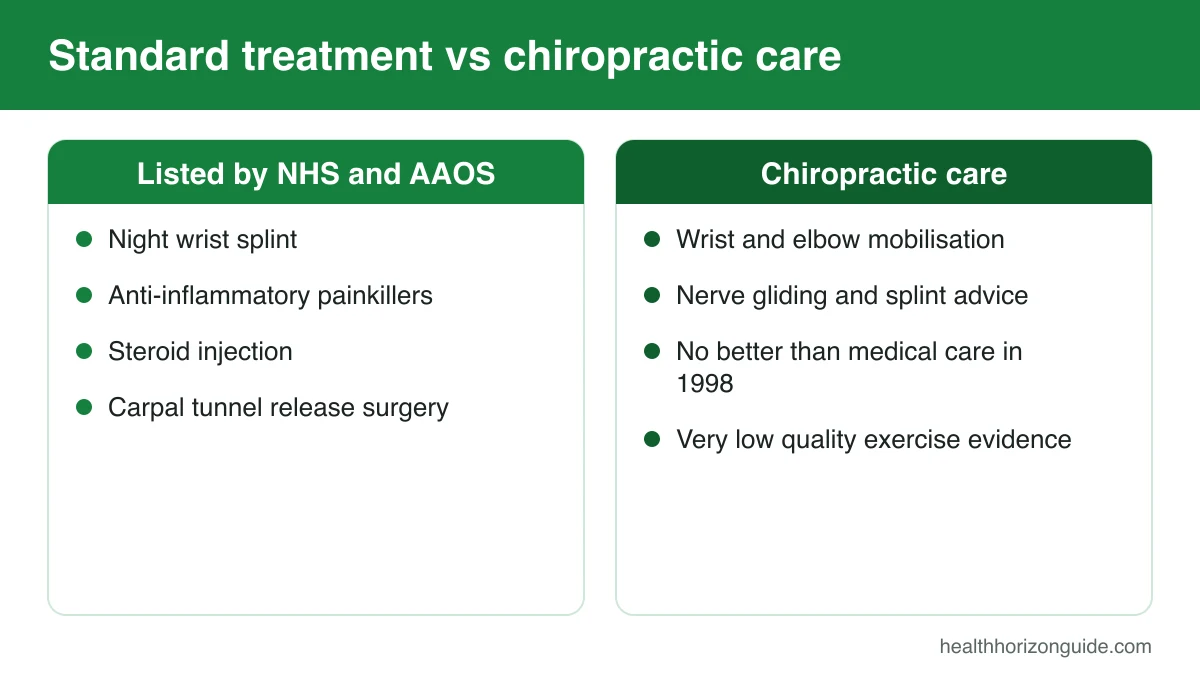
A chiropractor treating carpal tunnel typically uses wrist and elbow mobilisation, nerve gliding, splint advice and workstation advice. The 5 approaches that a chiropractor may use for carpal tunnel are listed below.
- Wrist mobilisation of the small carpal bones and the ligament over the tunnel.
- Elbow and forearm mobilisation, as in the 1998 trial.
- Nerve gliding exercises, which AAOS says may help the median nerve move more freely.
- Night splint advice, since a straight wrist lowers nerve pressure.
- Workstation advice to reduce long periods with the wrist bent.
Mayo Clinic cautions that nerve gliding exercises can irritate a median nerve that remains trapped. Some chiropractors also adjust the neck, an approach covered in the double crush section.
How does chiropractic care compare with standard carpal tunnel treatment?
Chiropractic care has weaker evidence than standard carpal tunnel treatment from the NHS and AAOS. The NHS starts with a wrist splint, then offers a steroid injection and finally considers surgery. The table below compares the 4 standard treatments and what the sources say about each one.
| Standard treatment | What the sources say |
|---|---|
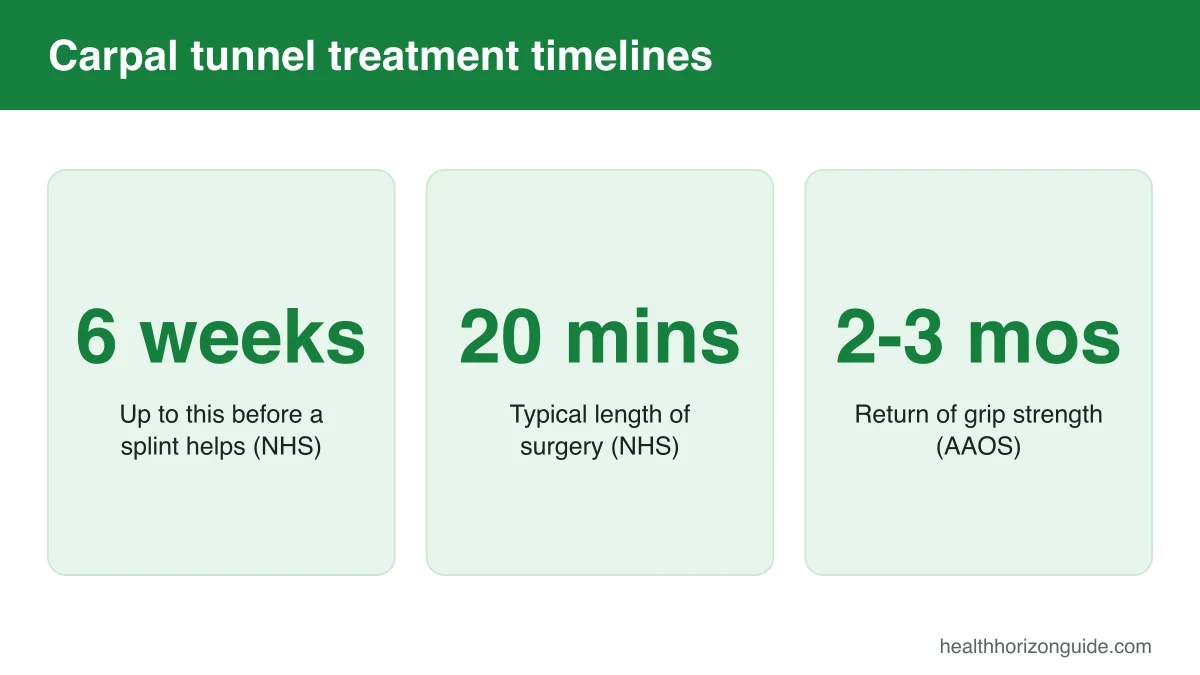
| Night wrist splint | Keeps the wrist straight. The NHS says up to 6 weeks may pass before the hand feels better. |
| Anti-inflammatory painkillers | AAOS says ibuprofen and naproxen can relieve pain. The NHS notes that painkillers do not treat the cause. |
| Steroid injection | Reduces swelling around the nerve. Relief is often temporary, and symptoms can return after a few months. |
| Carpal tunnel release surgery | Cuts the ligament that forms the roof of the tunnel. The NHS says surgery usually cures carpal tunnel syndrome. |
Cochrane reviewers advised that people choosing mobilisation treatment should be told about its limited evidence. A chiropractor can be one part of conservative care, not a replacement for medical assessment.
Carpal tunnel care beyond the chiropractor
Carpal tunnel care beyond the chiropractor covers the neck, the home, the desk and the doctor. The sections below cover each one in turn.
Carpal tunnel vs pinched nerve in the neck
Carpal tunnel syndrome and a pinched nerve in the neck both cause hand tingling but start in different places. Carpal tunnel compresses the median nerve at the wrist, while a pinched nerve in the neck compresses a nerve root at the spine. Our guide to a chiropractor for a pinched nerve covers the neck condition in detail.
What is double crush syndrome?
Double crush syndrome is the idea that pressure on a nerve in the neck makes the same nerve more vulnerable at the wrist. Some chiropractors use the idea to explain neck adjustments for carpal tunnel. A 2008 review in a chiropractic journal concluded that the original hypothesis remains controversial and is probably not valid, at least for sensory symptoms.
Carpal tunnel self-care and wrist exercises
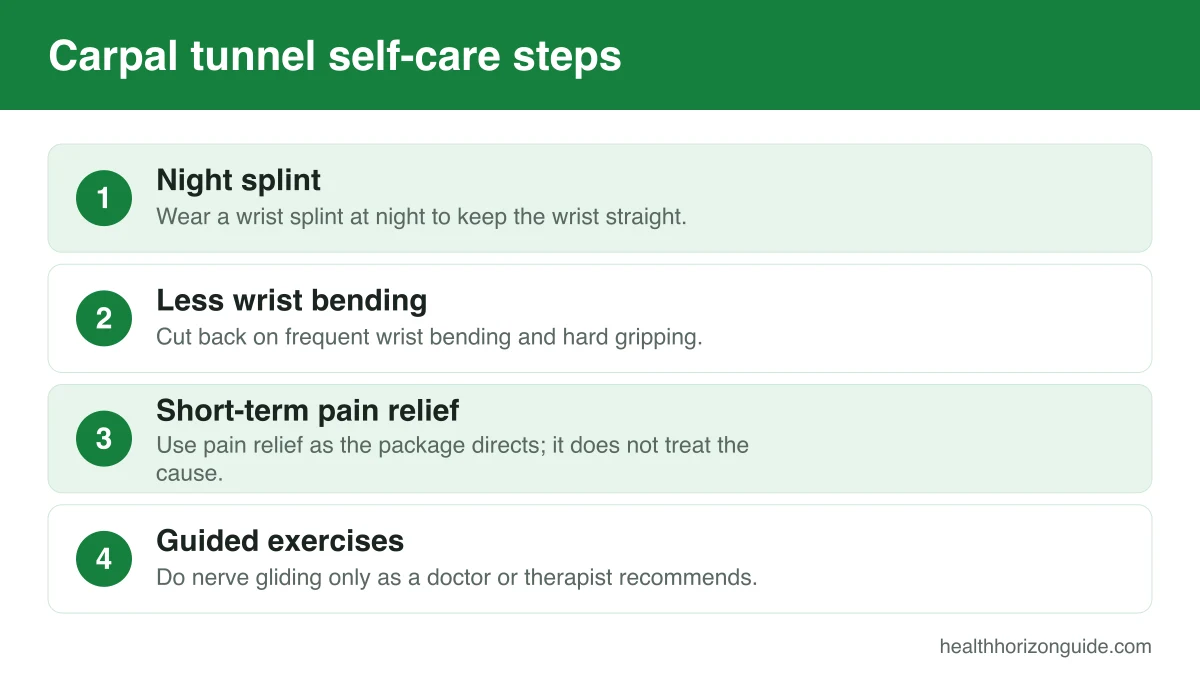
Carpal tunnel self-care starts with a night splint and fewer wrist-bending tasks, according to the NHS. The 4 self-care steps that the NHS and AAOS describe for carpal tunnel are listed below.
- Wear a wrist splint at night to keep the wrist straight.
- Cut back on activities that involve frequent wrist bending or hard gripping.
- Use short-term pain relief as directed on the package, knowing that it does not treat the cause.
- Do hand or nerve gliding exercises only as a doctor or therapist recommends.
The NHS states that evidence for hand exercises is limited, and wrist exercises from a chiropractor or therapist that worsen numbness need a pause and a review.
Workstation tips for carpal tunnel
Workstation tips for carpal tunnel centre on keeping the wrist straight and changing position often. AAOS lists workstation changes among the activity changes that can slow carpal tunnel syndrome. The 3 workstation changes supported by these sources are listed below.
- Keep the wrists straight over the keyboard, since Mayo Clinic advises against bending them fully up or down.
- Break up tasks that hold the wrist in one position for long periods.
- Review mouse use, since Mayo Clinic reports some evidence linking mouse use, but not keyboard use, to carpal tunnel syndrome.
Desk height and sitting posture shape the wrist angle too. Our guide on how to fix posture while sitting at a desk covers chair, screen and keyboard position.
When to see a doctor for carpal tunnel
Carpal tunnel needs a doctor rather than a chiropractor when numbness becomes constant, the thumb muscles waste or the hand grows weak. AAOS states that wasting of the muscles at the base of the thumb signals advanced nerve compression. The 4 warning signs of carpal tunnel syndrome are listed below.
- Numbness that no longer comes and goes.
- Visible shrinking of the muscles at the base of the thumb.
- Weakness, a poor grip or frequent dropping of objects.
- Symptoms that are getting worse or not improving with home treatment.
AAOS lists arthritis among the risk factors, and our page on a chiropractor for arthritis discusses joint pain in the hands and elsewhere.
When is carpal tunnel surgery considered?
Carpal tunnel surgery is considered when other treatments fail or give only short-term relief, according to AAOS. Constant numbness with thumb muscle wasting may also lead to surgery, to prevent permanent damage. The NHS describes a small cut in the hand under local anaesthetic, an operation of around 20 minutes and no overnight stay.
AAOS reports that grip and pinch strength usually return by about 2 to 3 months after surgery, and full recovery may take up to a year. No source reviewed for this article presents chiropractic care as an alternative to surgery once these signs appear.
Carpal tunnel in pregnancy
Carpal tunnel in pregnancy is a recognised risk that sometimes settles by itself within a few months of birth. AAOS explains that hormonal changes cause swelling that presses on the nerve. The NHS notes that pregnancy-related carpal tunnel sometimes goes away within a few months. A pregnant reader with hand numbness can raise the symptom with a midwife or GP before booking a chiropractor.
Chiropractor for carpal tunnel: common questions
Can a chiropractor fix carpal tunnel?
A chiropractor has not been shown to fix carpal tunnel syndrome. The NHS names surgery as the treatment that usually cures the condition.
Should a chiropractor adjust the neck for carpal tunnel?
A chiropractor who adjusts the neck for carpal tunnel relies on the double crush idea. A 2008 review described that idea as controversial and probably not valid for sensory symptoms.
Is a chiropractor or physical therapist better for carpal tunnel?
A chiropractor or physical therapist can both offer mobilisation and nerve gliding, and neither has been shown to be better for carpal tunnel. Our comparison of a chiropractor vs physical therapist explains how their training and methods differ.