Chiropractor for Arthritis: Can It Help and Is It Safe?
A chiropractor may ease osteoarthritis back and neck pain, but inflammatory arthritis needs caution. See which types suit chiropractic and who should avoid it.

A chiropractor for arthritis can help some people with osteoarthritis of the back or neck, where gentle manual therapy may ease pain and stiffness. The Arthritis Foundation describes chiropractic as one of the safer options for osteoarthritis back and neck pain, and advises against adjustments on joints with active swelling. Rheumatoid arthritis and ankylosing spondylitis call for more caution, especially in the neck and during a flare.
Action checklist
Before seeing a chiropractor for arthritis
Use these steps from the article to choose safe chiropractic care for your type of arthritis.
0 of 10 done
In this article
- Can a chiropractor help arthritis?
- Is chiropractic safe for arthritis?
- Who should not have chiropractic manipulation for arthritis?
- What does the evidence say about chiropractic for osteoarthritis?
- Techniques a chiropractor may use for arthritis
- What happens at a chiropractic visit for arthritis?
- How chiropractic fits into wider arthritis care
- Questions to ask a chiropractor about arthritis
- When to see a doctor instead of a chiropractor for arthritis
- Frequently asked questions about chiropractors and arthritis
Can a chiropractor help arthritis?
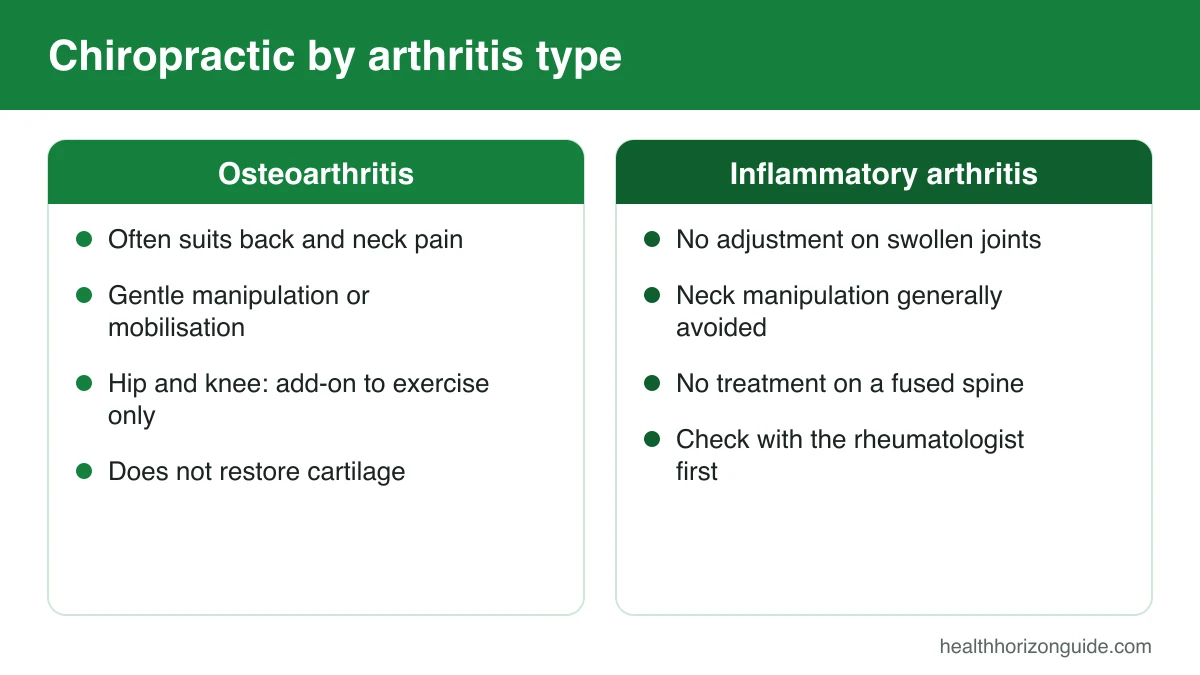
Yes, a chiropractor can help arthritis in some cases, mainly osteoarthritis pain in the back and neck. Chiropractic care eases symptoms such as pain and stiffness. Chiropractic care does not repair worn cartilage or stop the immune attack behind inflammatory arthritis. The right answer depends on the type of arthritis, the joint involved and whether the joint is inflamed.
The table below compares 6 arthritis situations by how well each one suits chiropractic care.
| Arthritis type | Chiropractic suitability | Main caution |
|---|---|---|
| Osteoarthritis of the back or neck | Often suitable, with gentle manipulation, mobilisation or soft tissue work | Tell the chiropractor about the diagnosis and any bone loss |
| Hip or knee osteoarthritis | Possible add-on only | NICE advises manual therapy only alongside therapeutic exercise |
| Rheumatoid arthritis | Limited, between flares and with a rheumatologist's agreement | No adjustment on swollen joints; neck manipulation is generally avoided |
| Psoriatic arthritis | Limited, with the same care as rheumatoid arthritis | No adjustment on joints with active inflammation |
| Ankylosing spondylitis | Limited, and soft tissue or exercise work is the safer focus | No chiropractic therapy on a fused spine |
| Any arthritis with spinal osteoporosis | Not suitable for spinal manipulation | Weak vertebrae carry a fracture risk |
Is chiropractic safe for arthritis?
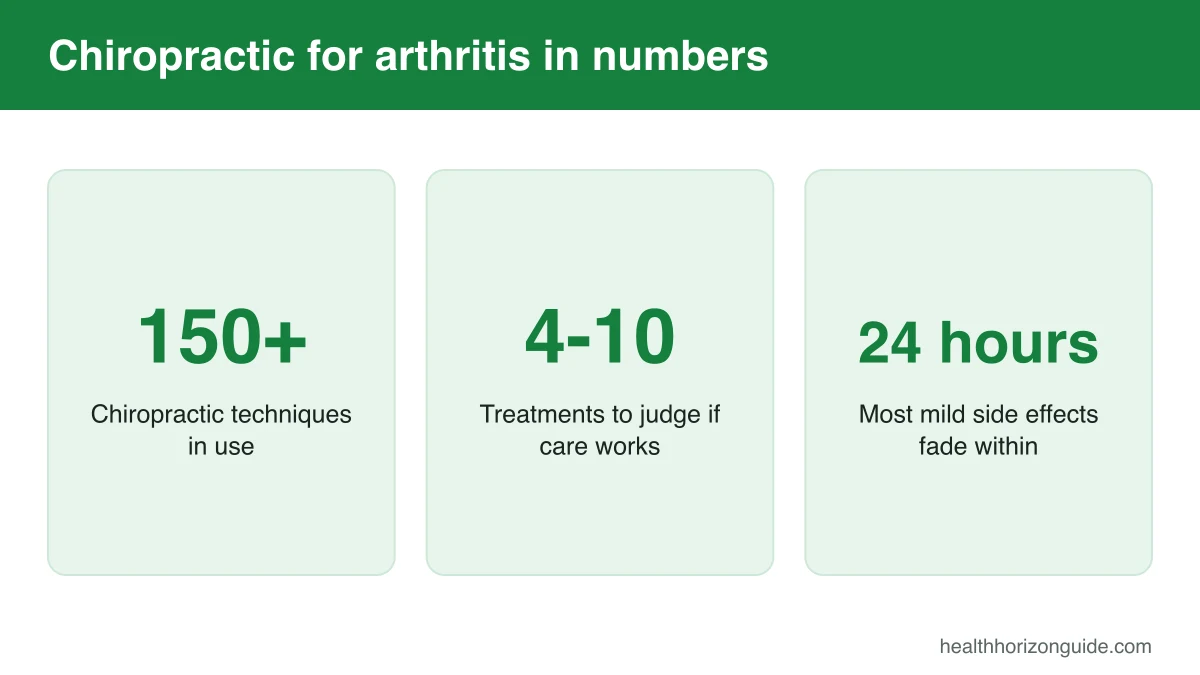
Yes, chiropractic is safe for arthritis when the technique matches the arthritis type and the state of the joints. Mild side effects are common. NCCIH states that increased pain, stiffness or headache often follow spinal manipulation, and most of these effects go away within 24 hours.
Serious complications from spinal manipulation are very rare, and NCCIH notes that no accurate estimates of their frequency exist. NCCIH adds that the chance of a serious side effect may be greater in people with underlying health problems. Neck manipulation has been linked to small tears in neck arteries, called cervical artery dissections, although experts disagree about whether manipulation causes them.
Why is neck manipulation avoided in rheumatoid arthritis?
Neck manipulation is avoided in rheumatoid arthritis because the disease can loosen the joints at the top of the neck. Inflammation of the joint lining can cause slippage between the first two neck vertebrae, called atlantoaxial subluxation, according to a 2020 review in Neurosurgical Review. Many people with this neck instability have no symptoms, so a rheumatoid arthritis patient may not know the neck is affected.
A quick thrust to an unstable upper neck carries a risk of pressure on the spinal cord. Ask the rheumatologist whether the neck needs imaging or clearance before any neck treatment. Lower-force work on the surrounding muscles avoids that thrust altogether.
Why does bone strength matter with inflammatory arthritis?
Bone strength matters with inflammatory arthritis because the disease and some of its medicines can lead to osteoporosis. WebMD notes that this bone loss puts a person at risk of a fracture during spinal manipulation. Our guide on whether chiropractic care is safe with osteoporosis explains the gentler options in detail.
Who should not have chiropractic manipulation for arthritis?
People with active joint inflammation, a fused spine or spinal osteoporosis should not have chiropractic manipulation for arthritis, according to the Arthritis Foundation. The 7 situations that rule out or limit manipulation are listed below.
- A joint with active swelling or an arthritis flare
- A fused spine, which can develop in ankylosing spondylitis
- Osteoporosis in the spine or neck
- Rheumatoid arthritis with known or suspected upper neck instability
- Blood-thinning medicines or a raised risk of bleeding or stroke
- Bones or joints that are very weak or seriously damaged
- A nerve condition such as peripheral neuropathy
The last 3 items come from the NHS, which also advises telling the chiropractor about every medical condition and medicine. The NHS states that chiropractors in the UK must be registered with the General Chiropractic Council.
What does the evidence say about chiropractic for osteoarthritis?
The evidence for chiropractic in osteoarthritis is limited and strongest for back and neck pain. NCCIH reports moderate-quality evidence that spinal manipulation gives a modest improvement in acute low back pain. Relief in chronic low back pain was similar to other recommended therapies. Evidence for chronic neck pain was rated low to moderate in quality.
Evidence for joints outside the spine is thinner. The Arthritis Foundation describes a 2013 study in which patient education plus 12 chiropractic sessions helped hip osteoarthritis more than stretching or education alone. The same source states that the evidence on manual therapy for hip and knee arthritis is still unsettled.
Can a chiropractor reverse arthritis?
No, a chiropractor cannot reverse arthritis. The Arthritis Foundation reports no clear evidence that chiropractic or any other treatment produces long-term change in arthritis seen on x-rays. Walk away from any clinician who promises to cure arthritis.
Techniques a chiropractor may use for arthritis
The techniques a chiropractor may use for arthritis range from firm adjustments to very gentle soft tissue work. The Arthritis Foundation notes that chiropractors use more than 150 techniques with different amounts of force. The 5 main approaches for arthritis are listed below.
- Spinal manipulation: a quick, controlled thrust to a joint, used only where the joint is not inflamed or fragile
- Mobilisation: slower, gentler movement of a joint through its range, suited to stiff arthritic joints
- Soft tissue work: pressure and stretching on the muscles around a painful joint
- Exercise advice: stretches and strengthening moves to do at home
- Supporting therapies: ultrasound, electrotherapy or low-level laser, which some chiropractors use around inflamed joints
Treating the tissue around an inflamed joint can lower overall pain while the joint itself is left alone, the Arthritis Foundation reports.
What happens at a chiropractic visit for arthritis?
A chiropractic visit for arthritis starts with a full history and joint examination before any treatment. The 5 stages of a typical course of care are listed below.
- The chiropractor takes a detailed medical history, including arthritis type, medicines and bone density results.
- The chiropractor examines the painful joints and checks movement and strength.
- The chiropractor may order or review a spine x-ray.
- The chiropractor explains the planned techniques, and the patient agrees to them.
- The patient and chiropractor review progress within 4 to 10 treatments.

The Arthritis Foundation advises switching chiropractor or trying a different treatment when no improvement appears within 4 to 10 treatments. Mild soreness the day after a session is common, as NCCIH describes. Pain that keeps worsening is a reason to stop treatment and tell the chiropractor.
How chiropractic fits into wider arthritis care
Chiropractic fits into wider arthritis care as an optional extra, not a replacement for first-line treatment. The NICE osteoarthritis guideline puts tailored therapeutic exercise and weight management at the centre of osteoarthritis care. NICE notes that any weight loss is likely to help, and losing 10% of body weight is likely to help more than 5%.
The 4 first-line parts of arthritis care are listed below.
- Exercise: tailored strengthening and aerobic activity, supervised by a physiotherapist where needed
- Weight management: for people with osteoarthritis who carry extra weight
- Physiotherapy: an exercise plan, with hydrotherapy as an option for ankylosing spondylitis
- Medicines prescribed by a doctor: anti-inflammatory painkillers, and disease-modifying or biologic medicines for inflammatory arthritis
The NHS lists exercise, physiotherapy and medicine as the usual treatment for ankylosing spondylitis, with daily stretching advised. Walking is an easy start for osteoarthritis, and our guide to how many steps a day to aim for helps set a realistic target. Our comparison of a chiropractor vs orthopedic doctor explains when joint damage needs a specialist.
Arthritis-related spine conditions
Arthritis-related spine conditions often overlap with spinal osteoarthritis. Disc wear and narrowing of the spinal canal can both cause back pain in older adults with arthritis. Our guides to a chiropractor for degenerative disc disease and a chiropractor for spinal stenosis cover each condition.
Questions to ask a chiropractor about arthritis
The questions to ask a chiropractor about arthritis check experience, technique and safety. The 6 questions worth asking at the first visit are listed below.
- Do you treat many patients with my type of arthritis?
- Which techniques do you plan to use, and how much force do they involve?
- Will you avoid my neck and any swollen joints?
- Do you need my x-rays, bone density results or a letter from my rheumatologist?
- How many sessions before we judge whether the treatment works?
- Which exercises can I do at home between visits?
When to see a doctor instead of a chiropractor for arthritis
See a doctor instead of a chiropractor for arthritis when a joint becomes hot and swollen or nerve symptoms appear. New numbness, tingling or weakness in the arms or legs needs a medical check, especially with rheumatoid arthritis. Seek urgent care for loss of bladder or bowel control, since the 2020 Neurosurgical Review lists these among the signs of spinal cord pressure.
Frequently asked questions about chiropractors and arthritis
Can a chiropractor help knee arthritis?
A chiropractor can help knee arthritis only as an add-on to exercise. NICE advises considering manual therapy for knee osteoarthritis only alongside therapeutic exercise, and says the evidence does not support manual therapy alone.
Does chiropractic help rheumatoid arthritis?
No, chiropractic does not treat rheumatoid arthritis itself. WebMD reports very little scientific evidence that chiropractic affects the immune system, so rheumatoid arthritis still needs medicines from a rheumatologist.
Can a chiropractor adjust a neck with arthritis?
A chiropractor can adjust a neck with osteoarthritis when no instability, osteoporosis or artery risk is present. People with rheumatoid arthritis need medical clearance first, and many choose gentle mobilisation instead.
How many chiropractic sessions does arthritis need?
Arthritis needs 4 to 10 chiropractic sessions to show whether care is working, according to the Arthritis Foundation. A different approach makes sense when nothing has changed by then.