Chiropractor for Pinched Nerve: Can It Help?
A chiropractor may ease pinched nerve pain short term, but the evidence is weak. See what medical sources list as treatment, the risks and the red flags.
A chiropractor may ease pinched nerve pain for some people in the short term, but the research behind spinal manipulation for a pinched nerve is weak. Orthopedic and hospital sources list rest, medication, physical therapy, steroid injections and sometimes surgery as treatment, and those sources do not list chiropractic manipulation. Most pinched nerves improve with time, and a few warning signs need a doctor quickly.
Action checklist
Pinched nerve action checklist
Use these steps from the article to manage a pinched nerve and to decide when a doctor is needed.
0 of 10 done
In this article
- Can a chiropractor help with a pinched nerve?
- What is a pinched nerve?
- What causes a pinched nerve?
- How long does a pinched nerve last?
- What treatment do medical sources list for a pinched nerve?
- Is neck manipulation safe with a pinched nerve?
- Pinched nerve relief without a chiropractor
- Pinched nerve treatment at home
- When to see a doctor for a pinched nerve
- Chiropractor or physical therapist for a pinched nerve?
- Chiropractor for pinched nerve: common questions
Can a chiropractor help with a pinched nerve?
A chiropractor can possibly help with short-term pain from a pinched nerve, but no strong evidence shows that a chiropractor can fix a pinched nerve. A 2023 systematic review of 59 trials on conservative care for a pinched nerve in the neck rated the evidence for cervical manipulation as very low certainty. The review authors wrote that a lack of high-quality evidence limited any meaningful conclusions. The National Center for Complementary and Integrative Health (NCCIH) reports that spinal manipulation is not widely used for sciatica, and that a 2015 review suggesting a benefit drew on studies with many limitations.
Chiropractors commonly offer spinal manipulation, mobilisation, traction and exercise advice for a pinched nerve. The table below summarises what research shows for 4 of these chiropractic methods.
| Chiropractic method | What the research shows |
|---|---|
| Neck (cervical) manipulation | Very low certainty evidence for less pain and disability in the immediate to short term (2023 review). |
| Mid-back (thoracic) manipulation | Very low certainty evidence for better neck movement right after treatment (2023 review). |
| Manual therapy combined with exercise | Low to very low certainty evidence, with inconclusive results for pain and disability (2023 review). |
| Low-back manipulation for sciatica | One 2014 study of 192 people found less leg pain at 12 weeks when manipulation was added to home exercise and advice, with no difference in leg pain at one year (NCCIH). |
None of the sources reviewed for this article state that a chiropractic adjustment removes the disc material or bone spur that presses on a pinched nerve.
What is a pinched nerve?
A pinched nerve is a nerve that is compressed by nearby tissue such as bone, ligament or a swollen disc. Cleveland Clinic describes pinched nerve as a nonmedical term, and doctors use the word radiculopathy when the nerve is squeezed where it leaves the spine. Cervical radiculopathy is a pinched nerve in the neck. Lumbar radiculopathy is a pinched nerve in the lower back, and people often call the leg pain sciatica.
Pinched nerve in neck symptoms
Pinched nerve in neck symptoms centre on pain that starts at the neck and travels down the arm, according to the American Academy of Orthopaedic Surgeons (AAOS). The 4 common symptoms of a pinched nerve in the neck are listed below.
- Burning or sharp pain that runs from the neck into the shoulder and arm.
- Tingling or a pins and needles feeling in the hand or fingers.
- Weakness in the arm, shoulder or hand.
- Numbness or loss of feeling in part of the arm or hand.
Cleveland Clinic notes that a pinched nerve in the neck typically affects only one side of the body.
Pinched nerve in back symptoms
Pinched nerve in back symptoms are pain, tingling, numbness or weakness that spreads from the lower back along the sciatic nerve into the leg. Symptoms of a pinched nerve can appear far from the spine, since one nerve supplies several areas of the body.
What causes a pinched nerve?
A pinched nerve is most often caused by a herniated disc, bone spurs or spinal stenosis. AAOS states that age-related wear of the spine is the most common cause in the neck. Worn discs lose height, and bone spurs form that narrow the openings where the nerves exit. Younger people more often get a pinched nerve from a sudden injury that herniates a disc. Cleveland Clinic lists arthritis, injury and spinal stenosis, a narrowing of the spinal canal, among the causes as well.
AAOS adds that nearly half of middle-aged and older people have worn discs and pinched nerves that cause no painful symptoms.
How long does a pinched nerve last?
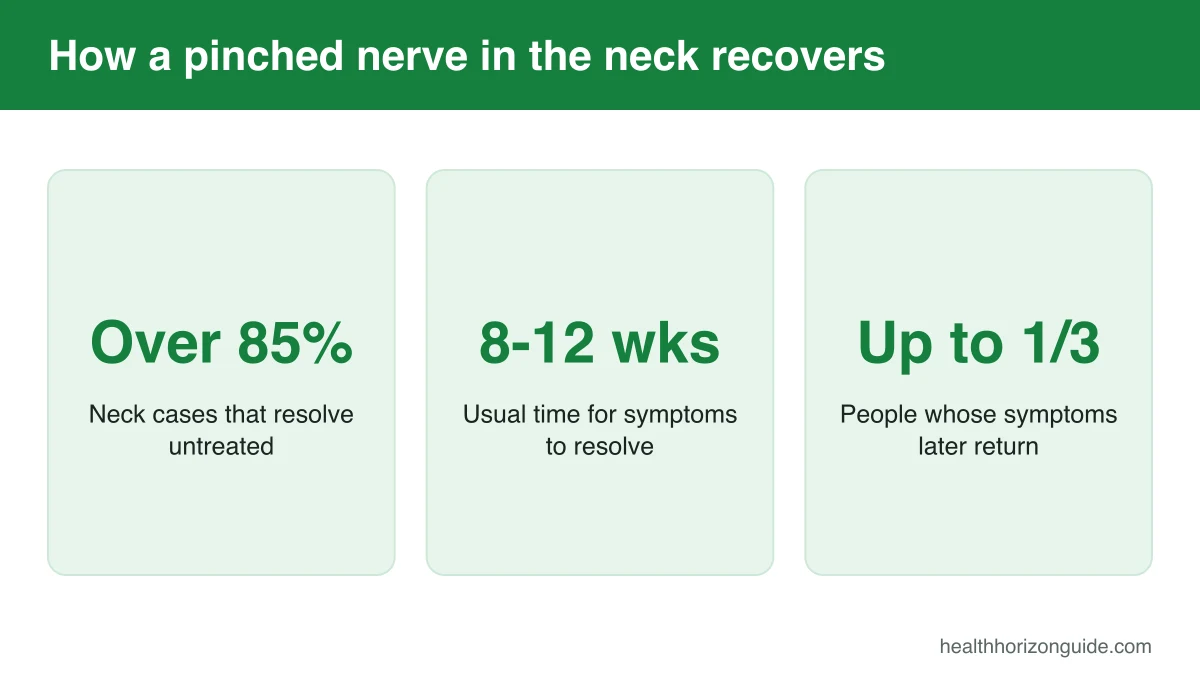
A pinched nerve lasts days or weeks for some people and longer for others, according to AAOS. Cleveland Clinic reports that over 85% of cervical radiculopathy cases resolve without specific treatment within 8 to 12 weeks. Symptoms return in up to one-third of people after the first improvement. Natural recovery of this kind means that improvement during a course of chiropractor visits may reflect time as much as treatment.
What treatment do medical sources list for a pinched nerve?
Medical sources list rest, medication, physical therapy, steroid injections and, for some people, surgery as pinched nerve treatment. The table below shows the 5 treatments that AAOS and Cleveland Clinic describe for a pinched nerve in the neck.
| Treatment | What the sources say |
|---|---|
| Rest and a soft collar | A soft collar rests the neck muscles. Cleveland Clinic says providers rarely advise a collar for more than 1 to 2 weeks. |
| Medication | Anti-inflammatory pain relievers or a short course of oral corticosteroids may reduce pain and swelling. |
| Physical therapy | Specific exercises relieve pain, strengthen neck muscles and improve range of motion. Traction may be used. |
| Steroid injection | An injection does not remove the pressure on the nerve. The injection may reduce swelling long enough for the nerve to recover. |
| Surgery | Surgery is considered when severe pain persists despite at least 6 to 12 weeks of nonsurgical care. |
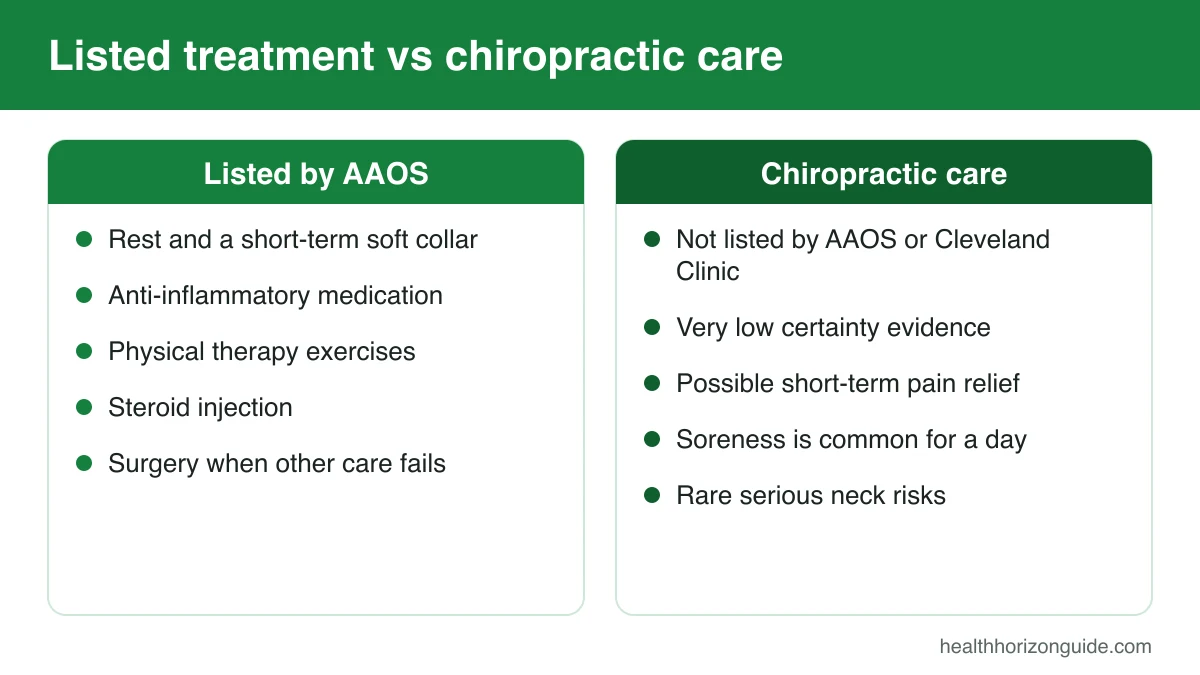
The AAOS page and both Cleveland Clinic pages on pinched nerve do not mention chiropractic care or spinal manipulation. Traction appears in these sources as part of physical therapy, and our guide to cervical decompression treatment explains that method.
Is neck manipulation safe with a pinched nerve?
Neck manipulation with a pinched nerve carries a small risk of serious harm, and the exact size of that risk is unknown. NCCIH reports that mild to moderate side effects such as increased pain, stiffness or headache are common and usually pass within a day. Serious spinal or neurological problems have been reported after spinal manipulation. NCCIH describes these events as rare and their frequency as unknown.
Manipulation of the neck has been linked to small tears in the artery walls of the neck, which are rare but can lead to stroke. NCCIH states that the incidence appears low, that experts disagree on whether manipulation causes the tears, and that patients should be told about the risk. People with underlying health problems may face a higher risk, so a chiropractor needs a full health history before treating a pinched nerve. Arm weakness needs a medical assessment before any neck adjustment, and so do symptoms in both arms.
Pinched nerve relief without a chiropractor
Pinched nerve relief without a chiropractor starts with home care and time, since most cases settle without specific treatment. The sections below cover home treatment, the red flags that need a doctor, and how a chiropractor compares with a physical therapist for a pinched nerve.
Pinched nerve treatment at home
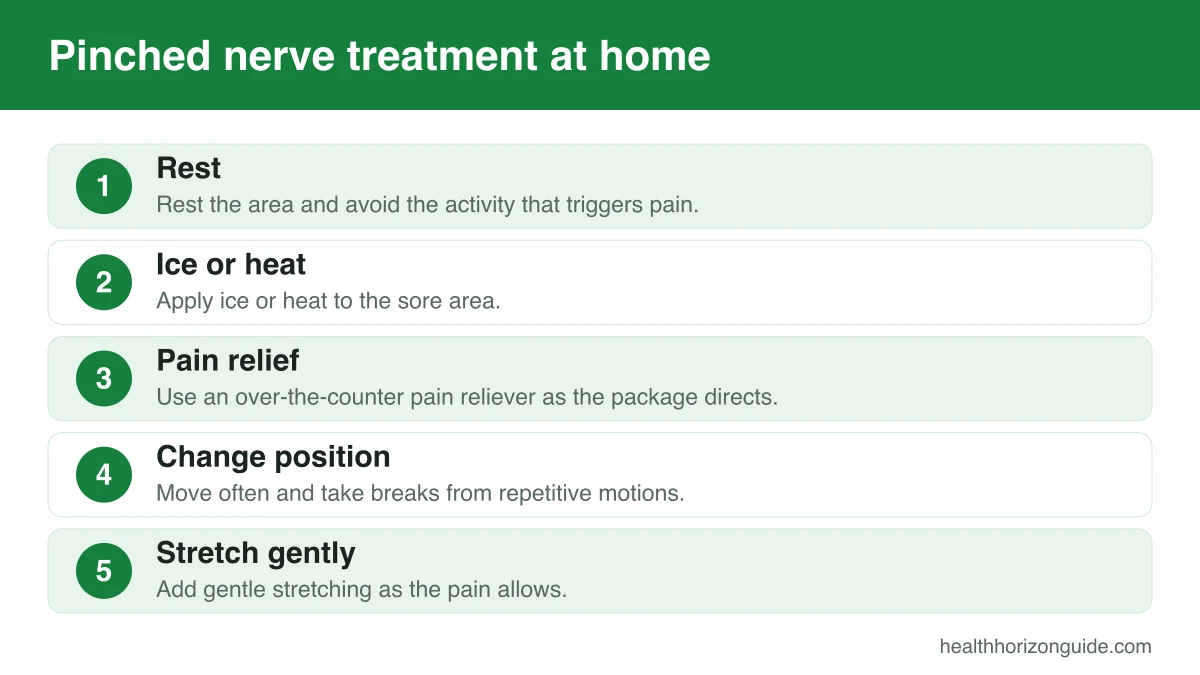
Pinched nerve treatment at home is rest, ice or heat, gentle movement and over-the-counter pain relief, according to Cleveland Clinic. The 5 home care steps that sources recommend for a pinched nerve are listed below.
- Rest the painful area and avoid the activity that triggers the pain.
- Apply ice or heat to the sore area.
- Take an over-the-counter pain reliever as directed on the package.
- Change position often, and take breaks from repetitive motions.
- Add gentle stretching as the pain allows.
The NHS advises people with sciatica to keep moving and to avoid long periods of sitting or lying down. Our page on sciatica stretches shows gentle options for a pinched nerve in the lower back. Cleveland Clinic advises seeing a healthcare provider when pinched nerve symptoms have not improved after a week of home care.
When to see a doctor for a pinched nerve
A pinched nerve needs a doctor, not a chiropractor, when red-flag symptoms appear. The NHS lists several of these as reasons to seek emergency care immediately. The 5 red flags are listed below.
- Weakness or numbness in an arm or leg that is sudden, severe or getting worse.
- Loss of bladder or bowel control, or difficulty starting to urinate.
- Numbness in the groin, around the genitals or around the anus.
- Sciatica on both sides, or symptoms in both arms or both legs.
- Neck pain that follows a fall or accident.
Chiropractor or physical therapist for a pinched nerve?
A physical therapist is the provider that orthopedic sources name for a pinched nerve, while a chiropractor is not listed. Exercise advice is offered by both professions. Our comparison of a chiropractor vs physical therapist covers training and methods. Readers with a confirmed disc problem can read our page on seeing a chiropractor for a herniated disc, and readers without arm symptoms can read about a chiropractor for neck pain.
Chiropractor for pinched nerve: common questions
Can a chiropractor fix a pinched nerve?
A chiropractor has not been shown to fix a pinched nerve. Research gives very low certainty evidence of short-term pain relief from neck manipulation, and most pinched nerves improve with time.
Can a chiropractor make a pinched nerve worse?
A chiropractor can make pinched nerve symptoms worse for a short time. NCCIH reports that increased pain and stiffness are common after manipulation and usually pass within a day, while serious nerve or spinal injuries are rare.
Does a pinched nerve go away on its own?
A pinched nerve goes away on its own in most cases. Cleveland Clinic reports that over 85% of pinched nerves in the neck resolve within 8 to 12 weeks without specific treatment.
Should I see a doctor before a chiropractor for a pinched nerve?
A doctor visit should come before a chiropractor when weakness, numbness or any red flag is present. Cleveland Clinic advises contacting a healthcare provider as soon as possible for arm weakness with a pinched nerve.