How to Fix Posture While Sitting at a Desk
Learn how to fix posture while sitting at a desk with a 7-step setup checklist, hourly movement breaks, simple exercises and the signs that need a doctor.
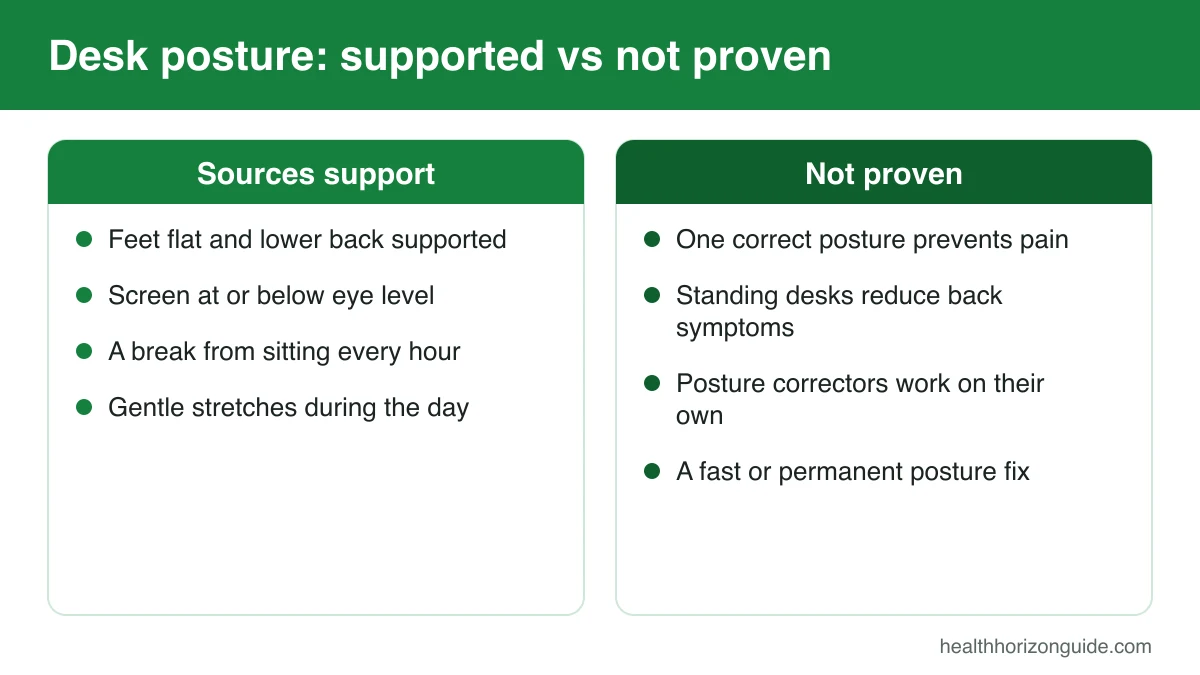
To fix posture while sitting at a desk, set the chair so both feet rest flat on the floor, support the curve of the lower back, place the screen straight ahead at or just below eye level, and change position often. No single sitting posture has been proven to prevent back pain, so regular movement matters as much as the desk setup.
Action checklist
Desk posture setup checklist
Work through these actions at the desk, then repeat the movement steps every working day.
0 of 10 done
In this article
- How to fix posture while sitting at a desk
- How often should movement breaks happen at a desk?
- Does sitting posture cause back pain?
- What else helps desk posture besides the chair setup?
- Which seated and standing exercises help desk posture?
- Do standing desks and posture correctors fix desk posture?
- How long does it take to fix sitting posture?
- When does desk-related back pain need a doctor?
- Frequently asked questions about desk posture
How to fix posture while sitting at a desk
Fixing posture while sitting at a desk means fitting the chair, screen and keyboard to the body and then moving often. Good posture keeps the three natural curves of the spine, with the head above the shoulders and the shoulders over the hips, according to the MedlinePlus guide to good posture. The 7 steps of a desk setup checklist are listed below.
- Set the chair height so both feet rest flat on the floor, or use a footrest.
- Keep the thighs roughly parallel to the floor, with the hips level with the knees or slightly higher.
- Sit back in the chair so the backrest supports the spine, and leave about two fingers of space between the seat edge and the back of the knees.
- Support the curve of the lower back with the backrest, a lumbar roll or a small rolled towel.
- Relax the shoulders and keep the elbows close to the body, bent between 90 and 120 degrees.
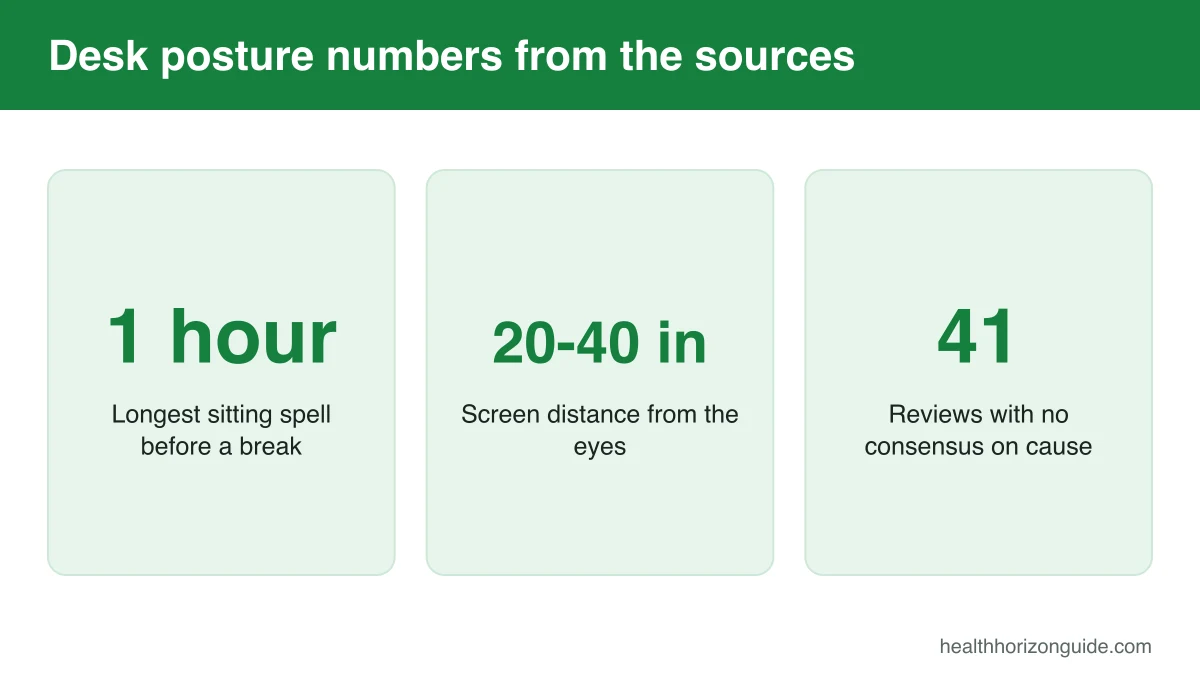
- Place the screen straight ahead, with the top line of the screen at or below eye level and 20 to 40 inches from the eyes.
- Keep the middle row of the keyboard level with the elbows and the mouse within easy reach.
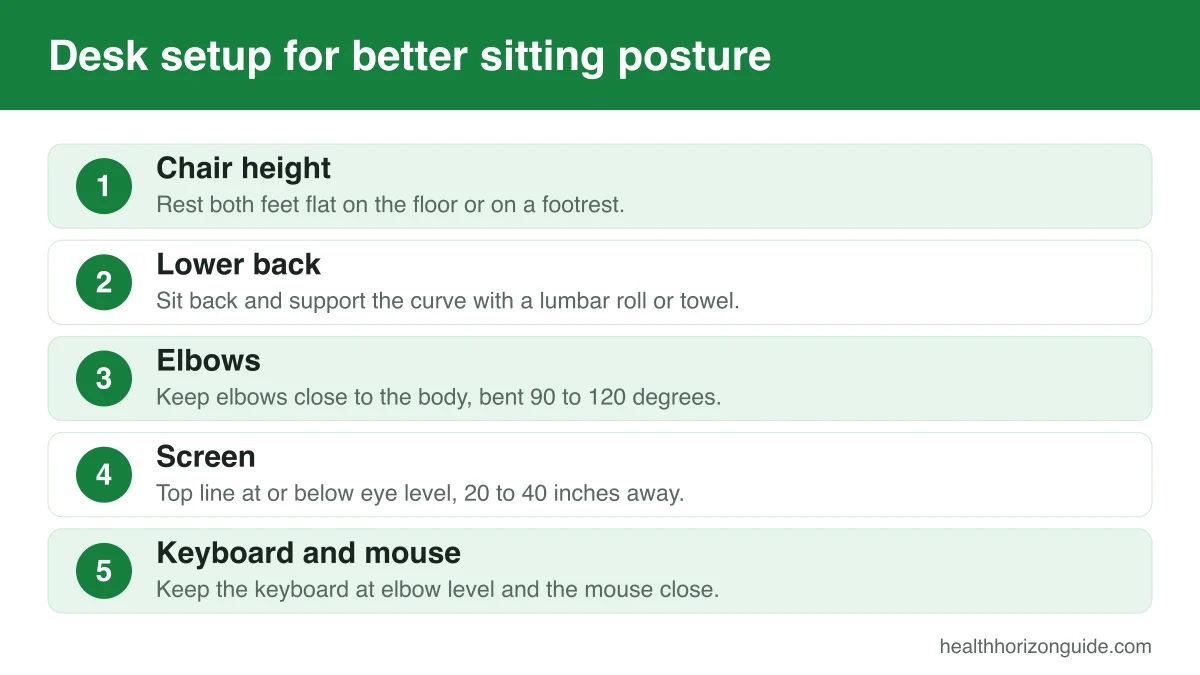
The chair and keyboard steps in this desk posture checklist follow a Cambridge University Hospitals NHS leaflet on seating and ergonomics and the MedlinePlus guide. The screen distance and height come from the OSHA computer workstation guidance on monitors. MedlinePlus adds that the legs stay uncrossed. Readers who want to review their own symptoms and habits can use our posture and back pain self-check tool.
How to sit with lower back pain
Sitting with lower back pain is often more comfortable with the hips slightly higher than the knees and firm support behind the lower back. The Cambridge NHS leaflet explains that a slightly raised seat puts more weight through the thighs and feet and takes some pressure off the base of the spine. A wedge cushion can raise the hips. A firm seat suits a desk sitting posture better than a very soft seat, which lets the back sink into a C-shaped curve.
How to fix posture when the shoulders are rolled forward
Shoulders rolled forward at a desk are eased by relaxing the shoulders and bringing the work closer to the body. MedlinePlus advises relaxed shoulders that are neither rounded nor pulled backward. The Cambridge NHS leaflet advises moving the chair close to the desk so the upper body does not stretch or lean forward. A head that drifts toward the screen often goes with rounded shoulders in a sitting posture, and our guide on how to fix forward head posture covers that pattern.
How to fix posture and pelvic tilt in a chair
Pelvic tilt in a chair is managed by sitting with the bottom at the back of the seat. Perching on the front of the seat lets the pelvis tip backward, which strains the lumbar spine in a sitting posture, according to the Cambridge NHS leaflet. The same leaflet describes a seat that tilts forward by 5 to 15 degrees, which rotates the top of the pelvis forward and lets the spine hold its natural S shape.
How often should movement breaks happen at a desk?
Movement breaks at a desk should happen at least once every hour, according to the Cambridge NHS leaflet, which states that no one should sit for more than one hour. MedlinePlus gives 3 habits for long periods of sitting, listed below.
- Switch sitting positions often.
- Take brief walks around the office or home.
- Stretch the muscles gently every so often to relieve tension.
The Cambridge NHS leaflet adds that muscle activity increases blood flow and reduces the fatigue of holding one sitting posture.
Does sitting posture cause back pain?
Sitting posture has not been proven to cause back pain. A 2020 review of 41 systematic reviews found both positive and null links between low back pain and spine posture, prolonged sitting and awkward postures. The authors concluded that there is no consensus on causality.
A 2025 scoping review of 22 studies in the Journal of Back and Musculoskeletal Rehabilitation found that longer sitting time, poor sitting posture, fewer breaks and more static sitting were associated with low back pain. The strongest evidence concerned sitting behavior, meaning breaks and position changes. These studies show association rather than cause, so evidence for one correct sitting posture remains limited.
What else helps desk posture besides the chair setup?
Desk posture also depends on exercise, equipment choices, time and knowing the warning signs. The sections below cover each of these in turn.
Which seated and standing exercises help desk posture?
Seated and standing exercises for desk posture are short stretches and posture drills that need no equipment. The 3 seated exercises below come from the NHS sitting exercises guide, which advises a stable chair without wheels.
- Chest stretch: sit upright, pull the shoulders back and down, extend the arms out to the sides and push the chest forward and up. Hold for 5 to 10 seconds and repeat 5 times.
- Upper-body twist: cross the arms and reach for the shoulders, then turn the upper body to one side without moving the hips. Hold for 5 seconds and repeat 5 times on each side.
- Neck rotation: turn the head slowly toward one shoulder as far as is comfortable. Hold for 5 seconds and repeat 3 times on each side.
Standing posture practice follows the MedlinePlus description: stand tall, keep the shoulders back, pull the stomach in, keep the head level and place the feet about shoulder-width apart. The NHS advises stopping any exercise that makes pain worse. A gentle routine such as our morning stretches for lower back pain can sit alongside desk posture work.
Do standing desks and posture correctors fix desk posture?
Standing desks and posture correctors have limited evidence as fixes for desk posture or back pain. A Cochrane review of 10 studies with 955 employees found insufficient evidence that sit-stand desks reduce the intensity of low back or upper back symptoms. The review rated the evidence as low or very low quality. Physical therapists at the Hospital for Special Surgery describe a posture corrector as an awareness aid. Their guidance limits wear to a few hours a day alongside strengthening exercises. The table below compares what sources say about 4 common desk posture fixes.
| Desk posture fix | What sources say | Strength of evidence |
|---|---|---|
| Chair and screen setup | Recommended by OSHA, MedlinePlus and NHS guidance for comfort and support | Guidance based on ergonomics practice |
| Movement breaks | Fewer breaks and static sitting are associated with low back pain in office workers | Association in observational studies |
| Sit-stand desk | Reduces sitting time, with no clear effect on back symptoms | Low or very low quality |
| Posture corrector | Short-term awareness aid used for a few hours a day | Expert guidance, with no trial data cited |
How long does it take to fix sitting posture?
Fixing sitting posture takes longer than a few days or weeks. The Cambridge NHS leaflet states that the effects of poor sitting posture develop over a long period and do not go away quickly. Readers who search for how to fix posture fast can change the desk setup in one session, yet a new position needs repeated practice. No source we reviewed supports a method that fixes posture permanently. Back pain follows a different clock: the NHS back pain guidance says back pain often improves within a few weeks.
When does desk-related back pain need a doctor?
Desk-related back pain needs a doctor when the pain does not improve after a few weeks or comes with numbness, tingling or weakness. The NHS lists 4 reasons to book a routine appointment, shown below.
- Back pain does not improve after a few weeks of home treatment.
- Back pain stops day-to-day activities.
- Back pain does not ease with rest or is worse at night.
- Back pain comes with unplanned weight loss, a lump or a change in the shape of the back.
Emergency care is needed when back pain comes with pain, tingling, weakness or numbness in both legs, loss of feeling around the genitals or anus, or new trouble controlling the bladder or bowels, according to the NHS. Our pages on seeing a chiropractor for lower back pain and chiropractic care for neck pain explain what research says about those options.
Frequently asked questions about desk posture
What is the best sitting position at a desk?
The best sitting position at a desk is a supported position that changes often. Research has not identified one correct sitting posture that prevents pain.
Why does the lower back hurt when sitting?
The lower back can hurt when sitting because an unsupported sitting posture strains the lumbar spine. The Cambridge NHS leaflet links this strain to a pelvis that tips backward and a soft seat that rounds the back.
Is a standing desk better than sitting for posture?
A standing desk is not proven to be better than sitting for back symptoms. The Cochrane review found insufficient evidence that sit-stand desks reduce back symptoms.
Can posture be fixed permanently?
Posture can improve with practice, although no source we reviewed describes a permanent one-time fix. Sitting posture is a daily habit.