Chiropractor for Degenerative Disc Disease: Can It Help?
A chiropractor may ease degenerative disc disease pain but cannot reverse disc wear. See the evidence, safe techniques, red flags and other treatments.
A chiropractor can ease the back or neck pain of degenerative disc disease for some adults, but a chiropractor cannot rebuild a worn disc or reverse the condition. The National Center for Complementary and Integrative Health (NCCIH) reports that spinal manipulation may bring small improvements in pain and function for low-back pain, and the strength of that evidence is low to moderate. Studies that test chiropractic care for degenerative disc disease alone are few and small, so gentle, exercise-based care is the sensible way to try it.
Action checklist
Before seeing a chiropractor for degenerative discs
Use these steps from the article to decide whether chiropractic care suits your degenerative disc disease.
0 of 8 done
In this article
- Can a chiropractor help degenerative disc disease?
- Degenerative disc disease vs herniated disc vs spinal stenosis
- What is degenerative disc disease?
- Degenerative disc disease symptoms
- What does a chiropractor do for degenerative disc disease?
- What does the evidence say about chiropractic care for degenerative disc disease?
- Is chiropractic care safe for degenerative disc disease?
- Beyond the chiropractor: when degenerative disc disease needs a doctor
- Other treatments for degenerative disc disease
- Daily habits for degenerative disc disease
- Frequently asked questions about chiropractors and degenerative disc disease
Can a chiropractor help degenerative disc disease?
Yes, a chiropractor can help degenerative disc disease symptoms in some people, mainly pain and stiffness over the short term. The benefit is symptom relief, not a change in the disc itself.
The 3 areas where a chiropractor may help with degenerative disc disease are listed below.
- Pain relief: gentle mobilisation or manipulation may reduce back or neck pain in the short term.
- Movement: low-force techniques may loosen stiff joints next to the worn disc.
- Self-care: a chiropractor can teach exercises and habits that protect the spine between visits.
A chiropractor cannot restore disc height, regrow disc tissue or stop ageing of the spine. Chiropractic care is also the wrong first step when degenerative disc disease causes worsening weakness, numbness in the groin area or loss of bladder or bowel control.
Degenerative disc disease vs herniated disc vs spinal stenosis
The table below compares degenerative disc disease, a herniated disc and spinal stenosis on three attributes.
| Attribute | Degenerative disc disease | Herniated disc | Spinal stenosis |
|---|---|---|---|
| What it is | Age-related drying and thinning of the spinal discs | Inner disc material pushes through the outer layer | Narrowing of the spinal canal around the nerves |
| Main symptom | Back or neck pain that comes and goes | Sharp arm or leg pain, numbness or tingling | Leg pain, heaviness or numbness on walking or standing |
| Chiropractor's role | Gentle mobilisation and exercise for pain | Low-force care only without worsening nerve signs | Flexion-based exercise and gentle care with medical oversight |
Degenerative disc changes can contribute to both a herniated disc and spinal stenosis over time. The safe level of hands-on treatment depends on which condition causes the pain.
What is degenerative disc disease?
Degenerative disc disease is the normal age-related wear of the spinal discs, not a true disease. The discs between the vertebrae lose water and height with age, which can reduce cushioning and narrow the space between bones.
Harvard Health explains that ageing is the main cause. Disc changes are more likely in people who smoke, do heavy physical work or are very overweight.
How common is degenerative disc disease in people without pain?
Degenerative disc disease is very common in people without pain, according to a 2015 systematic review in the American Journal of Neuroradiology. The Brinjikji review pooled 33 imaging studies covering 3,110 people with no back symptoms.
Disc degeneration appeared in 37% of pain-free 20-year-olds and in 96% of pain-free 80-year-olds. Disc bulges rose from 30% to 84% across the same ages. The authors concluded that many of these imaging findings are likely part of normal ageing and are not linked to pain.
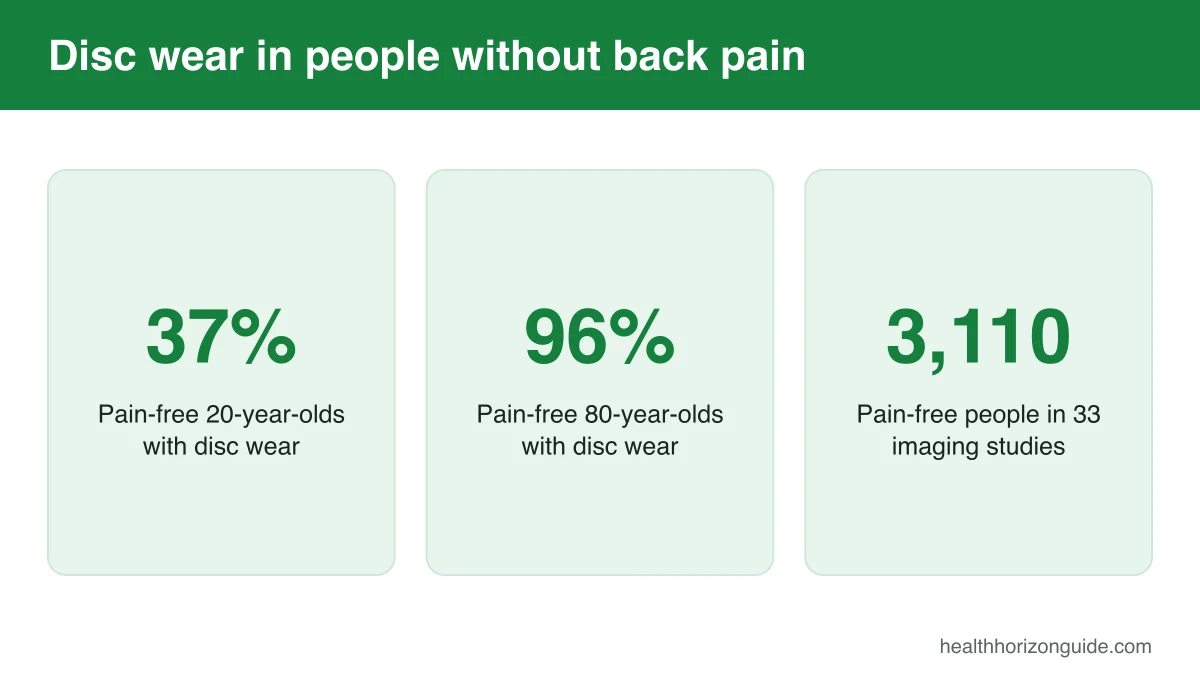
Reading the word "degenerative" on an MRI report can feel alarming, and many people fear the spine is crumbling. The imaging data offer a calmer view, since most older adults who feel well show the same changes.
Degenerative disc disease symptoms
Degenerative disc disease symptoms are mainly back or neck pain that comes and goes. Cleveland Clinic describes the pain as sharp, aching or stiff, and notes that it tends to flare with bending, twisting or lifting.
Lumbar degenerative disc disease symptoms
Lumbar degenerative disc disease symptoms centre on the lower back. The ache can spread into the buttocks or thighs, and a pinched nerve can add leg pain, numbness or tingling.
Cervical degenerative disc disease symptoms
Cervical degenerative disc disease symptoms centre on the neck. Stiffness and pain can reach the shoulders, and nerve pressure can cause arm pain or tingling in the hand.
What does a chiropractor do for degenerative disc disease?
A chiropractor treats degenerative disc disease with gentle mobilisation, flexion-distraction and exercise, after a history and an examination.
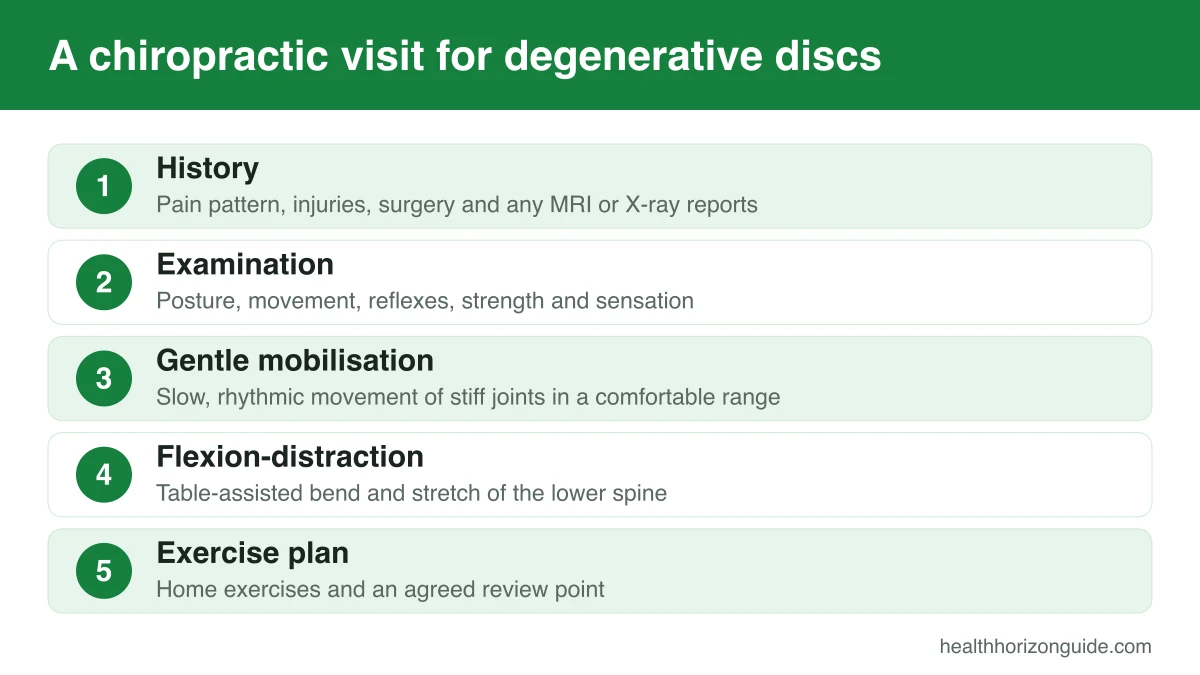
The 5 steps of a typical chiropractic visit for degenerative disc disease are listed below.
- History: pain pattern, past injuries, surgery and any scan reports.
- Examination: movement, reflexes, strength and sensation are checked for nerve involvement.
- Gentle mobilisation: slow, rhythmic movement of stiff spinal joints within a comfortable range.
- Flexion-distraction: a special table gently bends and stretches the lower spine in repeated cycles.
- Exercise plan: home exercises and an agreed review point.
The posture and back pain self-check helps you record your symptoms before the first appointment.
What is flexion-distraction for degenerative disc disease?
Flexion-distraction for degenerative disc disease is a slow, table-assisted stretch that bends the lower spine forward while gently pulling it lengthwise. Small trials report mixed results, with some showing less pain and others no clear gain.
What does the evidence say about chiropractic care for degenerative disc disease?
The evidence for chiropractic care for degenerative disc disease is limited and mostly indirect. Most trials study low-back pain in general, not degenerative disc disease alone.
NCCIH summarises a 2017 analysis of 15 studies with 1,699 participants that found moderate-quality evidence of a modest pain improvement with spinal manipulation for acute low-back pain. A 2019 review found that short-term pain relief at 1 month was similar to other recommended therapies. The American College of Physicians lists manipulation as an option, with low-strength supporting evidence.
A 2023 editorial in the Journal of the Canadian Chiropractic Association states that no accepted mechanism explains a direct effect of spinal manipulation on a degenerated disc. The same editorial notes that most cases of disc degeneration settle with conservative care.
Is chiropractic care safe for degenerative disc disease?
Chiropractic care is generally safe for degenerative disc disease when the chiropractor uses gentle techniques and screens for nerve problems first. NCCIH reports that mild to moderate side effects are common and short-lived, mostly extra soreness, stiffness or headache.
Neck manipulation carries a rare risk of a tear in a neck artery, called cervical artery dissection. The 2023 editorial also cites published reports of serious adverse events after manipulation in people with disc problems.
When is spinal manipulation not appropriate for degenerative disc disease?
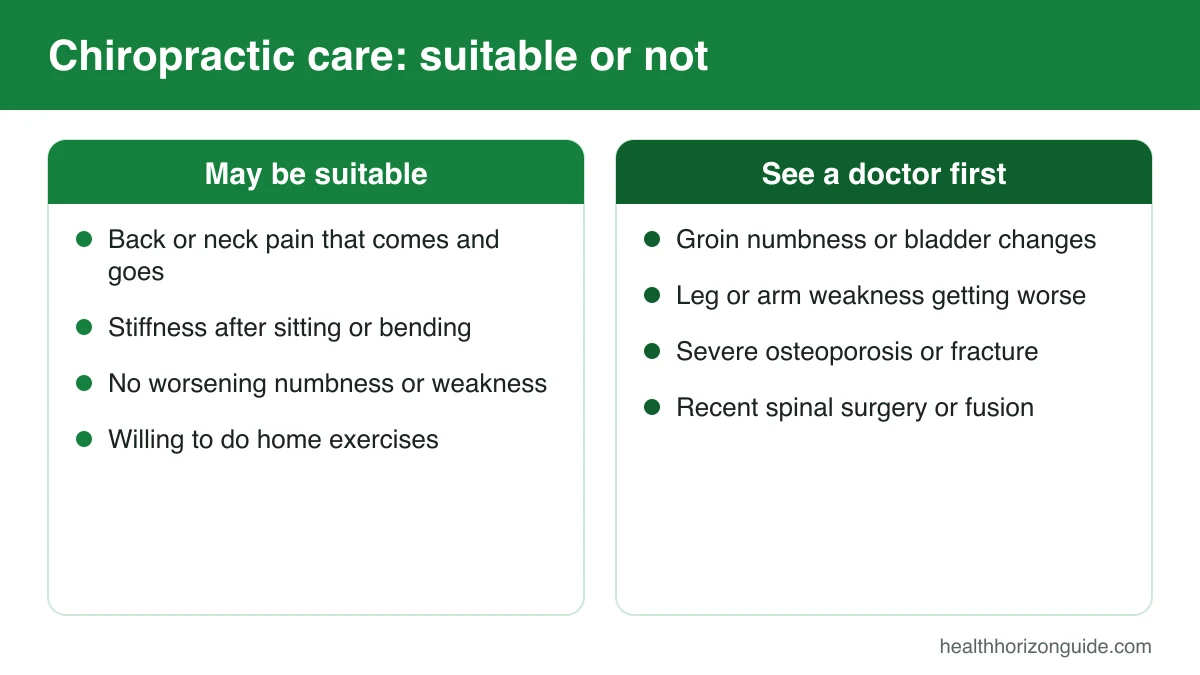
Spinal manipulation is not appropriate for degenerative disc disease in the 6 situations listed below.
- Leg or arm weakness, numbness or tingling that is getting worse.
- Any sign of cauda equina syndrome, such as groin numbness or bladder changes.
- Severe osteoporosis or a suspected spinal fracture.
- Recent spinal surgery, a spinal fusion or metal rods in the spine.
- Suspected infection or cancer, including fever or unexplained weight loss with back pain.
- Pain that keeps rising after each session.
Beyond the chiropractor: when degenerative disc disease needs a doctor
Hands-on care is one option among several, and some degenerative disc disease symptoms need a doctor instead.
Red flags with degenerative disc disease
The red flags with degenerative disc disease are signs of nerve compression that need same-day medical assessment. Cauda equina syndrome is compression of the nerve bundle at the base of the spinal cord, and the Royal Free London NHS Trust advises going to an emergency department straight away.
The 4 warning signs of cauda equina syndrome are listed below.
- Numbness or pins and needles between the inner thighs, in the genitals or around the back passage.
- New difficulty passing urine, or loss of bladder control.
- Loss of bowel control.
- New sexual problems, such as loss of sensation.
Progressive weakness in a leg or arm also needs a prompt medical review, even without the signs above. Leg heaviness that comes on with walking and eases on sitting may point to narrowing of the canal, covered in our guide to chiropractic care for spinal stenosis.
Other treatments for degenerative disc disease
Other treatments for degenerative disc disease include exercise, physiotherapy, weight management, stopping smoking and doctor-led care. Cleveland Clinic states that most people with degenerative disc disease do not need surgery.
The 5 main non-chiropractic treatments are listed below.
- Exercise: stretching, gentle yoga and walking keep the spine moving and the muscles strong.
- Physiotherapy: a graded strength and mobility plan, which Harvard Health places at the centre of care.
- Weight management: a healthy weight lowers the load on the lumbar discs.
- Stopping smoking: Cleveland Clinic notes that smoking worsens disc pain and makes treatment less effective.
- Doctor-led care: a doctor can advise on pain medicines and, when several non-surgical treatments fail and pain or weakness persists, on surgery.
Degenerative disc disease often sits alongside wear in the small facet joints of the spine. Our page on chiropractic care for spinal arthritis covers that overlap, and our guide to a chiropractor for lower back pain covers general back pain care.
Daily habits for degenerative disc disease
Daily habits for degenerative disc disease focus on regular movement and lower spinal load.
The 5 habits that protect worn discs are listed below.
- Walk most days, and break up long periods of sitting.
- Lift with bent knees and keep loads close to the body.
- Do the home exercises your chiropractor or physiotherapist sets.
- Choose a supportive sleep position that keeps the spine neutral.
- Stay smoke-free and keep a healthy weight.
Frequently asked questions about chiropractors and degenerative disc disease
Can a chiropractor reverse degenerative disc disease?
No, a chiropractor cannot reverse degenerative disc disease. Chiropractic care aims to ease pain and stiffness, and no treatment restores a worn disc to its younger state.
Can degenerative disc disease lead to a herniated disc?
Yes, degenerative disc disease can lead to a herniated disc, because a weakened outer disc layer tears more easily. Care for that problem differs, as explained in our article on a chiropractor for a herniated disc.
Do you need an MRI before seeing a chiropractor for degenerative disc disease?
No, most people do not need an MRI before seeing a chiropractor for degenerative disc disease. Imaging helps most when red flags or nerve symptoms are present.