Chiropractor for Spinal Stenosis: Can It Help and Is It Safe?
A chiropractor may ease lumbar spinal stenosis symptoms for a few months with mobilisation and exercise. Learn the evidence, the risks and the red flags.
A chiropractor can help some people with lumbar spinal stenosis feel and walk better in the short term, mainly through gentle mobilisation combined with exercise. Chiropractic care does not widen the spinal canal or cure spinal stenosis. People with cervical stenosis that presses on the spinal cord should avoid neck manipulation and see a spine specialist.
Action checklist
Before you see a chiropractor for spinal stenosis
Use these steps from the article to prepare for a visit and to stay safe during care.
0 of 10 done
In this article
- Can a chiropractor help with spinal stenosis?
- What is spinal stenosis?
- What does the research show about chiropractic care for spinal stenosis?
- Is it safe to see a chiropractor with spinal stenosis?
- What a chiropractic visit for spinal stenosis involves
- Spinal stenosis care beyond the chiropractor
- Spinal stenosis treatment without surgery
- Decompression surgery for spinal stenosis
- Spinal stenosis exercises and what to avoid
- When to see a doctor for spinal stenosis
- Frequently asked questions about chiropractors and spinal stenosis
Can a chiropractor help with spinal stenosis?
A chiropractor can help with spinal stenosis by easing symptoms in the short term, not by reversing the narrowing. The National Institute of Arthritis and Musculoskeletal and Skin Diseases (NIAMS) lists manipulation among the complementary treatments for spinal stenosis, next to physical therapy, medication and surgery. Chiropractic care for spinal stenosis usually centres on low-force methods and exercise, which matches the treatment tested in the main clinical trial.
The 3 things a chiropractor may offer for spinal stenosis are listed below.
- Flexion-based mobilisation: slow, gentle movement of the lower back in a forward-bent position, the posture that usually eases stenosis symptoms.
- Exercise: stretches and strength work for the hips, abdomen and back, with a programme to continue at home.
- Advice: guidance on pacing, posture and walking in ways that keep symptoms manageable.
What is spinal stenosis?
Spinal stenosis is a narrowing of the spaces in the spine that puts pressure on the spinal cord and nerve roots, according to NIAMS. The narrowing usually develops slowly with age. Common causes are thickened ligaments, bone spurs, bulging disks and arthritis. Spinal stenosis is most common in people over 50 and most often affects the lower back and the neck, as the Cleveland Clinic explains. Some people with narrowing on a scan have no symptoms.
Lumbar vs cervical stenosis
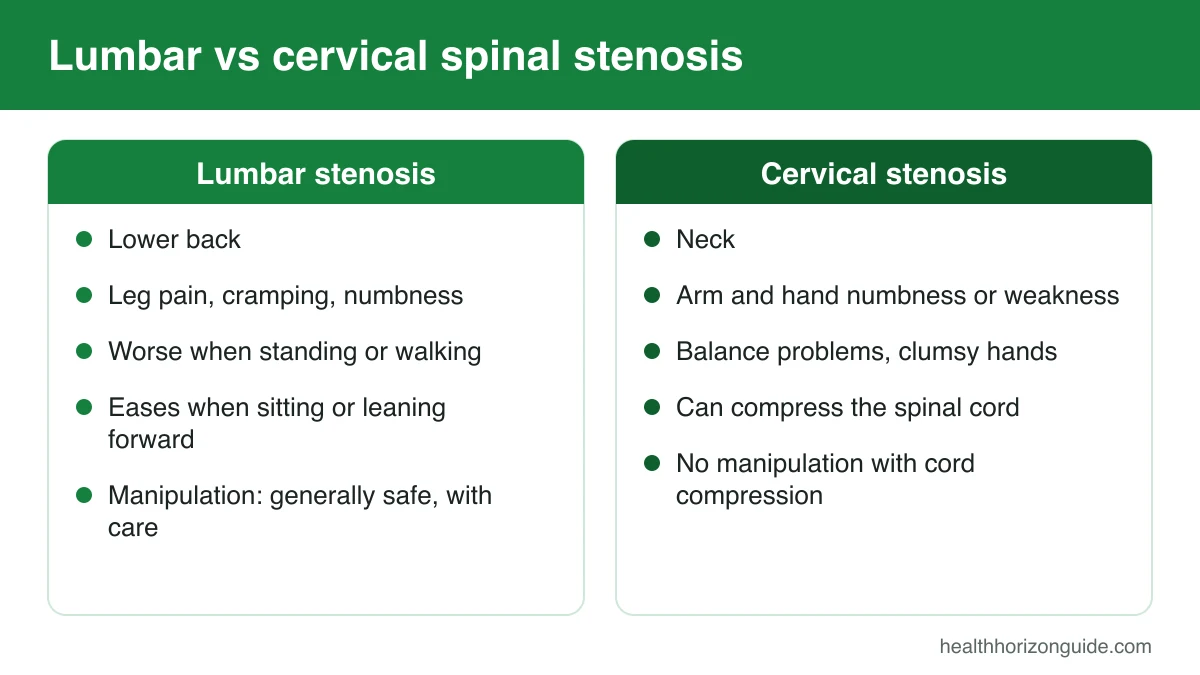
Lumbar stenosis affects the lower back and legs, while cervical stenosis affects the neck, arms and sometimes the spinal cord. The hallmark of lumbar spinal stenosis is neurogenic claudication: leg pain, cramping or heaviness that builds during standing or walking and eases with sitting or bending forward. Leaning forward, as people do over a shopping cart, flexes the spine and reduces pressure on the nerves.
The table below compares the symptoms and main concerns of lumbar and cervical spinal stenosis.
| Feature | Lumbar stenosis | Cervical stenosis |
|---|---|---|
| Location | Lower back | Neck |
| Main symptoms | Pain, cramping, numbness or tingling in the buttocks, legs and feet | Neck pain, with numbness, tingling or weakness in the arms and hands |
| Typical pattern | Worse with standing or walking, better with sitting or leaning forward | Balance problems and clumsy hands, such as trouble writing or buttoning |
| Main concern | Shorter walking distance and, rarely, cauda equina syndrome | Spinal cord compression, called myelopathy |
| Manipulation | Described as generally safe, with caution | Never advised where the spinal cord is compressed |
What does the research show about chiropractic care for spinal stenosis?
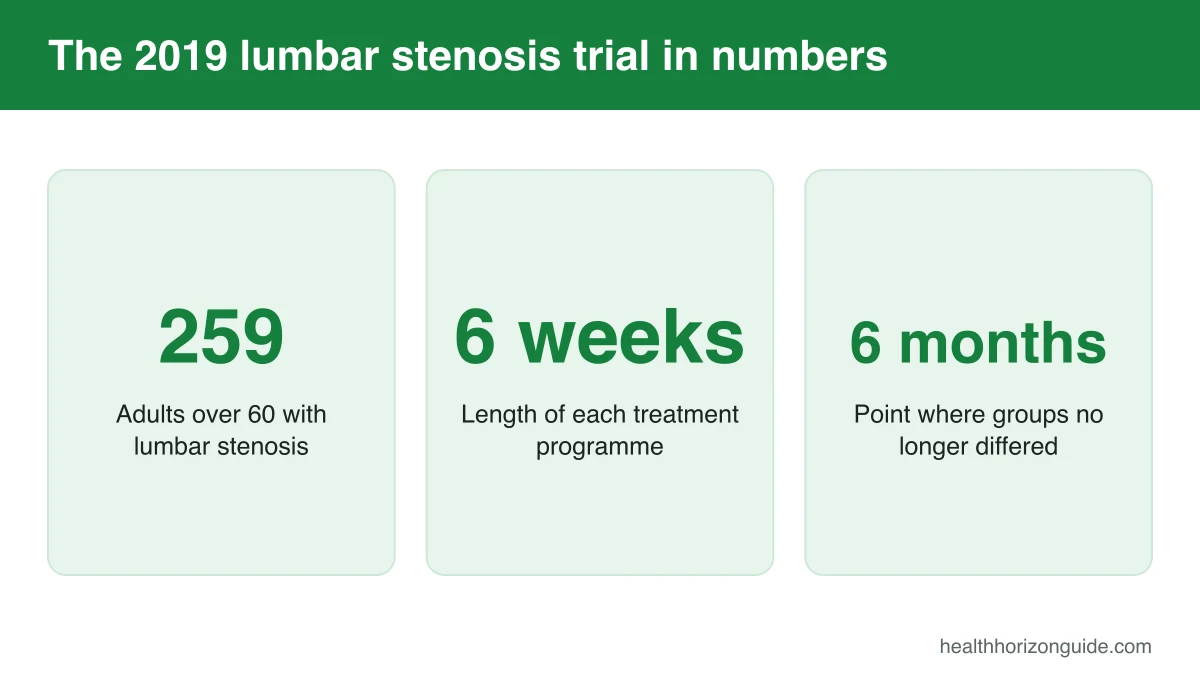
Research on chiropractic care for spinal stenosis shows a short-term benefit in one well-designed trial and no lasting advantage at 6 months. The strongest study is a randomized clinical trial published in JAMA Network Open in 2019. The trial assigned 259 adults over 60 with lumbar stenosis to 1 of 3 groups for 6 weeks: medical care with medication or epidural injections, group exercise classes, or manual therapy with individualised exercise delivered by chiropractors and physical therapists.
Manual therapy with individualised exercise produced greater improvement in symptoms, physical function and walking capacity at 2 months than the other two approaches. The difference was modest, at about 2 points on a symptom scale that runs from 12 to 55. No differences remained between the 3 groups at 6 months.
The trial has limits that matter for anyone with spinal stenosis. The treatment was spinal mobilisation plus stretches and strength training, not forceful adjustment alone, so the trial cannot show which part helped. Physical therapists delivered part of the care. The trial covered lumbar stenosis only, so the results do not apply to the neck.
Is it safe to see a chiropractor with spinal stenosis?
Seeing a chiropractor with spinal stenosis is generally safe for lumbar stenosis and unsafe for cervical stenosis with spinal cord compression. The American Academy of Orthopaedic Surgeons (AAOS) describes chiropractic manipulation for lumbar spinal stenosis as generally safe and able to ease some pain. The AAOS advises caution for people with osteoporosis or a herniated disk, where manipulation can worsen symptoms or cause injury. Our guide on seeing a chiropractor with osteoporosis covers that risk in detail.
Cervical stenosis with myelopathy and neck manipulation
Cervical stenosis with myelopathy rules out neck manipulation because the spinal cord itself is compressed. The AAOS states that manipulation should never be used for spinal cord compression in the neck. Signs of myelopathy include numb or weak hands, loss of fine skills such as handwriting or buttoning, and poor balance. The AAOS describes surgery as the main treatment for cervical myelopathy. A person with cervical spinal stenosis and any of those signs needs a neurosurgeon or orthopaedic spine surgeon, not a chiropractor.
What a chiropractic visit for spinal stenosis involves
A chiropractic visit for spinal stenosis involves a review of symptoms and scans, a physical examination and a plan built around movement. A confirmed diagnosis should come first. NIAMS explains that doctors diagnose spinal stenosis with a medical history, a physical examination and imaging such as MRI or CT. Bring the imaging report to the first visit, describe every symptom, including any in the hands or bladder, and ask which techniques the chiropractor plans to use.
The 2019 trial delivered its treatment over 6 weeks. Care that brings no change in pain or walking distance over a similar period is a reason to return to a doctor and review other options.
Spinal stenosis care beyond the chiropractor
Spinal stenosis care extends well beyond chiropractic treatment. The sections below cover the established medical treatments, the activity advice that health sources give, and the warning signs that need a doctor.
Spinal stenosis treatment without surgery
Spinal stenosis treatment without surgery relies on physical therapy, medication and epidural steroid injections. The 4 established nonsurgical options are listed below.
- Physical therapy: exercises that keep the spine moving, strengthen the abdominal and back muscles and build endurance.
- Medication: anti-inflammatory drugs and other pain relievers, chosen with a doctor or pharmacist.
- Epidural steroid injections: injections that can reduce pain and numbness for a time and do not improve weakness.
- Bracing: support that helps some people, such as those with weak abdominal muscles.
Traction is a weaker option. The AAOS notes that lumbar traction has very limited results and no scientific evidence of effectiveness, a point explored in our article on the pros and cons of spinal decompression therapy.
Decompression surgery for spinal stenosis
Decompression surgery for spinal stenosis is used when symptoms persist after nonsurgical treatment or when nerve function is at risk. Laminectomy, the most common operation, removes the bone, bone spurs and ligament that press on the nerves. Surgeons may add a spinal fusion where the spine is unstable. NIAMS reports that most people have less leg pain and walk better after surgery, although the wear in the spine can continue.
Spinal stenosis exercises and what to avoid
Spinal stenosis exercises should be low impact, regular and adjusted so that pain does not build. NIAMS suggests exercising about 3 times a week for 30 minutes, with a doctor's agreement first. The 4 pieces of activity advice that sources give are listed below.
- Choose gradual aerobic activity such as swimming or stationary cycling.
- Pace walking and standing, and sit or lean forward when leg symptoms build.
- Limit positions that arch the lower back, since extending the lumbar spine often worsens symptoms.
- Keep a healthy weight and stop smoking.
Spinal stenosis is one of several causes of back and leg pain. Our guides to chiropractic care for lower back pain and seeing a chiropractor for a pinched nerve cover the related conditions.
When to see a doctor for spinal stenosis
A doctor should assess spinal stenosis immediately when any red flag symptom appears. The 4 red flags are listed below.
- Loss of bladder or bowel control, or being unable to urinate.
- Numbness in the groin, genital area or inner thighs.
- Leg weakness that keeps getting worse or makes walking difficult.
- New trouble with balance or hand coordination.
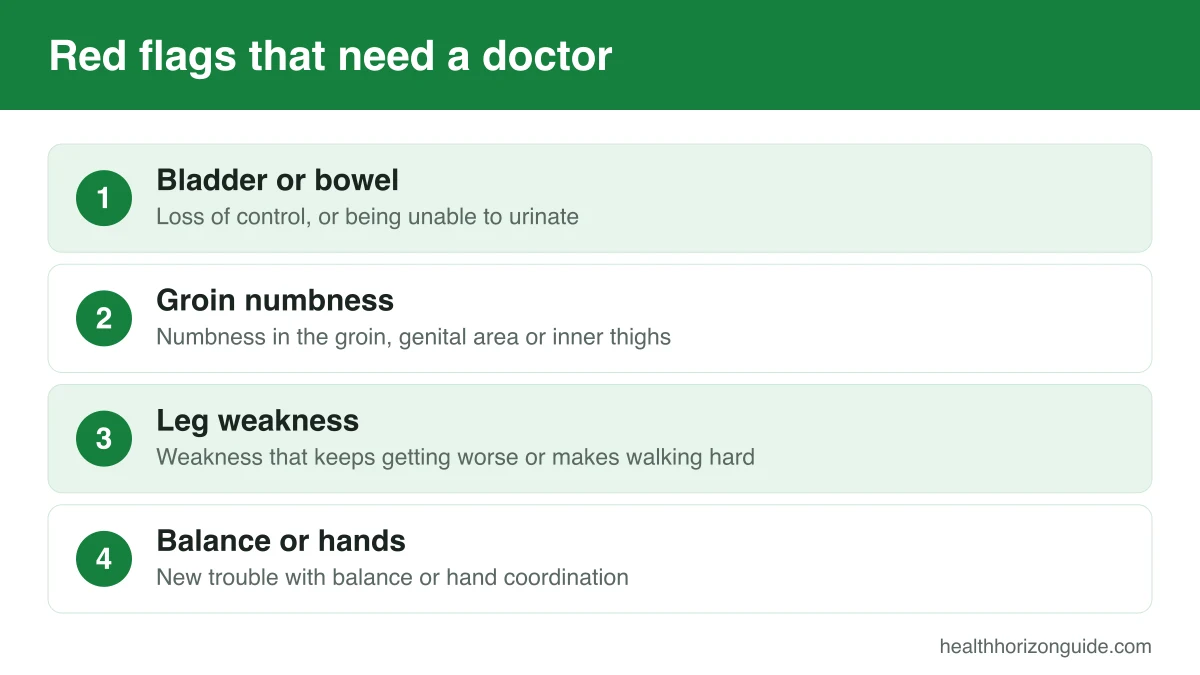
The first 3 red flags can signal cauda equina syndrome, a rare emergency that the AAOS says requires prompt treatment. The fourth red flag points to possible myelopathy from cervical spinal stenosis. Stop chiropractic care and seek emergency medical help when any of the first 3 signs appears.
Frequently asked questions about chiropractors and spinal stenosis
Can a chiropractor fix spinal stenosis?
A chiropractor cannot fix spinal stenosis. Manual therapy and exercise can ease symptoms for a time, and neither treatment creates more room in the spinal canal.
Can a chiropractor make spinal stenosis worse?
A chiropractor can make spinal stenosis symptoms worse in certain situations. The AAOS warns that manipulation can worsen symptoms or cause injury in people with osteoporosis or a herniated disk, and that manipulation should never be used where the spinal cord is compressed.
Is walking good for spinal stenosis?
Walking is good for spinal stenosis in paced amounts that do not bring on severe leg symptoms. NIAMS advises regular exercise that is modified to avoid worsening pain, with an assistive device for stability where needed.
Chiropractor or physical therapist for spinal stenosis?
A chiropractor or a physical therapist can both deliver manual therapy and exercise for lumbar spinal stenosis, and both professions provided the care in the 2019 trial. Our comparison of a chiropractor vs physical therapist explains how the two differ.