
Chiropractor vs Orthopedic Doctor: Which Should You See?
A chiropractor treats back and joint pain by hand. An orthopedic doctor can prescribe, inject and operate. Compare training, scope, imaging and red flags.
A chiropractor and an orthopedic doctor both treat muscle, joint and spine problems, but the two providers hold different degrees and use different tools. A chiropractor is a Doctor of Chiropractic who treats pain by hand without drugs or surgery, while an orthopedic doctor is a physician and surgeon who can prescribe medicine, give injections and operate. New, uncomplicated back or neck pain fits either provider, and a suspected fracture, tear or nerve problem with weakness belongs with an orthopedic doctor.
Action checklist
Choosing a chiropractor or an orthopedic doctor
Use these steps from the article to match a back or joint problem with the right provider.
0 of 8 done
In this article
- Chiropractor vs orthopedic doctor: what is the difference?
- What does a chiropractor treat?
- What does an orthopedic doctor treat?
- Can a chiropractor order an MRI or prescribe medicine?
- Chiropractor or orthopedist for back pain and neck pain
- Which problems fit a chiropractor and which fit an orthopedic doctor?
- First visit and insurance: chiropractor vs orthopedic doctor
- How chiropractors and orthopedic doctors work together
- Should I see a chiropractor or orthopedic doctor for knee or shoulder pain?
- Red flags that need an orthopedic or emergency doctor first
- Other providers for back and joint pain
- Chiropractor vs orthopedic doctor: common questions
Chiropractor vs orthopedic doctor: what is the difference?
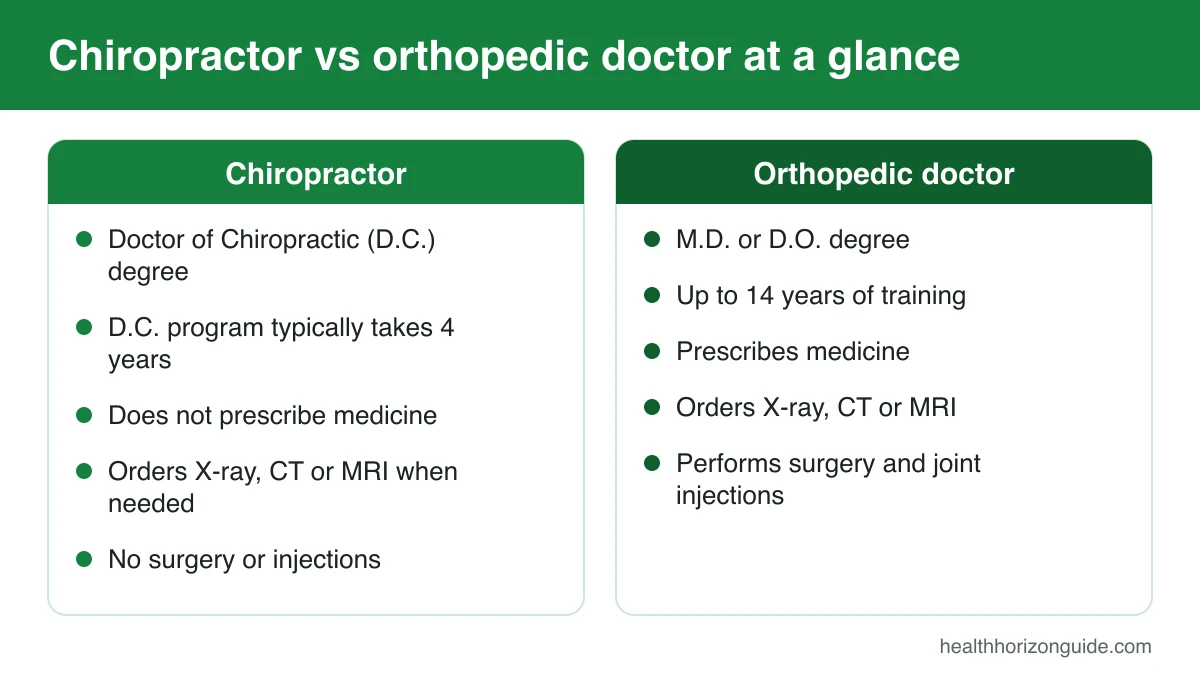
The difference between a chiropractor and an orthopedic doctor is training and scope of treatment. A chiropractor focuses on manual, non-drug care. An orthopedic doctor completes medical school and a surgical residency, and offers both non-surgical and surgical treatment.
The table below compares a chiropractor and an orthopedic doctor on training, licensing, treatment and access in the United States.
| Feature | Chiropractor | Orthopedic doctor |
|---|---|---|
| Degree | Doctor of Chiropractic (D.C.) | Doctor of Medicine (M.D.) or Doctor of Osteopathic Medicine (D.O.) |
| Training length | D.C. program that typically takes 4 years, after at least 3 years of undergraduate study | Up to 14 years: 4 undergraduate, 4 in medical school, about 5 in residency, plus an optional 1 to 2 year fellowship |
| Licensing | National Board of Chiropractic Examiners exam and a state license; scope of practice varies by state | Board certification exam from a body such as the American Board of Orthopaedic Surgery, plus continuing medical education |
| Diagnoses and treats | Musculoskeletal pain such as low back pain, neck pain, headaches and joint pain | Arthritis, fractures, sprains, sports injuries, scoliosis, neck and low back pain |
| Main treatments | Spinal and joint manipulation, stretching, exercise advice | Braces, casts, medicine, joint injections, physical therapy, surgery |
| Prescribes medicine | No | Yes |
| Orders imaging | Yes, X-rays, CT or MRI when needed | Yes, X-rays at most first visits, CT or MRI when needed |
| Surgery and injections | No | Yes, including fracture repair, joint replacement and steroid joint injections |
| Typical first visit | Health history, exam, working diagnosis, and treatment often begins | History, exam, X-rays, diagnosis and a treatment plan |
| Insurance and referral | Many health plans cover part of the cost; Medicare covers spinal manipulation only; referral rules depend on the plan | Billed as specialist medical care; referral rules depend on the plan |
What does a chiropractor treat?
A chiropractor treats musculoskeletal pain, most often in the low back and neck. The National Center for Complementary and Integrative Health (NCCIH) reports that 85.7 percent of adults who used chiropractic care in 2022 did so for pain management. A chiropractor uses manual methods that range from stretching and sustained pressure to joint manipulation, which is a quick thrust applied by hand. Chiropractic care involves no prescription medicine and no surgery, which is the main contrast with an orthopedic doctor.
What does an orthopedic doctor treat?
An orthopedic doctor treats injuries and diseases of the bones, joints, muscles, tendons and ligaments. Cleveland Clinic lists arthritis, bursitis, tendinitis, sprains, fractures, sports injuries, scoliosis, and neck and low back pain among the conditions an orthopedist manages. Non-surgical care comes first for most conditions and includes braces, casts, non-opioid pain medicine, steroid joint injections and physical therapy. Surgery is considered when non-surgical care fails, or straight away for some trauma. A chiropractor offers none of the drug or surgical options.
Chiropractor vs orthopedic surgeon training
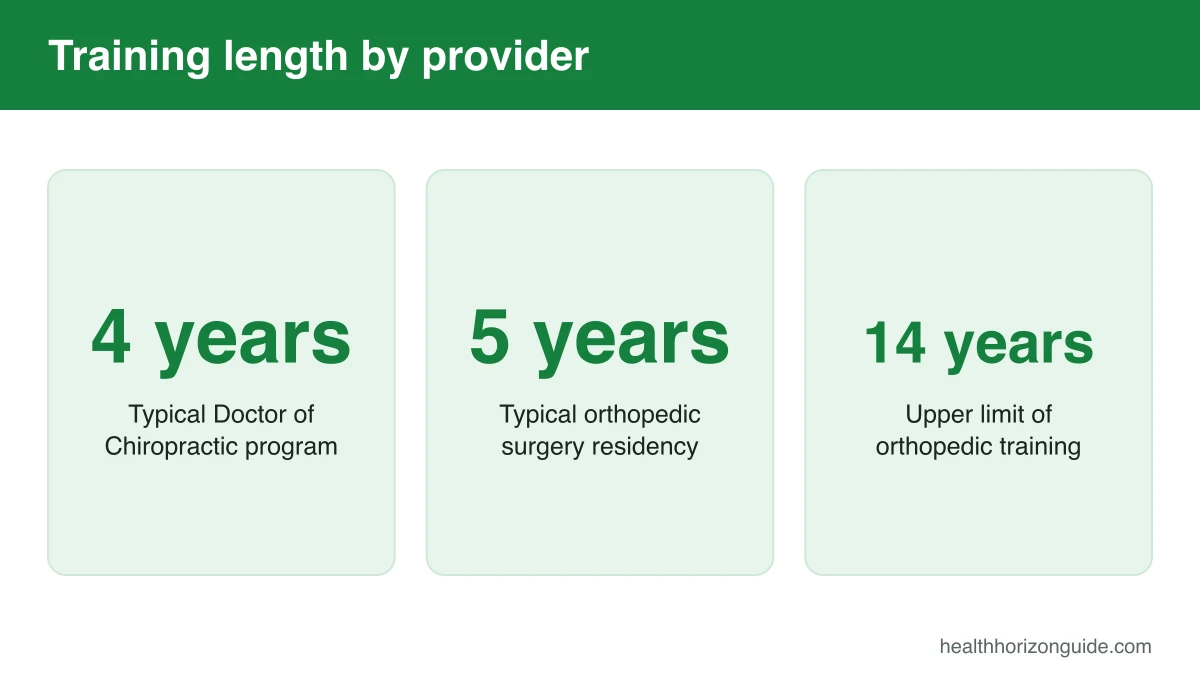
Chiropractor and orthopedic surgeon training differ in length and in content. A Doctor of Chiropractic program typically takes 4 years and requires at least 3 years of undergraduate education first, according to NCCIH. An orthopedic surgeon has up to 14 years of training, which includes medical school and a residency of about 5 years. The terms orthopedic doctor, orthopedist and orthopedic surgeon describe the same specialist. Both providers hold a doctoral degree, but only the orthopedic surgeon is a medical doctor.
Can a chiropractor order an MRI or prescribe medicine?
A chiropractor can order an MRI and does not prescribe medicine. Cleveland Clinic states that a chiropractor orders X-rays, CT scans or MRI scans when the exam shows a need, and describes chiropractic as care that does not involve prescribing medicine. Scope of practice varies from state to state, so the exact rules depend on where the chiropractor is licensed. Medicare pays for spinal manipulation by a chiropractor and does not cover X-rays or other tests that a chiropractor orders. An orthopedic doctor orders the same imaging and also prescribes medicine.
Chiropractor or orthopedist for back pain and neck pain
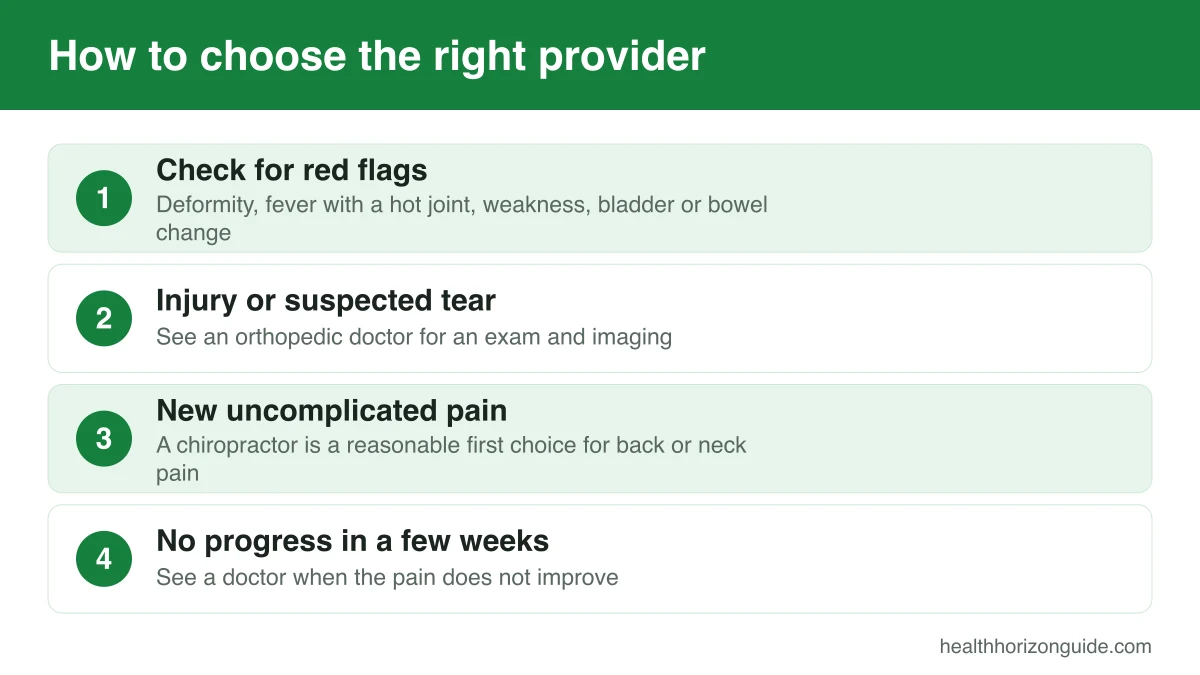
A chiropractor is a reasonable first choice for new back or neck pain without warning signs, and an orthopedist is the better choice when structural damage is suspected. The American College of Physicians guideline recommends non-drug treatment first for acute and subacute low back pain and names superficial heat, massage, acupuncture and spinal manipulation as options. The same guideline rates the evidence for spinal manipulation as low quality, and notes that most acute low back pain improves over time regardless of treatment.
Chiropractic adjustment carries real risks. Soreness, tiredness or a mild headache are common afterwards, and Cleveland Clinic lists a herniated disc, nerve compression in the lower spine and stroke as rare serious complications. An orthopedist suits back or neck pain that follows a fall, lasts beyond a few weeks, or comes with arm or leg weakness.
Which problems fit a chiropractor and which fit an orthopedic doctor?
A chiropractor fits uncomplicated pain, and an orthopedic doctor fits structural damage. The 5 problems that belong with an orthopedic doctor are listed below.
- Fractures: a broken bone needs imaging and a cast, splint or surgical repair.
- Suspected tears: a torn ligament or tendon, such as an ACL or rotator cuff tear, may need surgical repair.
- Joint replacement: a hip or knee worn down by arthritis is replaced by an orthopedic surgeon.
- Deformity: scoliosis, clubfoot and hip dysplasia fall within orthopedic care.
- Nerve compression with weakness: numbness, tingling or loss of strength needs a medical evaluation before any chiropractic care for a herniated disc.
New low back pain, neck pain and muscle aches without those features fit a chiropractor.
First visit and insurance: chiropractor vs orthopedic doctor
A first visit with a chiropractor or an orthopedic doctor starts with a health history and a physical exam. A chiropractor then forms a working diagnosis and often begins hands-on treatment. An orthopedic doctor usually takes X-rays, explains the diagnosis and recommends a plan.
Insurance treats the two providers differently. NCCIH notes that health plans may cover chiropractic care only in part. Medicare patients pay 20 percent of the approved amount for covered spinal manipulation once the Part B deductible is met. Referral rules depend on the plan, so a call to the insurer before booking is worthwhile. Our guide to how much a chiropractor costs covers fees in more detail.
How chiropractors and orthopedic doctors work together
Chiropractors and orthopedic doctors work together through referral in both directions. A chiropractor refers a patient to another healthcare provider when chiropractic care is not appropriate, according to Cleveland Clinic. An orthopedic doctor tries non-surgical care first for most conditions, so a patient cleared of serious damage can continue conservative care. The sections below cover knee and shoulder pain, red flags and related providers.
Should I see a chiropractor or orthopedic doctor for knee or shoulder pain?
Knee or shoulder pain after an injury belongs with an orthopedic doctor first, while a gradual ache without injury can start with a chiropractor. Cleveland Clinic states that chiropractors treat musculoskeletal pain in the shoulders, hips, knees and ankles. An orthopedic doctor repairs a torn ACL or rotator cuff and replaces a worn joint. A joint that swells, grinds, snaps or loses movement is on the Cleveland Clinic list of reasons to see an orthopedist. Our pages on chiropractors for knee pain and a chiropractor for shoulder pain cover each joint.
Red flags that need an orthopedic or emergency doctor first
Red flags that need an orthopedic or emergency doctor before a chiropractor are signs of fracture, infection or nerve damage. The 5 red flags are listed below.
- Injury with deformity: MedlinePlus lists a limb or joint that looks out of place or misshapen as a sign of a broken bone.
- Inability to bear weight: a limb that cannot move or take weight after an injury needs prompt medical help.
- A hot, swollen joint with fever: the NHS advises urgent medical help for sudden severe joint pain with heat, swelling and a high temperature, which can signal septic arthritis.
- Numbness or weakness: new numbness, tingling or leg weakness with back pain is a reason to see a doctor.
- Bladder or bowel changes: trouble urinating or a change in bowel habits with back pain needs a doctor without delay.
The National Institute of Arthritis and Musculoskeletal and Skin Diseases adds back pain after a fall, back pain with fever and back pain with unintended weight loss to the reasons to see a doctor. A chiropractor visit can wait until a doctor has ruled out these causes.
Other providers for back and joint pain
Other providers for back and joint pain include primary care doctors and physical therapists. A primary care doctor can rule out serious causes and refer to an orthopedic doctor. A physical therapist focuses on exercise-based rehabilitation, and our comparison of a chiropractor vs a physical therapist covers that choice in detail.
Chiropractor vs orthopedic doctor: common questions
Is a chiropractor a doctor?
A chiropractor is a Doctor of Chiropractic, not a medical doctor. An orthopedic doctor holds an M.D. or D.O. degree and completes a surgical residency.
Do I need a referral to see a chiropractor or an orthopedic doctor?
A referral to a chiropractor or an orthopedic doctor depends on the insurance plan. The insurer can confirm the rule before the first appointment.
How long should I try a chiropractor before seeing an orthopedic doctor?
Back pain that does not improve after a few weeks of chiropractor visits is a reason to see a doctor, according to NIAMS guidance on back pain. Any red flag listed above needs a doctor first.