Chiropractor for Tailbone Pain: Does It Help?
A chiropractor can ease some tailbone pain, but the evidence is limited. Learn what coccydynia is, how to sit, which treatments work and when to see a doctor.
A chiropractor can help some people with tailbone pain through gentle mobilisation of the coccyx, soft-tissue work on the surrounding muscles and advice on sitting. Research shows limited evidence for manual therapy, with a mild effect that is strongest in recent-onset pain. Most tailbone pain eases with a coccyx cushion, shorter sitting periods and simple pain relief, so home care is the usual first step.
Action checklist
Tailbone pain self-care checklist
Use these steps from the article to ease tailbone pain at home and to know when to get medical help.
0 of 10 done
In this article
- What is tailbone pain (coccydynia)?
- How to sit with tailbone pain: a 7-step self-care routine
- Can a chiropractor help tailbone pain?
- Coccydynia treatment beyond chiropractic care
- How long does tailbone pain take to heal?
- When does tailbone pain need a doctor?
- Is the pain coccydynia or another back problem?
- Tailbone pain FAQ
What is tailbone pain (coccydynia)?
Tailbone pain, called coccydynia, is pain at the coccyx, the small bone at the bottom of the spine. The coccyx is made of three to five fused vertebrae and helps support the body during sitting, according to Cleveland Clinic. Cleveland Clinic states that tailbone pain is five times more likely in females than in males.
Tailbone pain symptoms
The main symptom of tailbone pain is a dull ache at the base of the spine, with occasional sharp pains. The NHS states that coccydynia feels worse during sitting, during the move from sitting to standing, during bending forward and during a bowel movement. Tailbone pain when sitting can disturb sleep and daily activities.
What causes tailbone pain?
The causes of tailbone pain include a fall, pregnancy and childbirth, and long periods of sitting. Tailbone pain after a fall happens when a backward landing bruises, fractures or dislocates the coccyx. Tailbone pain after childbirth is linked to pregnancy hormones that soften the joint between the sacrum and the coccyx, which can overstretch the nearby muscles and ligaments, according to Cleveland Clinic. The NHS adds repeated strain from long drives or cycling, poor posture, being overweight or underweight, and joint hypermobility. The cause of coccydynia is sometimes unknown. Readers with a wider ache after birth can read our guide to a sore lower back after pregnancy.
How to sit with tailbone pain: a 7-step self-care routine
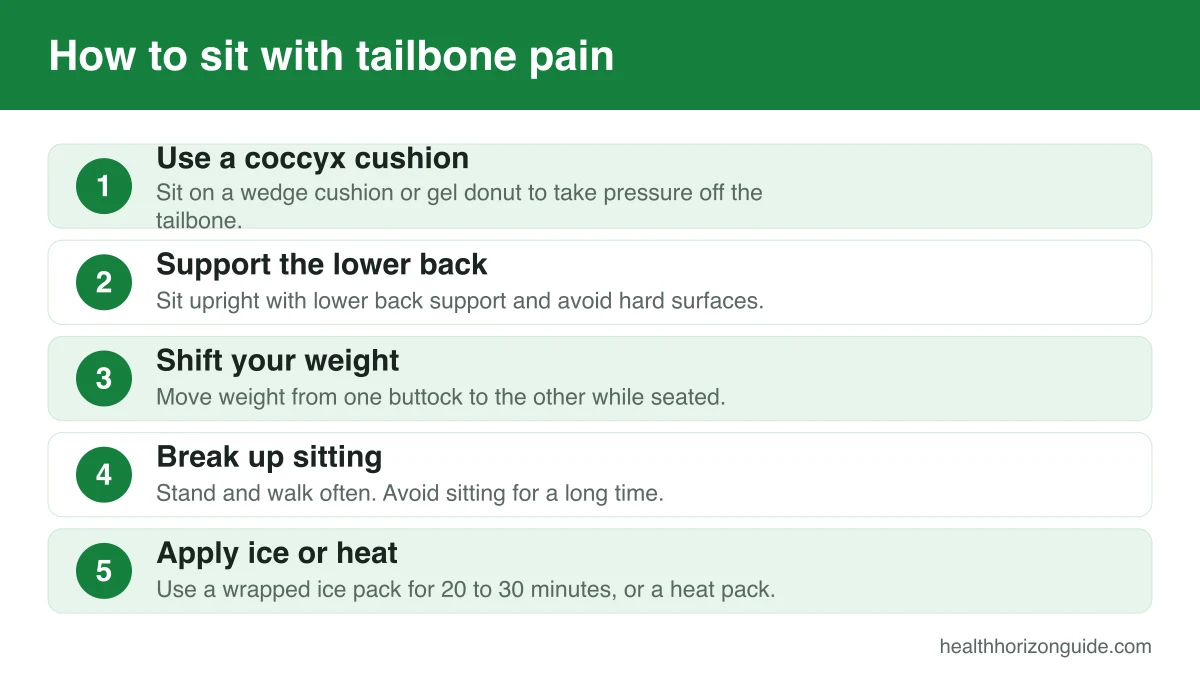
Sitting with tailbone pain is easier with a coccyx cushion, a supported posture and frequent breaks. Home care is the base of tailbone pain relief, with or without a chiropractor. The 7 steps below come from NHS and MedlinePlus self-care guidance for tailbone pain.
- Sit on a coccyx cushion, wedge cushion or gel donut to take pressure off the tailbone.
- Sit upright with the lower back supported, and avoid hard surfaces.
- Shift weight from one buttock to the other while seated.
- Break up sitting time. Stand and walk often, and avoid sitting for a long time.
- Apply an ice pack wrapped in a towel for 20 to 30 minutes, or use a heat pack.
- Lie on one side to rest, which reduces pressure on the coccyx.
- Ask a pharmacist about a stool softener when bowel movements make tailbone pain worse.
Pain relief for tailbone pain is part of the same routine. The NHS names NSAIDs such as ibuprofen, and MedlinePlus lists ibuprofen, naproxen and acetaminophen as medicines sold without a prescription. MedlinePlus advises people with heart disease, high blood pressure, kidney disease, liver disease or past stomach ulcers to speak to a provider first, and tells every reader to stay within the dose on the label. The NHS recommends pelvic floor exercises too. Desk workers can combine the routine with our steps on how to fix posture while sitting at a desk.
Can a chiropractor help tailbone pain?
A chiropractor can help tailbone pain in some cases, but the benefit shown in research is mild. Manual therapy is a second-line option, used when home care has not been enough. A 2014 review in the Ochsner Journal lists manual manipulation, massage and pelvic floor rehabilitation among the treatments for tailbone pain that persists after conservative care.
What a chiropractor does for tailbone pain
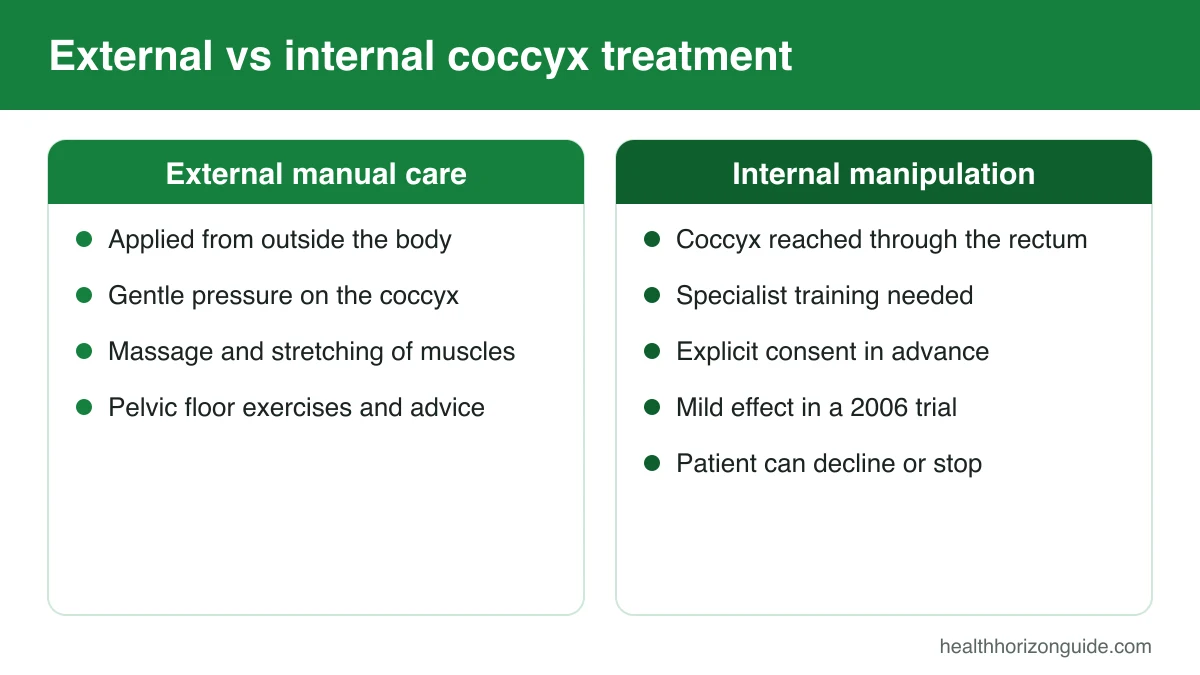
A chiropractor usually treats tailbone pain with hands-on techniques applied from outside the body, plus advice on sitting. The 3 common parts of manual care for coccydynia are listed below.
- External mobilisation: gentle pressure on the coccyx and the joint with the sacrum, applied through the buttock area.
- Soft-tissue work: massage and stretching of the muscles and ligaments around the coccyx. The NHS describes physiotherapy for coccydynia as manipulation of the muscles around the coccyx.
- Pelvic floor muscle work: release techniques and exercises for the pelvic floor muscles that attach to the coccyx.
Internal coccyx manipulation is a different procedure, in which the clinician reaches the coccyx through the rectum. Internal manipulation for tailbone pain is a specialist technique that needs specific training, a clear explanation and explicit consent in advance. A patient can decline internal work or stop the session at any point. Not every chiropractor treats the coccyx, so readers should ask about coccydynia experience before booking.
What the evidence shows for manual therapy and coccydynia
The evidence for manual therapy in tailbone pain is limited and points to a mild effect. The main trial is a 2006 randomized study in the journal Spine of 102 patients with chronic coccydynia. Half of the patients received three sessions of internal coccyx manipulation, and half received low-power external physiotherapy as a comparison. Good outcomes were recorded in 36% of the manipulation group and 20% of the comparison group at 1 month. The gap was 22% against 12% at 6 months and was not statistically significant. The authors described the effect as mild. The trial tested internal manipulation, so the results do not transfer directly to the external techniques most chiropractors use.
A 2025 systematic review of nine randomized trials with 532 participants found manual therapy most effective in recent-onset coccydynia, with effects that diminished over time. The reviewers reported small samples, short follow-up and a risk of bias. A 2022 narrative review rated the support for stretching and manipulation as level II evidence and called for higher-quality comparative studies. Our search found no large trial of chiropractic adjustment alone for tailbone pain.
Limits and risks of chiropractic care for tailbone pain
Chiropractic care for tailbone pain is limited to hands-on treatment and advice. Injections and surgery are medical procedures. A hard fall can fracture or dislocate the coccyx, so a medical check should come before any manual treatment in that case. Our guide compares a chiropractor vs physical therapist for readers choosing a profession.
Coccydynia treatment beyond chiropractic care
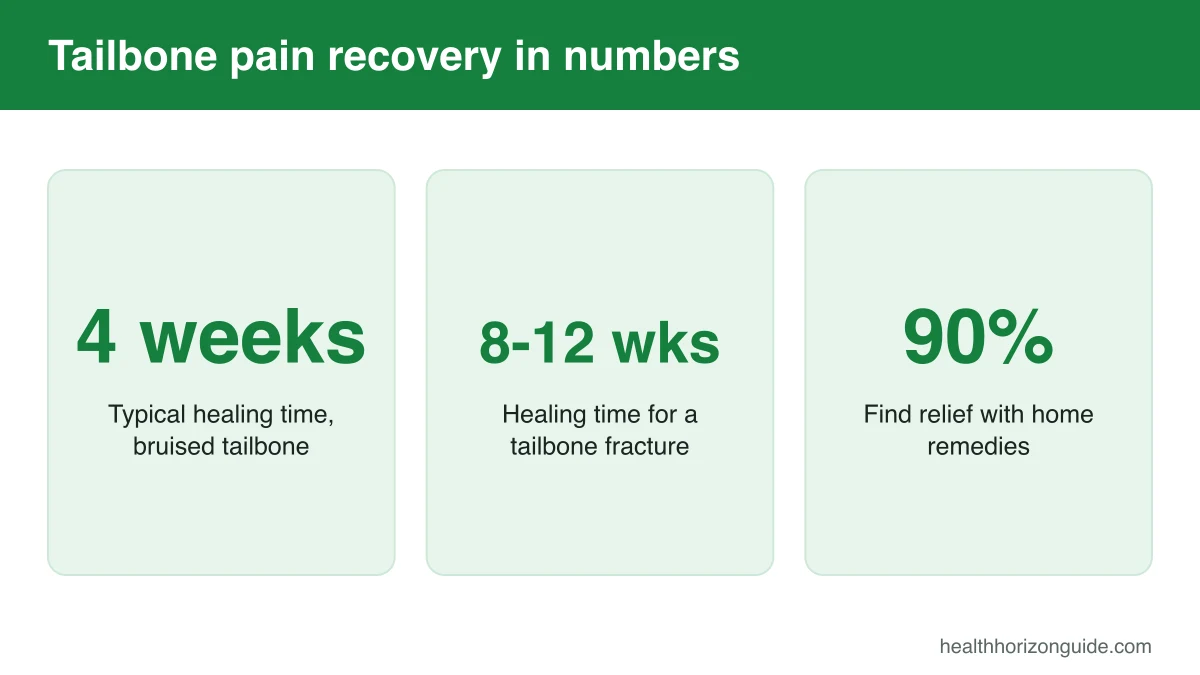
Coccydynia treatment starts with home care and moves to physiotherapy, injections and, rarely, surgery. Cleveland Clinic reports that 90% of people with tailbone pain find relief with home remedies. The table below summarises the 5 established treatments for tailbone pain and what the sources say about each one.
| Treatment | What the treatment involves | What sources say |
|---|---|---|
| Coccyx or wedge cushion and sitting changes | Pressure relief, supported posture and shorter sitting periods | First step in NHS, MedlinePlus and Cleveland Clinic guidance |
| Pain relief | NSAIDs such as ibuprofen, plus ice or heat packs | Named by the NHS; a pharmacist can advise on suitability |
| Physiotherapy and pelvic floor rehabilitation | Manipulation of the muscles around the coccyx, stretching and posture work | One of the first treatments the NHS may recommend |
| Injections | Corticosteroid and local anaesthetic into the joint, or a coccygeal nerve block | Offered by the NHS; the 2022 review found no high-quality trials |
| Surgery (coccygectomy) | Removal of part or all of the coccyx | Rare, and used only when other treatments fail; recovery can take several months |
How long does tailbone pain take to heal?
Tailbone pain may improve after a few weeks, although the NHS notes that coccydynia can sometimes last longer. MedlinePlus states that a bruised tailbone takes about 4 weeks to heal and a fractured tailbone takes 8 to 12 weeks. Surgery is not discussed until 6 months or more after an injury, according to MedlinePlus.
When does tailbone pain need a doctor?
Tailbone pain needs a doctor when the pain has not improved after a few weeks of home treatment, the period the NHS states, or when the pain affects daily activities. A chiropractor is not the right first contact for any of the 7 warning signs listed below.
- Pain after a hard fall, above all severe pain, which can point to a fracture or dislocation.
- A high temperature together with tailbone pain.
- A lump, a visible mass or a sudden increase in swelling.
- Bleeding from the back passage. Our sources do not list bleeding as a coccydynia symptom, so bleeding needs a separate medical assessment.
- Numbness, tingling or weakness in one or both legs.
- Bladder or bowel changes, such as loss of control, trouble urinating or prolonged constipation.
- Pain that has not improved after a few weeks of home treatment.
Cleveland Clinic notes that tailbone pain is rarely caused by a tumour near the coccyx, and that numbness, bladder or bowel trouble and a visible mass are the warning signs.
Is the pain coccydynia or another back problem?
Tailbone pain sits at the very base of the spine, below the lower back and the sacroiliac joints. Cleveland Clinic notes that back pain and sciatica can appear alongside coccydynia. Pain that sits higher or to one side may have a different source, which our guides to a chiropractor for lower back pain and a chiropractor for SI joint pain cover in detail.
Tailbone pain FAQ
Is a donut or wedge coccyx cushion better for tailbone pain?
Neither coccyx cushion is shown to be better for tailbone pain. Cleveland Clinic names both a donut pillow and a wedge-shaped gel cushion, so comfort during sitting is a fair guide.
How many chiropractic sessions does tailbone pain need?
No standard number of chiropractic sessions exists for tailbone pain. The 2006 trial used three sessions of manipulation.
Does tailbone pain after childbirth go away?
Tailbone pain after childbirth may improve after a few weeks, as the NHS describes for coccydynia in general, although some cases last longer. Pain that has not improved after a few weeks of home treatment needs a GP or doctor visit.
What is the best sleeping position for tailbone pain?
Side lying is the sleeping position the NHS recommends for tailbone pain, because side lying reduces pressure on the coccyx. MedlinePlus suggests sleeping on the belly as another option.