Chiropractor for Scoliosis: Can a Chiropractor Fix the Curve?
A chiropractor for scoliosis may ease back pain but cannot straighten the curve. See the proven treatments by curve size and the warning signs.
A chiropractor for scoliosis can ease back pain and stiffness, but chiropractic adjustments have not been shown to straighten a scoliosis curve or stop the curve from growing. Scoliosis treatment that changes the outcome is observation, bracing, scoliosis-specific exercise or surgery, chosen by curve size and age. A growing child with scoliosis needs an orthopedic specialist first, and chiropractic care must never replace a prescribed brace.
Action checklist
Scoliosis and chiropractic care checklist
Use these steps from the article before and during chiropractic care for scoliosis.
0 of 9 done
In this article
- Can a chiropractor fix scoliosis?
- What is scoliosis?
- What can a chiropractor do for scoliosis?
- Scoliosis treatment by curve size and age
- Why does a growing child with scoliosis need an orthopedic specialist?
- Scoliosis in adults and related back problems
- When should a person with scoliosis see a doctor?
- Chiropractor for scoliosis: common questions
Can a chiropractor fix scoliosis?
A chiropractor cannot fix scoliosis, because no reliable evidence shows that spinal adjustments correct the curve. The American Academy of Orthopaedic Surgeons (AAOS) states that chiropractic care has not been shown to shrink a scoliosis curve or to prevent the curve from progressing, although chiropractic may help the back pain linked to scoliosis. The NHS reaches the same verdict and reports little reliable evidence that osteopathy or chiropractic can correct a curved spine or stop the curve from getting worse.
A 2024 systematic review of five studies in children with idiopathic scoliosis concluded that high-velocity spinal manipulation does not seem to reduce spinal deformity significantly, although the therapy may reduce pain. The honest summary is weak evidence for pain relief and no reliable evidence for curve correction.
The table below shows the usual scoliosis treatment for each curve size and what a chiropractor can add at each stage.
| Curve size (Cobb angle) | Usual treatment | What a chiropractor can add |
|---|---|---|
| Under 10 degrees | No scoliosis diagnosis and no treatment | Nothing needed for the curve |
| Mild curve under about 20 to 25 degrees, child still growing | Observation with a spine check every 6 to 12 months | Pain relief only, with no effect on the curve |
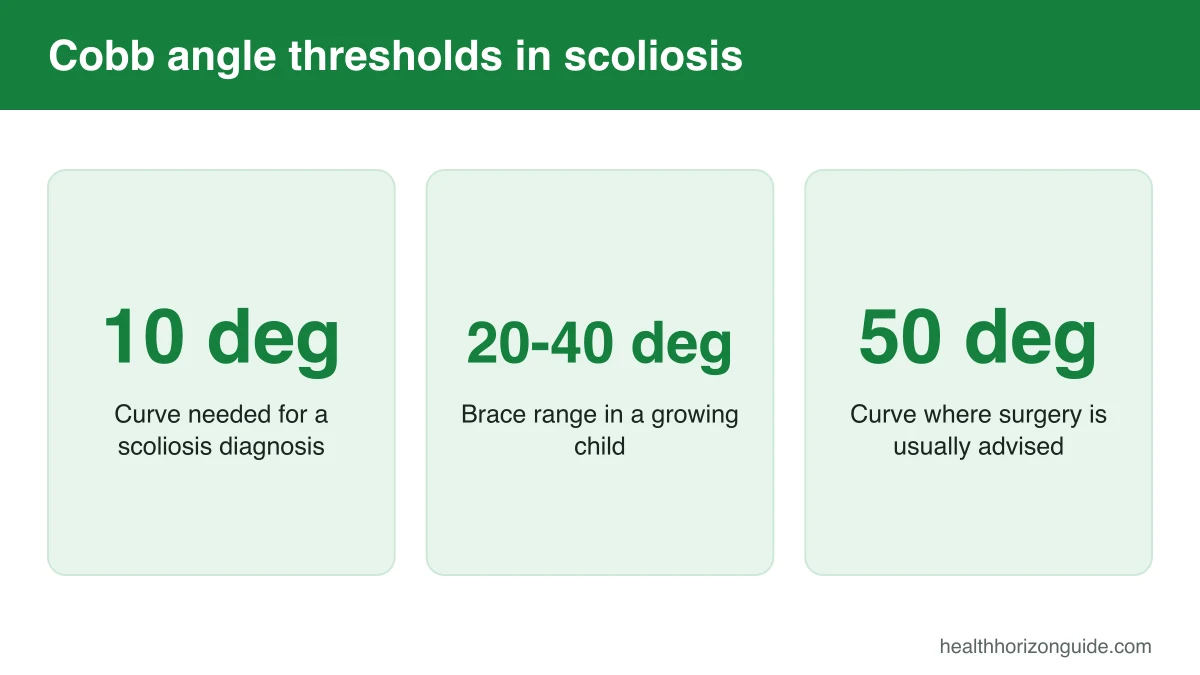
| About 20 to 40 degrees, child still growing | Brace worn 16 to 23 hours a day until growth stops | Pain relief only, never a substitute for the brace |
| Over 40 to 50 degrees, child or teenager | Surgery considered, usually spinal fusion | No role in correcting the curve |
| Adult curve under 30 degrees | Curve usually stays the same; pain is treated with exercise and physical therapy | May ease back pain and stiffness |
| Adult curve over 50 degrees | Monitoring, with surgery considered when nerve symptoms appear | May ease pain; specialist follow-up is still needed |
The thresholds in the table come from the AAOS and the American Association of Neurological Surgeons (AANS), which differ by a few degrees. A scoliosis specialist sets the plan, not a chiropractor.
What is scoliosis?
Scoliosis is an abnormal sideways curve of the spine that can look like a C or an S. MedlinePlus notes that most people with scoliosis have no symptoms, and uneven shoulders or hips are often the first visible signs. A chiropractor may be the first person to notice these signs, but a diagnosis needs a medical exam and an X-ray.
The 4 main types of scoliosis are listed below.
- Idiopathic scoliosis has no known cause and accounts for about 80% of cases.
- Congenital scoliosis is present at birth because the bones of the spine did not form properly.
- Neuromuscular scoliosis follows a nerve or muscle condition such as cerebral palsy or muscular dystrophy.
- Degenerative scoliosis develops in adults from wear and tear of the spine, most often in the lower back.
How is a scoliosis curve measured?
A scoliosis curve is measured with the Cobb angle on a spine X-ray. A diagnosis of scoliosis requires a Cobb angle greater than 10 degrees, according to the AANS. Curves above 45 to 50 degrees are considered severe. X-rays matter because the true scoliosis curve can be larger than a physical exam suggests, including a posture check by a chiropractor.
What can a chiropractor do for scoliosis?
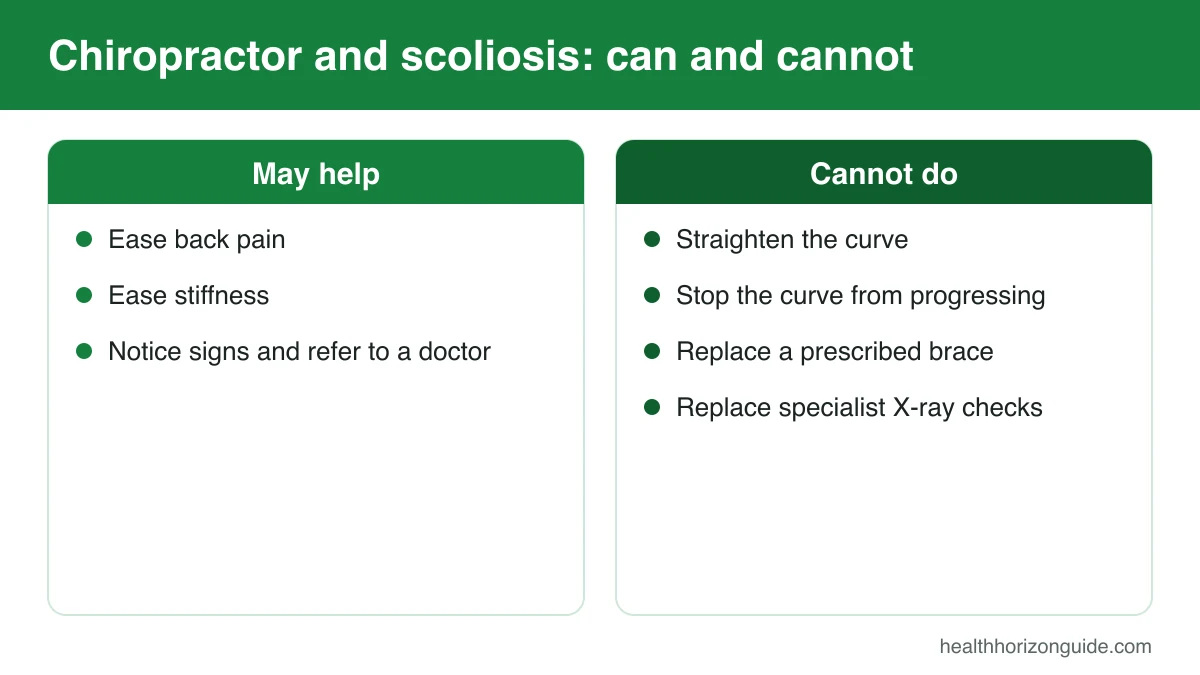
A chiropractor can ease the back pain and stiffness that come with scoliosis, mainly in adults. A chiropractic visit for scoliosis pain usually combines a posture and movement check with hands-on treatment such as spinal manipulation.
A chiropractor cannot straighten the curve, replace a brace, or track a growing spine the way an orthopedic team does with repeat X-rays. A chiropractor who promises to cure scoliosis, or sells a long prepaid plan to reverse the curve, makes a claim the evidence does not support. Our guide to how much a chiropractor costs helps readers judge a proposed course of visits.
Is chiropractic adjustment safe with scoliosis?
The clearest risk of chiropractic care for scoliosis is a delay in proven treatment. The AAOS warns that not wearing a prescribed brace raises the risk of the curve getting larger. The studies of manipulation for scoliosis are small, so the rate of side effects is not well established. A person with spinal fusion rods, weak bones or nerve symptoms should ask the spine specialist before any spinal manipulation.
Scoliosis treatment by curve size and age
Scoliosis treatment depends on the curve size, the cause and whether the person is still growing. The 4 established options are observation, bracing, scoliosis-specific exercise and surgery, and chiropractic adjustment is not one of the four.
Observation
Observation is regular monitoring of a mild scoliosis curve without active treatment. Growing children with mild curves have the spine checked every 6 to 12 months, according to the AAOS. Chiropractor visits do not count as observation, which relies on specialist exams and X-rays.
Scoliosis brace
A scoliosis brace is a rigid jacket that keeps a curve from getting worse while a child grows. Bracing is generally used for curves of 20 to 40 degrees in children with significant growth left, and common daytime braces are worn 16 to 23 hours a day. The brace does not straighten an existing curve. The BRAIST trial in the New England Journal of Medicine found treatment success in 72% of braced adolescents compared with 48% of adolescents who were only observed, and the benefit rose with longer daily wear. Success meant finishing growth with a curve under 50 degrees. No chiropractor technique for scoliosis has trial evidence of this kind.
Scoliosis exercises
Scoliosis exercises are physical therapy programs, such as the Schroth method, that are built around the individual curve. The AAOS reports that low-quality studies suggest scoliosis-specific exercises may prevent progression, and that no high-quality evidence shows physical therapy alone stops a curve during growth. Our comparison of a chiropractor vs a physical therapist explains which professional suits exercise-based care.
Scoliosis surgery
Scoliosis surgery is the only treatment that reduces the curve, usually through spinal fusion with rods and screws. The AAOS states that surgery is usually recommended above 50 degrees, and the AANS places the threshold above 40 degrees in a child whose curve is progressing. Surgery does not usually straighten the spine completely. Chiropractic care is not an alternative to surgery for a severe curve.
Why does a growing child with scoliosis need an orthopedic specialist?
A growing child with scoliosis needs an orthopedic specialist because curves tend to worsen during a growth spurt and bracing only works while the spine is still growing. The AAOS describes a brace worn only 6 hours a day as nearly useless, while wear above 16 hours a day lowers the chance of surgery. Months spent on chiropractor visits in place of a brace can therefore let a curve grow past the stage where bracing helps. A chiropractor for a teenager's back pain is reasonable only while orthopedic follow-up and brace wear continue.
Scoliosis in adults and related back problems
Scoliosis in adults is either a childhood curve carried into adult life or a new degenerative curve. Adult care focuses on pain and function, where a chiropractor for scoliosis has the most to offer.
Adult degenerative scoliosis
Adult degenerative scoliosis is a sideways curve caused by wear and tear of the spine. The AANS reports that degenerative scoliosis most often affects the lower back in people aged 65 and older and often occurs with spinal stenosis, a narrowing that pinches the spinal nerves. Adult curves under 30 degrees tend to stay the same, while curves over 50 degrees almost always worsen by about 1 degree a year, according to the AAOS. Surgery is considered when the curve exceeds 50 degrees and nerve damage in the legs or bladder or bowel symptoms appear. A chiropractor may help the back pain of degenerative scoliosis, but leg symptoms need a medical assessment first.
Scoliosis pain relief
Scoliosis pain relief usually starts with exercise and physical therapy, and the AAOS notes that a home exercise program can help. Yoga, massage, acupuncture and chiropractic may each ease back pain, although none has been shown to reduce the curve. Our guide to a chiropractor for lower back pain covers that evidence in detail. The posture and back pain self-check tool and the guide on spine alignment cover everyday posture strain, which differs from a scoliosis curve.
When should a person with scoliosis see a doctor?
A person with scoliosis should see a doctor when the curve changes quickly or when nerve or breathing symptoms appear. A chiropractor should refer the person to a doctor when any of these signs is present. The 4 warning signs that need a doctor are listed below.
- A curve, rib hump or uneven shoulder line that changes rapidly.
- Breathing difficulty, which severe scoliosis can cause.
- Leg weakness, leg numbness or pain that travels down the leg.
- Bladder or bowel changes, which need urgent medical assessment.
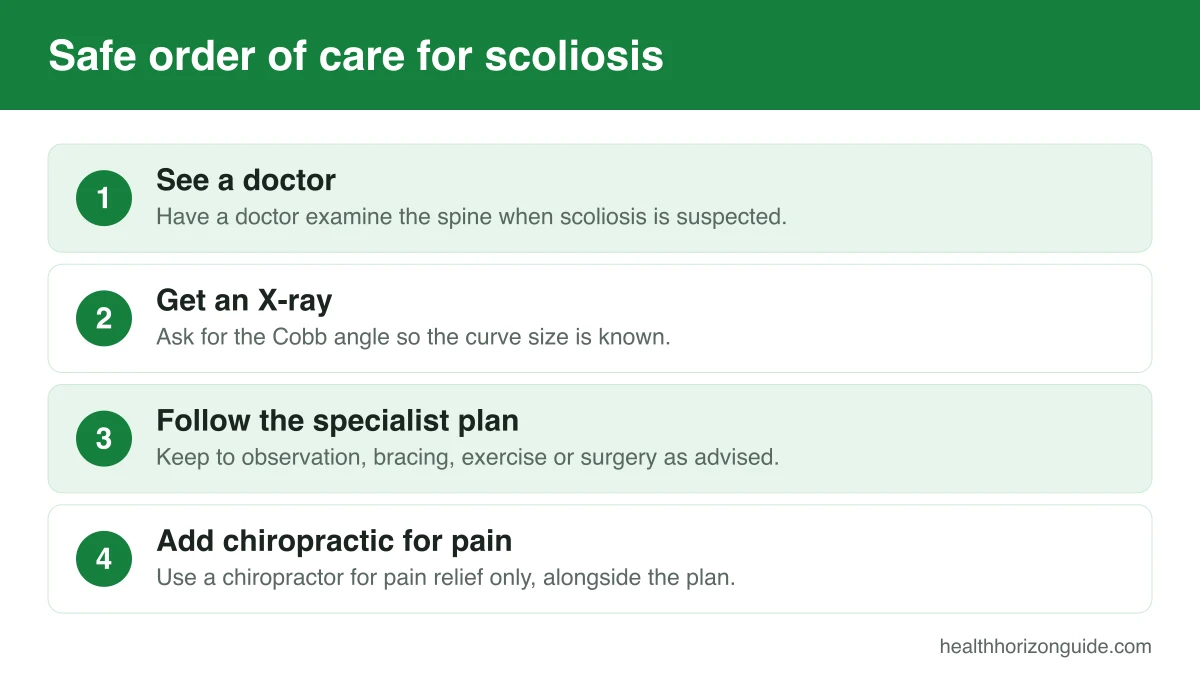
The safe order for anyone who suspects scoliosis is a doctor visit, an X-ray with a Cobb angle, a specialist plan, and only then a chiropractor for pain.
Chiropractor for scoliosis: common questions
Can a chiropractor straighten a curved spine?
A chiropractor cannot straighten a curved spine caused by scoliosis. The AAOS and the NHS both report no reliable evidence of curve correction.
Can a chiropractor make scoliosis worse?
Research has not shown that chiropractic adjustments enlarge a scoliosis curve, although the studies are small. The proven harm is indirect: a curve can progress while a growing child goes without a prescribed brace.
Does a scoliosis brace work for adults?
A scoliosis brace is a treatment for people who are still growing, according to the AANS. Adults use exercise, physical therapy and sometimes a chiropractor for pain.