Is Cracking Your Back Bad for You?
Occasional, gentle back cracking is unlikely to harm your spine. Learn what the pop is, when cracking carries risk, and which symptoms need a doctor.

Cracking your back is not bad for you when the pop happens occasionally during a gentle, pain-free stretch. Health sources describe that kind of back cracking as unlikely to cause lasting damage. Risk rises when a person cracks the back with force, many times a day, or despite pain, numbness or a recent injury.
Action checklist
Back cracking safety checklist
Use these steps to keep back cracking low risk and to know when a doctor should assess your symptoms.
0 of 10 done
In this article
- What is the cracking sound in your back?
- Is occasional back cracking harmful to the spine?
- Why are forceful or frequent back cracking and neck twisting riskier?
- Is cracking your back good for you?
- Why does my back crack so much?
- How does self-cracking differ from a chiropractic adjustment?
- Is cracking your knuckles bad for you?
- When does back cracking need a doctor?
- What are safer ways to relieve the urge to crack your back?
- What has research not settled about cracking your back?
- Frequently asked questions about cracking your back
What is the cracking sound in your back?
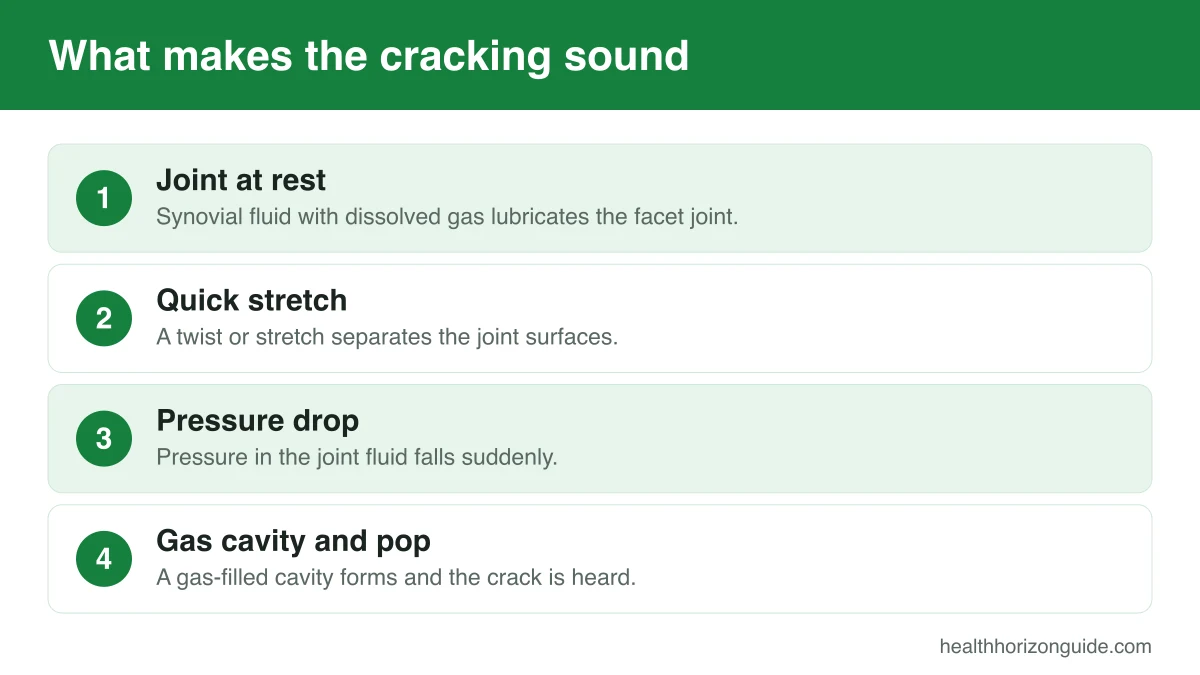
The cracking sound in your back is most likely gas forming or releasing inside the fluid of a spinal joint. The small facet joints between the vertebrae are synovial joints, the same type as the knuckles and knees. Synovial fluid lubricates each joint and contains dissolved gas. A quick stretch separates the joint surfaces, pressure in the fluid drops, and a gas-filled cavity forms. Physicists call that process tribonucleation, according to a physiotherapy explainer from the University of Technology Sydney (UTS).
The exact mechanism is not fully understood. Houston Methodist describes a general consensus that the pop comes from gas in the joint, with more than one theory about how the gas behaves. Tendons or ligaments sliding over bone can make a similar noise, and so can cartilage wear linked to age or osteoarthritis. People often call the habit cracking your bones, although the sound comes from joints and soft tissue. Cracking your back does not mean a bone has broken, slipped or moved back into place.
Is occasional back cracking harmful to the spine?
Occasional back cracking is unlikely to harm the spine, according to the sources we reviewed. A back that pops naturally during a gentle stretch is probably not causing long-term damage, Houston Methodist states. The UTS explainer reaches a similar conclusion: a crack during a comfortable movement gives little reason for concern. Neither source treats the sound alone as a sign of damage.
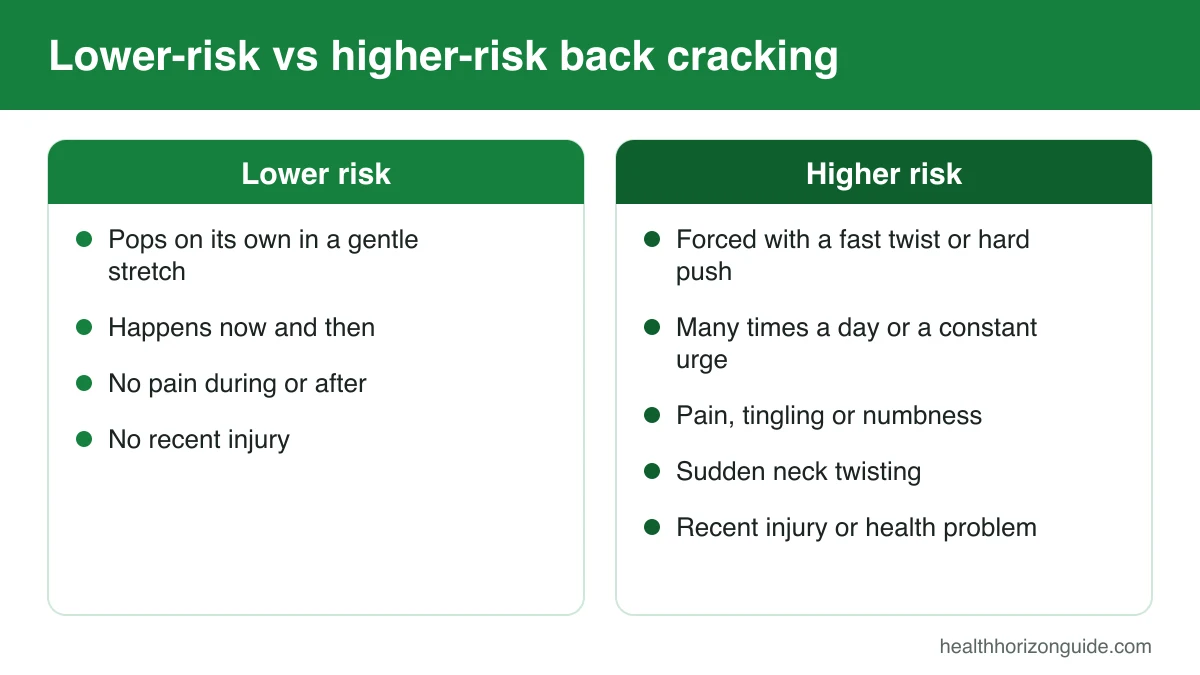
The table below compares lower-risk and higher-risk ways of cracking your back.
| Factor | Lower-risk cracking | Higher-risk cracking |
|---|---|---|
| How the pop happens | On its own during a gentle stretch | Forced with a fast twist or a hard push |
| How often | Now and then | Many times a day, or a constant urge |
| How the back feels | No pain during or after | Pain, soreness, tingling or numbness |
| Body area | Back | Sudden neck twisting |
| Health background | No recent injury | Recent injury or an underlying health problem |
Why are forceful or frequent back cracking and neck twisting riskier?
Forceful or frequent back cracking is riskier because force and repetition stress the tissues around the joint. Houston Methodist names two warning patterns: quick, forceful movements and a regular need to crack. The 4 problems that Houston Methodist links to forceful or habitual cracking are listed below.
- Pinched nerve: a forceful movement can compress a nerve near the spine.
- Muscle strain: a hard twist can overstretch a back or neck muscle.
- Joint instability: repeated stretching of the ligaments may loosen a joint over time, which could raise the risk of osteoarthritis.
- Blood vessel injury: an incorrect, forceful movement can damage a blood vessel near the spine.
Research on people who crack their own backs is thin, the UTS explainer notes. The long-term effect of repeatedly forcing a crack remains uncertain.
Is cracking your neck bad for you?
Cracking your neck is generally harmless when gentle and infrequent, with one rare but serious risk. A sudden neck movement can, in rare cases, tear a vertebral artery, which reduces blood flow and raises the risk of a clot or stroke, Cleveland Clinic explains. A Cleveland Clinic chiropractor describes one or two neck cracks a day as natural and treats cracking every hour as a sign to reassess. Repeated neck cracking may loosen ligaments in the same way that frequent back cracking can. Readers with ongoing stiffness can read our guide to seeing a chiropractor for neck pain.
Is cracking your back good for you?
Cracking your back is not proven to be good for you, although the relief can feel real. The UTS explainer describes a 2022 systematic review of five studies in 303 adults. Pain outcomes in that review were similar after noisy and quiet spinal movements, and more pops did not bring extra relief. The stretch itself may still ease a stiff back. The pop adds no measured benefit.
Why does cracking feel good?
Cracking feels good for reasons that research has not fully explained. Houston Methodist cites one study suggesting that the sound may trigger a placebo effect, where a person perceives a benefit from the noise. Expectation, a change of position and renewed confidence in moving may all play a part, the UTS explainer suggests. Relief after cracking your back does not prove that a structural problem was fixed.
Why does my back crack so much?
A back cracks so much because the spine contains many small joints, so one movement can produce several sounds. Frequent back cracking may point to tight back muscles, Houston Methodist notes. A repeated urge to crack a stiff or tight joint can signal that the joint needs attention, according to Cleveland Clinic. Posture and desk setup are common contributors to that tightness. Our posture and back pain self-check tool helps readers review daily habits.
How does self-cracking differ from a chiropractic adjustment?
Self-cracking differs from a chiropractic adjustment in training, control and the evidence behind it. Spinal manipulation is a technique in which a practitioner applies a controlled thrust to a spinal joint, as the National Center for Complementary and Integrative Health (NCCIH) defines it. Cracking your back at home is a general twist or stretch across many joints. The table below compares the two.
| Feature | Self-cracking | Chiropractic adjustment |
|---|---|---|
| Who performs it | The person, without training | A licensed practitioner |
| Type of force | General twist or stretch | Controlled thrust to a spinal joint |
| Health check | None | Health history can be reviewed first |
| Research | Thin | Moderate-quality evidence of modest relief for low back pain |
| Known side effects | Long-term effects uncertain | Temporary soreness, stiffness or headache are common |
A chiropractic adjustment is not risk-free. NCCIH reports that serious problems, including strokes involving neck arteries, have occurred but are very rare, with no accurate estimate of how often. Frequent adjustments can cause the same joint looseness as frequent back cracking, Cleveland Clinic warns. Research on spinal manipulation in pregnancy is limited, so our guide to cracking your back while pregnant covers that case separately.
Is cracking your knuckles bad for you?
Cracking your knuckles probably does not raise the risk of arthritis, according to Harvard Health Publishing. Several studies compared hand arthritis rates in habitual knuckle crackers and people who never crack. Chronic knuckle cracking may reduce grip strength, and a few injury reports exist. Knuckle cracking and back cracking share the same gas mechanism, yet the spine sits close to nerves, which is why forceful back cracking deserves more care.
When does back cracking need a doctor?
Back cracking needs a doctor when symptoms accompany the sound. Care decisions depend on symptoms, not on the noise. The 6 signs that call for medical assessment are listed below.
- Pain or discomfort follows cracking your back.
- Consistent pain or swelling affects a noisy joint, which Cleveland Clinic describes as a sign that something is wrong.
- Cracking starts after a significant injury.
- The back feels tight or sore every day, and gentle stretching does not help.
- New weakness, numbness around the groin, or a change in bladder or bowel control appears. These symptoms need urgent assessment.
- Fever occurs together with back pain.
What are safer ways to relieve the urge to crack your back?
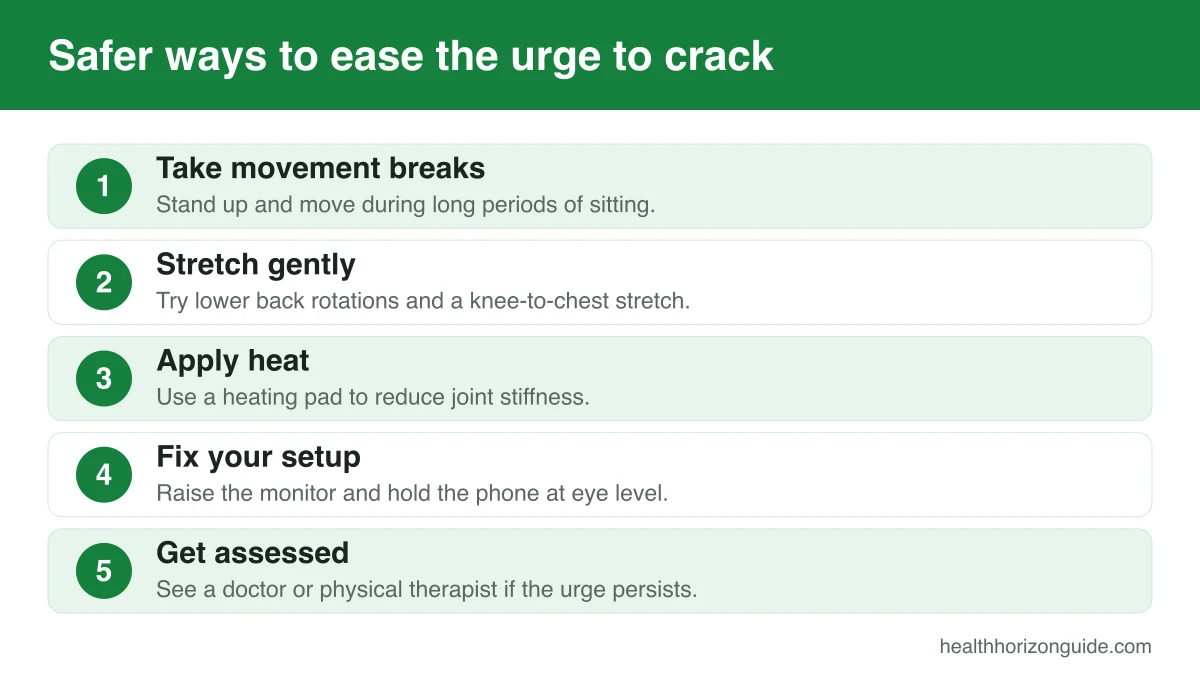
Safer ways to relieve the urge to crack your back focus on movement, stretching and posture. The 5 options below come from the sources cited in this article.
- Movement breaks: stand up and move regularly during long periods of sitting.
- Gentle stretching: Houston Methodist suggests seated and lying lower back rotations, a knee-to-chest stretch, an upward stretch and a bridge stretch.
- Heat: a heating pad can reduce joint stiffness.
- Posture: raise the computer monitor and hold the phone at eye level.
- Professional help: see a doctor or physical therapist when the urge persists despite self-care.
Our routine of morning stretches for lower back pain shows gentle stretches step by step. Readers who look down at screens for hours can review our guide to fixing forward head posture.
What has research not settled about cracking your back?
Research has not settled the long-term effect of habitual back cracking. Studies show that the sound relates to gas in the joint fluid and that the pop does not predict pain relief. No source we reviewed offers a reliable count of injuries from self-cracking or a safe number of cracks per day for the back. Warnings about loose ligaments and osteoarthritis rest on clinical reasoning more than on long-term studies of people who crack their own backs.
Frequently asked questions about cracking your back
Does cracking your back cause arthritis?
Cracking your back does not directly cause arthritis. Cleveland Clinic states that the popping is not the cause, although constant cracking may loosen ligaments, which may raise osteoarthritis risk.
Is cracking your back every day a bad habit?
Cracking your back every day is a habit worth reviewing when the urge feels constant. Houston Methodist advises against making back cracking a habit and recommends a doctor visit when the back regularly feels tight or painful.
Does cracking your back realign the spine?
Cracking your back does not realign the spine. The sound does not show that a vertebra moved back into place, the UTS explainer states.
Should another person crack your back?
Another person should not force your back to crack. Pushing harder until a noise occurs differs from a gentle pop, and a forceful, incorrect adjustment carries the nerve, muscle and blood vessel risks described above for cracking your back.