Sciatica Stretches: 5 Gentle Moves for Sciatic Nerve Pain
Sciatica stretches from medical sources, with hold times, the rule for when to stop, other pain relief options, recovery time and emergency warning signs.
Sciatica stretches are gentle floor movements that ease tension in the lower back, hips and buttock muscles around the sciatic nerve. The stretches that medical sources describe most often are the figure-four stretch, the knee-to-shoulder piriformis stretch, the knee cradle, cat-cow and the lower back press. Each sciatica stretch should stay mild, and any stretch that increases leg pain, numbness or tingling should end at once.
Action checklist
Sciatica stretch routine checklist
Use this checklist to follow the gentle sciatica stretches and home care steps described in the article.
0 of 10 done
In this article
What are the best stretches for sciatica?
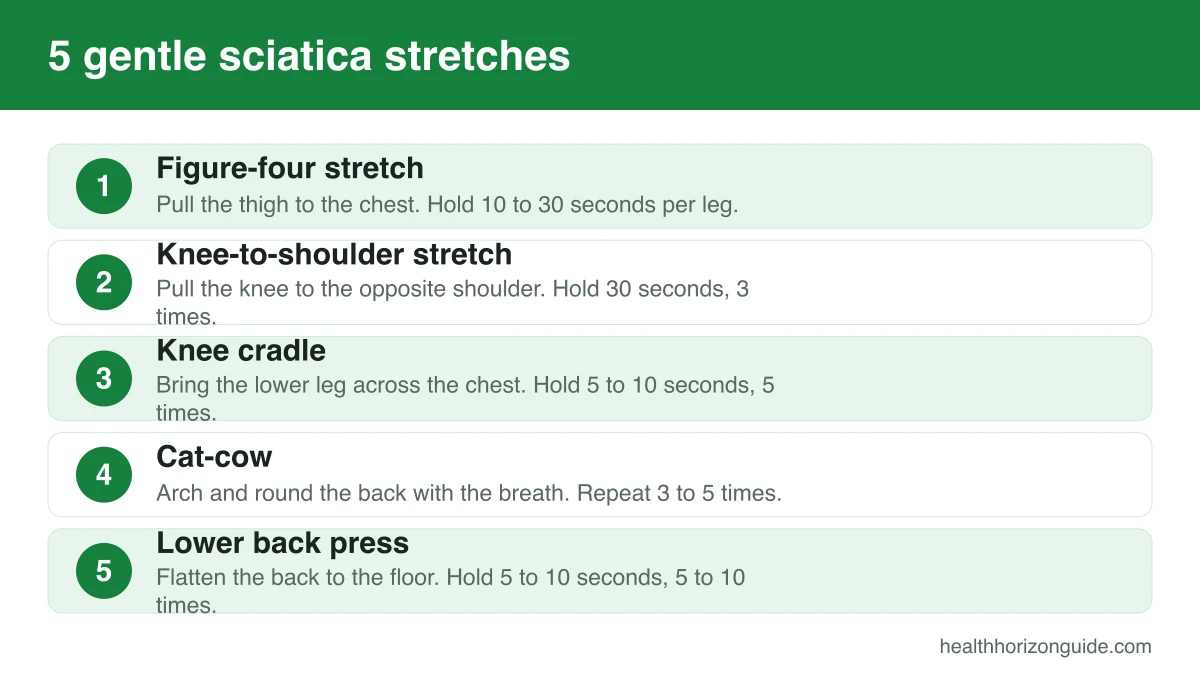
The best stretches for sciatica are slow, mild stretches for the hips, buttocks and lower back. Harvard Health describes 4 gentle sciatica stretches, and a Cleveland Clinic guide to piriformis stretches adds a knee-to-shoulder stretch held for 30 seconds. The 5 sciatica stretches below use only the positions, hold times and repetitions that those two sources give.
- Figure-four stretch: lie on the back with both knees bent. Cross the left ankle over the right knee, hold the right thigh and pull the thigh gently toward the chest. Hold for 10 to 30 seconds, then repeat with the other leg.
- Knee-to-shoulder piriformis stretch: lie on the back with both legs straight. Bend one knee and use the opposite hand to pull the knee toward the opposite shoulder. Hold for 30 seconds and repeat 3 times on each side.
- Knee cradle: lie on the back with both legs straight. Bend one knee and turn the hip outward so that the lower leg crosses the chest. Hold for 5 to 10 seconds and repeat 5 times with each leg.
- Cat-cow: start on hands and knees with the hands under the shoulders and the knees under the hips. Breathe in while the chest and tailbone lift and the belly drops, then breathe out while the back rounds. Repeat 3 to 5 times without holding.
- Lower back press: lie on the back with both knees bent and both feet flat. Flatten the lower back gently toward the floor, hold for 5 to 10 seconds and relax. Repeat 5 to 10 times.
Neither source presents these stretches as a cure for sciatica. The stretches aim to loosen the muscles around the sciatic nerve. Harvard Health adds that long periods of rest can make sciatica symptoms worse, which is one reason gentle movement is preferred.
Piriformis stretch for sciatica
The piriformis stretch for sciatica is a buttock stretch that pulls the knee across the body or toward the chest. The piriformis is a narrow muscle in the buttock, and piriformis syndrome is one recognised cause of sciatica. Cleveland Clinic describes a seated version for people who cannot lie on the floor: sit on a chair with both feet on the floor, cross one ankle over the opposite knee and lean forward gently. Hold the seated stretch for 30 seconds and repeat 3 times on each side. Cleveland Clinic suggests a check with a healthcare provider when about a month of consistent stretching brings no improvement.
Hamstring stretches, spinal twists and nerve glides for sciatica
Hamstring stretches, seated spinal twists and nerve glides for sciatica are common in online routines but not described in the medical guides used here. Harvard Health lists twisting or rotating the back among the movements to avoid with sciatica. The same guide warns against intense or deep stretches. We left these 3 movements out of the routine for that reason. A physical therapist can decide whether a hamstring stretch or a nerve glide suits a specific case of sciatica.
When should a sciatica stretch stop?
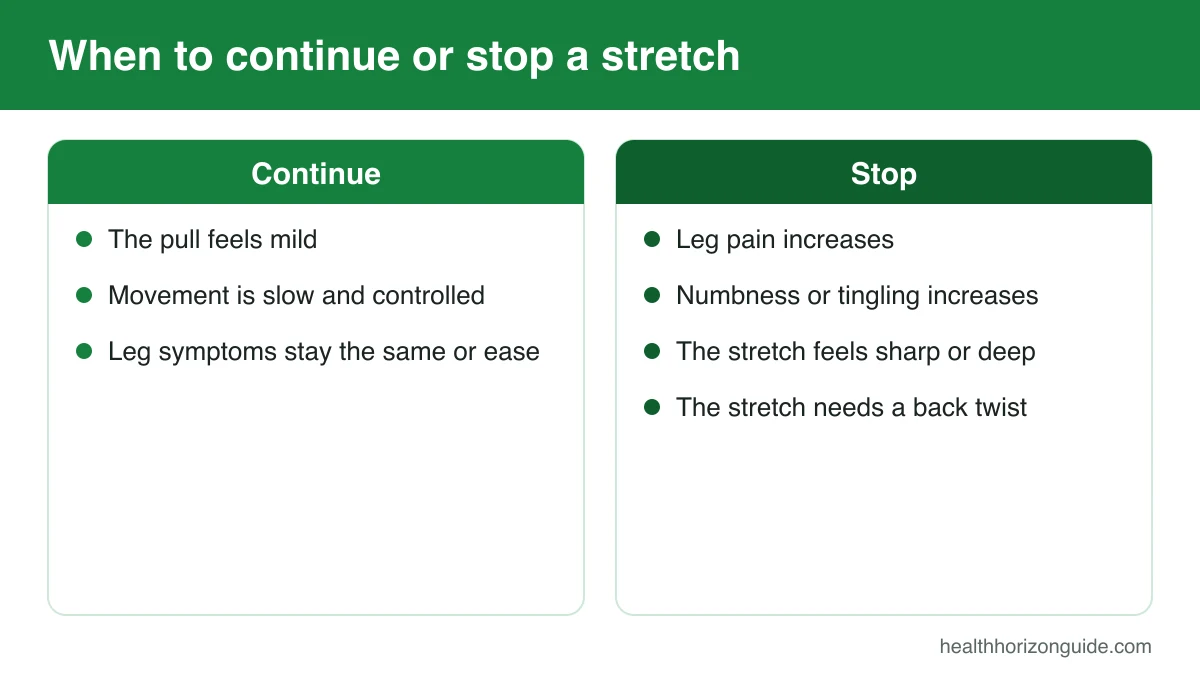
A sciatica stretch should stop as soon as the stretch increases pain. Harvard Health advises stopping any stretch that causes discomfort or sharp pain, and seeing a healthcare provider when stretching makes the pain worse. Numbness and tingling are sciatica symptoms too, so we apply the same rule to a stretch that increases numbness or tingling in the leg. People on patient forums often describe stretching that made sciatica worse, which is why a mild pull is the limit.
What is sciatica?
Sciatica is pain, numbness, tingling or weakness in the leg caused by pressure on the sciatic nerve or injury to the nerve. MedlinePlus describes sciatica as a symptom of another medical problem, not a condition on its own. The sciatic nerve is the largest nerve in the body and runs from the lower back through the buttock and down each leg.
Sciatica symptoms
Sciatica symptoms are felt mainly in the buttock and the back of one leg, often as far as the foot and toes. The NHS page on sciatica names the 4 symptoms listed below.
- Sharp or burning pain
- Tingling
- Numbness
- Weakness
Sciatica pain may get worse with movement, a cough or a sneeze. Back pain can occur with sciatica but is usually milder than the leg pain.
Sciatica causes
Sciatica causes are conditions that press on or irritate the sciatic nerve. A slipped disc is the most common cause according to the NHS, and our guide to chiropractic care for a herniated disc covers that condition. The 5 causes of sciatica named by the NHS and MedlinePlus are listed below.
- A slipped or herniated disc
- Spinal stenosis, a narrowing of the spinal canal
- Spondylolisthesis, a spinal bone that slips out of position
- Piriformis syndrome
- A back or pelvic injury
Some cases of sciatica have no clear cause, according to Cleveland Clinic.
Sciatica pain relief beyond stretching
Sciatica pain relief beyond stretching rests on staying active, heat or ice and physical therapy. Stretching is one part of home care, and the same medical sources recommend several other steps. The table below summarises what the sources say about each option for sciatica.
| Option | What the sources say |
|---|---|
| Staying active | The NHS advises keeping up normal activities and avoiding long periods of sitting or lying down. MedlinePlus states that bed rest is not recommended. |
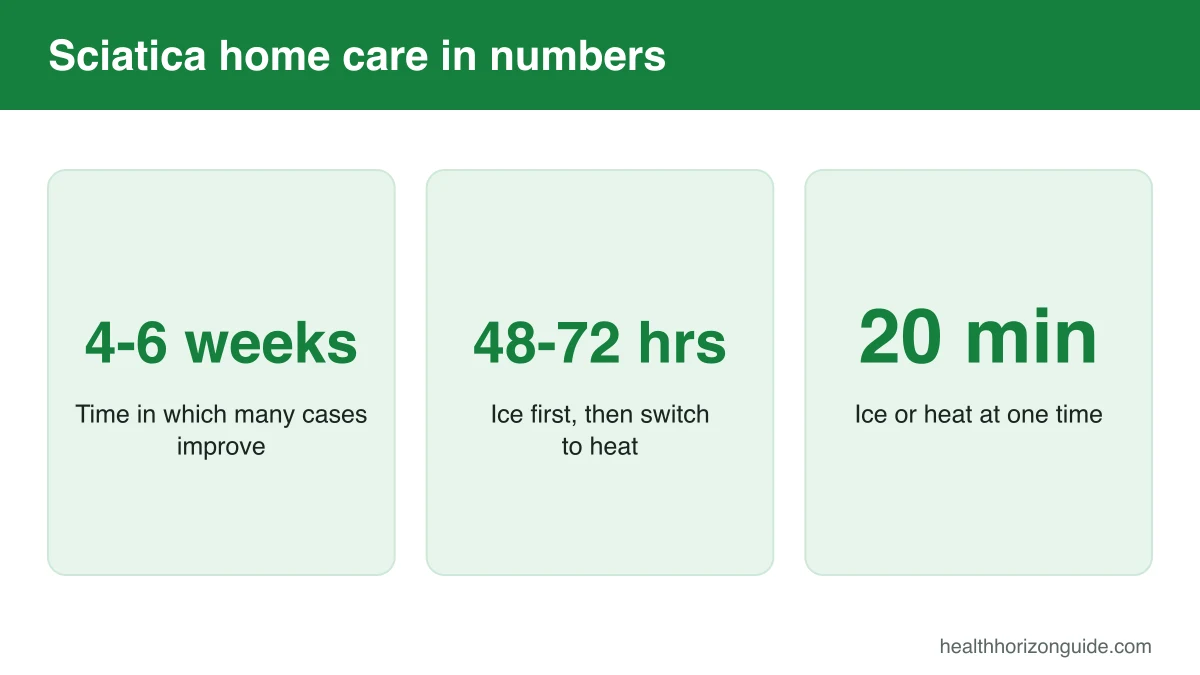
| Ice | MedlinePlus suggests ice for the first 48 to 72 hours. Cleveland Clinic suggests about 20 minutes at a time. |
| Heat | MedlinePlus suggests heat once the first 48 to 72 hours have passed. The NHS suggests heat packs on the painful areas. |
| Physical therapy | The NHS lists physiotherapy among the main treatments. Cleveland Clinic says guided exercises can improve strength and reduce pressure on the nerve. |
| Pain medicine | The NHS says paracetamol is unlikely to help and the benefit of anti-inflammatory tablets is unclear. A pharmacist can advise. |
A physical therapist builds an exercise plan around the person with sciatica, and our comparison of a chiropractor and a physical therapist explains how the two professions differ. Readers who want to learn about manual care can read our guide to chiropractic treatment techniques for sciatica.
How long does sciatica last?
Sciatica usually lasts a few weeks to a few months, according to the NHS. Cleveland Clinic states that many cases of sciatica improve within 4 to 6 weeks without medical treatment. MedlinePlus notes that sciatica often gets better on its own but commonly returns. Most cases of sciatica do not need surgery. An episode that lasts longer than 4 weeks is a reason to contact a healthcare provider, according to MedlinePlus.
Best sleeping position for sciatica
The best sleeping position for sciatica is the position that feels most comfortable, often on the back or on the side. Cleveland Clinic advice on sleep with sciatica suggests a pillow under the knees for back sleepers and a pillow between the knees for side sleepers. Lying on the side opposite the pain can take pressure off the sciatic nerve. Stomach sleeping is generally discouraged because the position arches the back.
When to see a doctor for sciatica
Sciatica needs a doctor's visit when the pain has not improved after a few weeks of home care, keeps getting worse or stops normal activities, according to the NHS. Some symptoms need emergency care on the same day. The 5 emergency signs listed by the NHS are below.
- Sciatica on both sides
- Severe or worsening weakness or numbness in both legs
- Numbness around the genitals or anus, sometimes called saddle numbness
- Difficulty starting to urinate, inability to urinate or loss of bladder control
- Loss of bowel control, or not noticing the need to pass stool
The NHS advises going to an emergency department or calling emergency services for these signs, and asking someone else to drive. Readers with everyday back pain and no sciatica warning signs can try our posture and back pain self-check tool.
Sciatica stretches FAQ
Sciatica stretches raise 4 common questions about frequency, risk, walking and recovery.
How often should sciatica stretches be done?
Sciatica stretches for the piriformis are done twice a day in the Cleveland Clinic guide, with 3 repetitions on each side. Harvard Health gives repetitions but no daily schedule. Our list of morning stretches for lower back pain offers more gentle movements.
Can stretching make sciatica worse?
Stretching can make sciatica worse when the stretch is intense, deep or painful. Harvard Health advises against such stretches and against twisting movements of the back.
Is walking good for sciatica?
Walking fits NHS advice to keep up normal activities with sciatica. The NHS says that movement may hurt but is not harmful, and that long periods of sitting or lying down should be avoided.
Does sciatica go away on its own?
Sciatica often improves on its own, according to MedlinePlus. The same source notes that sciatica commonly comes back.