Mediterranean Diet vs MIND Diet: Which Is Better for the Brain?
Mediterranean diet vs MIND diet: compare foods, the 2015 Rush study and the 2023 NEJM trial, heart health, weight, berries, leafy greens and wine.

The MIND diet is a brain-focused offshoot of the Mediterranean diet, built by Rush University researchers from the Mediterranean and DASH diets. A 2015 Rush study linked close MIND adherence to a 53% lower rate of Alzheimer's disease, but a 2023 randomized trial in the New England Journal of Medicine found no significant cognitive benefit over a control diet. The Mediterranean diet carries broader evidence for heart health, while the MIND diet sets specific targets for leafy greens, berries and other brain foods.
Action checklist
Choosing between the Mediterranean and MIND diets
Use these steps from the article to choose between the Mediterranean diet and the MIND diet.
0 of 9 done
In this article
- What is the difference between the Mediterranean diet and the MIND diet?
- What is the MIND diet?
- Mediterranean diet vs MIND diet foods
- What does the evidence say about the MIND diet and brain health?
- Which is better for brain health: the Mediterranean diet or the MIND diet?
- Mediterranean diet vs MIND diet for heart health
- Mediterranean diet vs MIND diet for weight loss
- What are the practical differences between the MIND diet and the Mediterranean diet?
- Who might choose the MIND diet or the Mediterranean diet?
- What are the dementia risk factors beyond diet?
- When should you see a doctor about memory changes?
- Mediterranean diet vs MIND diet: common questions
What is the difference between the Mediterranean diet and the MIND diet?
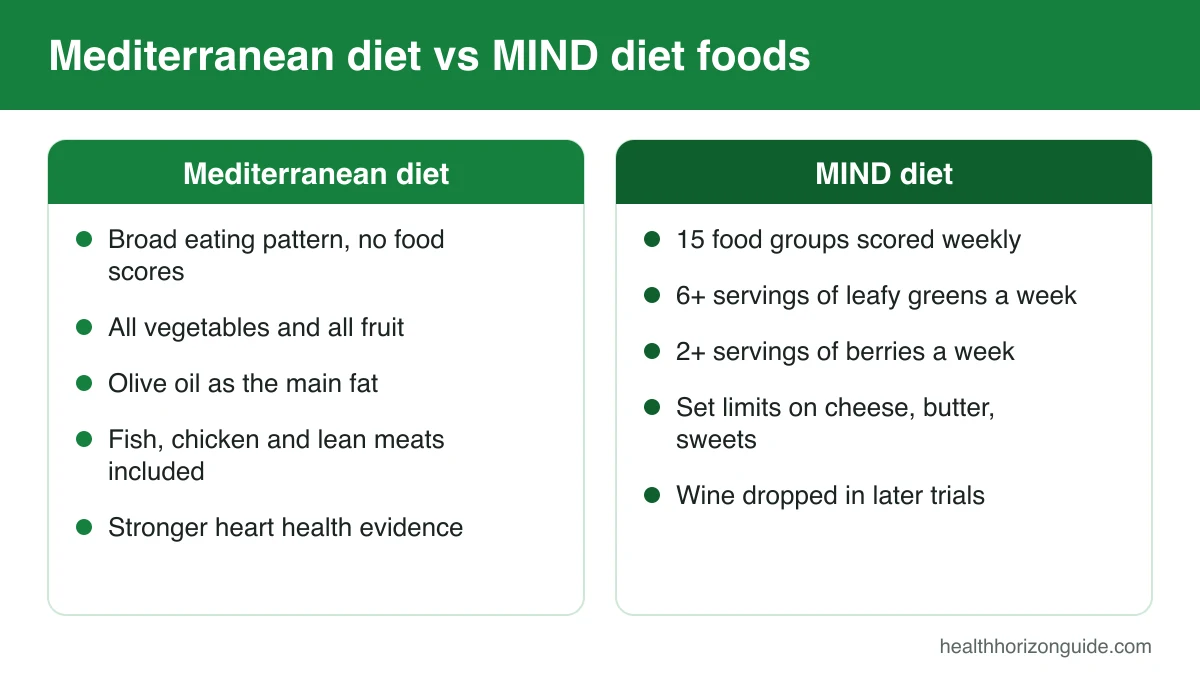
The difference between the Mediterranean diet and the MIND diet is that MIND scores specific brain foods with weekly targets, while the Mediterranean diet is a broader eating pattern. The Mediterranean diet centres on vegetables, fruits, whole grains, beans, nuts and olive oil, with room for fish, chicken and lean meats, according to Mayo Clinic.
The MIND diet keeps that plant-based base and adds numeric targets. Our complete Mediterranean diet food list shows every food group in the wider pattern.
What is the MIND diet?
The MIND diet is a hybrid of the Mediterranean and DASH diets designed to slow brain aging. MIND stands for Mediterranean-DASH Intervention for Neurodegenerative Delay. Martha Clare Morris and colleagues at Rush University Medical Center in Chicago developed the MIND diet.
The MIND diet scores 15 food groups, according to the 2015 Rush study report. The 15 groups are 10 brain-healthy groups and 5 groups to limit.
Mediterranean diet vs MIND diet foods
Mediterranean diet vs MIND diet foods overlap on almost every plant food, and differ mainly in how precisely MIND counts servings. The table below compares the MIND targets from the Harvard T.H. Chan School of Public Health with the general Mediterranean approach across 15 food groups.
| Food group | MIND diet target | Mediterranean diet approach |
|---|---|---|
| Green leafy vegetables | 6 or more servings a week | Eaten as part of all vegetables |
| Other vegetables | 1 or more servings a day | A core food |
| Berries | 2 or more servings a week | Eaten as part of all fruit |
| Nuts | 5 or more servings a week | A core food |
| Beans | 4 or more meals a week | A core food |
| Whole grains | 3 or more servings a day | A core food |
| Fish | 1 or more meals a week | Included |
| Poultry | 2 or more meals a week | Included |
| Olive oil | Main added fat | Main fat |
| Wine | One glass a day in the original score, dropped in later trials | Not required |
| Red meat | Fewer than 4 servings a week | Limited |
| Butter and stick margarine | Less than 1 tablespoon a day | Replaced by olive oil |
| Cheese | Fewer than 1 serving a week | No numeric limit |
| Pastries and sweets | Fewer than 5 servings a week | No numeric limit |
| Fried or fast food | Fewer than 1 serving a week | No numeric limit |
What does the evidence say about the MIND diet and brain health?
The evidence on the MIND diet and brain health is mixed, with strong observational links and one neutral randomized trial.
What did the 2015 Rush MIND diet study find?
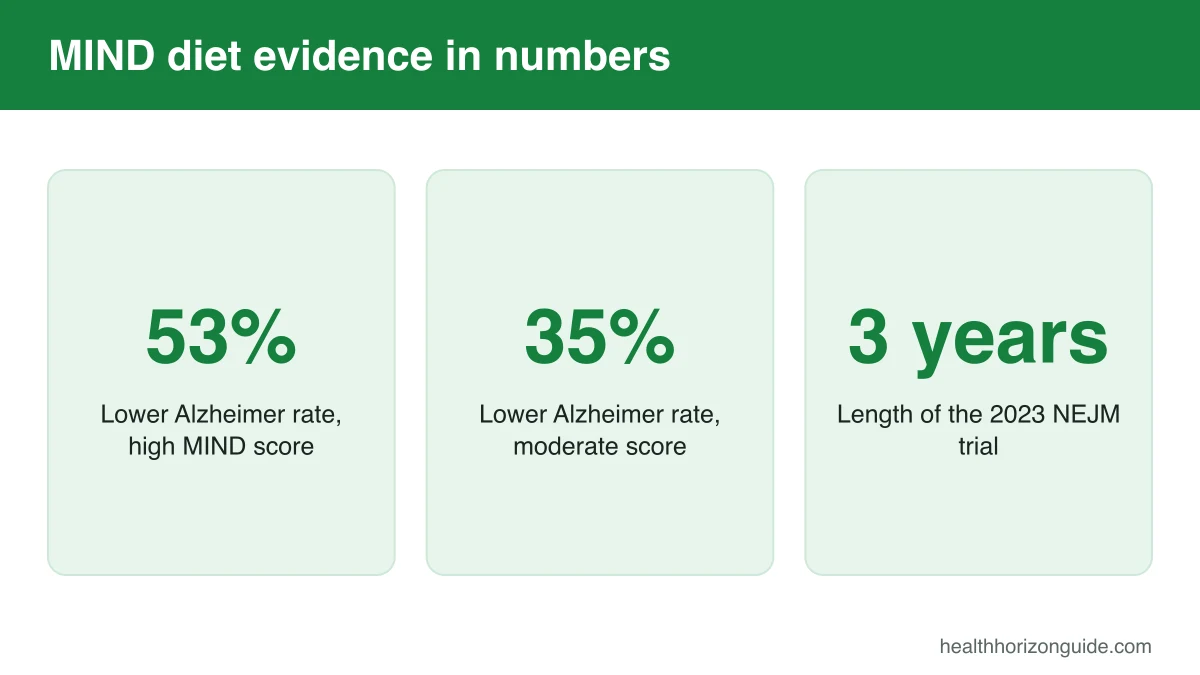
The 2015 Rush MIND diet study found a 53% lower rate of Alzheimer's disease in people who followed MIND most closely. Moderate adherence was linked to a 35% lower rate. The study followed 923 volunteers aged 58 to 98 for an average of 4.5 years, and 144 developed Alzheimer's disease.
The Rush researchers also scored the Mediterranean and DASH diets in the same group. High Mediterranean adherence was linked to a 54% lower rate, and high DASH adherence to a 39% lower rate. Moderate adherence to the Mediterranean or DASH diet showed negligible benefit.
The study was observational, so the results show a link and not proof of cause.
What did the 2023 NEJM MIND diet trial find?
The 2023 NEJM MIND diet trial found no significant difference in cognition or brain MRI results between the MIND diet and a control diet over 3 years. The trial in the New England Journal of Medicine enrolled 604 adults aged 65 or older with a family history of dementia, overweight and a suboptimal diet.
Both groups cut about 250 calories a day with dietitian support. Global cognition improved slightly in both groups, and the MIND group's gain was not significantly larger.
The trial has limits. Three years is short for a disease that develops over decades, and the control diet was itself a mild calorie cut.
For a family that has watched a parent live with dementia, the trial result can feel disappointing. The honest summary is that the MIND diet is a healthy pattern without proof that it prevents dementia.
Which is better for brain health: the Mediterranean diet or the MIND diet?
Neither the Mediterranean diet nor the MIND diet is proven better for brain health than the other. The 2015 Rush study linked high adherence to nearly the same lower Alzheimer's rate on both diets, 54% for the Mediterranean diet and 53% for MIND.
The MIND diet showed a link at moderate adherence, while the Mediterranean diet did not. The Rush report described MIND as easier to follow than the Mediterranean diet.
Mediterranean diet vs MIND diet for heart health
The Mediterranean diet has stronger evidence for heart health than the MIND diet. Mayo Clinic reports that the Mediterranean diet is linked with lower heart disease risk factors, such as high cholesterol and high blood pressure.
Harvard states that the MIND diet may also benefit heart health, mainly because MIND borrows from the Mediterranean and DASH diets. No MIND-specific heart outcome data appear in the Harvard review.
High blood pressure and high LDL cholesterol also appear on the 2024 Lancet Commission list of dementia risk factors.
Mediterranean diet vs MIND diet for weight loss
Neither the Mediterranean diet nor the MIND diet is designed mainly for weight loss. Weight loss on either diet depends on calories.
Both groups in the 2023 MIND trial lost about 11 pounds, according to Harvard. The weight loss came from the 250-calorie daily cut, so the MIND diet itself did not cause extra loss. Both diets lean on whole grains, and our article on oatmeal and longevity covers one filling option.
What are the practical differences between the MIND diet and the Mediterranean diet?
The practical differences between the MIND diet and the Mediterranean diet are berries, leafy greens, wine and how strictly portions are counted.
Berries on the MIND diet
Berries on the MIND diet are the only fruit with a set target, at 2 or more servings a week. The Rush report singled out blueberries as especially protective. The Mediterranean diet counts berries with all other fruit.
Leafy greens on the MIND diet
Leafy greens on the MIND diet have their own target of 6 or more servings a week, separate from other vegetables. The Rush report describes green leafy vegetables as part of a daily salad.
Wine on the MIND diet and the Mediterranean diet
Wine on the MIND diet was part of the original score but was dropped from later MIND trials for safety reasons. Mayo Clinic advises people not to start drinking alcohol or drink more often for possible health benefits.
Who might choose the MIND diet or the Mediterranean diet?
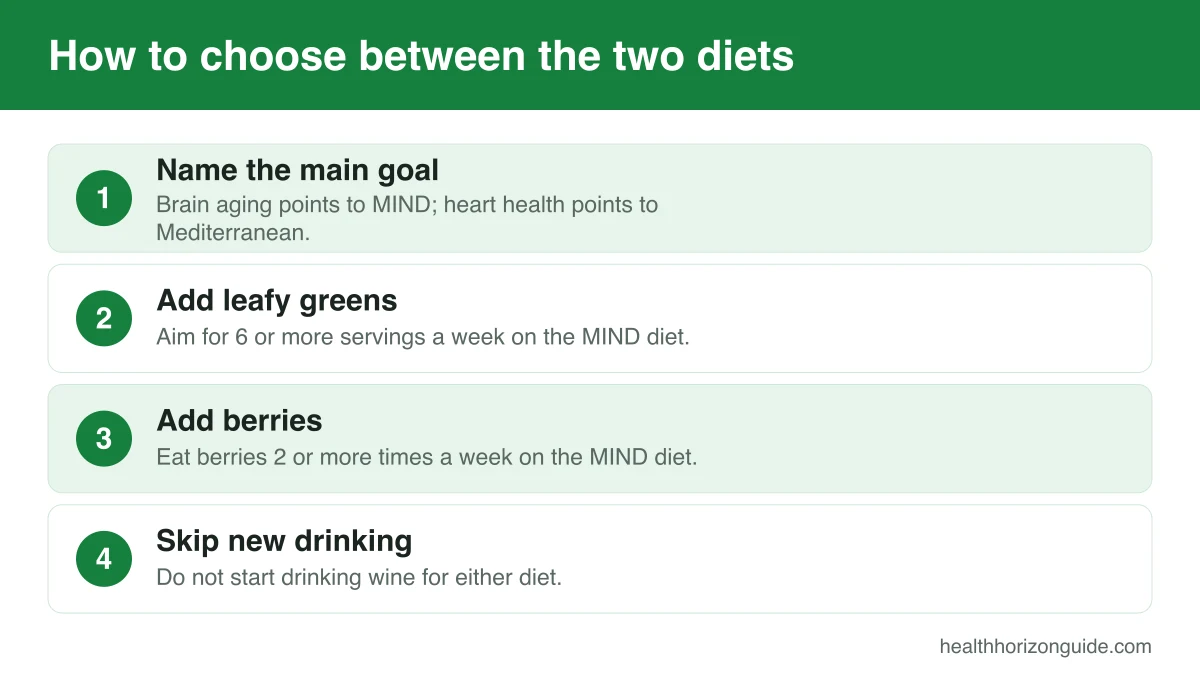
The choice between the MIND diet and the Mediterranean diet depends on whether the main goal is brain health or heart health. The 3 common situations below show how each diet fits.
- People focused on memory and brain aging may prefer the MIND diet's clear targets for leafy greens, berries and nuts.
- People focused on heart health may prefer the Mediterranean diet, which has broader heart evidence.
- People managing high blood pressure may also compare both diets with DASH. Our Mediterranean diet vs DASH diet comparison explains that third option.
What are the dementia risk factors beyond diet?
The dementia risk factors beyond diet include 14 modifiable factors named by the 2024 Lancet Commission. The Lancet Commission report estimates that addressing these factors could prevent or delay nearly half of dementia cases.
The 14 modifiable dementia risk factors in the Lancet Commission report are listed below.
- Lower levels of education
- Hearing impairment
- High blood pressure
- Smoking
- Obesity
- Depression
- Physical inactivity
- Diabetes
- Excessive alcohol consumption
- Traumatic brain injury
- Air pollution
- Social isolation
- High LDL cholesterol
- Vision loss
Physical inactivity is one factor a daily walk addresses, and our guide on how many steps a day to aim for gives practical targets.
When should you see a doctor about memory changes?
A doctor's visit for memory changes is needed when you, a family member or a friend has trouble remembering recent events or thinking clearly, according to the National Institute on Aging.
The 6 memory and thinking changes below are signs to discuss with a doctor.
- Asking the same question or repeating the same story over and over
- Becoming lost in familiar places
- Having trouble following directions
- Getting confused about time, people and places
- Having trouble handling money and paying bills
- Forgetting important events or appointments
Some causes of memory loss are treatable, including medication side effects, vitamin B12 deficiency and some thyroid, kidney or liver disorders. Stress, anxiety and depression can also make a person more forgetful. Our guide on how to lower cortisol covers habits that ease stress.
Mediterranean diet vs MIND diet: common questions
Is the MIND diet the same as the Mediterranean diet?
No, the MIND diet is not the same as the Mediterranean diet. The MIND diet combines parts of the Mediterranean and DASH diets and adds specific targets for leafy greens and berries.
Does the MIND diet prevent Alzheimer's disease?
No, the MIND diet has not been proven to prevent Alzheimer's disease. Observational studies link MIND to a lower Alzheimer's rate, but the 2023 randomized trial found no significant cognitive benefit over 3 years.
Do you have to drink wine on the MIND diet?
No, you do not have to drink wine on the MIND diet. Later MIND trials removed wine from the diet for safety reasons.