Mediterranean Diet Food List: What to Eat and How to Start
A Mediterranean diet food list sorted by how often to eat each food, with the health evidence, 7 steps to start, a sample menu and budget tips.

The Mediterranean diet food list is built on vegetables, fruit, whole grains, beans, nuts, herbs and olive oil eaten every day, with fish and seafood at least twice a week, according to the Oldways Mediterranean Diet Pyramid. Poultry, eggs, cheese and yogurt come in moderate portions. Red meat and sweets are eaten rarely.
Action checklist
Starting the Mediterranean diet
Use these steps from the article to start eating the Mediterranean way.
0 of 10 done
In this article
- What is the Mediterranean diet?
- Mediterranean diet food list
- Mediterranean diet health benefits
- How to start the Mediterranean diet in 7 simple steps
- Mediterranean diet meal plan: a sample 1-day menu
- Mediterranean diet on a budget
- Common Mediterranean diet mistakes
- How does the Mediterranean diet compare with other diets?
- Who should check with a doctor before starting the Mediterranean diet?
- Mediterranean diet FAQ
What is the Mediterranean diet?
The Mediterranean diet is an eating pattern based on plant foods and healthy fats, with extra-virgin olive oil as the main fat. Cleveland Clinic describes the Mediterranean diet as a set of overall habits rather than strict rules or calculations.
Where does the Mediterranean diet come from?
The Mediterranean diet comes from the mid-20th-century diets of Crete, Greece and southern Italy. Chronic disease rates in those regions were low, according to the Harvard T.H. Chan School of Public Health. Harvard, Oldways and the European office of the World Health Organization introduced the Mediterranean Diet Pyramid in 1993.
Is the Mediterranean diet a strict plan?
No, the Mediterranean diet is not a strict plan with set servings. The pyramid shows how often to eat each food group and gives no portion sizes. Physical activity and social connection sit at the base of the pyramid, beside the food.
The Mediterranean diet does not count calories, so weight loss on the Mediterranean diet still requires eating fewer calories, according to the American Heart Association. Our daily calorie calculator estimates a calorie target to pair with the food list below.
Mediterranean diet food list
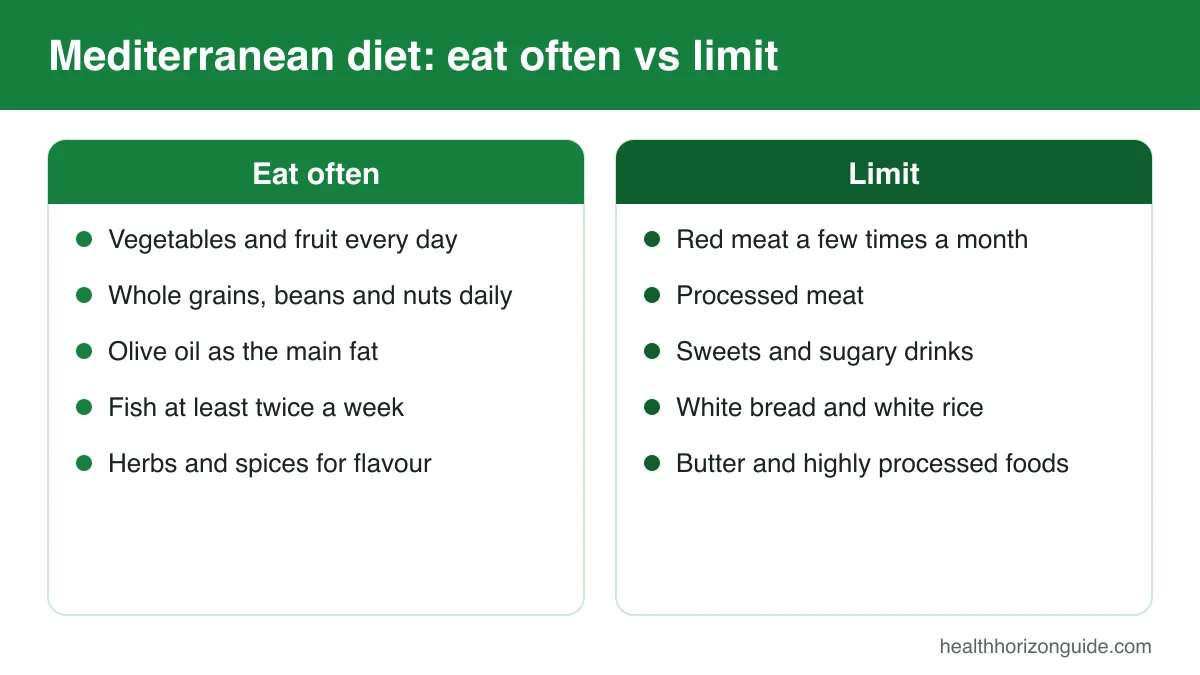
The Mediterranean diet food list sorts foods by how often to eat them, from every day to rarely. The table below combines the Oldways pyramid, Harvard and Cleveland Clinic guidance into 4 frequency groups.
| How often | Foods | Examples and notes |
|---|---|---|
| Eat daily | Vegetables, fruit, whole grains, beans and lentils, nuts and seeds, olive oil, herbs and spices | Leafy greens, tomatoes, oats, brown rice, barley, whole-wheat bread, chickpeas, almonds, walnuts |
| Eat weekly | Fish and seafood, at least twice a week | Salmon, sardines, mackerel, tuna, shellfish |
| Eat in moderation | Poultry, eggs, yogurt and cheese, daily to a few times a week | Plain Greek yogurt, feta, Parmesan, chicken |
| Limit | Red meat, processed meat, sweets, refined grains, sugary drinks, butter and highly processed foods | Red meat a few times a month at most, white bread and white rice less often |
Cleveland Clinic adds serving goals to the same food list. Those goals are 3 servings of fruit a day, at least 3 servings of vegetables a day, and beans about 3 times a week.
What drinks are allowed on the Mediterranean diet?
The drinks allowed on the Mediterranean diet are mainly water, with coffee and tea in moderation. Wine was once treated as part of the pattern. The American Heart Association now reports that the possible benefits of wine are outweighed by its potential harms. People who do not drink should not start drinking for the Mediterranean diet.
Mediterranean diet health benefits
The health benefits of the Mediterranean diet are strongest for heart health, with moderate evidence for type 2 diabetes and weaker evidence for the brain. The evidence for each benefit is summarised below.
Is the Mediterranean diet good for heart health?
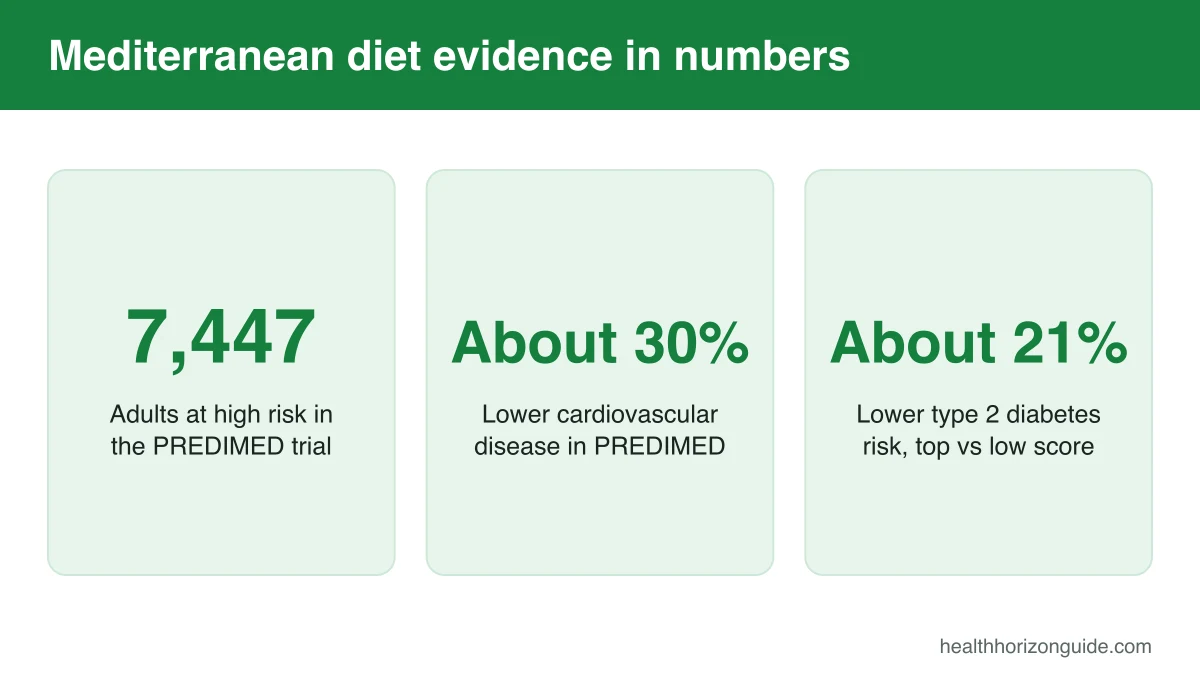
Yes, the Mediterranean diet is good for heart health, with the strongest trial evidence of any benefit. The PREDIMED trial assigned 7,447 adults at high cardiovascular risk to a Mediterranean diet with extra-virgin olive oil, a Mediterranean diet with nuts, or a reduced-fat diet. Cardiovascular disease was about 30% lower in both Mediterranean diet groups.
The New England Journal of Medicine retracted the 2013 PREDIMED paper in June 2018 because of errors in randomization. The authors republished a corrected analysis the same day, and the conclusion stayed largely the same, according to Harvard's Nutrition Source.
The American Heart Association adds that the Mediterranean diet tends to lower LDL cholesterol. A study of nearly 26,000 women linked the Mediterranean diet to about one-quarter lower risk of cardiovascular events over 12 years.
Does the Mediterranean diet lower type 2 diabetes risk?
Yes, the Mediterranean diet is linked to a lower type 2 diabetes risk, with moderate-certainty evidence. A 2025 meta-analysis of 25 studies found about 21% lower risk at the highest Mediterranean diet score compared with the lowest. Most of those studies were observational, so the result shows a link rather than proof of cause.
Is the Mediterranean diet good for brain health?
The Mediterranean diet and brain health show a promising link without firm proof. Harvard reviews studies on the Mediterranean diet and cognitive function and states no firm conclusion. Most brain research on the Mediterranean diet is observational, and controlled trials are still limited.
How to start the Mediterranean diet in 7 simple steps
Starting the Mediterranean diet works best as a series of small swaps, not a full pantry overhaul. The 7 steps below come from American Heart Association and Cleveland Clinic advice.
- Use extra-virgin olive oil for cooking and salad dressings in place of butter.
- Make vegetables the largest part of the plate, and eat leafy greens every day.
- Eat fish or seafood at least twice a week, such as salmon or sardines.
- Add beans, lentils or chickpeas to meals about 3 times a week.
- Switch to whole-grain bread, pasta and cereal.
- Choose fresh fruit or unsalted nuts for snacks and dessert instead of sweets.
- Eat red and processed meat less often, and plan meals ahead so cooking at home is easier.
Cleveland Clinic suggests involving family or friends in the Mediterranean diet. Shared meals make a new pattern easier to keep for a household, and the pyramid itself places social connection at its base.
Mediterranean diet meal plan: a sample 1-day menu
A sample 1-day Mediterranean diet menu uses foods from the daily list at every meal. The 4 meals below show one example day, built from the food list in this article.
- Breakfast: plain Greek yogurt with fresh berries, walnuts and oats.
- Lunch: a lentil and vegetable soup with a slice of whole-wheat bread.
- Snack: an apple and a small handful of unsalted almonds.
- Dinner: baked salmon with roasted vegetables, brown rice and a leafy green salad dressed with olive oil.
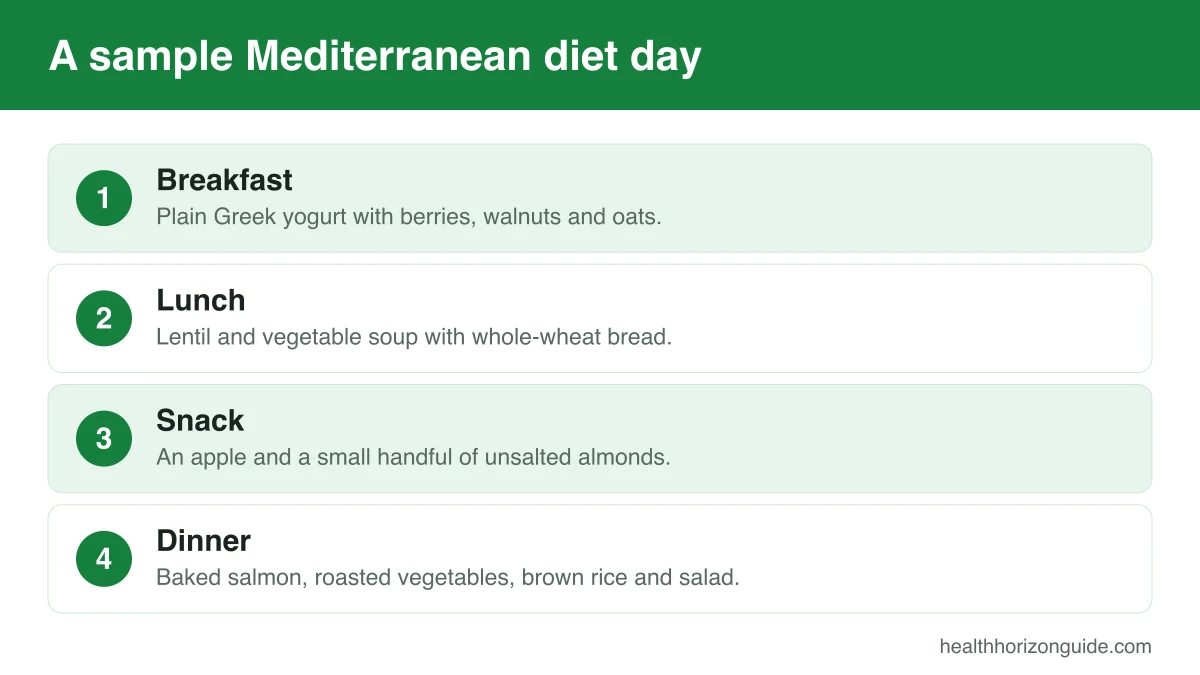
Water is the main drink across the day. Portion sizes depend on age, size and activity level, so the menu lists foods only.
Mediterranean diet on a budget
The Mediterranean diet on a budget relies on canned, frozen and dried staples. The American Heart Association notes that fresh produce can be hard to access on a low income. The 6 money-saving tips below come from Penn State Extension.
- Buy seafood canned, in pouches or as plain frozen portions.
- Choose dried or canned beans and lentils with no added salt, or rinse canned beans.
- Use no-salt-added canned or plain frozen vegetables and fruit when fresh produce is out of season.
- Buy nuts in bulk and plain Greek yogurt in large tubs.
- Cook with regular olive oil, and save extra-virgin olive oil for dressings and dips.
- Plan meals, use leftovers and choose store brands.
Common Mediterranean diet mistakes
The most common Mediterranean diet mistakes are eating large portions and treating single foods as the whole diet. The 4 mistakes below are drawn from Harvard, American Heart Association and Cleveland Clinic guidance.
- Large portions: the pyramid sets no portion sizes, and Harvard warns that excess calories and weight gain are possible.
- Single foods: Harvard states that the benefits come from the whole pattern, so adding olive oil or nuts alone is not the Mediterranean diet.
- Refined grains: white bread, white pasta and white rice replace the whole grains the pattern is built on.
- Starting to drink: wine is optional, and non-drinkers are advised not to start.
How does the Mediterranean diet compare with other diets?
The Mediterranean diet compares with other diets as a broad, flexible pattern that excludes no food group. Most other popular diets remove a food group or set a fixed rule. The table below lists 14 diets, the key difference from the Mediterranean diet, and our full comparison for each.
| Diet | Key difference from the Mediterranean diet | Full comparison |
|---|---|---|
| Keto | Very low in carbohydrates, so grains, beans and most fruit are cut | Mediterranean diet vs keto |
| Zone diet | Sets a fixed ratio of carbohydrate, protein and fat at each meal | Mediterranean diet vs Zone diet |
| Raw food diet | Mostly uncooked, unprocessed plant foods | Mediterranean diet vs raw food diet |
| Dairy-free diet | Removes all milk products | Mediterranean diet vs dairy-free diet |
| Egg-free diet | Removes eggs and foods made with eggs | Mediterranean diet vs egg-free diet |
| Nut-free diet | Removes nuts, a daily Mediterranean food | Mediterranean diet vs nut-free diet |
| Carnivore diet | Animal foods only, with no plant foods | Mediterranean diet vs carnivore diet |
| High-protein diet | Raises protein as a share of daily food | Mediterranean diet vs high-protein diet |
| DASH diet | Designed to lower blood pressure, with a sodium limit | Mediterranean diet vs DASH diet |
| MIND diet | Blends Mediterranean and DASH foods with a focus on the brain | Mediterranean diet vs MIND diet |
| Paleo diet | Removes grains, beans and dairy | Mediterranean diet vs paleo diet |
| Blood type diet | Chooses foods by ABO blood type | Mediterranean diet vs blood type diet |
| Macrobiotic diet | Centres on whole grains within a wider philosophy of balance | Mediterranean diet vs macrobiotic diet |
| Balkan diet | A neighbouring regional pattern from southeastern Europe | Mediterranean vs Balkan diet health benefits |
Who should check with a doctor before starting the Mediterranean diet?
People who should check with a doctor before starting the Mediterranean diet are people with a chronic condition, a food allergy or specific nutritional needs. Cleveland Clinic advises speaking to a primary care physician or dietitian before any major diet change. A dietitian can adapt the Mediterranean diet to medical history, allergies and preferences.
The 4 groups below benefit most from that conversation.
- People with diabetes or high blood pressure who take medicine, because diet changes can affect blood sugar and blood pressure readings.
- People with a fish, nut or sesame allergy, since those foods are staples of the pattern.
- People who should avoid alcohol, including anyone with a history of alcohol problems.
- Pregnant people, older adults and children with specific nutritional needs.
Mediterranean diet FAQ
Can you eat eggs on the Mediterranean diet?
Yes, you can eat eggs on the Mediterranean diet in moderation. Cleveland Clinic suggests up to 1 egg yolk a day, and no more than 4 yolks a week for people with high cholesterol.
Can you eat potatoes on the Mediterranean diet?
Yes, you can eat potatoes on the Mediterranean diet as a starchy vegetable. Cleveland Clinic groups starchy vegetables with whole grains, and baked or boiled potatoes fit better than fried ones.
Is the Mediterranean diet good for weight loss?
The Mediterranean diet is good for weight loss only when total calories fall. The pattern is filling and easy to keep, according to Harvard, but the pattern sets no calorie limit.
How much red meat is allowed on the Mediterranean diet?
Red meat allowed on the Mediterranean diet is limited to a few times a month, according to Harvard. Cleveland Clinic suggests no more than 1 serving of lean red meat a week.