Is It Safe to See a Chiropractor With Osteoporosis?
Seeing a chiropractor with osteoporosis can be safe when forceful spinal manipulation is avoided. Learn the fracture risks, gentler options and red flags.
Seeing a chiropractor with osteoporosis can be safe when the chiropractor knows the diagnosis and avoids forceful spinal manipulation. Chiropractic treatment is not safe for body areas affected by severe osteoporosis or a bone fracture, according to MedlinePlus. Chiropractic care does not raise bone density, so chiropractic care cannot replace medical treatment for osteoporosis.
Action checklist
Before seeing a chiropractor with osteoporosis
Use these steps from the article to lower fracture risk and keep osteoporosis treatment on track.
0 of 10 done
In this article
- Is it safe to see a chiropractor with osteoporosis?
- What are osteoporosis and osteopenia?
- Why does spinal manipulation carry fracture risk with osteoporosis?
- Who should avoid chiropractic adjustments?
- Which gentler approaches can a chiropractor use with osteoporosis?
- Can a chiropractor help osteoporosis?
- What treats osteoporosis when chiropractic care does not?
- Exercises to avoid with osteoporosis
- Compression fracture symptoms that need a doctor
- Frequently asked questions about chiropractors and osteoporosis
Is it safe to see a chiropractor with osteoporosis?
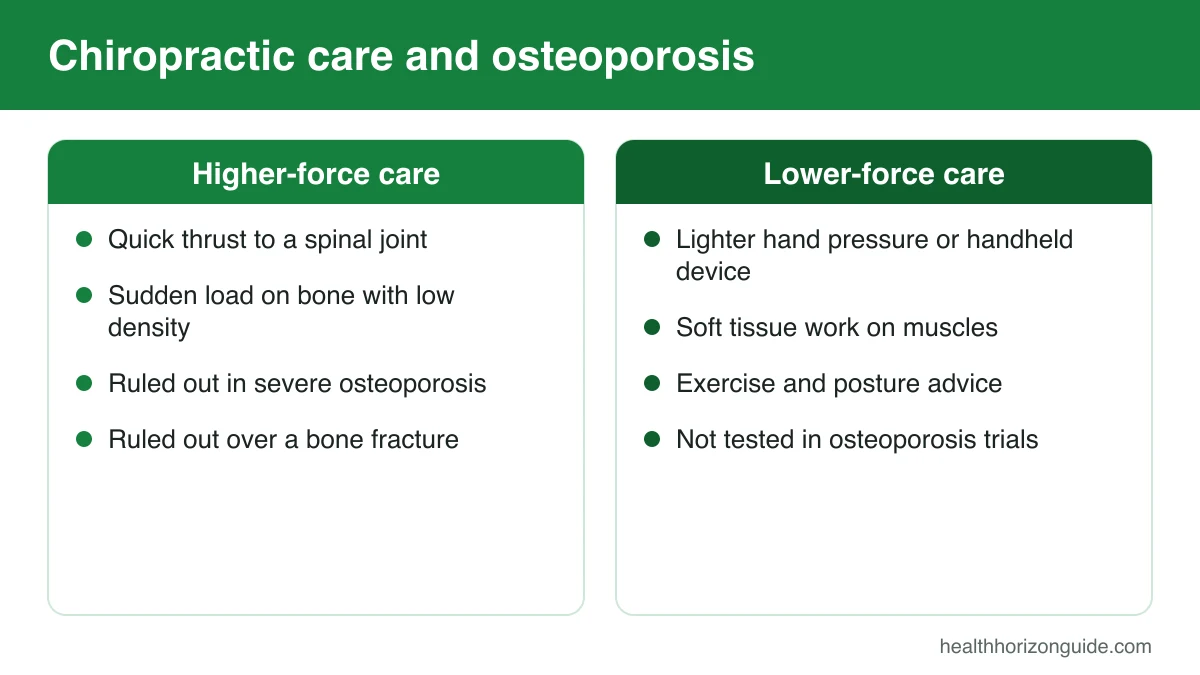
Seeing a chiropractor with osteoporosis is safe only within clear limits: no forceful thrusts on weak bone, and no treatment of an area with severe bone loss or a fracture. MedlinePlus lists severe osteoporosis and bone fractures among the conditions that rule out chiropractic treatment of the affected body part. Milder bone loss does not appear on that list, which leaves the decision to the doctor who manages the osteoporosis and to the chiropractor. Tell the chiropractor about the osteoporosis diagnosis, the latest bone density result and any past fracture before the first visit. MedlinePlus notes that a first chiropractic visit includes questions about past injuries, illnesses and medicines, followed by a physical exam that may include x-rays.
The table below compares 4 common chiropractic approaches by how each one fits a spine with osteoporosis.
| Chiropractic approach | What the approach involves | Fit with osteoporosis |
|---|---|---|
| High-velocity spinal manipulation (the adjustment) | A quick, hands-on thrust to a spinal joint | Ruled out for areas with severe osteoporosis or a fracture. Ask the doctor first with any bone loss. |
| Low-force or instrument-assisted techniques | Lighter pressure by hand or with a handheld device | Offered as a gentler option. We found no trials that test these methods in people with osteoporosis. |
| Soft tissue work and massage | Pressure on muscles instead of a thrust to a joint | Lower force. The chiropractor still needs to know about the osteoporosis. |
| Exercise and posture advice | Strength, balance and movement guidance | Matches medical exercise advice for osteoporosis when forceful bending and twisting are left out. |
What are osteoporosis and osteopenia?
Osteoporosis is a bone disease in which bone mineral density and bone mass decrease, which weakens bone and raises the risk of fractures. Osteopenia is the common name for low bone mass, a milder loss of bone density than osteoporosis. The National Institute of Arthritis and Musculoskeletal and Skin Diseases (NIAMS) describes osteoporosis as a silent disease. People with osteoporosis typically have no symptoms until a bone breaks.
How is osteoporosis diagnosed?
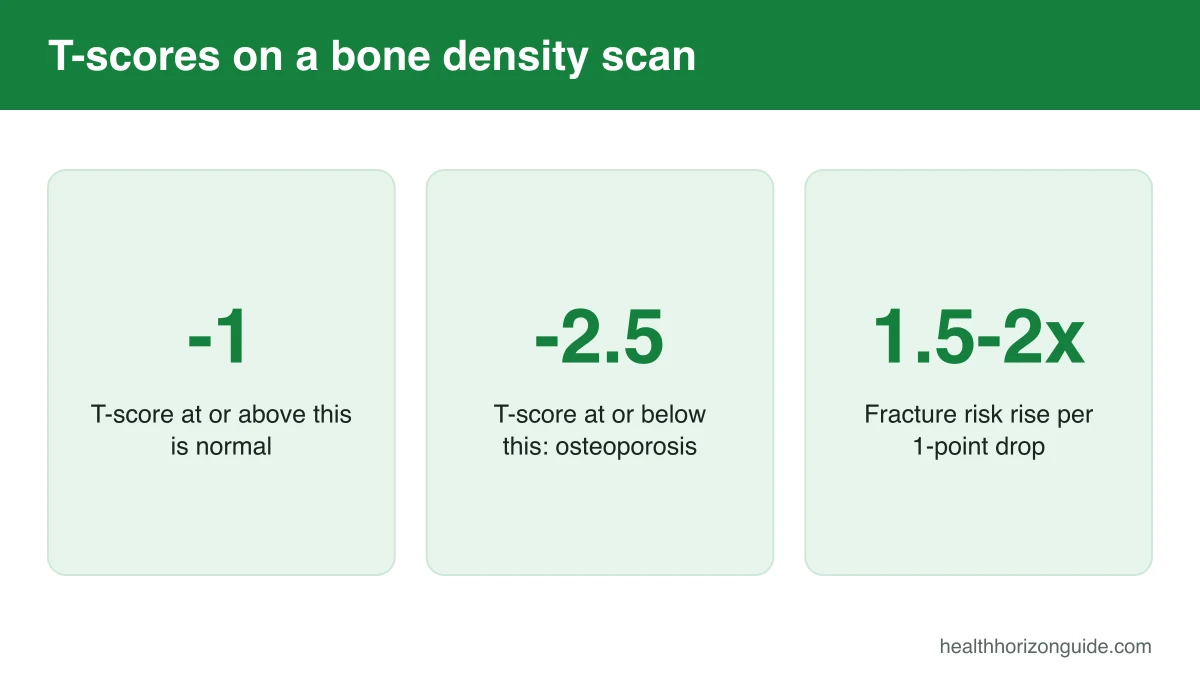
Osteoporosis is diagnosed with a bone density scan called DXA (dual-energy x-ray absorptiometry), which usually measures the hip and spine. The scan result is reported as a T-score, which compares bone mineral density with that of a healthy young adult. The table below shows the 3 T-score ranges as NIAMS states them.
| T-score | What the T-score means |
|---|---|
| -1 or higher | Normal bone density |
| Between -1 and -2.5 | Low bone mass (osteopenia) |
| -2.5 or lower | Osteoporosis |
Fracture risk rises 1.5 to 2 times with each 1-point drop in the T-score, according to NIAMS. A chiropractor who knows the T-score can judge how much caution osteoporosis or osteopenia calls for.
Why does spinal manipulation carry fracture risk with osteoporosis?
Spinal manipulation carries fracture risk with osteoporosis because a quick thrust places sudden force on bone that has lost density. NIAMS states that bones weakened by osteoporosis can break from a minor fall or from normal stresses such as bending, lifting or coughing. A manual thrust to the spine or rib cage adds one more load to bone that osteoporosis has already made fragile.
Research suggests that severe injury from manipulation is very rare overall, and that osteoporosis is where the fractures appear. A 2023 review of 960,140 spinal manipulation sessions at 30 chiropractic clinics in Hong Kong found 39 adverse events. The 2 severe events were both rib fractures in women over 60 with osteoporosis. That rate equals 0.21 severe events per 100,000 sessions. The study has limits: the data came from one clinic group's own complaint log and records, and the sample was too small to identify who is most at risk.
Who should avoid chiropractic adjustments?
People with severe osteoporosis or a fracture in the area to be treated should avoid chiropractic adjustments there. The 6 conditions that MedlinePlus says rule out chiropractic treatment of the affected body part are listed below.
- Bone fractures or bone tumors
- Severe arthritis
- Bone or joint infections
- Severe osteoporosis
- Severely pinched nerves with numbness, tingling and weakness in the arms or legs
- Acute neck pain with symptoms of pinched nerves
Sources do not attach a T-score to the word severe. Ask the doctor who ordered the bone density scan whether the osteoporosis counts as severe, especially when a past fracture is on record.
Which gentler approaches can a chiropractor use with osteoporosis?
A chiropractor can use lower-force methods instead of a thrust for a patient with osteoporosis. Lower-force methods include lighter hand pressure, a handheld instrument that taps a joint, soft tissue work and exercise advice. MedlinePlus confirms that chiropractors use massage and other soft tissue work alongside manipulation.
The evidence for these gentler approaches is limited. We found no clinical trials that test low-force chiropractic techniques for safety or benefit in people with osteoporosis. Lower force is a reasonable precaution, not a proven guarantee. Stop the session and tell the chiropractor when any technique causes pain. MedlinePlus states that manipulation should not hurt.
Can a chiropractor help osteoporosis?
A chiropractor cannot treat osteoporosis itself, because chiropractic care does not rebuild bone or change a T-score. A chiropractor may help with muscle and joint pain that occurs alongside osteoporosis, within the limits above. Our guide to seeing a chiropractor for lower back pain explains what the research shows for back pain in general. New or sudden osteoporosis back pain needs a medical check first, since the cause may be a spinal fracture.
What treats osteoporosis when chiropractic care does not?
Osteoporosis is treated with medication, exercise, nutrition and fall prevention, as NIAMS describes. The 4 established parts of osteoporosis care are listed below.
- Medication: prescription medicines such as bisphosphonates slow bone loss, and other medicine classes build bone in people at high fracture risk. A doctor chooses the medicine.
- Exercise: NIAMS states that the best activities for bone health include strength or resistance training. Mayo Clinic adds weight-bearing activities such as walking, plus balance exercises.
- Calcium and vitamin D: NIAMS lists 1,000 mg of calcium and 600 IU of vitamin D a day for adults aged 19 to 50, and 1,200 mg of calcium for women aged 51 to 70. A doctor decides whether a supplement is needed.
- Fall prevention: NIAMS recommends supportive shoes with nonslip soles, clear floors, good lighting, stair rails and bathroom grab bars.
NIAMS advises checking with a doctor or physical therapist before starting an exercise program with osteoporosis. Our comparison of a chiropractor vs physical therapist explains how the two professions differ.
Exercises to avoid with osteoporosis
The exercises to avoid with osteoporosis are forceful forward bends, twists at the waist and high-impact moves. Mayo Clinic states that bending forward at the waist and twisting at the waist can raise the risk of compression fractures in the spine. Toe touches and sit-ups are the examples Mayo Clinic gives. Jumping, running and jogging can lead to fractures in weakened bones, so Mayo Clinic advises slow, controlled movements instead.
The same caution applies to forceful self-twisting to crack the spine. Our article on whether cracking your back is bad for you covers that habit in more detail.
Compression fracture symptoms that need a doctor
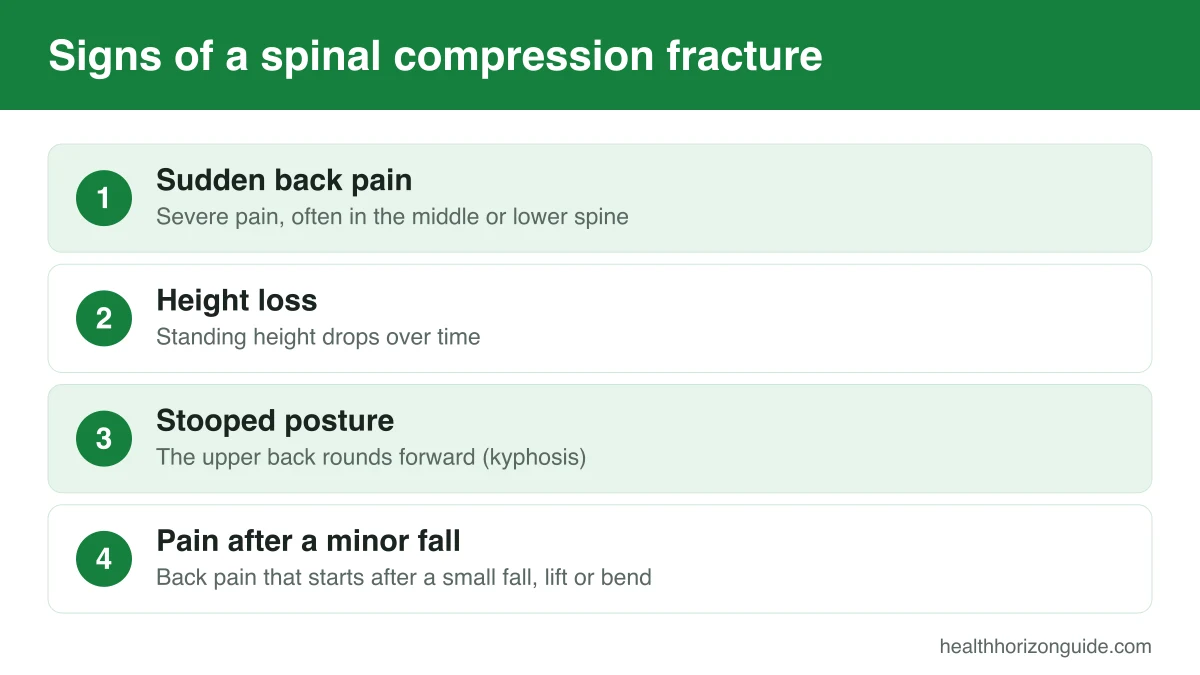
Compression fracture symptoms that need a doctor are sudden back pain, height loss, a stooped posture and back pain after a minor fall. Osteoporosis is the most common cause of spinal compression fractures, according to MedlinePlus. The 4 warning signs of a spinal compression fracture are listed below.
- Sudden, severe back pain, often in the middle or lower spine
- Loss of height over time
- A stooped-over posture, called kyphosis
- Back pain that starts after a minor fall, a lift or a bend
See a doctor, not a chiropractor, when any of these signs appears with osteoporosis. MedlinePlus notes that compression fractures from osteoporosis may cause no symptoms at first. Seek urgent medical care for numbness, weakness, trouble walking or loss of bladder or bowel control. Our posture and back pain self-check tool can help organise symptoms before an appointment, and the tool does not replace an exam.
Frequently asked questions about chiropractors and osteoporosis
Can a chiropractor treat osteopenia?
A chiropractor cannot treat osteopenia, because chiropractic care does not change bone density. Osteopenia is milder than osteoporosis and is not on the MedlinePlus list of conditions that rule out treatment, so gentle care may be an option once a doctor agrees.
Does a chiropractor need bone density scan results?
A chiropractor needs to know the bone density result to choose a safe technique for a patient with osteoporosis. Bring the DXA report or the T-score, and mention any past fracture.
Is osteoporosis back pain always a fracture?
Osteoporosis back pain is not always a fracture, since muscle and joint problems cause back pain too. Osteoporosis itself typically causes no symptoms until a bone breaks, so new back pain with osteoporosis deserves a medical check.
Can chiropractic adjustments increase bone density?
Chiropractic adjustments do not increase bone density. Osteoporosis treatment relies on medication, exercise, calcium and vitamin D, and fall prevention.