Chiropractor for Elbow Pain: Can It Help?
Chiropractor for elbow pain: what the evidence shows for tennis and golfer's elbow, nerve problems, safety, what a visit involves and when to see a doctor.

Chiropractic care for elbow pain has limited evidence. A Cochrane review of 23 studies with 1,612 participants found that manual therapy and exercise may give small, short-term relief of pain in tennis elbow, with low-certainty evidence. A chiropractor can assess the elbow, but a doctor should confirm the cause first.
In this article
- Can a chiropractor help with elbow pain?
- What causes elbow pain?
- What are tennis elbow and golfer's elbow?
- Can nerve compression or a joint problem cause elbow pain?
- What happens during a chiropractor visit for elbow pain?
- Does elbow pain get better without a chiropractor?
- Is chiropractic care for elbow pain safe?
- How much does a chiropractor for elbow pain cost?
- Which professional should treat elbow pain first?
- When should you see a doctor for elbow pain?
- Frequently asked questions
Can a chiropractor help with elbow pain?
A chiropractor may help some types of elbow pain, mainly tendon pain, although the evidence is weak. The main treatments are soft tissue work, joint mobilization and exercise, rather than a spinal "crack".
The same Cochrane review reports that benefits may not be clinically meaningful or sustained. Longer-term effects of chiropractic care for elbow pain are unknown.
The table below summarizes what chiropractic care for elbow pain can and cannot offer, based on the research.
| Question | What the evidence shows |
|---|---|
| Short-term pain relief | Manual therapy may lessen pain and disability at the end of treatment |
| Quality of life and treatment success | Little or no difference compared with minimal or no treatment |
| Certainty of evidence | Low for most findings |
| Long-term effects | Unknown |
What causes elbow pain?
Elbow pain most often comes from repetitive strain injuries, according to Cleveland Clinic. Chiropractors see these conditions, but the cause decides whether chiropractic care for elbow pain is suitable.
The Cleveland Clinic elbow pain guide lists the main groups of causes below.
- Tendinitis, which includes tennis elbow on the outer side and golfer's elbow on the inner side.
- Bursitis, which is inflammation of the bursae at the tip of the elbow.
- Nerve compression, including radial tunnel syndrome on the outer side and cubital tunnel syndrome on the inner side.
- Arthritis, where osteoarthritis is the most common type affecting the elbow.
- Injuries such as sprains, strains, fractures and dislocations.
Less common causes include bone spurs and referred pain from the neck or shoulder.
What are tennis elbow and golfer's elbow?
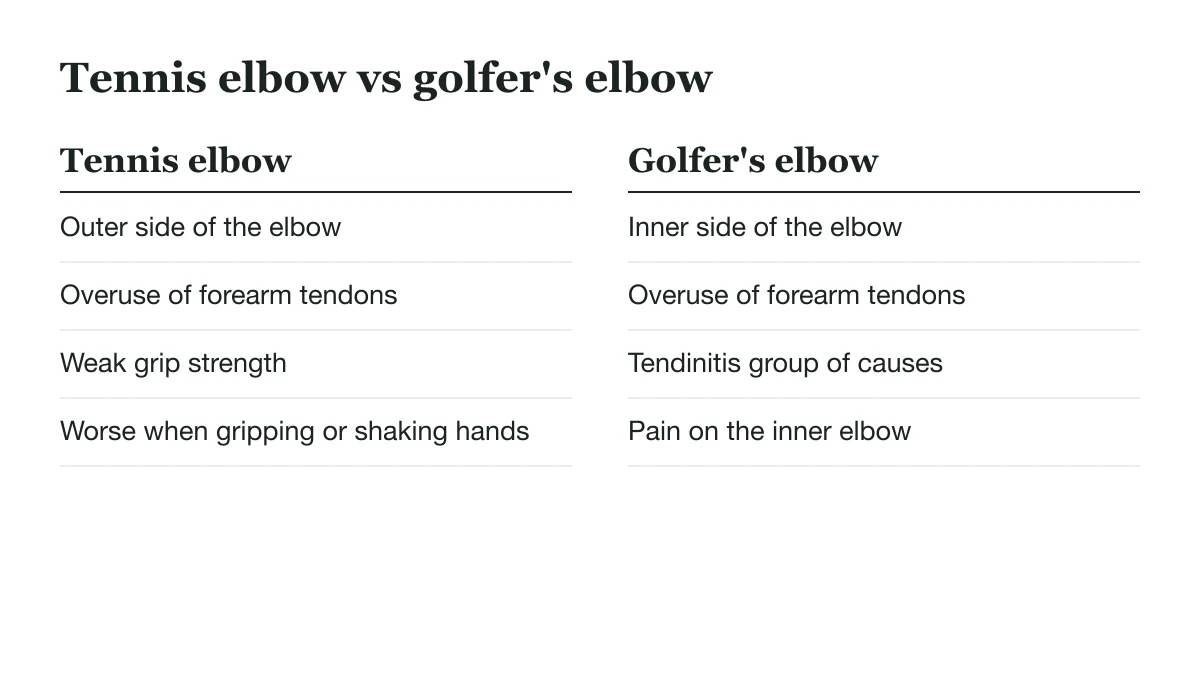
Tennis elbow is a painful overuse condition on the outside of the elbow, and golfer's elbow affects the inside. Both involve the forearm tendons.
The American Academy of Orthopaedic Surgeons describes tennis elbow as wear and tear, or sometimes microtears, of the forearm tendons. Repeated forearm and wrist motions damage the extensor carpi radialis brevis tendon.
Most people with tennis elbow are between 30 and 50. Painters, plumbers, carpenters, auto workers, cooks and butchers are affected more often.
These are the symptoms of tennis elbow.
- Pain or burning on the outer elbow that develops gradually.
- Weak grip strength.
- Pain at night in some people.
- Worse pain when gripping, turning a wrench or shaking hands.
Golfer's elbow causes tenderness on the inner side of the elbow instead.
Can nerve compression or a joint problem cause elbow pain?
Yes, nerve compression and joint problems can cause elbow pain, and they need a different approach from tendon pain. Cubital tunnel syndrome compresses a nerve on the inner side of the elbow, and radial tunnel syndrome does so on the outer side.
Cleveland Clinic lists nerve-related symptoms as a reason to seek care. Arthritis, bursitis and injuries also sit in the joint group of causes.
Referred pain from the neck or shoulder can mimic an elbow problem. A chiropractor may look at the neck in that case, and a related article explains chiropractic care for a pinched nerve.
Elbow pain also overlaps with other arm problems. Readers with hand symptoms may find the guide to chiropractic care for carpal tunnel useful.
What happens during a chiropractor visit for elbow pain?
A chiropractor visit for elbow pain starts with a history and a physical exam. The chiropractor asks about work, sport and past injuries, then tests grip, movement and tender points.
A typical visit follows these steps, although the order and content vary between clinics.
- History of the pain, including activities that make it worse.
- Examination of the elbow, wrist, shoulder and neck.
- A discussion of the likely cause and whether a referral is needed.
- Hands-on care such as soft tissue work or joint mobilization, if the chiropractor considers it suitable.
- Advice on rest, activity changes and exercises.
Exercise is the part with the most support. The Cochrane review looked at manual therapy and prescribed exercises, and both may slightly reduce pain and disability compared with minimal or no treatment.
Does elbow pain get better without a chiropractor?
Yes, most tennis elbow improves with non-surgical care. The American Academy of Orthopaedic Surgeons reports that about 80 to 95% of patients succeed with nonsurgical treatment.
That figure covers care from several clinicians, not chiropractic care alone. The options it lists are shown below.
- Rest from aggravating activities for several weeks.
- Acetaminophen or NSAIDs for pain and swelling.
- Physical or occupational therapy with forearm strengthening exercises.
- A counterforce brace worn over the back of the forearm.
Surgery is considered when symptoms do not improve after 6 to 12 months of nonsurgical treatment.
Harvard Health notes there are many treatments for tennis elbow but not much high-quality evidence about their effectiveness. Many treatments relieve pain, but usually only temporarily.
Is chiropractic care for elbow pain safe?
Chiropractic care for elbow pain is generally low risk, although side effects do occur. The National Center for Complementary and Integrative Health reports that mild to moderate side effects such as increased pain, stiffness or headache often occur after spinal manipulation.
The NCCIH page on spinal manipulation says most of these side effects go away within 24 hours. Serious events, including neurological problems and neck-artery strokes, are very rare, and there are no accurate estimates of how often they occur.
Neck-focused manipulation has been linked to rare tears in neck arteries. Experts disagree on whether manipulation causes them.
The NCCIH also says that underlying health problems may raise the chance of serious side effects. Tell the chiropractor about all medical conditions before treatment. Go to the emergency room if sudden severe headache, neck pain, dizziness, vision changes or trouble speaking follows any neck manipulation.
How much does a chiropractor for elbow pain cost?
The cost of a chiropractor for elbow pain depends on the clinic, the region and the number of visits. No reliable national price exists for elbow care.
A separate guide covers how much a chiropractor costs in general. Asking a clinic for its fees and visit plan before starting is sensible.
Which professional should treat elbow pain first?
A doctor is the safest first step for elbow pain that is severe, follows an injury or comes with nerve symptoms. A doctor can rule out fractures, infection and nerve damage.
For ongoing tendon pain, physical therapy and chiropractic care overlap, because both use exercise. A comparison of a chiropractor and a physical therapist explains the differences.
Elbow pain sometimes starts in the shoulder. The article on chiropractic care for shoulder pain covers that region.
When should you see a doctor for elbow pain?
See a doctor for elbow pain when pain persists after a week of home care or when warning signs appear. Cleveland Clinic gives that one-week point.
Here are the warning signs that call for medical care.
- Numbness, tingling or other nerve-related symptoms.
- Weakness in the arm or hand.
- Severe swelling, bruising or bleeding.
- A fall or injury, especially when the arm cannot move or bend.
- Suspected serious injury.
- Redness, heat and fever with a swollen elbow, which can mean infection.
Elbow pain in a child also needs medical care, according to Cleveland Clinic. Do not rely on chiropractic care alone while any of these signs are present.
Frequently asked questions
Can a chiropractor fix tennis elbow?
No, a chiropractor cannot guarantee a fix for tennis elbow. Manual therapy and exercise may give small, short-term relief, and the evidence is low certainty.
Can a neck problem cause elbow pain?
Yes, referred pain from the neck or shoulder is a less common cause of elbow pain, according to Cleveland Clinic. A doctor or chiropractor can check the neck during an exam.
How long does tennis elbow take to heal?
Tennis elbow recovery varies. Orthopaedic guidance describes several weeks of rest, and surgery is considered only after 6 to 12 months without improvement.
Is a counterforce brace worth trying?
A counterforce brace is one of the nonsurgical options the American Academy of Orthopaedic Surgeons lists for tennis elbow. It is worn over the back of the forearm to rest the tendons.
Action checklist
Elbow pain checklist before you book
Use these steps to decide who to see and what to ask.
0 of 9 done