Chiropractor for Migraines and Headaches: Does It Help?
A chiropractor may ease neck-related headaches, but evidence for migraine is preliminary. Learn the risks, red flags and proven medical treatments.
A chiropractor may ease some headaches that start in the neck, but a chiropractor is not a proven treatment for migraine. Research on spinal manipulation for migraine is preliminary, and the most supportive findings concern cervicogenic headache, a headache caused by a neck problem. Chiropractic care can sit beside medical migraine treatment, and chiropractic care does not replace a diagnosis or medicine from a doctor.
Action checklist
Before you see a chiropractor for migraines or headaches
Use these steps from the article to stay safe and get the right headache care.
0 of 9 done
In this article
- Can a chiropractor help with migraines?
- Which headache types respond to chiropractic care?
- Can a pinched nerve in the neck cause headaches?
- What are the risks of neck manipulation for headaches?
- What happens at a chiropractor visit for headaches?
- Headache care beyond the chiropractor
- What medical treatments does a doctor offer for migraine?
- When is a headache an emergency?
- What are the alternatives to a chiropractor for neck-related headaches?
- Frequently asked questions about chiropractors and migraines
Can a chiropractor help with migraines?
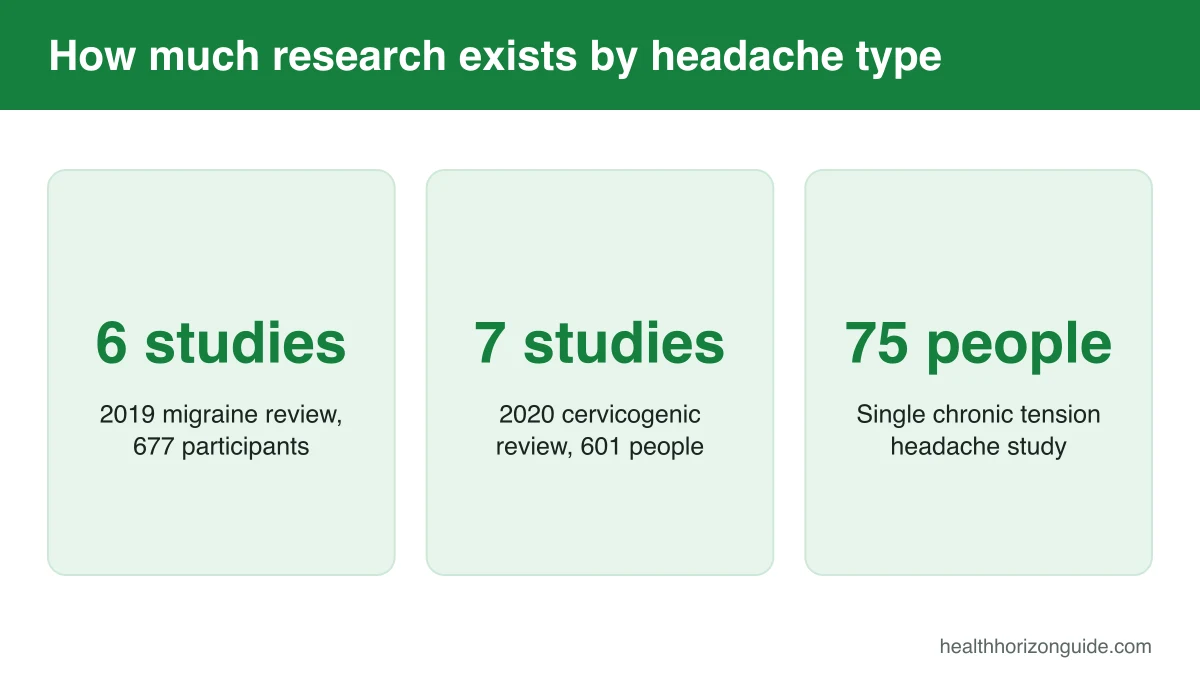
A chiropractor may reduce migraine days for some people, but the evidence is preliminary. The National Center for Complementary and Integrative Health (NCCIH) describes a 2019 review of 6 studies with 677 participants. The review found that spinal manipulation may reduce the number of days with migraine, and the reviewers considered the results preliminary. NCCIH also states that studies of manipulation for headaches have had contradictory results, so the benefit remains uncertain.
Migraine involves moderate to severe throbbing pain, often on one side of the head, with nausea and sensitivity to light and sound. Spinal manipulation is a hands-on technique applied to the joints of the spine. No strong research shows that a chiropractor can stop the migraine process itself. People who feel better after chiropractic care often have neck pain or neck stiffness as part of the headache pattern.
The table below compares the 3 main headache types and the evidence for spinal manipulation in each type.
| Headache type | Typical features | Evidence for spinal manipulation |
|---|---|---|
| Migraine | Moderate to severe throbbing pain, often one-sided, with nausea and light or sound sensitivity | Preliminary. A 2019 review of 6 studies found possible fewer migraine days. |
| Tension-type headache | The most common headache type, linked to tight muscles in the shoulders, neck, scalp and jaw | Limited. A single study of 75 people with chronic tension headache showed short-term improvement. |
| Cervicogenic headache | One-sided pain that starts in the neck or the base of the head, with limited neck movement | Most supportive, but still modest. A 2020 review of 7 studies found possible lower frequency and intensity. |
Which headache types respond to chiropractic care?
Chiropractic care has the most support for cervicogenic headache, less support for tension-type headache and the least certainty for migraine. The correct headache type matters more than the choice of clinic, so a diagnosis should come first.
Chiropractor for tension headaches
A chiropractor for tension headaches has limited evidence behind the treatment. A 2020 analysis cited by NCCIH linked spinal manipulation to small improvements in function and moderate improvements in pain in the short term for chronic tension headache. The conclusion rested on a single study with 75 participants. Tension headaches are tied to tight muscles in the shoulders, neck, scalp and jaw, and to stress, poor sleep and skipped meals. A chiropractor cannot fix those triggers with an adjustment alone.
Cervicogenic headache and chiropractic adjustment
Cervicogenic headache is the headache type with the most supportive research for a chiropractic adjustment. A 2020 review of 7 studies with 601 participants found that spinal manipulation may reduce the frequency and intensity of cervicogenic headache. Cleveland Clinic describes cervicogenic headache as one-sided head pain caused by an injury or condition in the neck. The pain often starts at the base of the head and can worsen with neck movement. Cervicogenic headache is hard to diagnose, and the symptoms can be mistaken for migraine or tension headache.
Chiropractor for vestibular migraines
A chiropractor for vestibular migraines has no reliable research support. We found no good-quality studies of chiropractic care for vestibular migraine during our research. Cleveland Clinic describes vestibular migraine as a neurological disorder that causes vertigo and balance problems along with common migraine symptoms. Doctors manage vestibular migraine with medication, lifestyle changes and vestibular rehabilitation therapy. New dizziness needs a medical assessment, not a neck adjustment.
Can a pinched nerve in the neck cause headaches?
A pinched nerve in the neck can cause a cervicogenic headache. Cleveland Clinic lists a pinched nerve, arthritis, a slipped disk, sprained muscles and whiplash among the neck conditions behind cervicogenic headache. A chiropractor may suspect a neck source when the headache changes with neck movement, but a scan alone cannot confirm the link. A doctor confirms the diagnosis with a physical exam and may order imaging to rule out similar conditions. Our guide on seeing a chiropractor for neck pain explains the neck side of the problem.
What are the risks of neck manipulation for headaches?
The risks of neck manipulation are mostly mild and short-lived, with a rare but serious risk of artery injury. Common side effects are temporary headaches, tiredness and discomfort in the treated area. Most of these side effects go away within 24 hours, according to NCCIH. A person who gets a headache after a chiropractor visit is usually experiencing one of these short-term effects.
The serious risk is cervical artery dissection, a small tear in an artery wall in the neck. NCCIH states that these tears are rare but can lead to a stroke. Experts disagree about whether manipulation actually causes the tears, and no accurate estimate exists for how often serious events occur. The likelihood may be greater in people with underlying health problems. Every person should tell the chiropractor about health conditions and medicines, and should ask whether a gentler technique can replace a fast neck thrust.
What happens at a chiropractor visit for headaches?
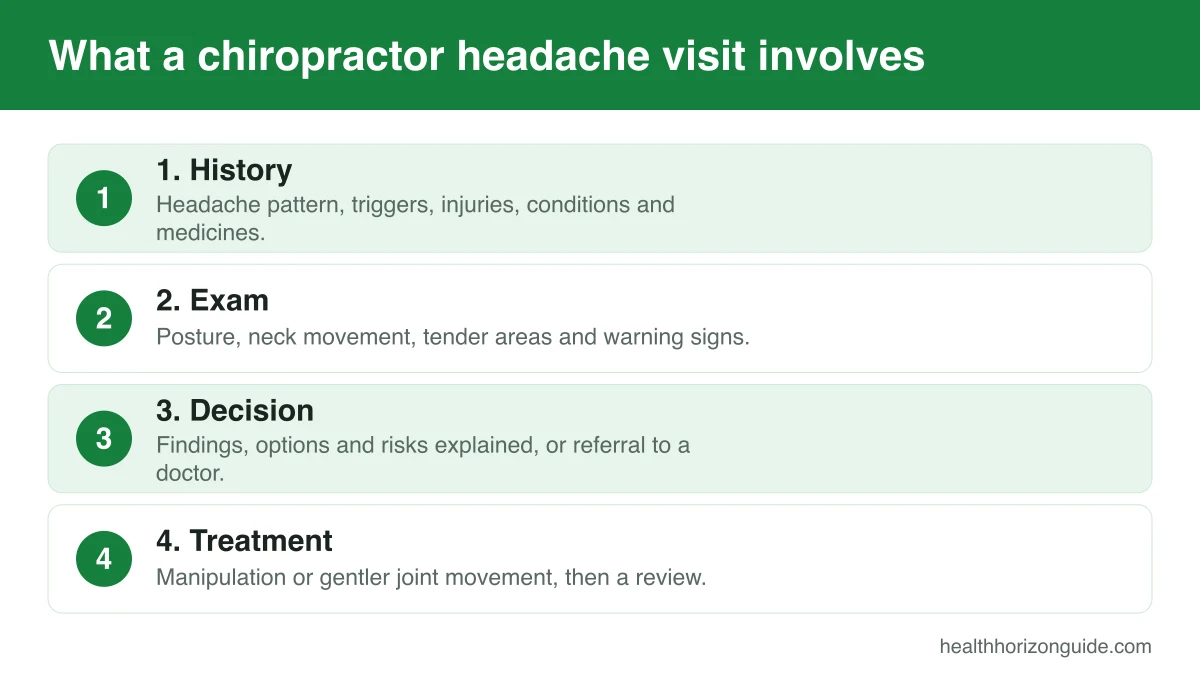
A chiropractor visit for headaches starts with a health history and a physical exam, and treatment follows only when the exam supports a neck source. The 4 usual stages of a first visit are listed below.
- History: the chiropractor asks about headache pattern, triggers, past injuries, health conditions and medicines.
- Exam: the chiropractor checks posture, neck movement and tender areas, and screens for warning signs.
- Decision: the chiropractor explains the findings, the options and the risks, or refers the person to a doctor.
- Treatment: care may include spinal manipulation or gentler joint movement, with a review of results over the following visits.
Readers should treat a clinic that promises a migraine cure, or that pushes a long prepaid plan, with caution. The research does not support either promise.
Headache care beyond the chiropractor
Headache care beyond the chiropractor includes medical treatment, urgent care for red flags and non-manual options. The sections below cover what a doctor offers, which symptoms need emergency help and which alternatives exist for neck-related headaches.
What medical treatments does a doctor offer for migraine?
A doctor offers medicines that stop a migraine attack and medicines that prevent attacks, and chiropractic care does not replace either group. Mayo Clinic explains that migraine diagnosis rests on medical history, symptoms and a physical and neurological exam. The 2 groups of established migraine treatments are listed below.
- Attack treatments: pain relievers, triptans, and gepants such as ubrogepant and rimegepant.
- Preventive treatments: beta blockers, certain antidepressants, antiseizure drugs, onabotulinumtoxinA injections and CGRP-blocking antibodies.
Preventive medicines suit people with frequent or disabling attacks. A doctor or pharmacist decides which medicine is safe for each person.
When is a headache an emergency?
A headache is an emergency when the pain is sudden and severe or arrives with neurological symptoms. No chiropractor should treat these headaches. Mayo Clinic lists headache warning signs that need emergency care. The 4 red flags below need an emergency department, not an appointment.
- A sudden, severe "thunderclap" headache that peaks within about a minute.
- A headache with fever and a stiff neck, a rash or confusion.
- A headache with new neurological symptoms, such as weakness, numbness, double vision, trouble speaking or a seizure.
- A headache that follows a head injury, fall or bump.
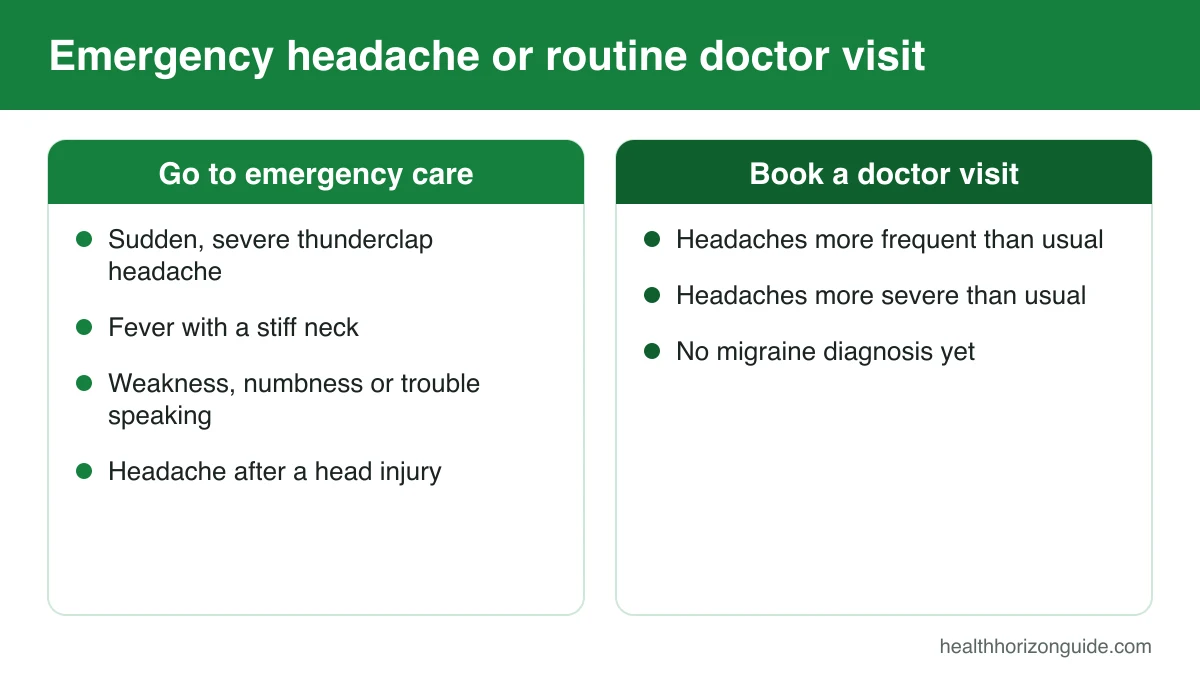
The same urgent response applies when severe neck pain, dizziness, vision changes or weakness appear following a neck adjustment. A routine doctor visit is the right step when headaches become more frequent or more severe than usual.
What are the alternatives to a chiropractor for neck-related headaches?
The alternatives to a chiropractor for neck-related headaches are physical therapy, posture changes and stress management. Cleveland Clinic lists physical therapy as a treatment for cervicogenic headache and reports one study in which 72% of people had at least 50% fewer headaches 12 months later. Our comparison of a chiropractor vs a physical therapist explains how the two professions differ.
Desk posture can strain the neck, so a guide to fixing forward head posture and our posture and back pain self-check are useful starting points. Stress is a shared trigger for tension headaches and migraine, and these simple stress relief tips cost nothing to try. NCCIH notes that evidence for relaxation techniques is limited, so expectations should stay modest.
Frequently asked questions about chiropractors and migraines
Can a chiropractor cure migraines?
A chiropractor cannot cure migraines. Research shows only a possible reduction in migraine days, and the reviewers called those results preliminary.
Can a chiropractor make migraines worse?
A chiropractor can trigger a temporary headache, which is a known side effect of spinal manipulation. Most side effects fade within 24 hours, and severe or unusual symptoms need urgent medical care.
Should I see a chiropractor or a doctor first for migraines?
A doctor should come first for migraines, and a chiropractor can be an add-on later. Migraine diagnosis needs a medical history and a neurological exam, and proven migraine medicines need a prescriber.
How many chiropractor sessions do headaches need?
No standard number of chiropractor sessions is established in the sources we reviewed. A fair approach is a short trial with a clear goal, and a stop when headaches do not improve.