Chiropractor for SI Joint Pain: Does It Help?
A chiropractor may ease SI joint pain for some people, but the evidence is limited. Learn the symptoms, tests, proven treatments and warning signs.
A chiropractor can help some people with SI joint pain, mainly through hands-on manipulation of the sacroiliac joint combined with exercise. Research supports a short-term benefit, but the certainty of that evidence is low, and a chiropractor cannot treat every cause of SI joint pain. A medical diagnosis comes first, since sciatica, hip problems and inflammatory arthritis can feel similar.
Action checklist
SI joint pain: steps before and after a chiropractor
Use these steps from the article to manage SI joint pain safely and to know when a doctor is needed.
0 of 10 done
In this article
- What is the sacroiliac joint and what does SI joint pain feel like?
- SI joint pain vs sciatica vs hip pain
- How is sacroiliac joint dysfunction diagnosed?
- Can a chiropractor help SI joint pain?
- What other treatments are used for SI joint pain?
- SI joint pain exercises and self-care
- SI joint pain during pregnancy
- When does SI joint pain need a doctor?
- Questions people ask about a chiropractor for SI joint pain
What is the sacroiliac joint and what does SI joint pain feel like?
The sacroiliac joint is the joint where the sacrum at the base of the spine meets the iliac bone of the pelvis, and SI joint pain is usually felt in the lower back and buttock on one side. The body has two SI joints, one on each side. Each joint connects the spine to the pelvis and normally moves very little, according to MedlinePlus. Sacroiliac joint dysfunction is the name doctors use when one of these joints becomes a source of pain.
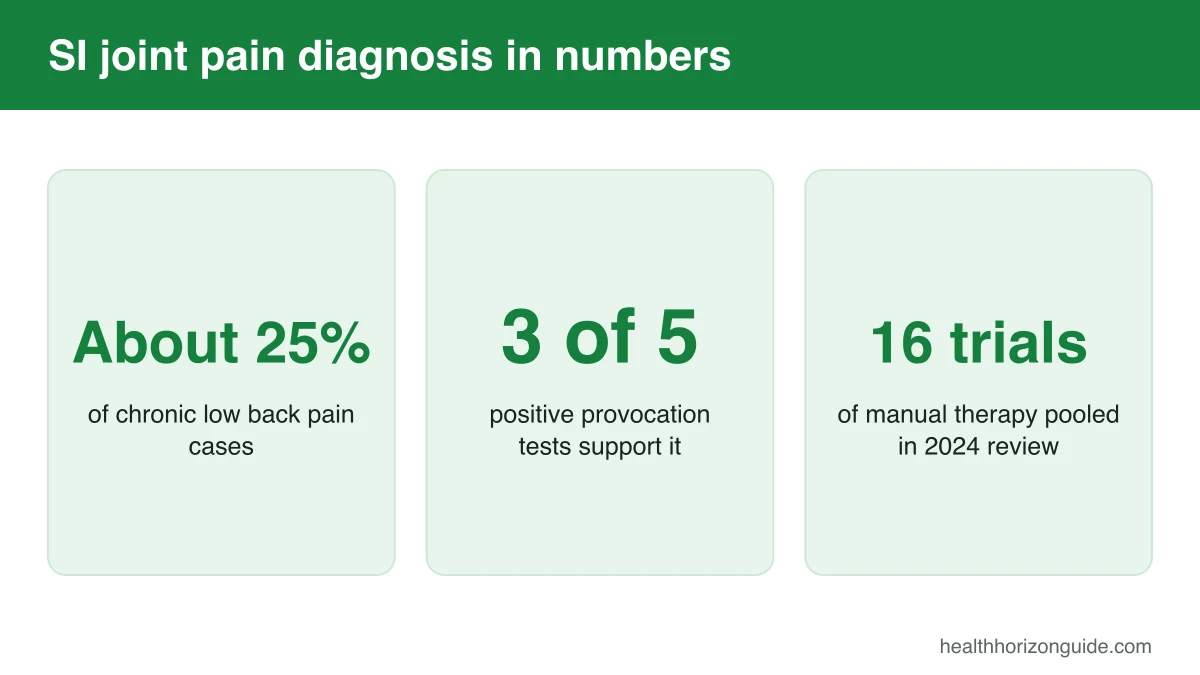
SI joint pain symptoms follow a recognisable pattern. The pain sits low in the back, usually to one side and not in the midline. Pain often spreads to the buttock, hip, groin or thigh. Climbing stairs, turning in bed, lying on the sore side and standing up after long sitting tend to make the pain worse, and lying down often eases the pain. A review in American Family Physician reports that SI joint dysfunction is present in about 25% of adults with chronic low back pain.
SI joint pain vs sciatica vs hip pain
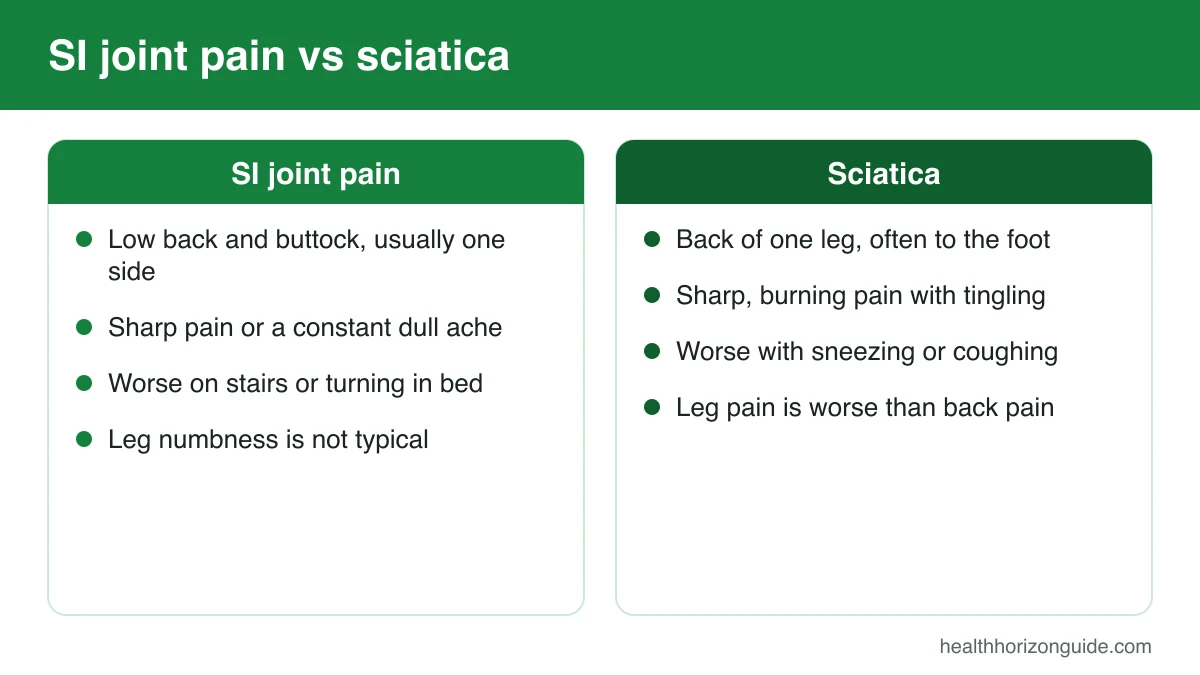
SI joint pain differs from sciatica and hip pain mainly in where the pain sits and whether the leg has nerve symptoms. SI joint pain centres on the low back and buttock. Sciatica travels down the back of one leg, often with tingling, numbness or weakness, and leg pain is usually worse than back pain. The NHS states that a person who has only back pain probably does not have sciatica.
The table below compares SI joint pain with sciatica and hip joint problems.
| Feature | SI joint pain | Sciatica | Hip joint problem |
|---|---|---|---|
| Where the pain is felt | Low back on one side and the buttock, sometimes the hip, groin or thigh | Bottom and back of one leg, often down to the foot and toes | Hip or buttock area |
| How the pain feels | Sharp pain or a constant dull ache | Sharp, burning pain with pins and needles | Pain with locking, clicking or snapping in the hip |
| Common triggers | Stairs, turning in bed, standing up after long sitting | Moving, sneezing or coughing | Activity or prolonged sitting |
| Numbness or weakness in the leg | Not typical, and a reason to see a doctor | Common | Not a listed feature |
How is sacroiliac joint dysfunction diagnosed?
Sacroiliac joint dysfunction is diagnosed with a physical examination that includes provocation tests, and a numbing injection can confirm the diagnosis when the cause stays unclear. Provocation tests stress the SI joint to see whether the familiar pain returns. American Family Physician describes 5 provocation tests: Gaenslen, thigh thrust, distraction, compression and sacral thrust. Three or more positive tests out of the 5 reasonably support SI joint pain as the diagnosis.
MRI, CT and bone scans do not reliably show the source of SI joint pain, although scans help rule out other conditions. An image-guided injection of local anaesthetic into the SI joint can confirm the joint as the pain source. The review suggests this diagnostic injection for people who have not improved with first-line care.
Can a chiropractor help SI joint pain?
A chiropractor can help SI joint pain in some cases, with a modest and mostly short-term benefit. Patient forums show both sides: some people report lasting relief, while others say the adjustment did not hold or the pain flared after a visit.
What does a chiropractor do for SI joint pain?
A chiropractor treats SI joint pain with spinal manipulation, a controlled thrust applied to the joint by hand or with a device. NCCIH notes that chiropractors perform most spinal manipulation, and that osteopathic physicians and physical therapists use the technique too. The examination that American Family Physician recommends before any SI joint treatment covers the hips, the spine and a check of reflexes, sensation and strength in the legs.
What does the evidence show for chiropractic care for SI joint pain?
The evidence shows a short-term benefit from manipulation for SI joint pain, with low certainty. American Family Physician lists manipulation, alone or with exercise, as a first-line option alongside physical therapy, based on limited-quality evidence. The same review states that manipulation combined with exercise gives longer-lasting results than exercise alone.
A 2024 systematic review pooled 16 randomized trials with 421 adults who had SI joint pain. Manual therapy did not reduce pain significantly more than exercise-based physiotherapy or sham treatment. Manual therapy did improve disability moderately. The authors rated the certainty as very low for pain and low for disability. These trials tested manual therapy in general, so the results are not specific to chiropractors. NCCIH describes a similar modest effect of manipulation for general lower back pain.
What are the risks and limits of a chiropractor for SI joint pain?
The main risks and limits are temporary soreness, an uncertain long-term effect and causes that manipulation cannot treat. NCCIH reports that increased pain, stiffness or headache often follow spinal manipulation, and most of these side effects resolve within 24 hours. Serious side effects are very rare, and the risk may be higher in people with underlying health problems. SI joint pain caused by inflammatory arthritis, infection or a fracture needs medical assessment and treatment first.
What other treatments are used for SI joint pain?
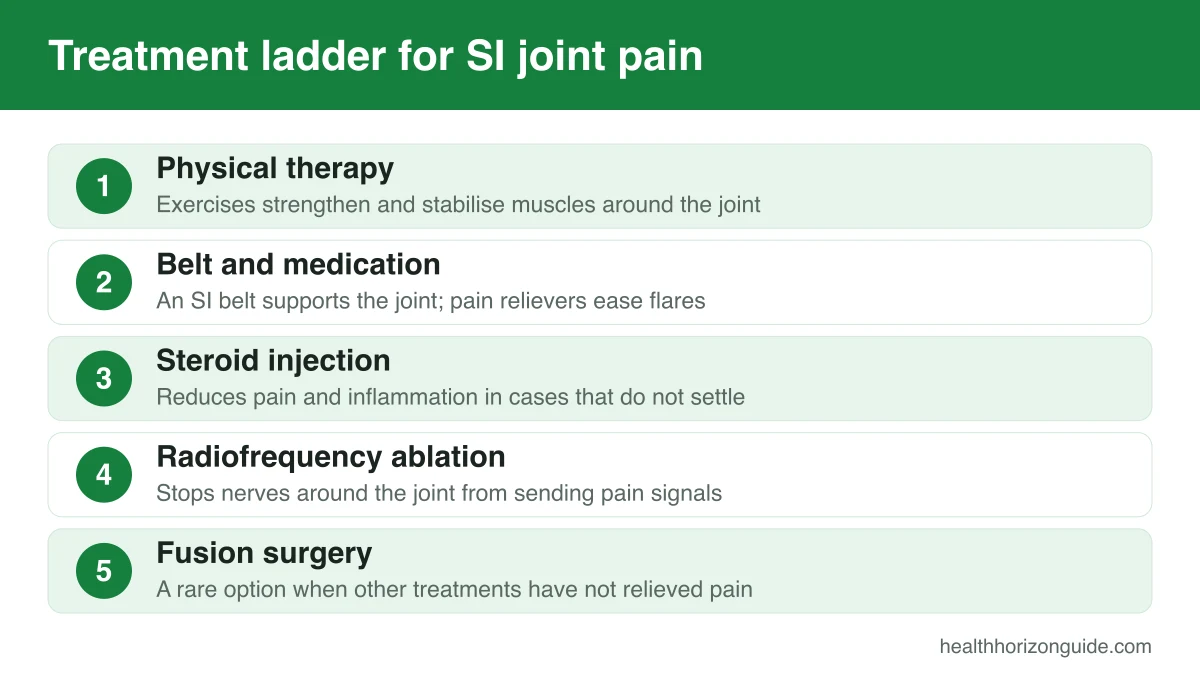
The established treatments for SI joint pain start with physical therapy and simple pain relief, and doctors move to injections or procedures only when those steps fail. Cleveland Clinic names physical therapy as the most common treatment, and our chiropractor vs physical therapist comparison explains the difference. The 6 established treatments are listed below in the order doctors usually consider them.
- Physical therapy: exercises strengthen and stabilise the muscles around the SI joint and improve range of motion.
- SI joint belt: a sacroiliac belt or brace supports the joint during activity.
- Medication: anti-inflammatory pain relievers are a usual first medicine, and a doctor or pharmacist can advise who should avoid them.
- Corticosteroid injection: a steroid injected into the SI joint reduces pain and inflammation in cases that do not settle.
- Radiofrequency ablation: a less common procedure stops nerves around the joint from sending pain signals.
- SI joint fusion surgery: a rare operation fastens the joint with screws when other treatments have not relieved the pain.
SI joint pain exercises and self-care
Self-care for SI joint pain consists of short rest from painful movements, ice or heat, and gentle exercise. MedlinePlus describes the 5 self-care steps listed below.
- Avoid the movements that make SI joint pain worse during a flare.
- Apply ice to the lower back or upper buttock for about 20 minutes, 2 to 3 times a day, never directly on the skin.
- Use a heating pad on a low setting to loosen tight muscles.
- Massage the lower back, buttocks and thighs.
- Ask a doctor or physical therapist which exercises suit the joint.
One SI joint pain exercise from MedlinePlus starts with lying on the back with knees bent, then slowly rotating the knees to each side and stopping at any pain. American Family Physician adds stretches for the hip flexor and piriformis muscles and strengthening for the abdominal, pelvic floor and gluteal muscles.
SI joint pain during pregnancy
SI joint pain during pregnancy is common and usually resolves after the birth. Cleveland Clinic explains that pregnancy hormones can cause the sacroiliac joints to widen and rotate. A pelvic belt may help stabilise the SI joint and reduce strain on the ligaments around pregnancy, according to American Family Physician. NCCIH notes that little rigorous research covers spinal manipulation in pregnancy, so a pregnant person should discuss the risks and benefits with a healthcare provider before seeing a chiropractor. Our guide to pelvic girdle pain in pregnancy gives more detail.
When does SI joint pain need a doctor?
SI joint pain needs a doctor when the pain comes with fever, nerve symptoms, bladder or bowel changes, or long morning stiffness. The 6 warning signs listed below call for a medical check before any chiropractor visit.
- Fever together with back or buttock pain.
- New trouble controlling the bladder or bowel.
- Numbness in the groin, around the genitals or around the anus.
- Weakness or numbness in the legs.
- Stiffness that lasts more than an hour every morning, which can point to inflammatory arthritis such as ankylosing spondylitis.
- Unexplained weight loss, night pain, a history of cancer or a recent injury.
The NHS treats loss of bladder or bowel control, numbness around the genitals or anus, and severe or worsening weakness in both legs as an emergency that needs hospital care straight away.
Questions people ask about a chiropractor for SI joint pain
Can a chiropractor make SI joint pain worse?
A chiropractor can make SI joint pain worse for a short time, since increased pain and stiffness often follow manipulation and usually settle within 24 hours. Pain that keeps rising or new numbness in the leg needs a doctor.
Is SI joint pain the same as sciatica or hip pain?
SI joint pain is not the same as sciatica or hip pain. Sciatica runs down the leg with nerve symptoms, and our guides to sciatica stretches and how a chiropractor treats hip pain cover those conditions.
Does an SI joint belt work?
An SI joint belt can support the joint during activity, according to MedlinePlus. American Family Physician does not grade the strength of the evidence for belts.
Why does an SI joint adjustment not hold?
An SI joint adjustment may not hold because the benefit of manipulation alone is short-term. American Family Physician reports longer-lasting results for SI joint pain when manipulation is combined with exercise.