How to Fix Rounded Shoulders: Exercises, Causes and Timeline
Learn how to fix rounded shoulders with a 6-step exercise routine, desk and phone habits, what research shows, and the symptoms that need a doctor.
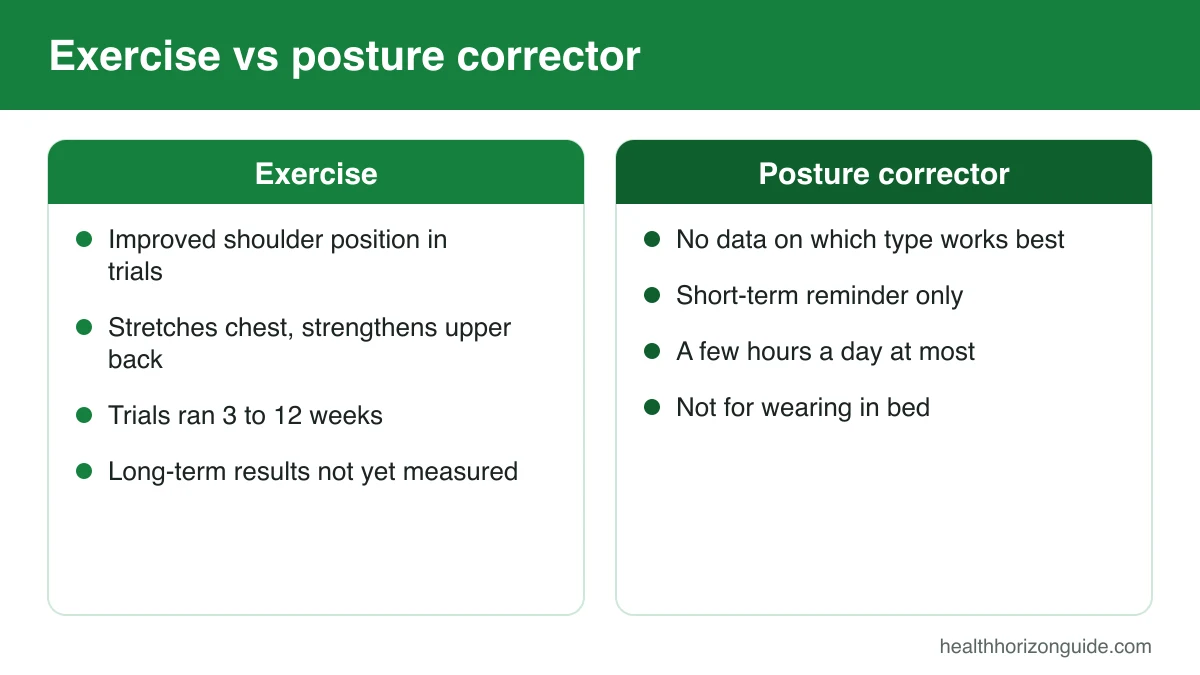
To fix rounded shoulders, stretch the tight chest muscles, strengthen the upper back muscles and change the sitting and phone habits that pull the shoulders forward. Reviews of clinical trials report that corrective exercise improves shoulder position, and the trials ran for 3 to 12 weeks. A posture corrector alone does not fix rounded shoulders.
Action checklist
Rounded shoulders action checklist
Use these steps from the article to work on rounded shoulders safely.
0 of 10 done
In this article
- What are rounded shoulders?
- What causes rounded shoulders?
- Rounded shoulders exercises: a 6-step routine
- Does exercise fix rounded shoulders? What the research says
- How long does it take to fix rounded shoulders?
- Daily habits that support a rounded shoulders fix
- Do posture correctors work for rounded shoulders?
- Upper crossed syndrome and rounded shoulders
- When do rounded shoulders need a doctor?
- Rounded shoulders: frequently asked questions
What are rounded shoulders?
Rounded shoulders are a resting shoulder position that sits forward of the body's ideal alignment. Medical News Today describes rounded shoulders as one part of poor posture that can get worse when nothing changes. People often describe the same posture as shoulders rolled forward, slouching or hunching. Rounded shoulders can add stress to the shoulder joints and lead to pain around the neck and upper back, according to the same source.
Rounded shoulders self-check
A rounded shoulders self-check is a standing hand-position test that physical therapists use. Stand naturally with the arms relaxed at the sides. Hands that face backward, with the thumbs pointing toward each other, suggest rounded shoulders. Hands that face the body, with the thumbs pointing ahead, match good shoulder posture. A second check from Cleveland Clinic is to stand with the head, shoulder blades, hips and backs of the legs against a wall and notice how hard that position is to hold. Our posture and back pain self-check tool gives a wider picture of posture than a single rounded shoulders test.
What causes rounded shoulders?
Rounded shoulders are caused by long periods spent looking down and forward. The activities named by Medical News Today include computer and laptop work, smartphone and tablet use, long sitting, driving and repeated bending or carrying. Cleveland Clinic explains the muscle side of the problem: a head held forward strains the muscles at the back of the neck, the chest muscles tighten, and the shoulders round forward. The upper back muscles that pull the shoulder blades together become weak in the same pattern. Familiarity keeps rounded shoulders in place, since the body treats the slumped position as normal once the habit is old.
Rounded shoulders exercises: a 6-step routine
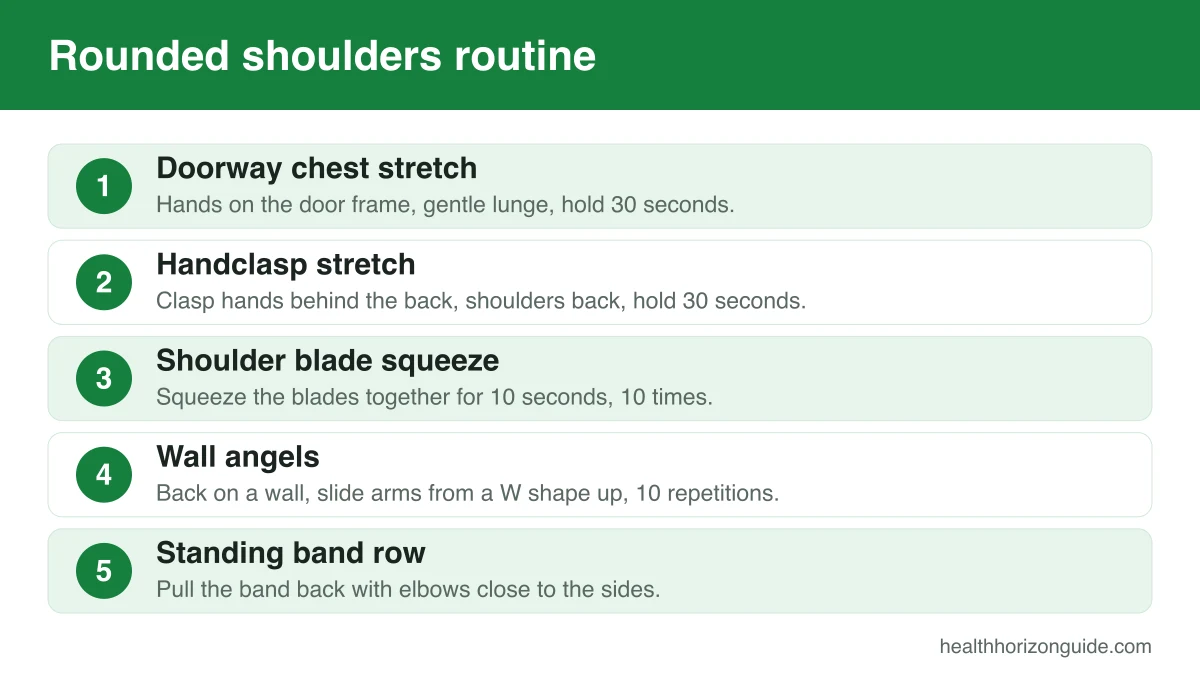
Rounded shoulders exercises work by stretching the chest and strengthening the muscles between the shoulder blades. Medical News Today suggests 20 to 30 minutes of posture exercise a day on at least 2 days a week. The 6 steps of the rounded shoulders routine below use only the holds and repetitions that the cited sources give.
- Doorway chest stretch: place one hand on each side of a door frame, step one foot forward into a gentle lunge and hold for 30 seconds.
- Handclasp stretch: clasp the hands behind the back and pull the shoulders back without pushing the neck forward, then hold for 30 seconds.
- Shoulder blade squeeze: sit tall, squeeze the shoulder blades together as though holding a tennis ball between them, hold for 10 seconds and repeat 10 times.
- Wall angels: stand with the back against a wall, slide the arms from a W shape up toward the ceiling and back down, and complete 10 repetitions.
- Standing band row: anchor a resistance band to a doorknob, squeeze the shoulder blades and draw the band back with the elbows close to the sides. One trial of band exercises for the shoulder blade muscles used 3 sets of 10 repetitions on 3 days a week.
- Lying T stretch: lie on the back with the knees bent, feet flat and arms out to the sides with the palms up, and rest there for up to 10 minutes.
Stop any rounded shoulders exercise that causes pain and contact a doctor or physical therapist. Slow, unforced movement matters more than range, and Medical News Today advises against rushing or forcing a position.
Does exercise fix rounded shoulders? What the research says
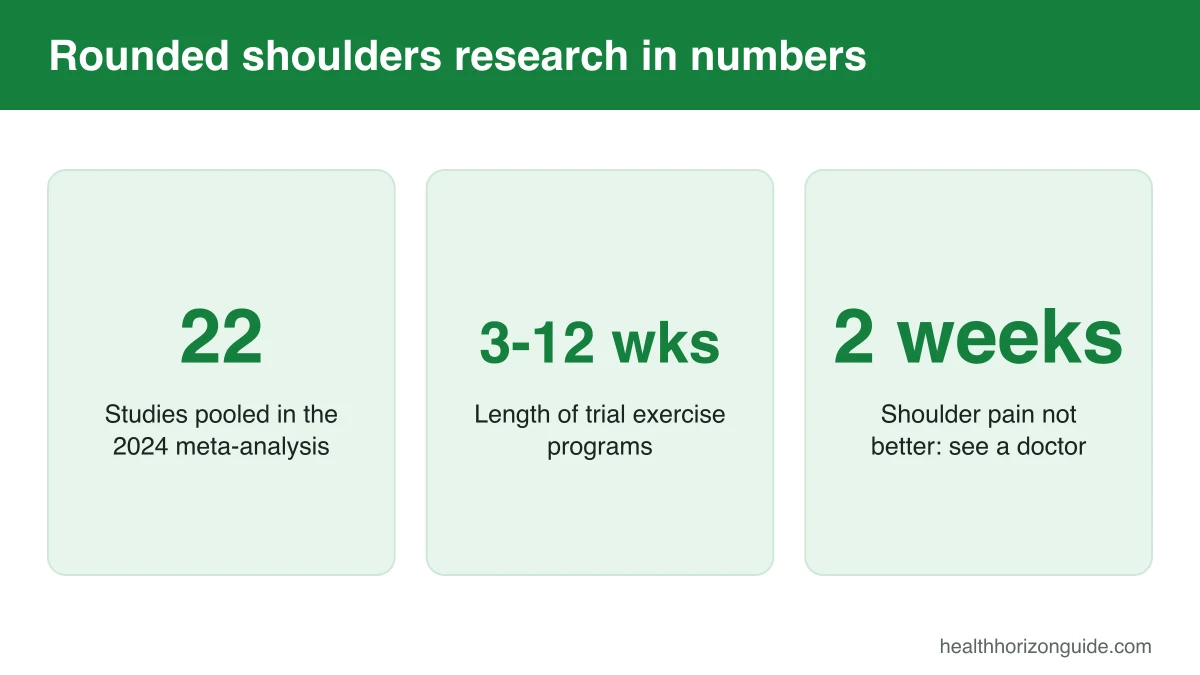
Exercise improves rounded shoulders in clinical trials, with evidence of limited certainty. A 2024 systematic review and meta-analysis pooled 22 studies of people with upper crossed syndrome and found that therapeutic exercise improved forward head posture, rounded shoulders and upper back curvature. The programs combined strength exercise, stretching and shoulder-focused exercise. A 2023 narrative systematic review of 11 studies reached a similar conclusion for pain, neck disability and posture.
The limits of the rounded shoulders research are real. The 2024 authors reported large differences between study results, signs of publication bias and very little long-term follow-up. Nobody knows from the current trials how long the improvement in rounded shoulders lasts once the exercise stops. The findings support exercise as a reasonable first step, not a guaranteed cure.
How long does it take to fix rounded shoulders?
Fixing rounded shoulders takes weeks to months of regular practice, with no fixed timeline in the research. The table below shows what each source reports about time and rounded shoulders.
| Source | What the source reports |
|---|---|
| 2023 review of 11 studies | Exercise programs lasted 3 to 12 weeks, often with 3 sessions a week for 4 or 8 weeks |
| 2024 meta-analysis of 22 studies | Only programs of 3 weeks or longer were included, and long-term results were not measured |
| NHS shoulder pain guidance | Shoulder exercises continue for 6 to 8 weeks to help stop pain returning |
| Cleveland Clinic | Posture change takes practice and diligence, with no number of weeks given |
Forum posts on rounded shoulders show the same spread. Some people notice a change within weeks, and others report months of effort with little visible difference. Years of slouching, daily desk hours and how often the routine is done all affect the result.
Daily habits that support a rounded shoulders fix
Daily habits decide whether rounded shoulders exercises hold, because posture is a habit that fills far more hours than a routine does. Medical News Today states that exercises alone are not enough and that good posture must be kept up through the day.
Rounded shoulders at a desk
Rounded shoulders at a desk improve with a setup that keeps the shoulders lowered. Cleveland Clinic advises feet flat on the floor, a monitor at eye level, and a keyboard and mouse at a height that lets the shoulders stay down. A timer set for every 10 minutes or so works as a reminder to check posture. Our guide to fixing posture while sitting at a desk covers the full setup.
Rounded shoulders and phone use
Rounded shoulders and phone use are linked through the head-down position often called text neck. Cleveland Clinic recommends limiting the time spent looking down at a phone. The head follows the eyes forward and the shoulders follow the head, which is why forward head posture and rounded shoulders usually appear together.
Do posture correctors work for rounded shoulders?
Posture correctors for rounded shoulders work as a short-term reminder, not as a fix. The Hospital for Special Surgery states that no data shows which type of corrector works best. HSS compares a corrector to training wheels, advises a limit of a few hours a day and warns against wearing one to bed. Wearing a corrector too long may leave the body reliant on the device. Cleveland Clinic discourages passive shoulder harnesses because the benefit stops when the harness comes off. Devices that buzz or vibrate as a reminder have helped some people learn what upright posture feels like.
Upper crossed syndrome and rounded shoulders
Upper crossed syndrome is a muscle imbalance pattern that includes rounded shoulders. The 2023 review defines upper crossed syndrome as tightness and weakness in the muscles of the neck, shoulders and upper back. Researchers group rounded shoulders, forward head posture and an increased upper back curve under the same label. Neck ache often travels with the pattern, and our article on care options for neck pain explains that side of the problem.
When do rounded shoulders need a doctor?
Rounded shoulders need a doctor when arm or shoulder symptoms go beyond stiffness and mild ache. The NHS advises a routine appointment for shoulder pain that is getting worse, has not improved after 2 weeks or makes the arm very difficult to move. The NHS does not list night pain separately, so the 2-week rule applies to shoulder pain at night too. The 7 symptoms below need an urgent appointment according to the NHS.
- Pins and needles that do not go away.
- Loss of feeling in the arm or shoulder.
- Pain that started after an injury or fall.
- Sudden or very bad shoulder pain.
- An arm that cannot be moved.
- A shoulder or arm that has changed shape or is badly swollen.
- Fever or feeling generally unwell with shoulder pain.
Rounded shoulders with pain that exercise does not help deserve an assessment from a primary care doctor or physical therapist, as Cleveland Clinic recommends. Our page on shoulder pain care describes what an assessment can involve.
Rounded shoulders: frequently asked questions
What is the best sleeping position for rounded shoulders?
No sleeping position is shown by the sources we reviewed to fix rounded shoulders. Medical News Today suggests the lying T stretch just before sleep or after waking, and HSS advises against wearing a posture corrector in bed.
How often should rounded shoulders exercises be done?
Rounded shoulders exercises are done at least 2 days a week in the Medical News Today guidance, for 20 to 30 minutes a day. Most trials in the 2023 review used 3 sessions a week.
Can rounded shoulders be fixed with stretching alone?
Rounded shoulders are unlikely to change with stretching alone. The reviewed trials combined stretching with strengthening, and the sources stress daily posture habits alongside both.
Is fixing rounded shoulders permanent?
A permanent fix for rounded shoulders is not proven by current research. The 2024 meta-analysis found that most studies did not measure long-term results, so continued practice is the cautious assumption.