Mediterranean Diet vs Nut-Free Diet: Can You Skip Nuts?
Mediterranean diet vs nut-free diet: learn the role nuts play, whether the diet is safe with a nut allergy, and which seeds and swaps replace nuts.
Yes, you can follow the Mediterranean diet without nuts. The Mediterranean diet is a whole eating pattern, while a nut-free diet removes one food group, and the PREDIMED trial tested about 30 grams of mixed nuts a day as one part of that pattern. Olive oil, beans, fish and, for many people, seeds supply the same healthy fats, fibre and protein that nuts provide.
Action checklist
Nut-free Mediterranean diet checklist
Use these steps to follow the Mediterranean diet safely without nuts.
0 of 9 done
In this article
- What is the difference between the Mediterranean diet and a nut-free diet?
- What role do nuts play in the Mediterranean diet?
- Can you follow the Mediterranean diet without nuts?
- Is the Mediterranean diet safe with a nut allergy?
- Which seeds replace nuts on a nut-free Mediterranean diet?
- Nutrients to replace on a nut-free Mediterranean diet
- Living nut-free on the Mediterranean diet day to day
- Which is better for heart health, the Mediterranean diet or a nut-free diet?
- When to see a doctor about a nut allergy
- Mediterranean diet vs nut-free diet FAQ
What is the difference between the Mediterranean diet and a nut-free diet?
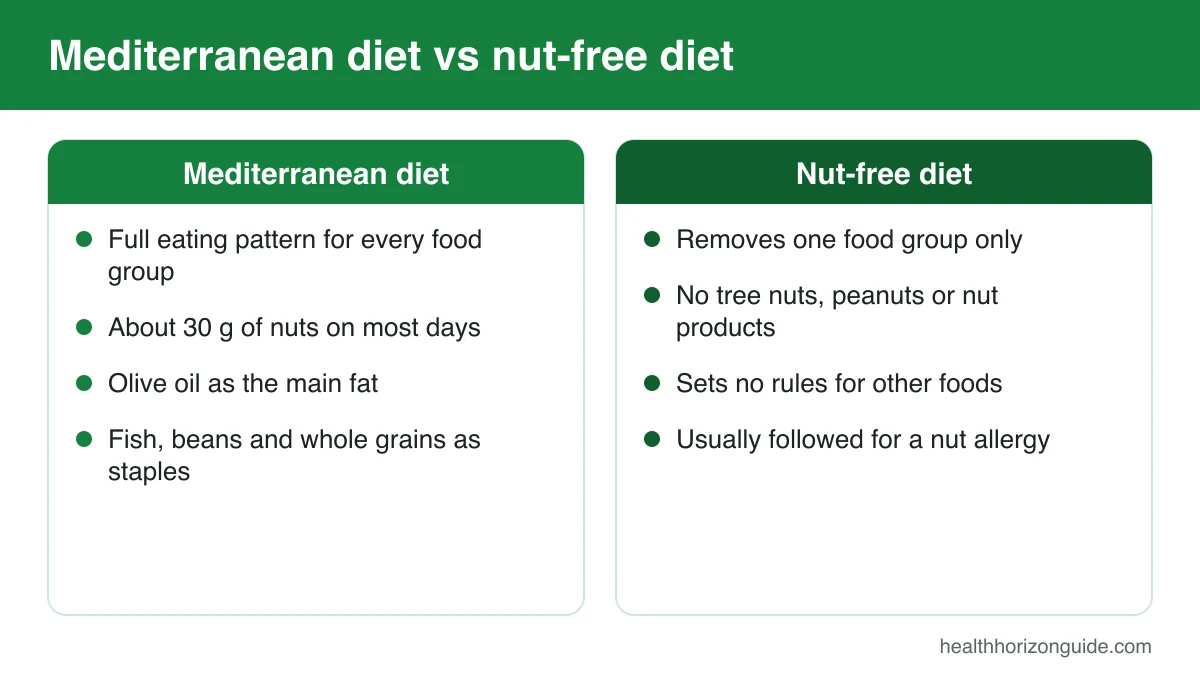
The difference between the Mediterranean diet and a nut-free diet is that one is a full eating pattern and the other is a single exclusion. The Mediterranean diet sets guidance for every food group. A nut-free diet names only the foods to leave out and sets no rules for the rest.
Most people follow a nut-free diet because of a tree nut or peanut allergy. Our Mediterranean diet food list shows the full range of foods the pattern covers.
Foods on the Mediterranean diet and a nut-free diet
Foods on the Mediterranean diet and a nut-free diet overlap in every group except nuts and nut products. The table below compares the Mediterranean diet and a nut-free diet across 7 food groups.
| Food group | Mediterranean diet | Nut-free diet |
|---|---|---|
| Vegetables and fruit | Eaten as the base of the diet | Allowed, with no rule set |
| Beans, lentils and chickpeas | Eaten as staples | Allowed, with peanut avoided when peanut is the allergy |
| Whole grains | Eaten as staples | Allowed, with labels checked for nut cross-contact |
| Tree nuts and peanuts | Eaten most days in small portions | Excluded |
| Seeds | Included | Often allowed, depending on the person's allergy |
| Fish and seafood | Eaten regularly | Allowed, with no rule set |
| Main fat | Olive oil | Olive oil and other nut-free oils |
What role do nuts play in the Mediterranean diet?
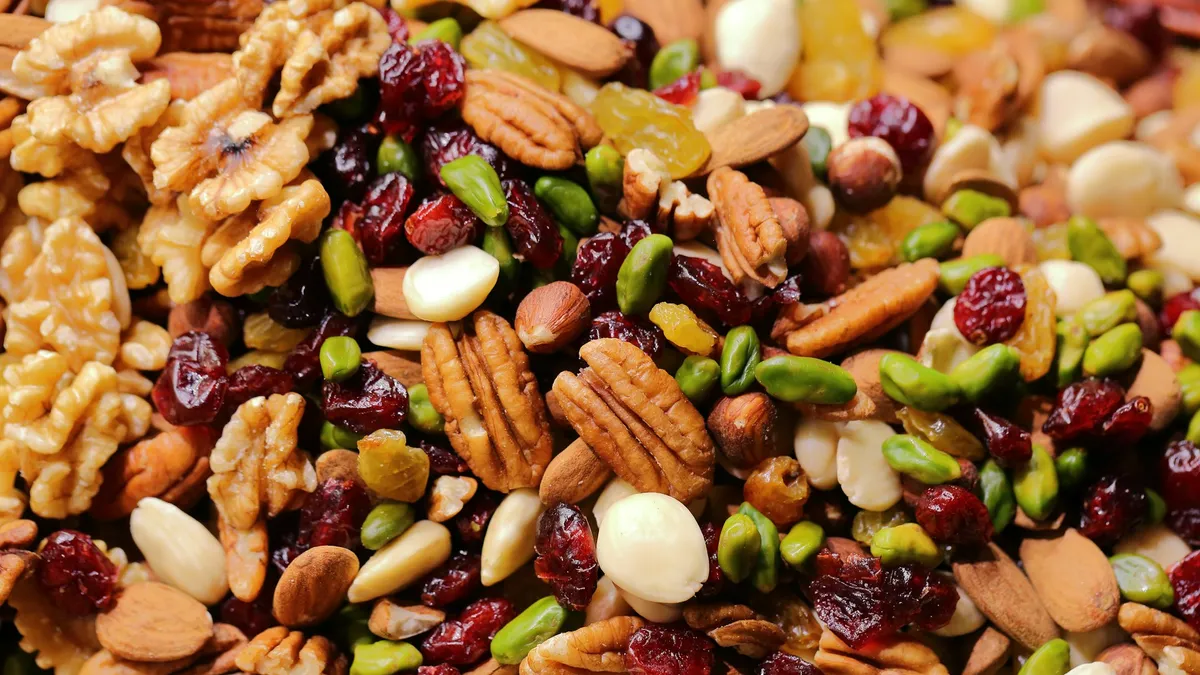
Nuts play the role of a daily source of unsaturated fat, fibre and plant protein in the Mediterranean diet. The Better Health Channel reports that the Australian Dietary Guidelines recommend about 30 grams of nuts on most days for adults. That amount is roughly one handful.
What the PREDIMED nut arm tested
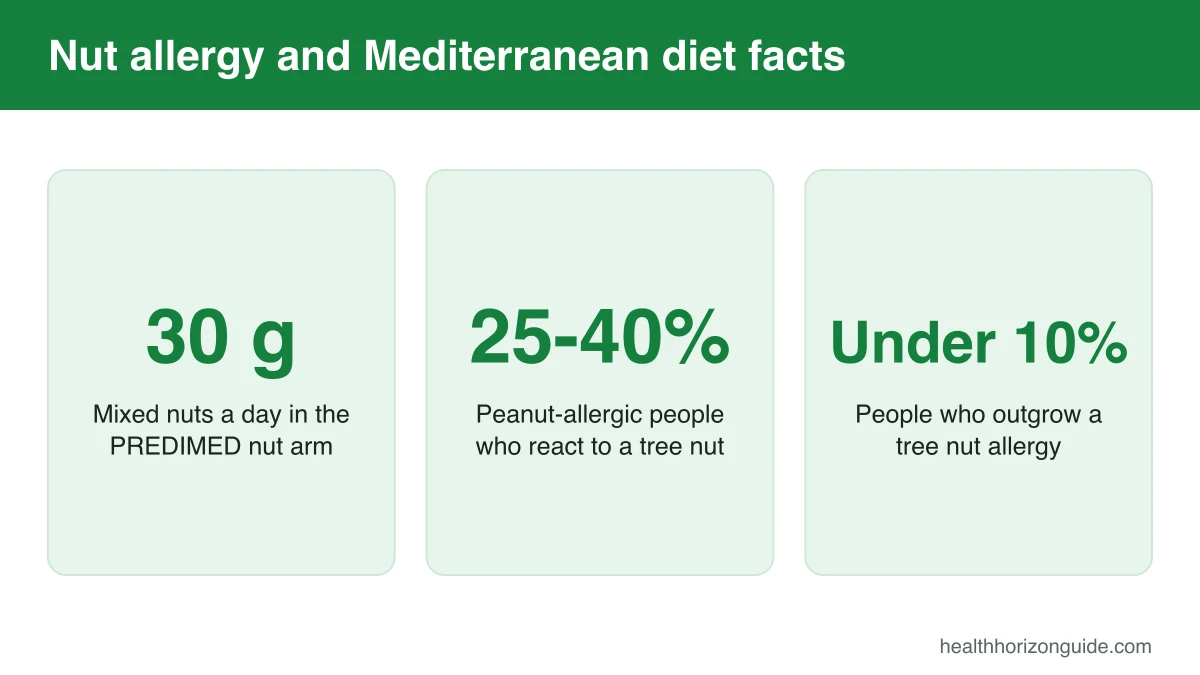
The PREDIMED nut arm tested a Mediterranean diet supplemented with 30 grams of mixed nuts a day. The American Academy of Family Physicians describes the daily mix as 15 grams of walnuts, 7.5 grams of hazelnuts and 7.5 grams of almonds. Every nut in that mix is a tree nut.
PREDIMED enrolled 7,447 adults at high cardiovascular risk in Spain. The trial was retracted and republished in 2018 over randomisation problems. Harvard's Nutrition Source reports that both Mediterranean groups still had roughly 30% fewer cardiovascular events than the low-fat control group.
Can you follow the Mediterranean diet without nuts?
Yes, you can follow the Mediterranean diet without nuts, because nuts are one food among many in the pattern. Vegetables, fruit, beans, whole grains, fish and olive oil make up most of the Mediterranean diet, and none of them is a nut.
The PREDIMED olive oil group, which received no extra nuts, showed a heart benefit similar to the nut group.
Is the Mediterranean diet safe with a nut allergy?
Yes, the Mediterranean diet is safe with a nut allergy once nuts, nut products and cross-contact risks are removed.
The American College of Allergy, Asthma and Immunology (ACAAI) reports that fewer than 10% of people with a tree nut allergy outgrow it.
Tree nut allergy vs peanut allergy on the Mediterranean diet
Tree nut allergy and peanut allergy differ because peanuts are legumes and tree nuts grow on trees. Almonds, walnuts, hazelnuts, cashews and pistachios are tree nuts. Peanuts belong to the same plant family as beans and lentils.
ACAAI reports that 25 to 40% of people with a peanut allergy also react to at least one tree nut. Allergists often advise avoiding both groups because of cross-contact in food factories. The safe list of legumes for each person comes from an allergist.
Which seeds replace nuts on a nut-free Mediterranean diet?
The seeds that replace nuts on a nut-free Mediterranean diet are mainly sunflower, pumpkin and sesame seeds. The Better Health Channel notes that seeds have a nutrient profile comparable to nuts and can be used as a nut replacement. Seeds can also trigger severe allergic reactions.
The 3 most common seed swaps on a nut-free Mediterranean diet are listed below.
- Sunflower seeds: a rich source of vitamin E, and sunflower seed butter works in place of nut butter.
- Pumpkin seeds: a crunchy topping for salads, grain bowls and yogurt.
- Sesame seeds and tahini: a traditional Mediterranean ingredient in hummus and dressings, and a major allergen in its own right.
The US Food and Drug Administration made sesame the ninth major food allergen under the FASTER Act, with labelling required from 1 January 2023. People with a nut allergy should check with an allergist before adding sesame, since some people react to both.
Nut-free swaps for Mediterranean diet meals
Nut-free swaps for Mediterranean diet meals keep the texture and fat of a dish while removing the nuts. The table below lists 6 common nut uses and a nut-free Mediterranean diet replacement for each.
| Nut use | Nut-free Mediterranean replacement |
|---|---|
| Handful of nuts as a snack | Roasted chickpeas or sunflower seeds |
| Almond butter on toast | Sunflower seed butter |
| Walnuts on salads | Pumpkin seeds or olives |
| Pine nut pesto | Basil, olive oil and sunflower seeds |
| Almond flour in baking | Oat flour or whole wheat flour |
| Almond drink | Unsweetened, fortified oat or soy drink |
Nutrients to replace on a nut-free Mediterranean diet
The nutrients to replace on a nut-free Mediterranean diet are healthy fats, vitamin E, magnesium, fibre and protein. The Better Health Channel lists all 5 as nutrients that nuts supply. The 5 nutrients and their nut-free Mediterranean diet sources are listed below.
- Healthy fats: extra-virgin olive oil, avocado, oily fish and seeds.
- Vitamin E: sunflower seeds, olive oil and leafy green vegetables.
- Magnesium: pumpkin seeds, beans, whole grains and leafy greens.
- Fibre: beans, lentils, whole grains, vegetables and fruit.
- Protein: fish, beans, lentils, chickpeas, eggs and yogurt.
Sunflower seeds match almonds closely for vitamin E. The NIH Office of Dietary Supplements lists 7.4 milligrams of vitamin E in 1 ounce of dry roasted sunflower seeds, against 6.8 milligrams in 1 ounce of dry roasted almonds.
Seeds and nuts are both high in fat, so portions still matter. Our daily calorie calculator estimates a calorie target for a nut-free Mediterranean diet.
Living nut-free on the Mediterranean diet day to day
Living nut-free on the Mediterranean diet day to day depends on labels, kitchen habits and clear communication. The extra work comes from hidden nuts and shared equipment.
Label reading becomes part of every shop and every meal out for a parent, partner or carer of someone with a nut allergy.
Cross-contact and food labels
Cross-contact and food labels matter because nut protein can reach foods through shared equipment. ACAAI explains that US law requires tree nuts to be named on ingredient lists. Statements such as "may be made in a facility" with nuts are voluntary, so the absence of a warning does not prove a product is nut-free.
The 4 label checks for a nut-free Mediterranean diet are listed below.
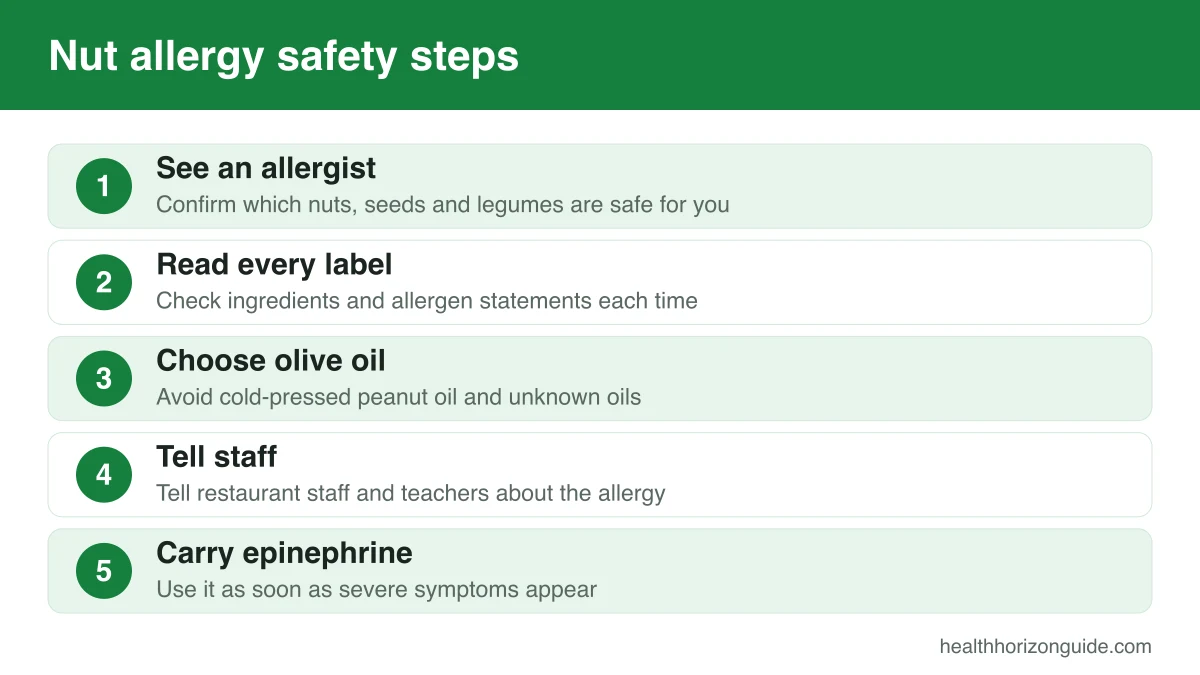
- Read the ingredient list and allergen statement on every product.
- Check seed mixes, granola, pesto, baked goods and Middle Eastern sweets for hidden nuts.
- Contact the manufacturer when a label lists natural flavours or botanicals.
- Tell restaurant staff about the allergy before ordering.
Families managing several allergies face the same label work. Our guides to the Mediterranean diet without eggs and the Mediterranean diet without dairy cover those exclusions.
Cooking oils on a nut-free Mediterranean diet
Cooking oils on a nut-free Mediterranean diet start with olive oil, which contains no nut protein. Peanut oil needs more care. Ohio State University Wexner Medical Center reports that most people with a peanut allergy tolerate highly refined peanut oil, because refining removes nearly all the allergen protein.
Cold-pressed, crude or gourmet peanut oil still contains peanut protein and should be avoided by people with a peanut allergy. Ohio State notes that the FDA exempts highly refined peanut oil from allergen labelling, so the type of oil is not always clear. Choose olive oil when the type of oil is unknown.
Which is better for heart health, the Mediterranean diet or a nut-free diet?
The Mediterranean diet is better for heart health than a nut-free diet on its own, because a nut-free diet sets no rules for the rest of the plate. Research shows moderate evidence, led by PREDIMED, that the Mediterranean pattern lowers cardiovascular events in high-risk adults.
The best choice for someone with a nut allergy is both diets together. Other exclusion-based diets, such as the paleo diet compared with the Mediterranean diet, cut more food groups than a nut-free plan does.
Nut-free Mediterranean diet for children and schools
A nut-free Mediterranean diet for children works well at home and in nut-free schools. Hummus with vegetables, fruit and sunflower seed butter suit most nut-free lunchboxes. ACAAI advises that teachers and caregivers know about a child's allergy and how to use the prescribed epinephrine auto-injector.
When to see a doctor about a nut allergy
See a doctor about a nut allergy when you suspect an allergy, before adding seeds or peanut oil, and after any reaction. An allergist can test which foods are safe for you.
Anaphylaxis is a medical emergency. ACAAI lists shortness of breath, difficulty swallowing and swelling among the serious symptoms of tree nut allergy. Use the prescribed epinephrine as soon as severe symptoms appear, then call emergency services.
Mediterranean diet vs nut-free diet FAQ
Is coconut allowed on a nut-free Mediterranean diet?
Coconut is allowed on a nut-free Mediterranean diet for most people with a tree nut allergy, according to ACAAI. Coconut is botanically a fruit, though reactions have been reported, so check with an allergist first.
Are pine nuts safe on a nut-free Mediterranean diet?
Pine nuts are not automatically safe on a nut-free Mediterranean diet. ACAAI lists pine nut among the tree nuts, so avoid pine nuts unless an allergist confirms they are safe.