Mediterranean Diet vs Paleo Diet: Which Is Better?
Mediterranean diet vs paleo diet: compare foods, rankings, weight loss, blood sugar, heart health, calcium, fiber and cost, and learn who should avoid paleo.
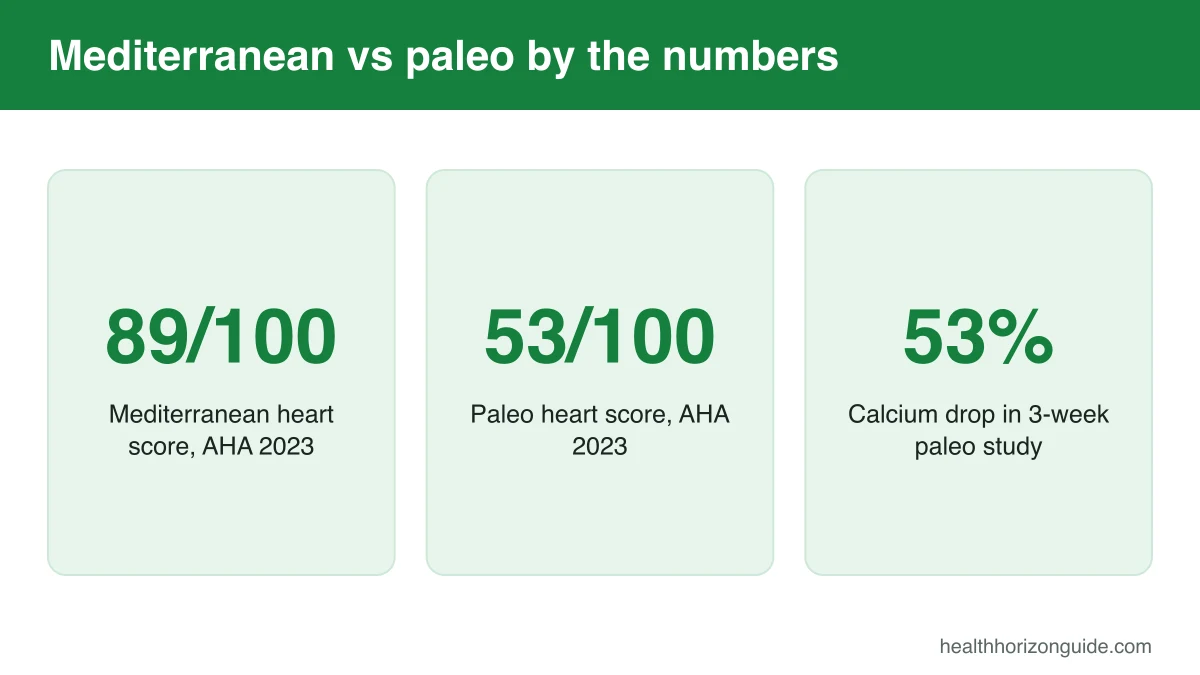
The Mediterranean diet is the better-supported choice for most people, while the paleo diet shows benefits mainly in small, short-term trials. The American Heart Association scored the Mediterranean diet 89 out of 100 for heart-healthy eating in 2023 and the paleo diet 53. The biggest difference is that paleo removes grains, legumes and dairy, which the Mediterranean diet keeps.
Action checklist
Choosing between Mediterranean and paleo
Use these steps from the article to pick and plan a Mediterranean or paleo style of eating.
0 of 8 done
In this article
- What is the difference between the Mediterranean diet and paleo diet?
- What is the paleo diet?
- Mediterranean diet vs paleo diet: which is better?
- Mediterranean diet vs paleo for weight loss
- Mediterranean diet vs paleo for blood sugar
- Mediterranean diet vs paleo for heart health and cholesterol
- Calcium and fiber concerns on paleo without dairy and grains
- Is the paleo diet more expensive than the Mediterranean diet?
- Which diet is easier to stick with long term?
- Can you combine the Mediterranean and paleo diets?
- Who should avoid a strict paleo diet?
- When to see a dietitian about the Mediterranean or paleo diet
- Mediterranean diet vs paleo FAQ
What is the difference between the Mediterranean diet and paleo diet?
The difference between the Mediterranean diet and paleo diet is whether grains, legumes and dairy are allowed. The Mediterranean diet encourages whole grains and legumes and allows moderate dairy. The paleo diet excludes all three food groups.
Both diets favor fish, vegetables, fruit, nuts, seeds and minimally processed foods. Neither diet requires counting calories or tracking portions, according to a Healthline comparison.
Mediterranean diet vs paleo food list
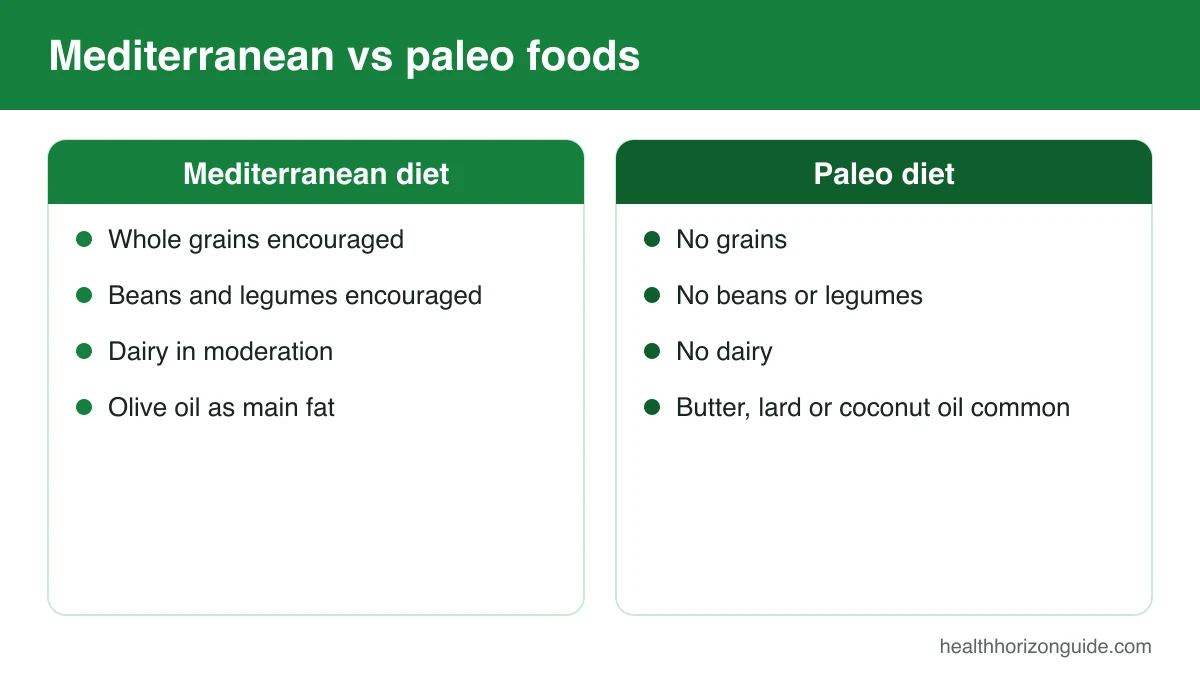
The Mediterranean diet and paleo food lists overlap on produce, fish and nuts, and split on grains, legumes, dairy and cooking fats. The table below compares the Mediterranean diet and the paleo diet across 8 food groups.
| Food group | Mediterranean diet | Paleo diet |
|---|---|---|
| Whole grains | Encouraged | Excluded |
| Beans and legumes | Encouraged | Excluded |
| Dairy | Allowed in moderation | Excluded |
| Vegetables and fruit | Eaten daily | Eaten daily, with white potatoes usually excluded |
| Fish | Encouraged | Encouraged |
| Meat | Red meat limited | Lean meats central |
| Main fats | Olive oil | Butter, lard and coconut oil are common |
| Refined sugar and processed food | Limited | Avoided |
Our Mediterranean diet food list covers each Mediterranean food group in more detail.
What is the paleo diet?
The paleo diet is an eating pattern that tries to mirror what humans ate in the Stone Age. The Harvard T.H. Chan School of Public Health describes paleo as high in protein, moderate in mostly unsaturated fat and low to moderate in carbohydrate.
Paleo supporters argue that human genes and anatomy have changed little since the Paleolithic era.
Critiques of the paleo diet premise
Critiques of the paleo diet premise focus on what Stone Age people really ate and how long they lived. Harvard notes that early humans had a life expectancy of only a fraction of today's. Ancestral diets also varied widely between tropical and Arctic regions.
Modern paleo foods differ from their wild versions, and enthusiasts disagree on the rules. Healthline reports that one 2018 review found 14 different definitions of the paleo diet. The Mediterranean diet, by contrast, rests on traditional eating in Greece, Italy and Spain.
Mediterranean diet vs paleo diet: which is better?
The Mediterranean diet is better than the paleo diet for overall health in most rankings and reviews. The American Heart Association placed the Mediterranean diet in its top tier in 2023 and the paleo diet in its fourth, bottom tier.
The heart association stated that paleo diets are high in fat without limiting saturated fat. U.S. News & World Report rated the Mediterranean diet 4.8 out of 5 as its top overall diet in its 2025 edition, according to WebMD.
The 4 main differences in results between the Mediterranean diet and paleo diet are listed below.
- Weight loss: paleo produced greater short-term fat loss in one trial, with no lasting advantage at 2 years.
- Blood sugar: the Mediterranean diet lowered fasting glucose and A1c more reliably than paleo.
- Heart health: the Mediterranean diet has long-term outcome data, while paleo data are short-term.
- Nutrients: paleo carries a risk of low calcium, vitamin D and fiber intake.
Mediterranean diet vs paleo for weight loss
Neither the Mediterranean diet nor the paleo diet is proven better for long-term weight loss. Harvard reports that randomized trials of paleo lasted 6 months or less and had fewer than 40 participants each.
The largest paleo trial followed 70 postmenopausal Swedish women with obesity for 2 years. The paleo group lost more fat at 6 months than a Nordic guideline diet group. The difference was gone at 24 months.
Harvard concludes that strong recommendations for the paleo diet for weight loss cannot be made at this time. The heart association adds that paleo has not been shown to beat less restrictive diets for long-term weight loss.
Mediterranean diet vs paleo for blood sugar
The Mediterranean diet has stronger evidence than paleo for lowering blood sugar. A review of 56 studies found the Mediterranean diet reduced fasting glucose and A1c in type 2 diabetes more effectively than the paleo diet, according to Healthline.
Paleo eating also lowered blood sugar in some studies, though results are mixed. One randomized paleo trial found no change in A1c after 12 weeks. A 2015 meta-analysis found no significant drop in fasting glucose on paleo compared with control diets.
Mediterranean diet vs paleo for heart health and cholesterol
The Mediterranean diet is the better-studied diet for heart health and cholesterol. The PREDIMED trial followed 7,447 adults aged 55 to 80 at high cardiovascular risk for a median of 4.8 years.
Mediterranean diets with extra-virgin olive oil or nuts had about 30% fewer major cardiovascular events than a reduced-fat control diet in PREDIMED. The trial was retracted and republished in 2018 over randomization errors, with similar results after reanalysis.
A 2015 meta-analysis of 4 trials with 159 participants found that paleo lowered triglycerides by 0.40 mmol/L and waist size by 2.38 cm more than control diets. The authors rated the evidence quality as moderate.
Paleo can raise cholesterol depending on how fatty the meat is, according to Cleveland Clinic. Our guide to the Mediterranean diet compared with keto covers a second high-fat diet and its effect on LDL cholesterol.
Calcium and fiber concerns on paleo without dairy and grains
Calcium and fiber concerns on paleo arise because the paleo diet removes dairy, grains and legumes. Harvard warns that cutting these foods may lead to shortfalls in calcium, vitamin D and B vitamins. The Mediterranean diet keeps all three food groups.
Calcium intake fell 53% from baseline in one small, 3-week paleo study of healthy volunteers. Meeting calcium needs without dairy would take five or more daily servings of greens such as collards or canned bone-in fish.
Fiber is the second gap, since whole grains and beans supply much of the fiber in a Mediterranean diet. Paleo may raise TMAO, a heart disease risk marker, possibly because of lower fiber intake.
Our science-backed gut health guide explains why fiber matters, and our Mediterranean diet vs dairy-free diet comparison lists non-dairy calcium sources.
Is the paleo diet more expensive than the Mediterranean diet?
Yes, the paleo diet is often more expensive than the Mediterranean diet. Paleo relies on fresh meat, fish and produce, which Harvard notes tend to cost more than frozen or canned options. The Mediterranean diet includes beans, lentils and grains, which are low-cost staples in many areas.
Which diet is easier to stick with long term?
The Mediterranean diet is easier to stick with long term than the paleo diet. The heart association described bottom-tier diets such as paleo as highly restrictive and difficult for most people to follow long-term.
Daily life on paleo means more planning and cooking, which Harvard flags as a burden for busy people and new cooks. Shared meals, restaurants and family dinners can be harder when bread, beans and cheese are off the table. Healthline notes that restrictive diets may raise the risk of disordered eating and social isolation.
Can you combine the Mediterranean and paleo diets?
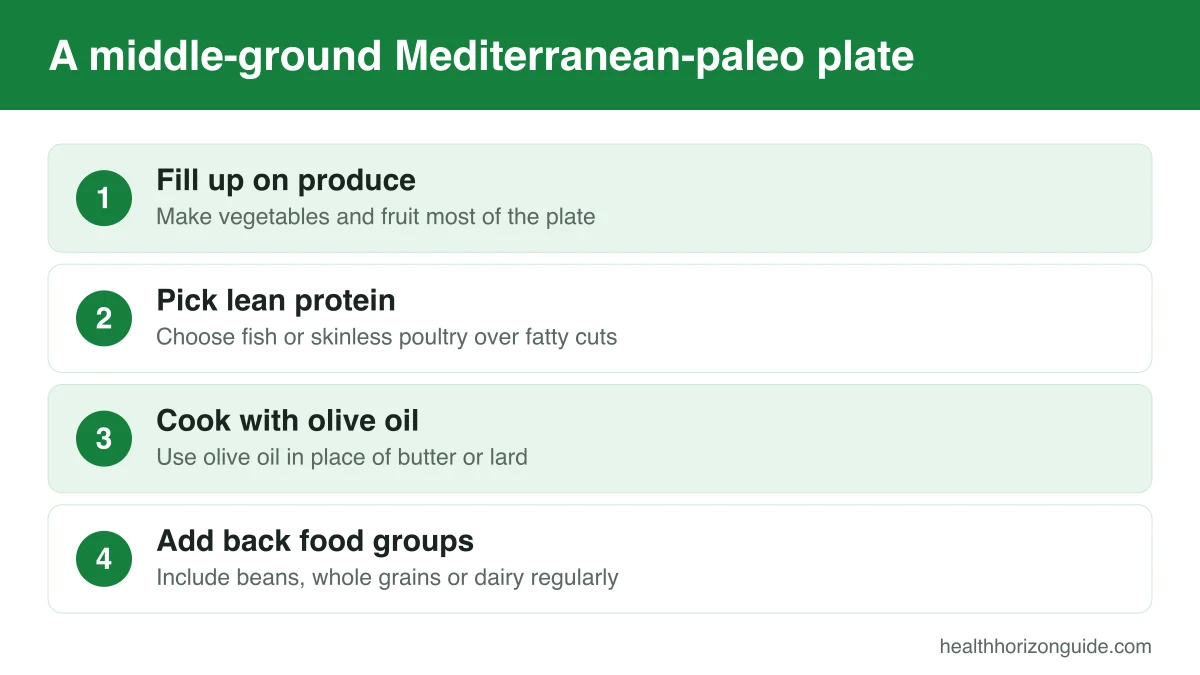
Yes, you can combine the Mediterranean and paleo diets by keeping the shared whole foods and adding back some grains, legumes or dairy. Cleveland Clinic suggests adding beans or cooked grains to a paleo diet on a routine basis to fill nutrient gaps.
The 4 steps to a middle-ground Mediterranean and paleo plate are listed below.
- Fill most of the plate with vegetables and fruit, which both diets share.
- Choose fish or lean meats such as skinless poultry instead of fatty cuts.
- Use olive oil as the main fat in place of butter or lard.
- Add back beans, whole grains or dairy on a regular basis.
Some people call this middle ground a "pegan" style, which blends paleo and plant-heavy eating. Cleveland Clinic notes that the Mediterranean diet is already similar to paleo but less restrictive.
Who should avoid a strict paleo diet?
People who should avoid a strict paleo diet include those with chronic kidney disease or a protein-restricted diet, according to Cleveland Clinic. The Mediterranean diet carries fewer of these cautions.
The 5 groups who need caution with a strict paleo diet are listed below.
- People with chronic kidney disease or on a protein-restricted diet.
- People with osteopenia or osteoporosis, or at high risk of either, due to low calcium and vitamin D.
- People with diverticulitis or diverticulosis, since paleo relies on nuts and seeds.
- People with a history of an eating disorder or weakened immunity.
- Older adults and people with chronic diseases, for whom paleo safety is not established.
Our comparison of the Mediterranean diet and the carnivore diet covers an all-meat diet that removes even more food groups.
When to see a dietitian about the Mediterranean or paleo diet
You should see a dietitian about the Mediterranean or paleo diet before removing whole food groups or when you have a health condition. Cleveland Clinic advises following paleo under the guidance of a healthcare professional, and Harvard advises checking with a physician first.
A registered dietitian can check calcium, vitamin D and fiber intake and adjust a plan for diabetes, kidney disease or bone health. See a doctor promptly for unexplained weight loss, ongoing constipation or signs of an eating disorder.
Mediterranean diet vs paleo FAQ
Is paleo healthier than the Mediterranean diet?
No, paleo is not healthier than the Mediterranean diet based on current evidence. The Mediterranean diet has long-term heart outcome data, while paleo evidence comes from small, short trials.
Can you eat beans on the paleo diet?
No, beans and other legumes are excluded on a strict paleo diet. The Mediterranean diet treats beans as a staple food.
Does the Mediterranean diet allow dairy?
Yes, the Mediterranean diet allows dairy in moderation, such as yogurt and cheese. The paleo diet excludes all dairy.