Chiropractor for TMJ: Can a Chiropractor Help With Jaw Pain?
A chiropractor may ease TMJ pain with soft-tissue work, jaw and neck mobilisation and exercises. Learn what the evidence shows and who to see first.
A chiropractor can help some people with TMJ pain, mainly through hands-on work on the jaw and neck muscles, gentle joint mobilisation and home exercises. The research behind chiropractic care for TMJ disorders is limited and low in quality, so a chiropractor for TMJ works best as one part of conservative care. A dentist or doctor should confirm the diagnosis first.
Action checklist
TMJ Care Checklist Before You See a Chiropractor
Use these steps from the article to manage TMJ pain safely and choose the right provider.
0 of 10 done
In this article
- Can a chiropractor help with TMJ?
- What does a chiropractor do for TMJ pain?
- What are TMJ disorders and TMJ symptoms?
- What does the evidence show about chiropractic care for TMJ?
- What do NIDCR and dental sources recommend first for TMJ?
- Who should you see first for TMJ: dentist, doctor, physical therapist or chiropractor?
- Why do jaw pain and neck pain occur together?
- Can TMJ cause headaches?
- Which TMJ exercises and self-care steps help?
- When does TMJ pain need a dentist or doctor promptly?
- Chiropractor for TMJ: common questions
Can a chiropractor help with TMJ?
A chiropractor can ease TMJ pain for some people, but the proof is weak. The National Institute of Dental and Craniofacial Research (NIDCR) states that manual therapy, in which a therapist uses the hands to stretch the soft tissues and muscles around the joint, may improve function and relieve pain. The NIDCR page describes manual therapy as part of physical therapy and does not name chiropractic care. Chiropractors use similar hands-on methods, which explains why many people with a clicking or stuck jaw look for a chiropractor for TMJ. Patient forum reports are mixed. Some people describe less pain and a wider mouth opening, some describe only a slight change, and some say the jaw felt worse.
What does a chiropractor do for TMJ pain?
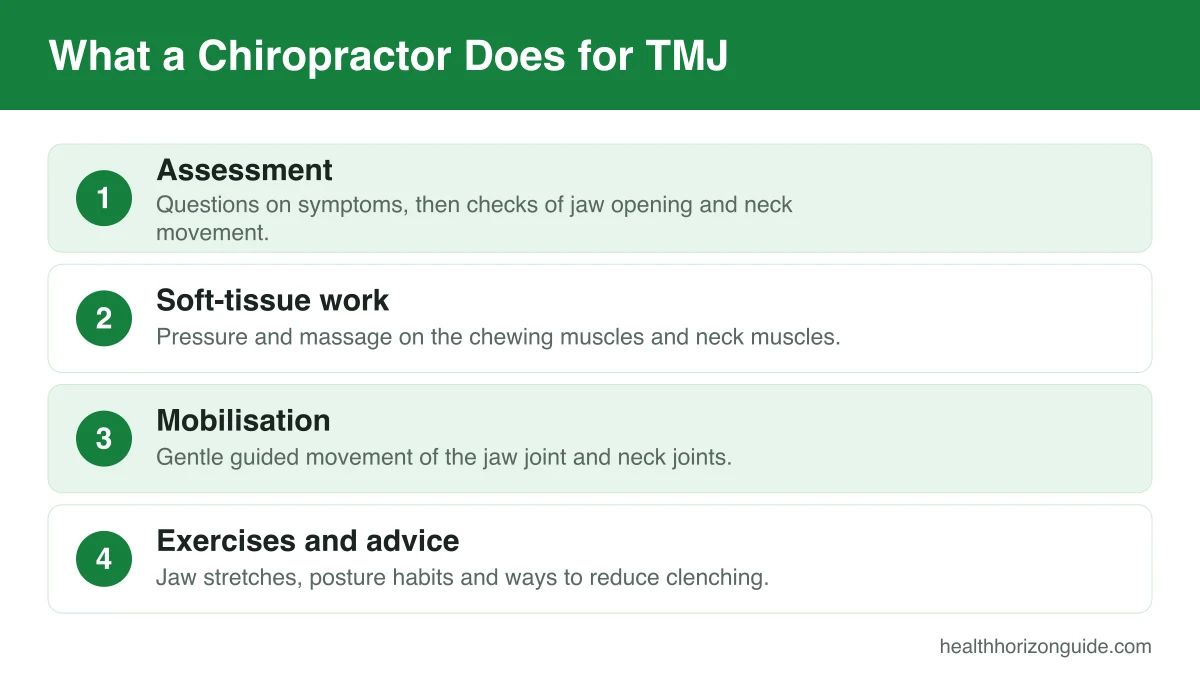
A chiropractor treats TMJ pain with soft-tissue work, jaw and neck mobilisation, and exercises. The 4 common parts of a chiropractic visit for TMJ are listed below.
- Assessment: the chiropractor asks about symptoms, health history and daily habits, then checks jaw opening, joint sounds and neck movement.
- Soft-tissue work: the chiropractor applies pressure and massage to the chewing muscles and the neck muscles.
- Mobilisation: the chiropractor guides the jaw joint and the neck joints through gentle movement, and some chiropractors add neck adjustments.
- Exercises and advice: the chiropractor teaches jaw stretches, posture habits and ways to reduce clenching.
Chiropractic care for TMJ usually takes more than one visit. No source we reviewed sets a standard number of visits or a standard price, so ask the clinic for a written plan with a review date.
What are TMJ disorders and TMJ symptoms?
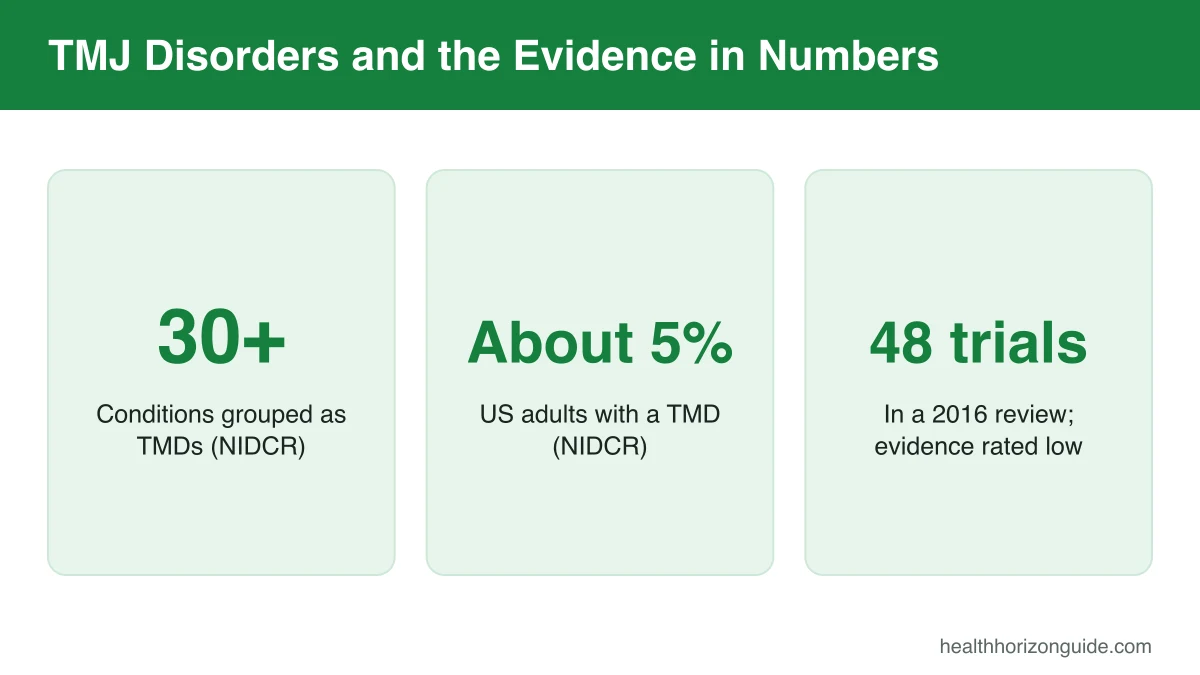
TMJ disorders are a group of more than 30 conditions that cause pain and dysfunction in the jaw joint and the muscles that move the jaw. TMJ is the name of the temporomandibular joint, and TMD is the name for the disorders. NIDCR reports that about 5% of adults in the United States have a TMD and that TMDs are twice as common in women as in men.
The 7 TMJ symptoms that NIDCR lists are shown below.
- Pain in the chewing muscles or the jaw joint, which is the most common symptom.
- Pain that spreads to the face or neck.
- Jaw stiffness.
- Limited jaw movement or jaw locking.
- Painful clicking, popping or grating in the joint when the mouth opens or closes.
- Ringing in the ears, hearing loss or dizziness.
- A change in the way the upper and lower teeth fit together.
Clicking or popping in the TMJ without pain is common, is considered normal and needs no treatment.
What does the evidence show about chiropractic care for TMJ?
The evidence for chiropractic care for TMJ is limited and low in quality. A 2016 systematic review in the journal Physical Therapy analysed 48 trials of manual therapy and exercise for TMD. The review rated the overall evidence as low and found no high-quality evidence. Manual therapy at the jaw or the neck, alone or combined with exercise, showed promising effects. The authors concluded that great uncertainty remains.
The 2016 review assessed manual therapy and exercise as treatments, not chiropractors as a profession. The findings therefore support chiropractic care for TMJ only indirectly. Published reports that name chiropractors are mostly single case reports and small case series, which cannot prove that the treatment caused the improvement.
Is chiropractic treatment for TMJ safe?
Chiropractic treatment for TMJ carries mostly minor, short-lived side effects, with rare serious risks from neck manipulation. The National Center for Complementary and Integrative Health (NCCIH) reports that spinal manipulation can cause temporary soreness, stiffness or headache. NCCIH also notes rare reports of serious problems after neck manipulation, including tears in the neck arteries that can lead to stroke. Whether the manipulation caused those events remains unclear. Tell the chiropractor about every health condition before treatment starts. A patient can decline neck manipulation and ask for gentler methods.
What do NIDCR and dental sources recommend first for TMJ?
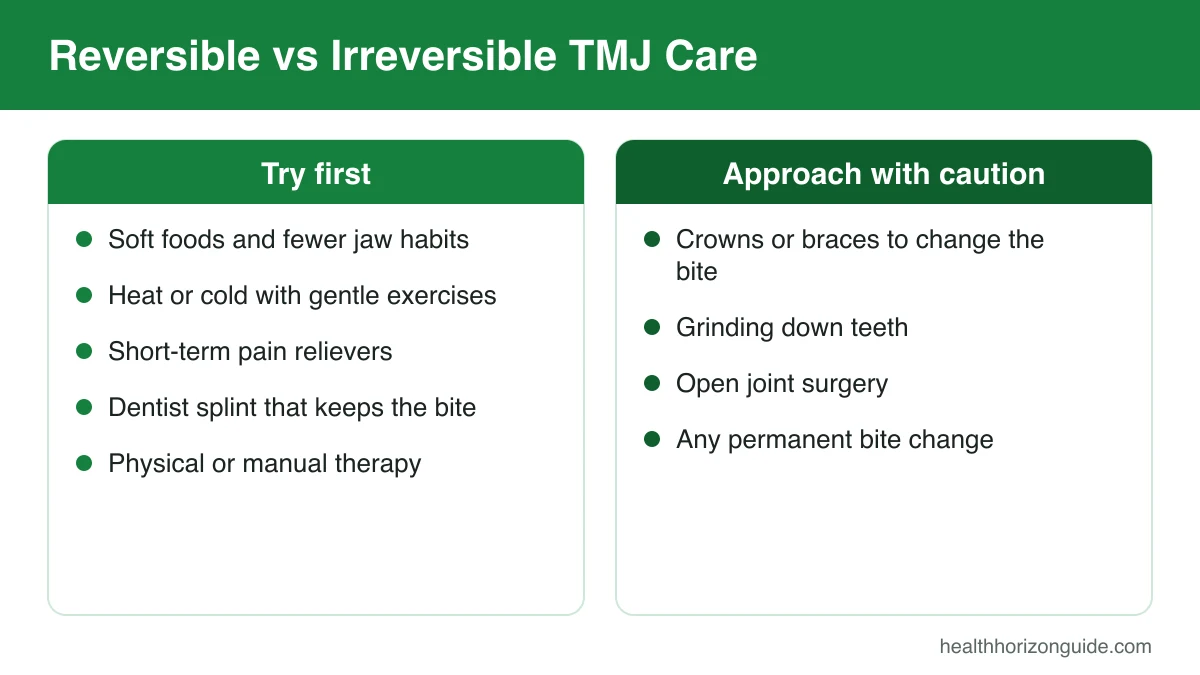
NIDCR recommends conservative, reversible care first for TMJ disorders. Evidence for many TMD treatments is limited, so experts advise people to avoid treatments that permanently change the jaw joints, the teeth or the bite, and treatments that involve surgery. The table below compares first-line TMJ care with the treatments that NIDCR says to approach with caution.
| Treatment | Type | What NIDCR says |
|---|---|---|
| Soft foods and fewer jaw habits such as clenching, gum chewing and nail biting | Reversible | Recommended as a first step |
| Heat or cold on the face with gentle jaw exercises | Reversible | Recommended as a first step |
| Over-the-counter pain relievers such as ibuprofen | Reversible | Used for pain relief; ask how long to take any medicine |
| Splint or night guard from a dentist | Reversible | Protects teeth; limited evidence for pain relief; must not change the bite |
| Physical therapy and manual therapy | Reversible | May improve function and relieve pain |
| Crowns, tooth grinding or braces to change the bite | Irreversible | Not enough evidence; can make the problem worse |
| Open joint surgery | Irreversible | No long-term safety studies; only for severe cases after other care fails |
Mayo Clinic gives similar advice and states that self-managed home care, physical therapy for the jaw and a mouth guard can treat TMJ symptoms. A chiropractor for TMJ fits inside the reversible group, since soft-tissue work, mobilisation and exercises do not change the teeth or the bite. NIDCR advises a second opinion before surgery or any permanent bite change.
Who should you see first for TMJ: dentist, doctor, physical therapist or chiropractor?
A dentist or doctor is the right first visit for TMJ pain. NIDCR explains that a dentist or doctor takes a detailed history, examines the head, neck, face and jaw, and may order imaging to rule out other conditions. The table below shows what each of the 4 providers offers for TMJ.
| Provider | Role in TMJ care |
|---|---|
| Dentist | Diagnosis, first-line advice, splints and night guards, referral to an orofacial pain specialist |
| Doctor | Diagnosis, checks for other causes of jaw pain, pain medicine, referrals |
| Physical therapist | Manual therapy and exercise programmes to restore jaw movement and function |
| Chiropractor | Soft-tissue work, jaw and neck mobilisation, exercises and posture advice after a diagnosis |
Physical therapists and chiropractors use overlapping hands-on methods for TMJ, and our guide to a chiropractor vs a physical therapist explains the differences in training and approach.
Why do jaw pain and neck pain occur together?
Jaw pain and neck pain occur together because TMJ pain can spread to the face and neck, according to NIDCR. The 2016 review included manual therapy at the neck as well as the jaw, which is one reason a chiropractor for TMJ often examines both areas. Readers with ongoing neck symptoms can read our guide to a chiropractor for neck pain. Some chiropractors also give posture advice, including ways to fix forward head posture. The sources we reviewed do not show that posture correction alone relieves TMJ disorders.
Can TMJ cause headaches?
TMJ disorders can cause headaches. NIDCR names headaches associated with a TMD as one of the 3 main groups of TMDs, next to joint disorders and disorders of the chewing muscles. A dentist or doctor should assess a TMJ headache that keeps returning, since many other conditions cause head pain. Our guide to a chiropractor for migraines and headaches covers the evidence for other headache types.
Which TMJ exercises and self-care steps help?
TMJ exercises that help are gentle stretching and strengthening movements for the jaw muscles, used together with heat or cold. A dentist, physical therapist or chiropractor can teach the correct TMJ exercises for the specific disorder. The 5 self-care steps from NIDCR are listed below.
- Eat soft foods.
- Apply heat or cold to the face.
- Do gentle jaw stretching and strengthening exercises.
- Reduce jaw clenching, gum chewing and nail biting.
- Practise relaxation or meditation.
NIDCR notes that psychological and life stressors may contribute to TMJ disorders, and our stress relief tips offer simple ways to relax.
When does TMJ pain need a dentist or doctor promptly?
TMJ pain needs a dentist or doctor promptly when the jaw locks, will not open or close fully, or hurts constantly. Mayo Clinic and NIDCR flag the 3 jaw symptoms listed below.
- A locked jaw that will not open or close completely.
- Trouble opening the mouth.
- Constant pain or tenderness in the jaw.
Jaw pain with chest pain or shortness of breath is an emergency and not a job for a chiropractor for TMJ. The American Heart Association lists discomfort in the jaw, chest discomfort and shortness of breath among the warning signs of a heart attack. Call 911 or the local emergency number immediately when these symptoms appear together.
Chiropractor for TMJ: common questions
Can a chiropractor fix TMJ permanently?
A chiropractor cannot promise a permanent fix for TMJ. Conservative treatments relieve symptoms, and the research on manual therapy for TMD is low in quality.
How many chiropractic sessions does TMJ need?
TMJ has no standard number of chiropractic sessions in the sources we reviewed. Ask the chiropractor for a short trial with a clear review date, and return to the dentist or doctor when the jaw does not improve.
Should I see a dentist or a chiropractor for TMJ?
A dentist should come before a chiropractor for TMJ. The dentist confirms the diagnosis and can provide a splint, and a chiropractor can then add hands-on care and exercises.
Does a clicking jaw need chiropractic treatment?
A clicking jaw needs no treatment when the click is painless. NIDCR considers painless clicking or popping in the TMJ normal.