
Chiropractor for Vertigo: Can an Adjustment Help?
A chiropractor can perform the Epley maneuver for BPPV, but a neck adjustment is not a proven vertigo treatment. Learn the evidence, risks and stroke signs.

A chiropractor for vertigo can help in a narrow set of cases, and a neck adjustment is not a proven vertigo treatment. Most vertigo starts in the inner ear, where the established treatments are repositioning maneuvers and balance exercises, not spinal manipulation. Sudden vertigo with stroke signs is an emergency that needs an ambulance, not a chiropractor.
Action checklist
Before you see a chiropractor for vertigo
Use these steps from the article to get the right vertigo care and stay safe.
0 of 9 done
In this article
- Can a chiropractor help with vertigo?
- What causes vertigo?
- Is the Epley maneuver a chiropractic adjustment?
- What does the evidence say about chiropractic adjustment for vertigo?
- Is neck manipulation safe for a person with dizziness?
- What does a chiropractor visit for vertigo involve?
- What helps vertigo besides a chiropractor?
- Neck pain, posture and dizziness
- When is vertigo an emergency?
- Chiropractor for vertigo: common questions
Can a chiropractor help with vertigo?
A chiropractor can help with vertigo only when the cause suits a treatment the chiropractor is trained to give. Vertigo is the feeling that you, or the things around you, are spinning. The NHS states that inner ear problems are the most common cause of vertigo.
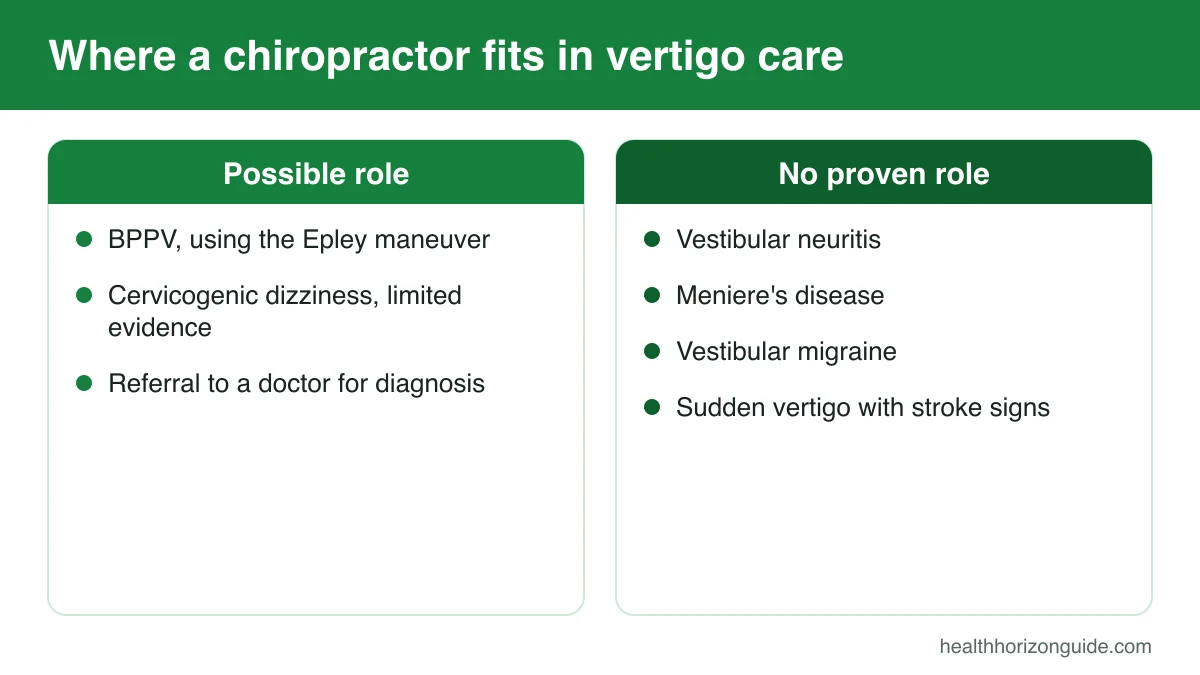
Two causes give a chiropractor a possible role. The first cause is benign paroxysmal positional vertigo (BPPV), where a chiropractor trained in canalith repositioning can perform the Epley maneuver. The second cause is cervicogenic dizziness, a dizziness of suspected neck origin, where manual therapy has limited research support. We found no reliable research showing that a neck adjustment treats vestibular neuritis, Meniere's disease or vestibular migraine.
The table below lists the 5 main causes of vertigo, the established treatment for each cause and the role of a chiropractor.
| Cause of vertigo | What the cause is | Established treatment | Role of a chiropractor |
|---|---|---|---|
| BPPV | Short episodes of vertigo set off by rapid changes in head position | Canalith repositioning, such as the Epley maneuver, from a trained clinician | Possible when the chiropractor is trained in the Epley maneuver. No neck adjustment is involved. |
| Vestibular neuritis | Inflammation of the vestibular nerve | Medical assessment, then vestibular rehabilitation exercises | None proven |
| Meniere's disease | A rare inner ear condition that can involve tinnitus or hearing loss | Medical care from a doctor or specialist | None proven |
| Vestibular migraine | Vertigo linked to migraine | Medical care from a doctor | None proven |
| Cervicogenic dizziness | Dizziness of suspected neck origin | No single established treatment. Manual therapy and exercise are used. | Possible, with limited evidence |
What causes vertigo?
Vertigo is most often caused by an inner ear problem, such as BPPV, labyrinthitis, vestibular neuritis or Meniere's disease. Migraine and some medicines are other causes. An attack can last from a few seconds to several hours, and severe vertigo can last for many days or months.
A diagnosis comes before any chiropractor visit, since each cause of vertigo has a different treatment. A doctor asks about the symptoms and may move the patient quickly from sitting to lying down to see whether the movement triggers vertigo.
Is the Epley maneuver a chiropractic adjustment?
The Epley maneuver is not a chiropractic adjustment. The Epley maneuver is a canalith repositioning procedure, a guided sequence of head and body positions with no thrust to the spine. A chiropractor for vertigo caused by BPPV offers the same maneuver that doctors and physical therapists use.
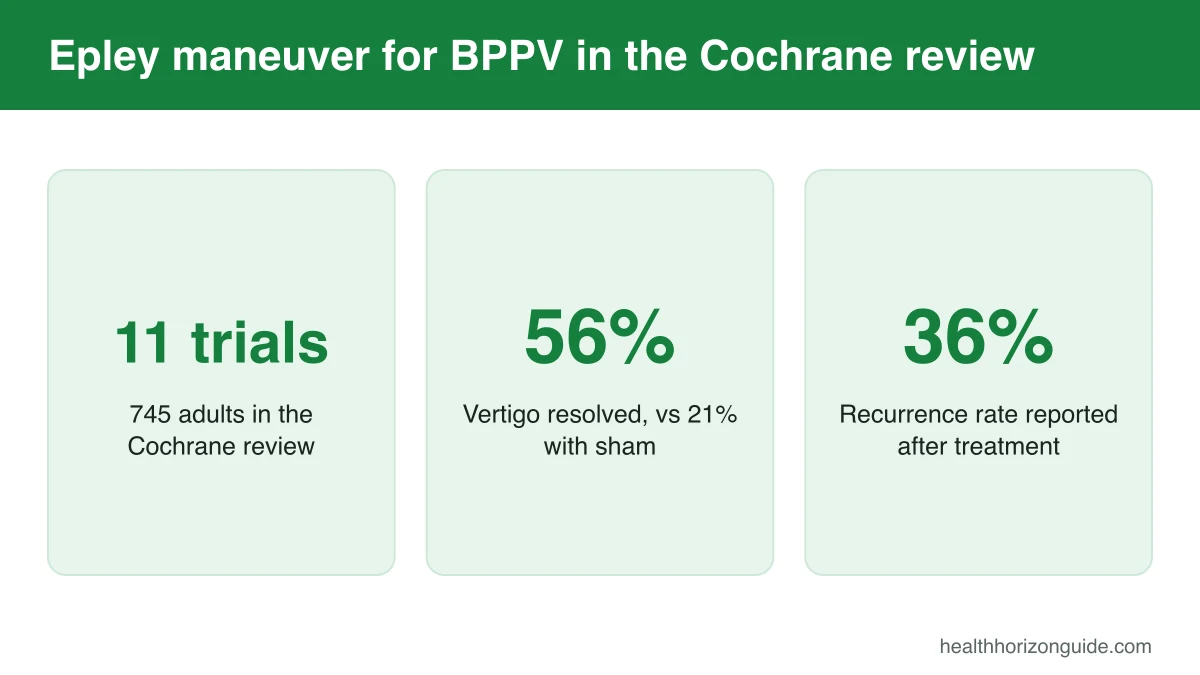
Research shows good evidence for the Epley maneuver in BPPV. A Cochrane review of 11 trials with 745 adults concluded that the Epley maneuver is a safe, effective treatment for posterior canal BPPV. Vertigo resolved completely in 56% of treated patients, compared with 21% of patients given a sham maneuver or no treatment. The trials were mostly small and had short follow-up.
The same review reported no serious adverse effects. Nausea during the maneuver affected 16.7% to 32% of patients, and some patients could not tolerate the maneuver because of neck problems. The review also reported a high recurrence rate of 36%, so BPPV can return after a successful treatment.
Evidence from chiropractic clinics is far thinner. One published case series described 8 patients with persistent BPPV who received the Epley maneuver from a chiropractor and reported fewer symptoms over 30 days. A case series has no comparison group, so the finding shows only that some chiropractors use the maneuver.
What does the evidence say about chiropractic adjustment for vertigo?
The evidence for chiropractic adjustment for vertigo is limited to cervicogenic dizziness and comes from studies of poor to moderate quality. A systematic review led by a university chiropractic department examined 13 investigations: 5 randomised controlled trials and 8 uncontrolled cohort studies. All but one study reported less dizziness after manual therapy. The authors concluded that there is moderate evidence for manual therapy, in particular spinal mobilisation and manipulation, for cervicogenic dizziness, and the authors called for further research.
These findings apply only to dizziness of suspected neck origin. The findings do not show that a chiropractor can treat an inner ear cause of vertigo with a spinal adjustment.
Vestibular rehabilitation has stronger support than manual therapy. A Cochrane review of 39 studies with 2,441 participants found moderate to strong evidence that vestibular rehabilitation is safe and effective for vestibular dysfunction on one side, and the trials reported no adverse effects. Vestibular rehabilitation is an exercise programme, and Cleveland Clinic states that a physical therapist evaluates balance and gait, and most people have 6 to 8 weekly sessions. Our comparison of a chiropractor vs physical therapist explains how the two professions differ.
Is neck manipulation safe for a person with dizziness?
Neck manipulation is not risk-free for a person with dizziness, and the main concern is a tear in a neck artery. A tear in a neck artery is called a cervical artery dissection. The American Heart Association and American Stroke Association describe cervical artery dissection as one of the most common causes of stroke in young and middle-aged adults.
The same scientific statement reports that most population studies found an association between neck manipulation and vertebral artery dissection stroke in young patients. The evidence does not establish that manipulation causes the tear, and the incidence is probably low. The statement advises that patients be told about the association before any manipulation of the neck. A dissection can begin with a one-sided headache or pain at the back of the neck, so a person with those symptoms and new dizziness needs a medical check, not a chiropractor.
The 4 safety steps before a chiropractor treats the neck of a person with vertigo are listed below.
- Get a medical diagnosis for the vertigo first.
- Tell the chiropractor about the dizziness, every health condition and every medicine.
- Ask for techniques that avoid a fast thrust to the neck.
- Stop treatment and see a doctor when dizziness persists or worsens.
What does a chiropractor visit for vertigo involve?
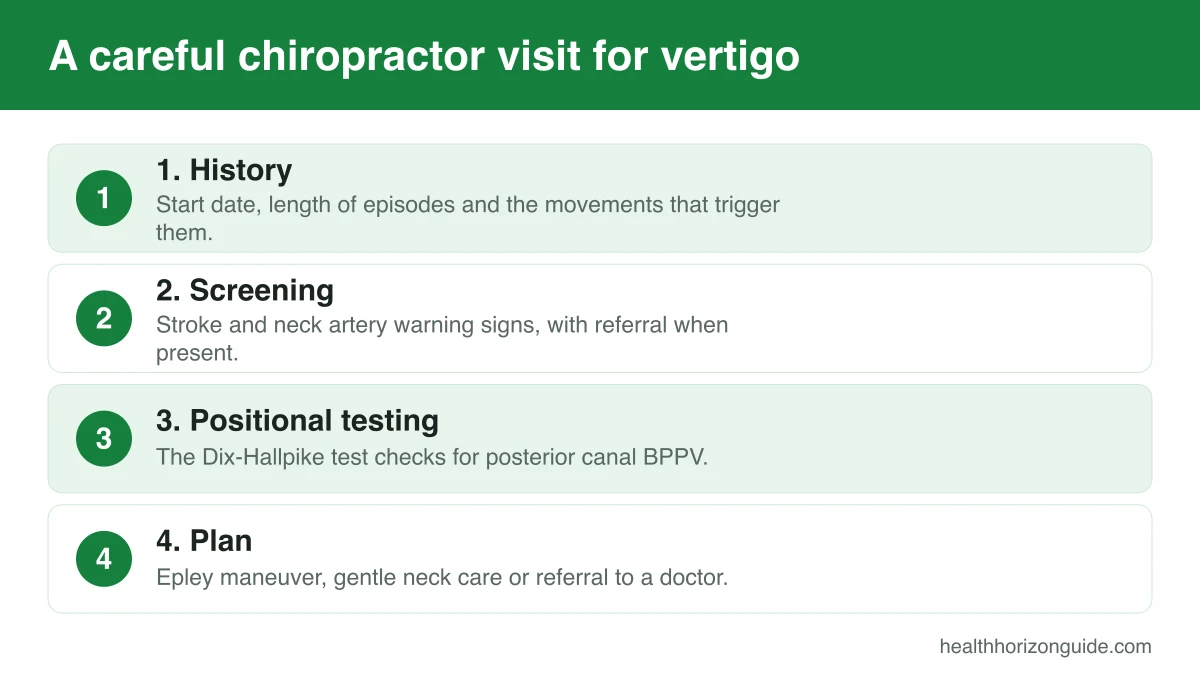
A chiropractor visit for vertigo should begin with a history and a screen for warning signs, not with an adjustment. The 4 steps of a careful chiropractor visit for vertigo are listed below.
- History: the chiropractor asks when the vertigo started, how long each episode lasts and which movements trigger an episode.
- Screening: the chiropractor checks for stroke signs and neck artery warning signs, and refers the patient to medical care when any sign is present.
- Positional testing: the Dix-Hallpike test checks for posterior canal BPPV.
- Plan: the chiropractor offers the Epley maneuver for BPPV, gentle neck care for suspected cervicogenic dizziness, or a referral to a doctor.
A chiropractor who promises to cure vertigo with neck adjustments is making a claim that research does not support.
What helps vertigo besides a chiropractor?
Vertigo is helped by treatment matched to the cause, and the NHS states that most people recover without treatment. A chiropractor is one option for a small group of patients, and self-care suits many people during an attack. The 5 NHS self-care steps during a vertigo attack are listed below.
- Lie still in a quiet, dark room.
- Move the head slowly and carefully.
- Sit down straight away when dizziness starts.
- Sleep with the head raised on 2 or more pillows.
- Get out of bed slowly and sit on the edge of the bed first.
The NHS also advises against stretching the neck during vertigo, such as reaching up to a high shelf.
Neck pain, posture and dizziness
Neck pain and dizziness can occur together, and the overlap does not prove that the neck causes the vertigo. Cervicogenic dizziness remains a suspected cause, which is why inner ear and brain causes need to be checked first. Our guides to a chiropractor for neck pain and to forward head posture cover the neck problem alone. Neither guide treats posture correction as a vertigo cure. Readers with vertigo and headaches can read about a chiropractor for migraines and headaches.
When is vertigo an emergency?
Vertigo is an emergency when vertigo starts suddenly with any sign of a stroke. The Centers for Disease Control and Prevention lists sudden dizziness, trouble walking and loss of balance among the signs of stroke. A chiropractor is the wrong place for these symptoms. The 6 stroke warning signs that make sudden vertigo an emergency are listed below.
- Face drooping on one side.
- Arm weakness or numbness, often on one side.
- Trouble speaking or slurred speech.
- Double vision or loss of vision.
- Sudden, severe headache.
- Trouble walking or loss of balance.
Call 911 in the United States, or 999 in the United Kingdom, and do not drive to the hospital. The NHS also treats vertigo with hearing loss as an emergency. An urgent doctor appointment is needed for vertigo with a severe headache, vomiting or a very high temperature.
Chiropractor for vertigo: common questions
Can a chiropractor make vertigo worse?
A chiropractor can make vertigo feel worse for a short time during treatment. Nausea affected 16.7% to 32% of patients during the Epley maneuver in trials. Dizziness that persists or worsens after a neck adjustment needs a medical check, not another adjustment.
Which doctor should I see for vertigo first?
A primary care doctor is the first doctor to see for vertigo that will not go away or keeps coming back. The doctor can test for BPPV and refer the patient to a specialist before any chiropractor visit.
Should I see a chiropractor or a physical therapist for vertigo?
A physical therapist is the usual provider of vestibular rehabilitation, the exercise treatment with the strongest evidence. A chiropractor trained in the Epley maneuver is a reasonable choice for diagnosed BPPV.