Chiropractor vs Osteopath: What Is the Difference?
Chiropractor vs osteopath: compare training, licensing, hands-on methods, back pain evidence and safety, and learn why a DO in the US is a physician.
A chiropractor and an osteopath both treat back, neck and joint pain with their hands, but the word osteopath does not mean the same thing in every country. A chiropractor is a manual therapist who centers care on the spine, while an osteopath is a fully licensed physician (DO) in the United States and a regulated manual therapist in the United Kingdom and Australia. Neither a chiropractor nor a UK-style osteopath is a medical doctor.
Action checklist
Choosing a chiropractor or an osteopath
Use these steps from the article to choose and check a chiropractor or an osteopath safely.
0 of 9 done
In this article
- What is the difference between a chiropractor and an osteopath?
- How do chiropractic adjustments and osteopathic manipulative treatment (OMT) differ?
- Is a chiropractor or an osteopath better for back pain?
- Are chiropractic and osteopathic treatments safe?
- How to choose between a chiropractor and an osteopath
- Chiropractor vs osteopath vs physiotherapist
- Red flags that need a medical doctor
- Chiropractor vs osteopath: frequently asked questions
What is the difference between a chiropractor and an osteopath?
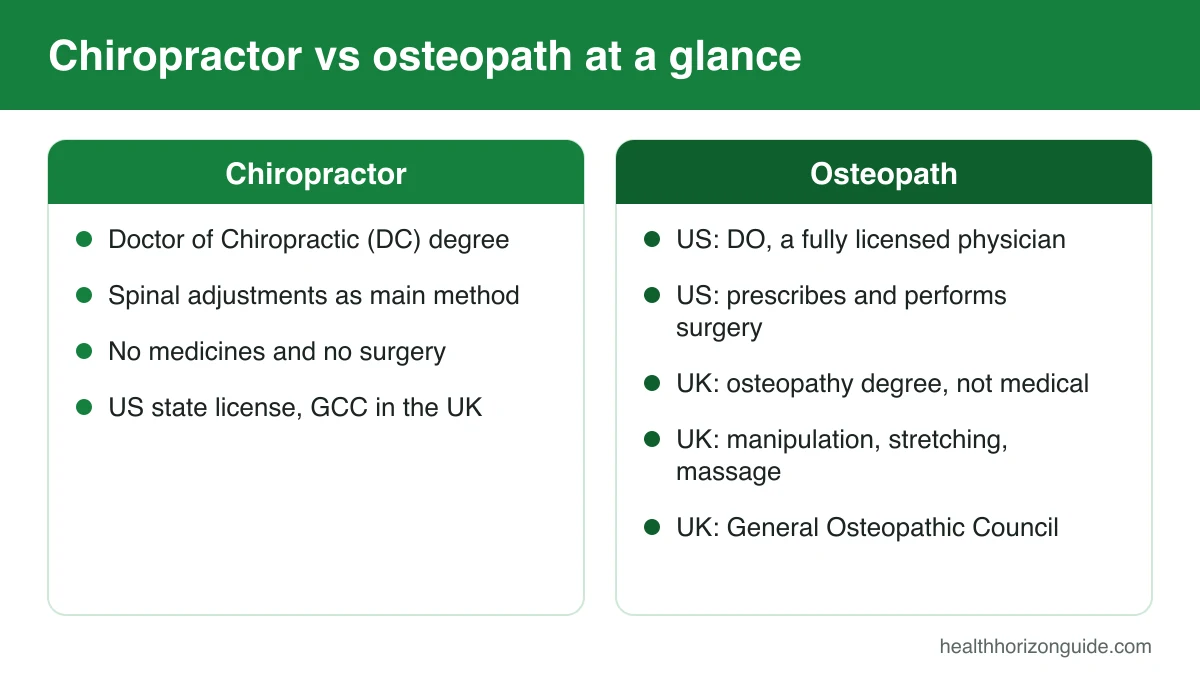
The difference between a chiropractor and an osteopath is the training, the legal scope of practice and the range of hands-on methods. A chiropractor holds a Doctor of Chiropractic (DC) degree and mainly uses spinal adjustments. An osteopath is either a physician who may add osteopathic manipulative treatment (OMT) or a manual therapist, depending on the country.
The table below compares a chiropractor, a US osteopathic physician and a UK osteopath on 5 points.
| Point of comparison | Chiropractor | Osteopathic physician (DO, United States) | Osteopath (United Kingdom, Australia) |
|---|---|---|---|
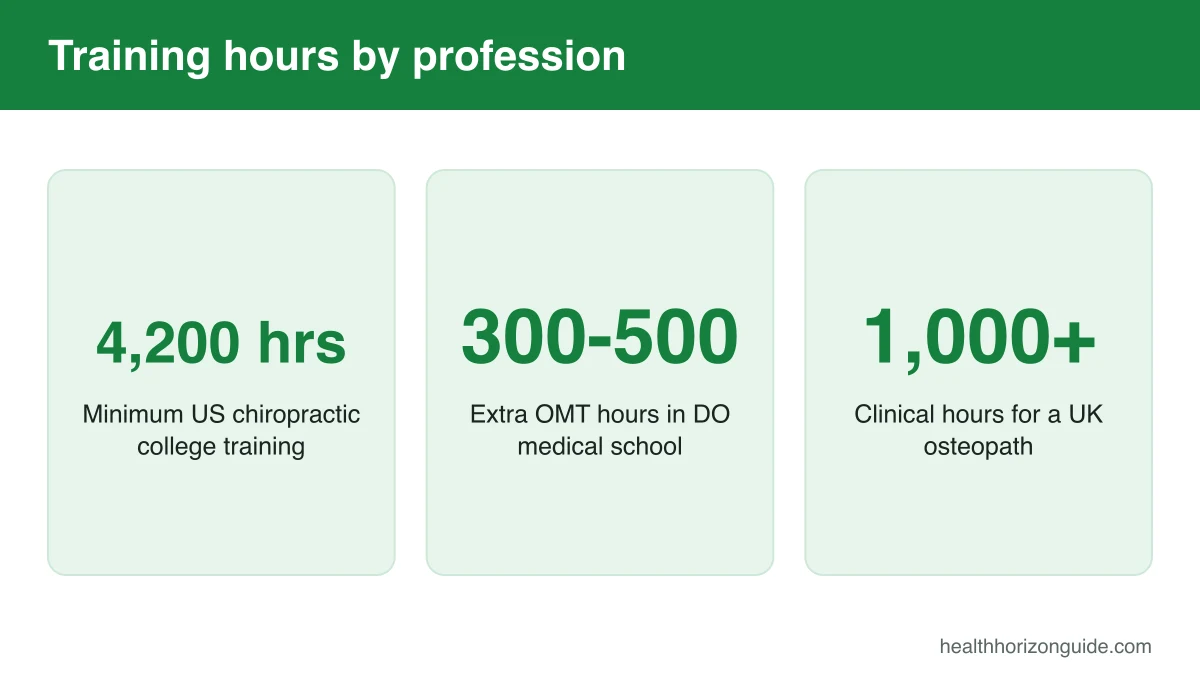
| Training | Doctor of Chiropractic degree, 4 to 5 years at an accredited chiropractic college in the US | 4 years of medical school with 300 to 500 extra hours of OMT study, then a residency of 2 to 6 years | Bachelor's or master's degree in osteopathy, typically 3 to 5 years, with over 1,000 hours of clinical training in the UK |
| Licensing or regulator | State license in the US, General Chiropractic Council in the UK, Ahpra register in Australia | State medical license, the same level of licensing as an MD | General Osteopathic Council in the UK, Ahpra register in Australia |
| Main methods | Spinal adjustments, often with exercise advice and heat or cold treatments | Standard medical and surgical care, with OMT added when indicated | Touch, manipulation, stretching and massage, with advice on posture and exercise |
| Medicines and surgery | No medicines and no surgery, and the scope of practice varies by state | Prescribes medicines and performs surgery | Hands-on care only, with a letter to the GP or hospital for conditions outside osteopathy |
| Typical visit | Health history, checks of posture and spine movement, then an adjustment | A medical appointment, with OMT given on an exam table when useful | History, movement checks and hands-on treatment, about 45 to 60 minutes on a first visit |
Is an osteopath a doctor?
An osteopath is a medical doctor in the United States only, where the profession trains physicians and a chiropractor remains a separate, non-physician provider. MedlinePlus describes a DO as a physician licensed to practice medicine, perform surgery and prescribe medicine. A DO completes 4 years of medical school, plus 300 to 500 hours of OMT study, and works in every specialty. An osteopath in the UK follows a different route. NHS Health Careers states that UK osteopaths complete a bachelor's or master's degree, typically over 3 to 5 years, with more than 1,000 hours of patient-facing clinical training. That degree is in osteopathy, not medicine.
What training does a chiropractor have?
A chiropractor has a Doctor of Chiropractic degree, not a medical degree, which sets a chiropractor apart from an osteopathic physician. MedlinePlus states that doctors of chiropractic complete 4 to 5 years at an accredited chiropractic college, with at least 4,200 hours of classroom, laboratory and clinical experience. Licensing happens at the state level, and the scope of practice varies by state.
How do chiropractic adjustments and osteopathic manipulative treatment (OMT) differ?
Chiropractic adjustments and osteopathic manipulative treatment differ in the amount of force and the variety of techniques. A chiropractor mainly uses manipulation of the spine and other joints, which the General Chiropractic Council calls an adjustment. Cleveland Clinic describes OMT as gentler, with more light pressure and with popping or thrust techniques used less often than in chiropractic care.
The 4 examples of OMT techniques below come from a longer Cleveland Clinic list.
- Muscle energy relaxes and lengthens muscles to improve range of motion.
- Myofascial release relaxes tight muscle and the connective tissue around the muscle.
- Balanced ligamentous tension applies light pressure to a joint to improve position and movement.
- Rib raising gently lifts the ribs to open the rib cage.
Is a chiropractor or an osteopath better for back pain?
Neither a chiropractor nor an osteopath is proven to be better for back pain, because research mostly tests the technique and not the profession. The sources reviewed for this article contain no trial that compares the two professions head to head. The NICE guideline on low back pain and sciatica advises clinicians to consider manual therapy, meaning spinal manipulation, mobilisation or soft tissue techniques such as massage, only as part of a treatment package that includes exercise.
The evidence for spinal manipulation is modest. The National Center for Complementary and Integrative Health (NCCIH) reports moderate-quality evidence from a 2017 analysis of 15 studies that spinal manipulation gives a modest improvement in acute low back pain. A 2019 review of 47 studies found short-term relief of chronic low back pain similar to the relief from other recommended therapies. Our guide to seeing a chiropractor for lower back pain covers the topic in more depth.
The evidence for osteopathic treatment is mixed. A 2014 systematic review of 15 trials found moderate-quality evidence that OMT reduced pain and improved function in nonspecific low back pain at 3 months, and the authors called for larger, high-quality trials. A 2021 randomized trial of 400 people compared six sessions of OMT with sham treatment. The trial found a small effect on activity limitations, which the authors judged to be of questionable clinical relevance, and no significant difference in pain.
Are chiropractic and osteopathic treatments safe?
Chiropractic and osteopathic treatments are generally low risk, with temporary soreness as the most common side effect. NCCIH states that mild to moderate side effects, such as increased pain, stiffness or headache, often follow spinal manipulation and usually resolve within 24 hours. The General Osteopathic Council notes that soreness for 24 to 48 hours after a visit to an osteopath is not unusual. Serious side effects are very rare, and NCCIH says no accurate estimate of their frequency exists.
Neck manipulation carries a specific concern. NCCIH reports that neck manipulation has been linked to cervical artery dissection, a tear in a neck artery that can lead to stroke, although experts disagree about whether manipulation causes the tear. The NHS advises that chiropractic and osteopathy may not be safe for 3 groups: people who take blood-thinning medicines or have a raised risk of bleeding or stroke, people with very weak or seriously damaged bones or joints, and people with a nerve condition such as peripheral neuropathy. Our article on adjustment benefits and side effects covers the risks of a chiropractor's adjustment.
How to choose between a chiropractor and an osteopath
The choice between a chiropractor and an osteopath depends on the country, the kind of care wanted and the individual practitioner. A person in the United States who wants one provider for diagnosis, prescriptions and hands-on treatment needs a DO or another physician.
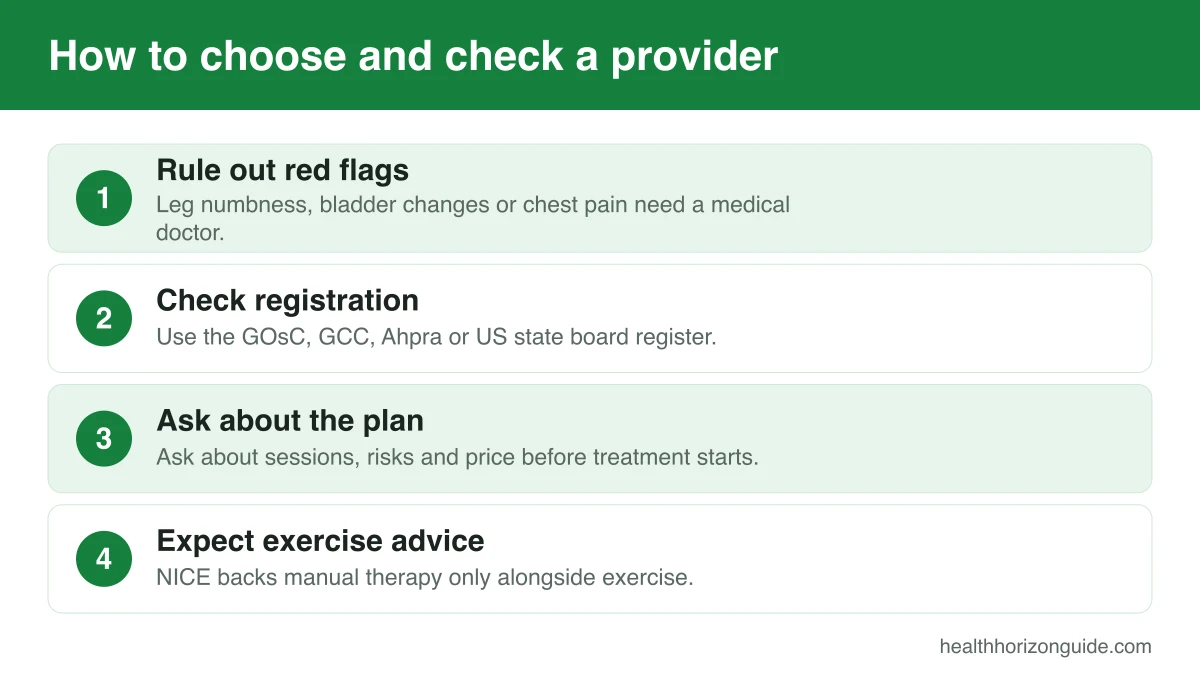
The 4 steps below help a reader choose and check a chiropractor or an osteopath.
- Rule out red-flag symptoms first, and see a medical doctor when any are present.
- Check registration. In the UK, search the General Osteopathic Council register for an osteopath and the General Chiropractic Council register for a chiropractor. In the US, confirm the license with the state licensing board. In Australia, search the Ahpra register of practitioners.
- Ask about the treatment plan, the expected number of sessions, the risks and the price. Our guide to how much a chiropractor costs covers pricing.
- Expect exercise and self-care advice alongside hands-on treatment, in line with the NICE guideline.
Both titles are protected by law in the UK, so an unregistered person cannot legally practice as a chiropractor or an osteopath.
Chiropractor vs osteopath vs physiotherapist
A chiropractor, an osteopath and a physiotherapist differ mainly in how much of the session is hands-on and how much is exercise. A chiropractor and a UK osteopath spend most of a session on manual treatment. A physiotherapist, called a physical therapist in the US, builds care around exercise and movement, and NCCIH notes that physical therapists also use spinal manipulation. Our comparison of a chiropractor vs physical therapist sets out the differences in detail.
Red flags that need a medical doctor
Red flags are symptoms that need urgent medical care instead of a chiropractor or an osteopath. The 6 red-flag symptoms below come from the NHS guidance on back pain.
- Pain, tingling, weakness or numbness in both legs.
- Loss of feeling around the genitals or anus.
- Difficulty passing urine, or loss of bladder or bowel control.
- Chest pain together with back pain.
- Back pain that started after a serious accident, such as a car crash.
- Back pain with feeling hot, shivery or generally unwell, or severe pain that starts suddenly or worsens quickly.
The first 5 symptoms need emergency care. The sixth needs an urgent medical appointment. Our comparison of a chiropractor vs orthopedic doctor explains when a specialist is the right choice.
Chiropractor vs osteopath: frequently asked questions
Is a DO the same as a chiropractor?
A DO is not the same as a chiropractor. A DO is a US osteopath and a licensed physician who can prescribe medicine and perform surgery, while a chiropractor holds a Doctor of Chiropractic degree and treats without medicines or surgery.
Do osteopaths crack your back like a chiropractor?
Osteopaths sometimes use quick manipulations, but Cleveland Clinic states that thrust techniques are used less often in OMT than by a chiropractor. Much of an osteopath's session involves stretching and gentle pressure.
Do I need a referral to see a chiropractor or an osteopath?
A referral is not needed to see an osteopath in the UK, where most patients self-refer according to the General Osteopathic Council. The General Chiropractic Council states that most UK chiropractors work privately, so patients usually pay directly or through health insurance. Insurance rules for a chiropractor or an osteopath vary elsewhere, so checking the plan first is sensible.